Yes, Teslas have a 12V battery besides the traction pack. When a car goes dark in Harry Reid long-term parking, start with the 12-volt. The same pattern shows up in a Paradise resort garage. That small battery is usually the reason, not an empty pack.
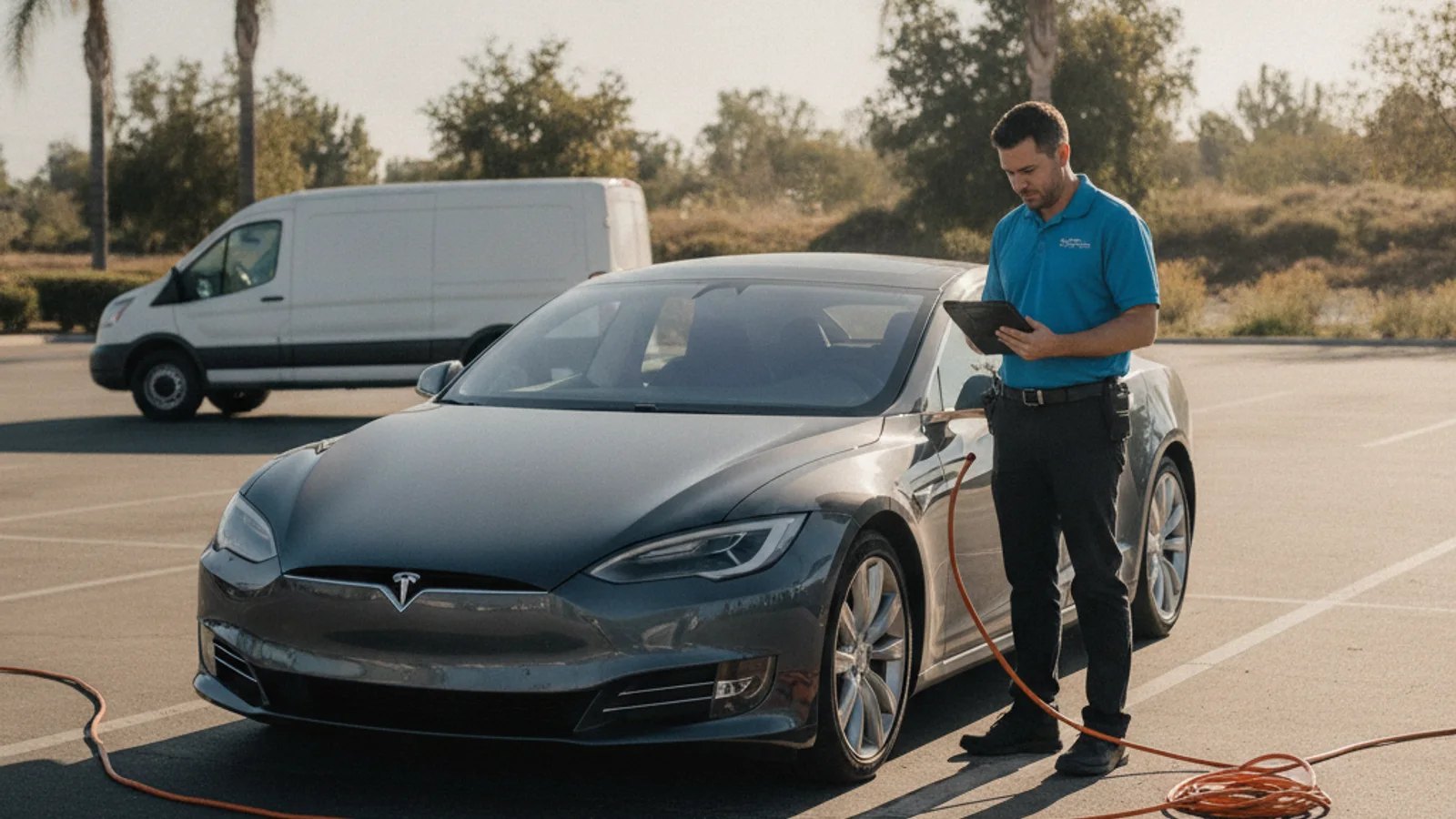
A dark Tesla at the airport is rarely the pack
Drivers leaving Harry Reid International Airport often think the traction pack hit zero. The app is silent and the handles stay flush. The last range they remember still looked healthy. That mismatch is the low-voltage battery, not a drained pack.
The airport sits in Paradise, unincorporated Clark County. It isn’t inside the City of Las Vegas. Strip resort garages sit in Paradise and Winchester. Those lots bake through the afternoon and hold heat after dark. NWS Las Vegas lists an average July high of 104.5F. About 78 days a year reach 100F or more. The airport often runs 5 to 15F warmer than outlying areas. East-valley and downtown pavement can run up to 11F hotter than the rim.
A Tesla that sat in Long Term through a trip is a textbook 12-volt stall. Terminal 1 Short Term decks fail the same way after a long pickup wait. Sentry Mode in a Strip structure keeps cameras alive all night. The small battery is what pays for that watch.
Tesla dead in Harry Reid long-term parking walks through the airport stall. Dead in a Paradise resort lot covers the garage after dinner or a show.
Two power systems, not one battery
The traction pack runs at several hundred volts. It feeds the motors and sets the window-sticker range. A much smaller low-voltage battery runs everything that isn’t propulsion. That list includes the touchscreen, cameras, and door handles. It also runs the computer that has to boot first.
Nearly every production EV keeps this split, and Tesla didn’t invent it. High voltage is efficient at the motors but wrong for door locks. Cabin lights and airbag modules expect ordinary automotive voltage.
Contactors isolate the pack, and they’re large relays that need low-voltage power to close. Until they close, the pack can’t do any work. That’s the design puzzle every EV solves. The high-voltage system can’t turn itself on.
A gasoline car uses the same idea with a starter and alternator. Tesla uses contactors and a DC-DC converter instead. The layout isn’t new, and it’s the same stack without an engine.
While the car is awake or plugged in, the converter steps pack voltage down. That current is what keeps the small battery charged. Once the car sleeps, that 12-volt battery carries the background loads alone. App pings, Sentry Mode, and cabin overheat protection all draw from it. A parked Tesla can go fully dark with range still sitting in the pack.
The U.S. Department of Energy explains this two-system layout. Its overview of how electric vehicles work doesn’t pick a brand.
Heat, sitting, and why the Strip is a 12-volt problem
Valley heat is what wears the small battery out. About 9.4 days a year hit 110F or more. The official record is 120F, set on 2024-07-07. A car in a named Strip garage sits in that heat after a show. Sphere, T-Mobile Arena, and the Forum Shops at Caesars all produce that stall.
Las Vegas Convention Center lots write the same story after a long event. Allegiant Stadium parking does too after a Raiders or UNLV game. The car isn’t driving and it isn’t plugged in. Hours later, the handles still won’t present.
Recurrent Auto found about 5% range loss at 90F on EVs. That work also found 17 to 18% loss at 100F. AAA, in May 2026, measured 8.5% range loss at 95F. Those studies describe traction range and cabin cooling. They aren’t Tesla-published 12-volt life figures. Tesla hasn’t published a range-loss number we could cite. Heat still loads every electrical system in the car.
Summerlin sits near 3,500 feet and runs cooler than the floor. A week in Downtown Summerlin isn’t the same as one sit in Paradise. The rim and the airport don’t share a climate.
NV Energy serves Paradise, Winchester, Las Vegas, Henderson, and North Las Vegas. Home charging on NV Energy’s overnight EV window keeps the converter working. That window runs from 10:01pm to 8:00am. That helps a car in a driveway. It doesn’t help a car already dark at Harry Reid.
How to tell a 12-volt failure from an empty pack
A dead 12-volt battery leaves the car fully unresponsive. The screen stays black and the handles don’t present. The mobile app can’t reach the vehicle either. Owners often say it went to sleep and never woke up.
An empty traction pack looks different on the car. The car usually still wakes, and the screen still lights. You get a range warning, not silence. If the app opens and shows a low percent, that’s the pack. If nothing opens, start with the 12-volt.
Airport parking lists free battery jump starts and tire inflation at (702) 261-5122. Ask that desk whether they’ll jump a Tesla’s low-voltage battery. Don’t assume a gas-car jump procedure fits this car. Don’t assume they can reach Tesla’s access point. The airport’s site also doesn’t publish whether those lots have EV charging. Treat charging in those lots as unconfirmed. Work from the car in front of you.
On a freeway shoulder, NRS 484B.440 lets a disabled vehicle remain. NRS 484B.443 lets law enforcement remove a vehicle treated as abandoned. On freeways and primary highways that clock starts at 24 hours. NDOT’s Freeway Service Patrol runs 5:00am to 8:30pm on the busiest valley freeways. It lists tire changes, jump starts, fuel, and traffic control. The patrol’s published materials don’t advertise EV charging. A 12-volt jump may be in their toolbox. Their materials don’t promise a pack charge.
How to tell a Tesla 12V is dead goes deeper on this split.
What changes across Model S, 3, X, and Y
Tesla has moved this battery more than once, and the chemistry changed too. Some cars still use a conventional lead-acid 12-volt. Later Model 3 and Model Y cars use a lithium low-voltage pack. The access path isn’t one shared procedure. Some cars need only modest trim work. Others have to be reached from underneath.
A year-by-year chart goes stale the moment Tesla makes a running change. Your owner’s manual for that VIN is the authority. Tesla’s current service notes override any blog, including this one.
If you don’t know whether yours is lead-acid or lithium, say so. Tell the operator that when you ask for help. Guessing the wrong hookup is how people crack trim or hit the wrong terminals. New Model 3 or Y lithium 12V is dead stays on that chemistry.
Who works the battery, and who doesn’t
Charge Pro LV is a referral line for the Las Vegas Valley. It matches stranded drivers with independent local operators. It doesn’t own trucks, employ techs, or set a price. The operator quotes you before starting and bills you directly.
For a dark Tesla, the first move is usually a 12-volt jump. If the battery won’t hold, an on-site replacement may follow. The matched tech confirms model, year, and access path first. If the traction pack is actually empty, that’s a different job. Operators bring a 240-volt Level 2 source to the car, with a native NACS plug. Charging time is typically 15 to 30 minutes. That usually adds about 10 to 20 miles of range. That’s time on the plug, not an arrival window.
A tow is the last move when a lot won’t let the car sit. Nevada Transportation Authority rules cover non-consent tows under NRS 706.4463. There’s no single statewide maximum on this site. Confirm any tow charge with the operator and the property.
Tesla 12V battery jump is the service page for a dark car. Tesla roadside rescue covers the broader stall, including a pack that’s truly empty. For airport and resort geography, use the Paradise charging and rescue page.
When you call, have the model, year, and lot name ready. Terminal 3 Short Term and Long Term are different access problems. A named Strip garage and an I-15 shoulder aren’t the same job either. The electrical question stays the same, but the logistics don’t.
Call when the Tesla is dark and the last range you saw wasn’t zero. That mismatch points to the 12-volt battery. Call Charge Pro LV at (702) 935-4699. We’ll connect you with a local operator who works that system on site.