You left a Tesla in Harry Reid parking and flew out. You walked back, and the car won’t unlock. Handles stay flush, and the app stays quiet. A sit in Long Term, Economy, or a Terminal deck usually kills the 12V. The traction pack is usually still holding miles.
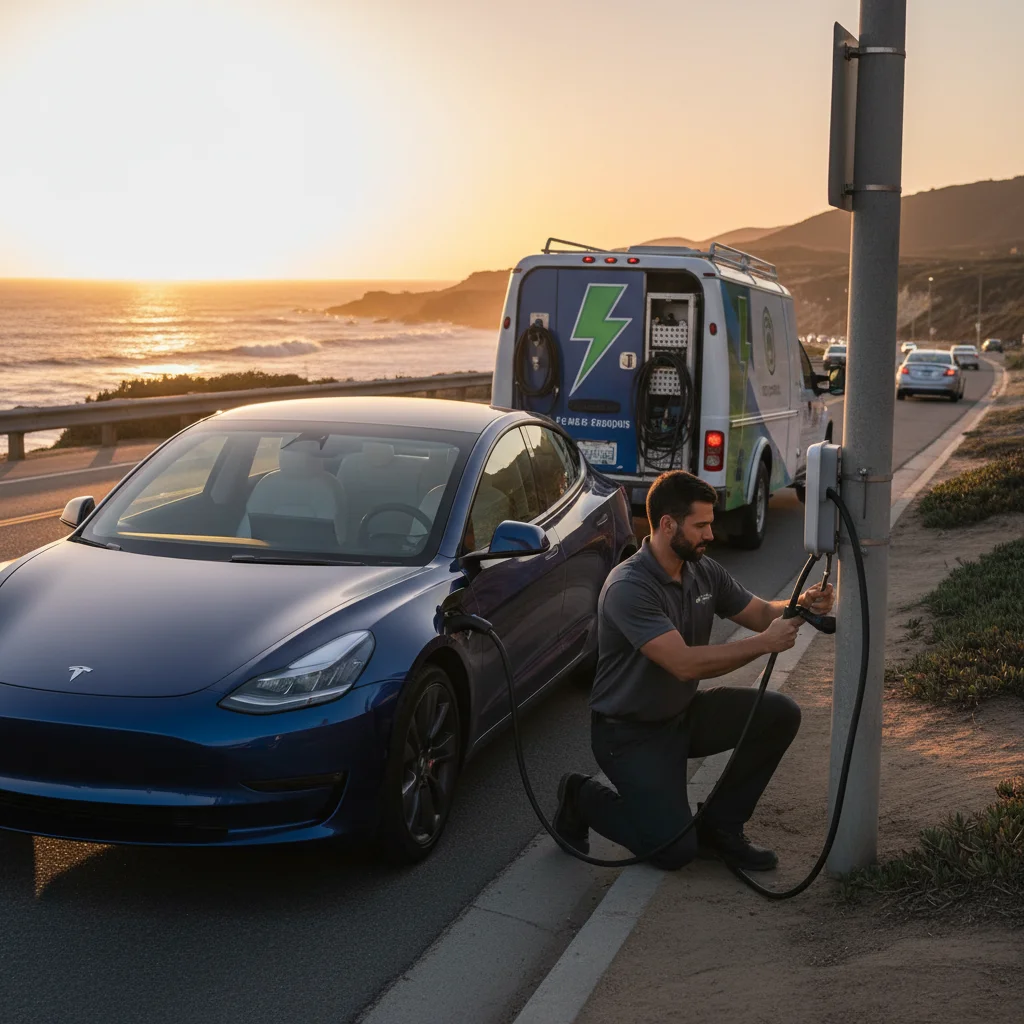
A trip sit is what this stall looks like
Harry Reid International Airport sits in Paradise. That’s unincorporated Clark County, not the City of Las Vegas. The airport was renamed from McCarran on 2021-12-14. The lots bake on the valley floor while you’re gone. You weren’t driving those hours, so the car sat still through the trip.
Use the airport’s own lot names when you call. Terminal 1 and Terminal 3 are the published terminal decks. Short Term, Long Term, and Economy are the named stay lots. Remote Lot, Cell Phone Lot, and Reservation Parking round out that list. Cell Phone Lot is a short wait by design. Long Term and Economy are multi-day sits. Those rows are where a Tesla goes dark.
The last range you remember can still look healthy, and that mismatch is the tell. An empty pack usually still wakes a screen. A dead 12V leaves a brick that won’t unlock.
Yes, Teslas keep a 12V-class battery besides the traction pack. Do Teslas have a 12V battery is the short version. It runs locks, the display, and the contactors. Until those contactors close, the pack can’t move the car. Have the row letter and stall number if you can see them. Terminal 3 Short Term and Long Term are different access problems. Don’t make the operator guess which deck you’re in.
Paradise heat works the car while you’re gone
NWS Las Vegas at KLAS puts the average July high at 104.5F. About 78 days a year hit 100F or more. About 9.4 days hit 110F or more. The all-time record is 120F, set on 2024-07-07.
The airport runs 5 to 15F warmer than outlying areas. Downtown and the east valley can run up to 11F hotter than the rim. Summerlin sits near 3,500 ft, and Henderson sits around 1,867 ft. Your Tesla sat in that airport pocket, not on the west rim.
Newer Model 3 and Model Y cars often use a lithium 12V. Older Model S and Model X cars used lead-acid, and so did early Model 3 cars. Chemistry changes, but the lockout still looks the same from the stall.
Cabin Overheat Protection and Sentry Mode keep the car busy if you left them on. Tesla describes those loads in the car. A published drain figure for either one couldn’t be confirmed here. Don’t treat a forum number as a spec. Treat them as parked work the 12V paid for. App pings add another trickle while the car sleeps.
Recurrent Auto found about 5% range loss at 90F, and 17 to 18% at 100F. Air conditioning can draw 3 to 5 kW to cool a hot cabin. Holding that cabin takes about 1 kW. AAA, in May 2026, measured 8.5% range loss at 95F. None of those figures come from Tesla, but they still describe a parked car in Paradise heat.
Two failures that look the same in the lot
From the curb they look identical, but they aren’t the same job. Tesla looks dead: pack or 12V walks this split in more detail.
The 12V is flat and the pack still has miles
Screens stay black, and door handles stay in. The phone key does nothing, and the app can’t reach the car. That’s a low-voltage failure. The traction pack can still hold a healthy percentage, because the contactors never close.
A jump at the stall can wake it. Sometimes the 12V needs a replacement, not another jump. If it dies again after a jump, treat the battery as worn. The Tesla 12V battery jump path is for that brick.
Don’t keep hammering the app or the start button. Don’t borrow clamps from a gas car unless you know Tesla’s jump points. Wrong clamps cost you a computer.
The car wakes and the percentage is gone
The screen lights, and you see a low number. Climate still tries to run, which means the pack is empty, not locked out. You need 240V at the bumper, not another 12V lecture.
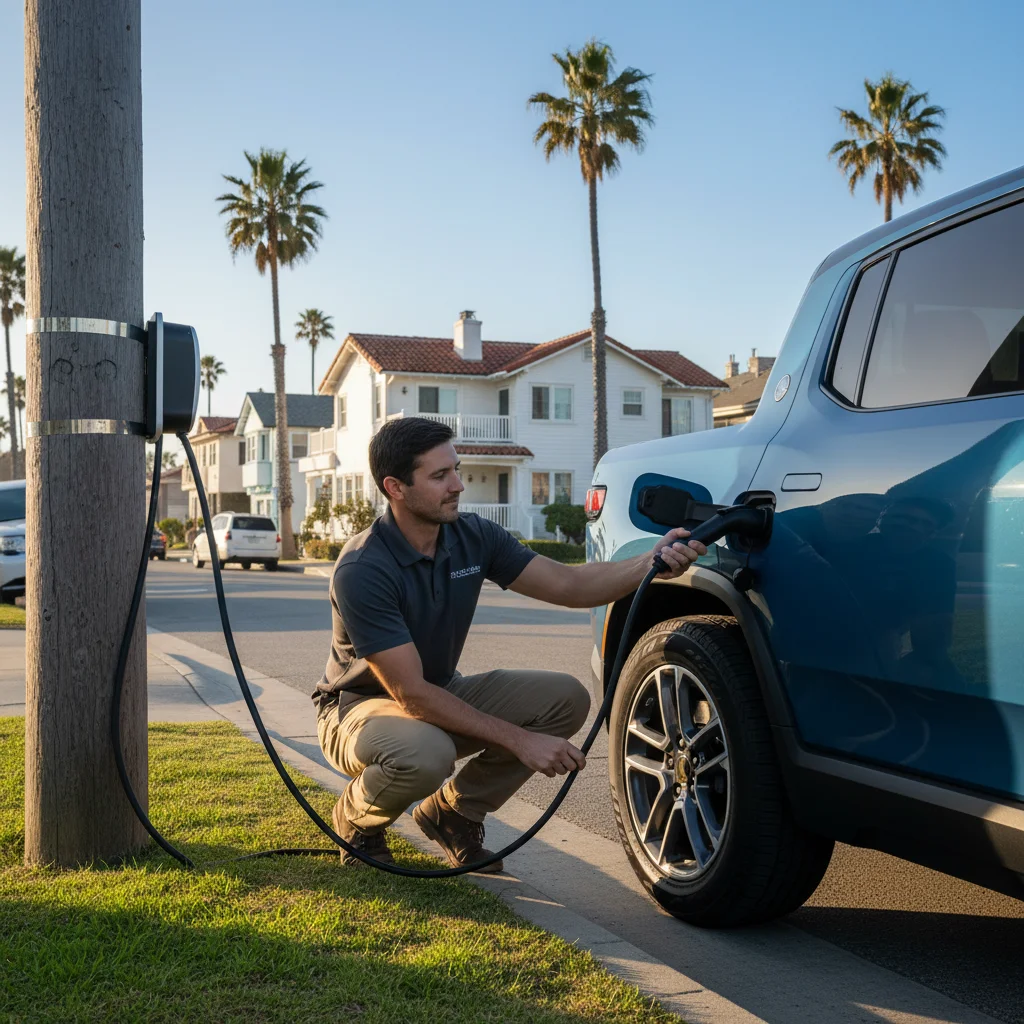
Operators we connect you with bring a 240V Level 2 source to the car. They use a native NACS plug on Teslas, plus a CCS or J1772 adapter for other brands. They typically add about 10 to 20 miles of range in 15 to 30 minutes of charging. That’s charging time, not an arrival time.
That’s an out-of-charge recovery job when the car already talks to you.
What the airport parking desk can do
Airport parking offers free battery jump starts and tire inflation at (702) 261-5122. That’s the airport’s published lot service, not Charge Pro LV. Ask whether they’ll jump a Tesla’s low-voltage battery. Don’t assume a gas-car clamp procedure fits this car. Don’t assume they can reach Tesla’s jump point.
Tesla publishes a 12V jump point on most cars. On a Model 3 or Model Y it sits under the hood, front right. On a Model S or Model X it sits in the frunk area near the firewall. How to jump start a Tesla 12V covers the port and the sequence. A jump that wakes the car is a test, not a repair.
Access rules for a service truck are the airport’s. Confirm with parking staff before you assume a truck can enter. Stay with the car if you can do it safely.
The airport’s site doesn’t publish EV charging as a confirmed amenity. Third-party stall maps aren’t treated as fact here. Charging inventory for Clark County couldn’t be verified on 2026-09-18. The NREL station API was in a DNS outage that day. Tesla’s site blocks automated stall counts. This page won’t name a plug in those lots. It also won’t guess a distance to one. Open your charging app after the car wakes, and read what’s actually online. If a public stall is open and you can still roll, use it. If you can’t roll, work the car where it sits.
Jump, charge, or hook from this pavement
Harry Reid parking isn’t a freeway shoulder. A tow still isn’t the first tool for a dark Tesla. A car that won’t go into neutral is a drivetrain risk on a hook. Wake the 12V first when that’s the failure.
Private-property tows in Nevada follow NRS 706.4463 through 706.4479. Tow operators need a Nevada Transportation Authority certificate, and posted signs are required. A 48-hour warning sticker is required before some private-property tows. Owners get certified-mail notice within 15 days, or 21 days if the tow is crash-related. A still-hooked vehicle must be released at the original location. The operator sets that release fee.
Non-consent tow rates are operator-filed tariffs under NAC 706.408. There’s no single statewide maximum on this site. Confirm posted lot rules before you assume a hook is coming.
Charge, jump, or tow is the decision tree. Jump in place when the 12V is the failure. Charge in the stall when the pack is empty. Tow when the car still can’t move.
If you die on I-15 or I-215 after you leave, stay with the car. NRS 484B.440 lets a disabled vehicle remain when it can’t avoid stopping. The statute sets no time limit. NRS 484B.443 lets law enforcement remove a disabled or abandoned vehicle. On freeways and primary highways, abandoned is 24 hours. On other roads, 72 hours, and the owner pays removal.
NDOT’s Freeway Service Patrol covers the busiest valley freeways from 5:00am to 8:30pm, seven days a week. None of NDOT’s published FSP materials mention EV charging. That’s an advertised silence, not a claim the patrol can’t touch an EV.
Nevada State Police Highway Patrol dispatches rotation tows through Autura. The cell shortcode is *647, and Southern Command is (702) 486-4100. Nevada has no toll roads, and I-15 and I-215 are free.
If the pack really did hit zero
It happens when you arrived thin and Sentry stayed on. Cabin cooling ran in 100F heat, so the 12V may still be fine while the car has nowhere to go.
Ten to twenty miles is often enough to leave the airport and join I-15. From there you still have to find a working public stall in an app. This page won’t guess that map. A Supercharger is Tesla’s DC fast-charge network, and you have to reach a working stall first. Don’t plan a roll you can’t make.
South on I-15 is Enterprise and Silverado Ranch. West is Spring Valley and the Summerlin rim. North takes you through Paradise toward the Strip and Winchester. Keep climate modest until you’ve got a buffer. Read the dash after the car wakes, because this page won’t invent remaining miles.
Home charging doesn’t wake a dark lot stall
NV Energy serves Paradise, Las Vegas, Henderson, North Las Vegas, Winchester, Spring Valley, and Enterprise. Nevada has no retail electric choice, because Question 3 failed in 2018. NV Energy’s Residential Electric Vehicle Recharge Rider is called REVRR. It sets an EV charging window from 10:01pm to 8:00am. Confirm the current tariff with NV Energy, because this page doesn’t publish a rate. That overnight window helps the next trip. It doesn’t wake a car that’s already dark in Long Term.
For the local geography around the airport, use Paradise EV charging.
What we connect, and what we don’t
Charge Pro LV is a referral line for the Las Vegas Valley. It matches stranded EV drivers with independent local operators. It performs no work, owns no trucks, and employs no technicians. It sets no prices, promises no arrival time, and holds no license.
The operator quotes you before starting, then bills you directly. The pros we connect you with are licensed and insured. That’s a claim about the network. They handle Tesla and every major EV brand. They can jump or replace a dead 12V on site. They can add a Level 2 charge when the pack is the problem.
Have the lot name ready, plus the model and year. Say whether the car won’t unlock, or whether it wakes with a low percentage.
If the Tesla is dark in Harry Reid parking, call (702) 935-4699. We’ll connect you with a local operator who quotes before work starts.