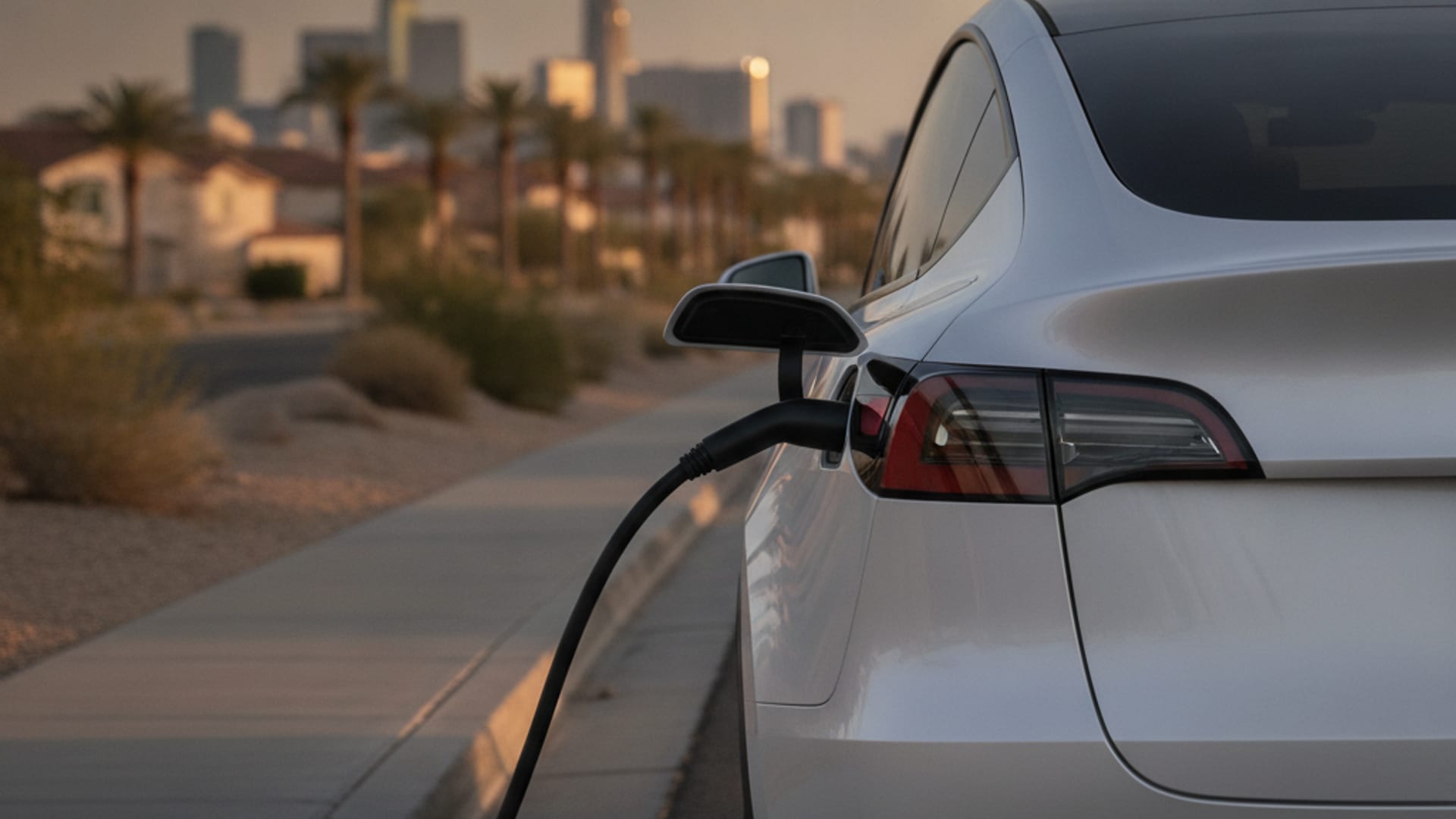
Your Model Y sat overnight in a Winchester apartment lot. The doors won’t unlock from the handle. The app can’t connect. The screen is dark. The traction pack still holds 60 percent. None of that matters until the 12V wakes the car back up.
What the 12V actually does in an EV
The traction pack is the big battery that moves the car. The 12V is the small battery that runs the lights, the computers, the door handles, and the contactors that close the high-voltage system. The traction pack cannot energize the car until the 12V closes those contactors. A dead 12V means a bricked car, even with a full pack.
The 12V is roughly the same part as in a gas car. Lead-acid in older models, lithium in newer ones. Both work the same way on the symptom. A voltage below about 11.5 volts usually means the car cannot boot. The pack is fine. The 12V cannot close the relay.
The car charges the 12V from the traction pack through a DC-DC converter. A 12V that drains to zero usually points at one of three things. A door left ajar. A stuck module that draws current when the car is off. Or a battery that has aged past its useful life. The valley’s heat accelerates that aging.
Why the valley cooks 12V batteries
NWS Las Vegas publishes the climate record. The average July high is 104.5F. About 78 days a year hit 100F or more. About 9.4 days hit 110F or more. The record high is 120F, set on July 7, 2024. January lows average 37F with about 10 freeze nights. The 12V lives in that full range.
Heat is the harder stress. A 12V in a 140F engine bay of a parked car in July loses water faster and sulfates faster. Lead-acid fails first in the heat. Lithium variants hold up better but still degrade above about 110F sustained. A car that lives outside in the valley ages its 12V roughly twice as fast as the same car in a milder climate.
A car that sits for a week is more exposed than a daily driver. The DCDC converter only tops up the 12V while the car is awake or charging. A 12V that sits at 60 percent for a week in August loses capacity the whole time. A daily driver rarely gets below 80 percent because the converter catches up overnight.
What the symptoms look like from the driver’s seat
The first sign is usually the door handle. A Tesla with a healthy 12V presents the handle when you approach with a phone or fob. A weak 12V gives you nothing. You tap the handle. Nothing happens. You try the key card. Nothing.
The next sign is the frunk. The emergency frunk release under the hood is a mechanical pull on most Teslas. If the 12V is dead, the powered frunk won’t open. The mechanical pull still works. That gets you to the jump points on a Tesla.
The third sign is the dashboard. Plug the car in. If the 12V is the problem, the charge port may not even light. The big pack still has energy. The car cannot use it without a working 12V. Drivers often assume the traction pack is empty. It usually isn’t.
A non-Tesla EV shows the same pattern. Rivian, Ford Lightning, Hyundai Ioniq, Kia EV6. The doors fail. The screens stay dark. The car looks dead with a full pack behind it.
Jump at the car, not at the pack
The right jump point is the 12V system. On a Tesla, that is under the hood, behind the frunk, at dedicated terminals. On other brands, it is usually under the hood at the 12V posts. A normal 12V jump starter or a second car’s jumper cables, used at the 12V posts, will close the contactors. The car wakes. The big pack takes over from there.
Do not try to jump the traction pack. The voltages and connectors are different. A 12V jump starter cannot reach the high-voltage system and shouldn’t try. The 12V is the gate. Open the gate.
Once the 12V is awake, drive the car or plug it in. A 12V that died of heat age will not hold a charge. The DCDC converter will top it up while the car is on, but a parked car will drain it again. The fix is a new 12V. The operator that jumps the car can usually replace the 12V at the same visit.
What the operator brings to the car
Charge Pro LV is a referral line. It matches stranded EV drivers with independent local mobile rescue operators. It performs no work, owns no trucks, and employs no technicians. It does not set prices or publish hours.
Operators carry a 12V jump pack and a 12V battery for the common models. They know where the jump points sit on a Model 3, a Model Y, a Model S, a Model X, and a Cybertruck. They know the Ford Lightning jump points and the Rivian R1T points. A jump at the car wakes the system in seconds. A replacement 12V takes a few minutes more.
The pros we connect you with are licensed and insured. They quote you before starting and bill you directly. That keeps the work in scope and the cost clear. Tesla 12V battery jump and mobile EV charging cover the typical 12V-died-on-a-lot call.
How to tell 12V from a dead traction pack
The 12V failure looks dead with a full pack behind it. The traction pack failure shows range on the dash dropping toward zero. A car with 60 percent pack but no boot is the 12V. A car that drives, then slows, then stops, with the range counting down is the pack.
A car that sat three weeks without being plugged in is usually the 12V. A car that drove 250 miles of indicated range and now shows zero is the pack. The split tells the operator which truck to send.
A driver in the east valley, in Winchester, or in Sunrise Manor hits 12V failures more than pack failures. The valley heat ages the 12V. The same driver with a full pack and a dead 12V should not panic about a replacement car. The car is fine. The 12V is the only bad part.
For the broader pattern across brands, see do Teslas have a 12V battery, EV 12V battery replacement signs, and Tesla 12V battery failure in desert heat. Mobile EV charging covers the broader pattern when the pack is also low.
If the car is on a freeway shoulder and cannot move, NRS 484B.440 lets a disabled vehicle stay when it cannot avoid stopping. NDOT’s Freeway Service Patrol runs 5:00am to 8:30pm seven days a week and helps with tire changes, jump starts, fuel, minor fire suppression, and traffic control. NDOT’s published materials do not mention EV charging. The patrol is one of the faster free options on the freeway in those hours.
The NWS Las Vegas climate page is where the official heat record lives. The valley average July high is 104.5F. That is the number to plan a 12V replacement against.
Frequently asked questions
Can I drive my EV if the 12V is weak?
No, a weak 12V will leave the car unable to boot. Once the car is awake, the DCDC converter charges the 12V from the traction pack. A 12V that has died of age will not hold a charge while parked. Replace it before relying on the car.
Why did my Tesla 12V die overnight?
Three common causes. A door or module that drew current while the car was off. A 12V already weakened by heat age that finally fell below the boot threshold. Or a car that sat for days without the DCDC converter topping up the 12V. Valley heat accelerates the first two.
Where are the jump points on a Tesla?
On a Tesla, pull the mechanical frunk release under the hood, lift the frunk, and look for the red and black 12V terminals. The Model S, 3, X, Y, and Cybertruck all have accessible 12V jump points under the frunk. The owner’s manual has the exact location for each model.
Will a jump from a gas car work on an EV?
Yes, at the 12V posts the same way as on any car. The traction pack cannot be jumped from a 12V source. The 12V jump only opens the contactors so the car can boot. The traction pack takes over once the car is awake.
How long does a Tesla 12V last in the desert?
Tesla has not published a desert-specific replacement figure we could verify. A 12V in the Las Vegas Valley usually lasts about three to four years because of the heat cycle. A garage-stored car lasts longer. Replace the 12V at the first sign of slow boot, not after it leaves you stranded.