You left a Green Valley garage on last night’s charge. The pack looked fine on the driveway this morning. Then the climb toward Anthem ate the leftover miles. The other common stall is a long sit at The District. Cabin cooling ran through July heat while you shopped. That’s the usual EV roadside assistance call in Green Valley. This isn’t a forgotten plug in a dark garage. It’s a home-charged car that still ran short on the way out.
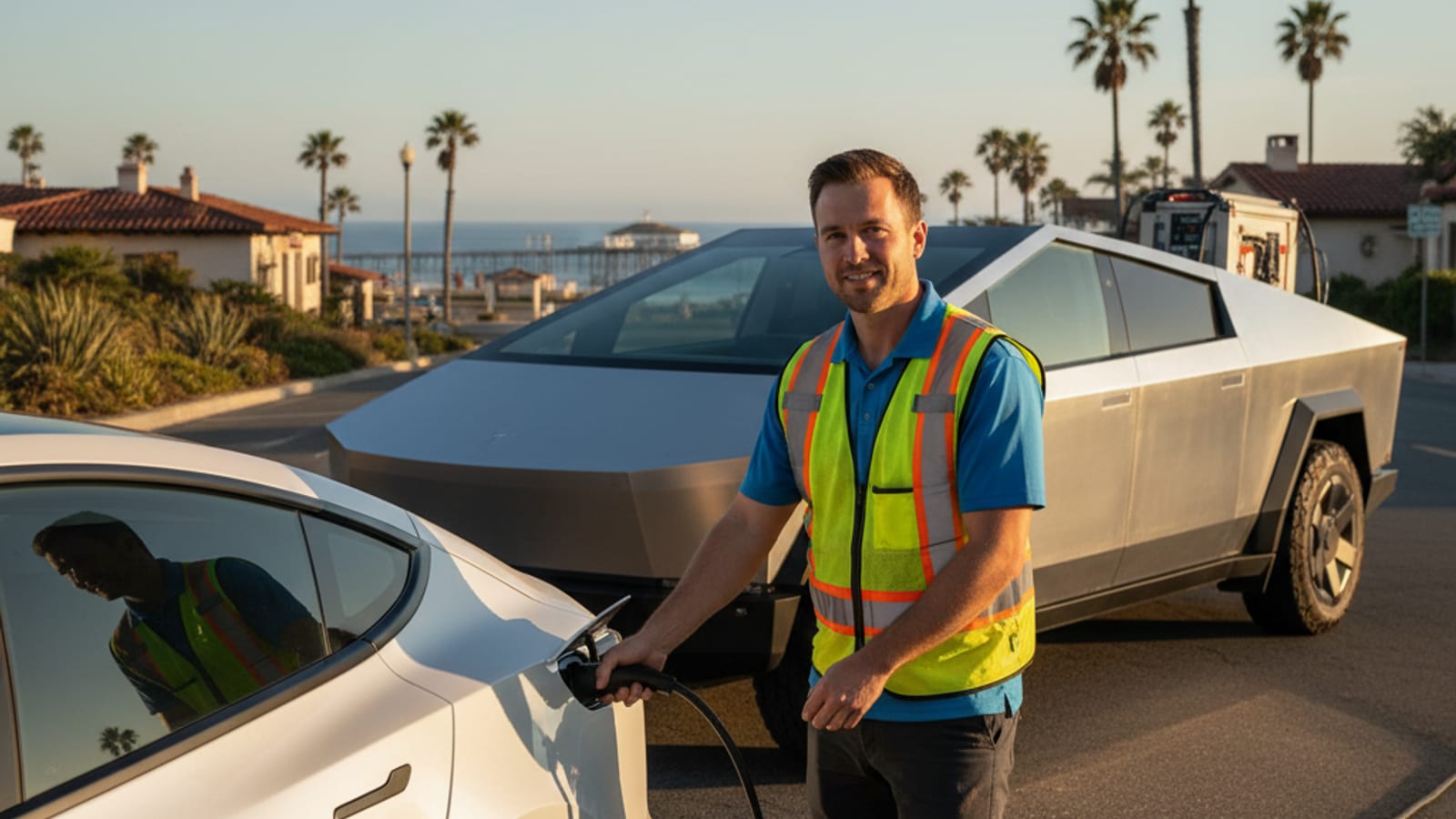
Why Green Valley calls start after a full overnight charge
Henderson is Nevada’s second-largest city, and it’s a home-charging town. The Census 2024 city estimate sits at 350,039 residents. ACS 2019-2023 counted 324,523 people in Henderson. Only 7.1% of housing went up before 1980. Newer streets mean newer garages and home Level 2 plugs. Green Valley isn’t a separate Census place, so this page won’t invent a headcount. The community is the master-planned heart of Henderson. It sits around The District and Galleria at Sunset. NV Energy serves Henderson and the rest of the Las Vegas Valley.
Most Green Valley drivers charge at home, not on a public stall. Clark County’s Title 30 code requires EV-ready wiring in new construction. A Level 2 home charger still needs an electrical permit. NV Energy’s Residential Electric Vehicle Recharge Rider sets an overnight window. That window runs from 10:01pm to 8:00am. The Residential Managed Charging Program is still active. NV Energy revised that handbook on July 29, 2026. Nevada doesn’t have a state EV purchase rebate or tax credit. Confirm current rider rules on nvenergy.com before you enroll. This site doesn’t publish a kilowatt-hour rate for that rider.
Overnight charging covers a lot of weekday miles. It doesn’t cover a long sit in July heat. It also doesn’t cover a grade you didn’t feel going down. That’s why the Green Valley charging and rescue page exists. Charge Pro LV is a referral line for stranded EV drivers. It matches you with independent local mobile rescue operators. It doesn’t hold a license, own trucks, or employ technicians. It doesn’t set prices or promise an arrival window. The operator quotes you before any work starts. Then that operator bills you directly for the stop. The pros we connect you with are licensed and insured.
Two stall patterns, not a forgotten garage plug
Henderson’s call mix skews to road strandings, not dead garage outlets. Green Valley sits in the middle of that pattern.
The climb toward Anthem and the south hills
Anthem sits on Henderson’s high south end, climbing toward Sloan Canyon. MacDonald Highlands shares that same south rim above the valley floor. The grade home eats a margin drivers don’t notice on the way down. You left Green Valley with what looked like enough range. The climb still takes those leftover miles anyway. Whitney Ranch and Inspirada sit farther south toward the hills. Home charging is common in those streets too. The calls are the climb, the long errand, and a car that wouldn’t wake.
US-93 and I-11 launch east toward Boulder City and the dam. Lake Las Vegas sits on the east edge of Henderson. The enclave sits off Lake Mead Parkway, a longer dispatch than the valley core. A visitor who drove out for the day can end it short of charge. The core of the city is a real distance back. This page isn’t a map of public plugs. It’s about a car that’s already sitting where it stalled. The remaining miles may not match the next grade. See EV roadside assistance in Henderson for the citywide version. The climb is on the Anthem roadside page.
Hours at The District, Galleria, and event lots
The District holds people for a long evening. Galleria at Sunset does the same on a slower errand. People linger for dinner, a movie, or a long walk through the shops. July heat sits on a parked pack the whole time you’re inside. Cabin cooling keeps running if you left it on. You come back to a car that looks asleep. Nevada State University sits in Henderson, and visitor lots stay full for hours. The College of Southern Nevada has a Henderson campus. Dignity Health St. Rose Dominican draws the same long visitor sits. Henderson Hospital draws the same long visitor sits. Arena nights add another layer for Green Valley drivers. People roll toward T-Mobile Arena, Sphere, and Allegiant Stadium. Michelob ULTRA Arena is on that list too. Then they sit in event parking until the pack is thinner than the drive home.
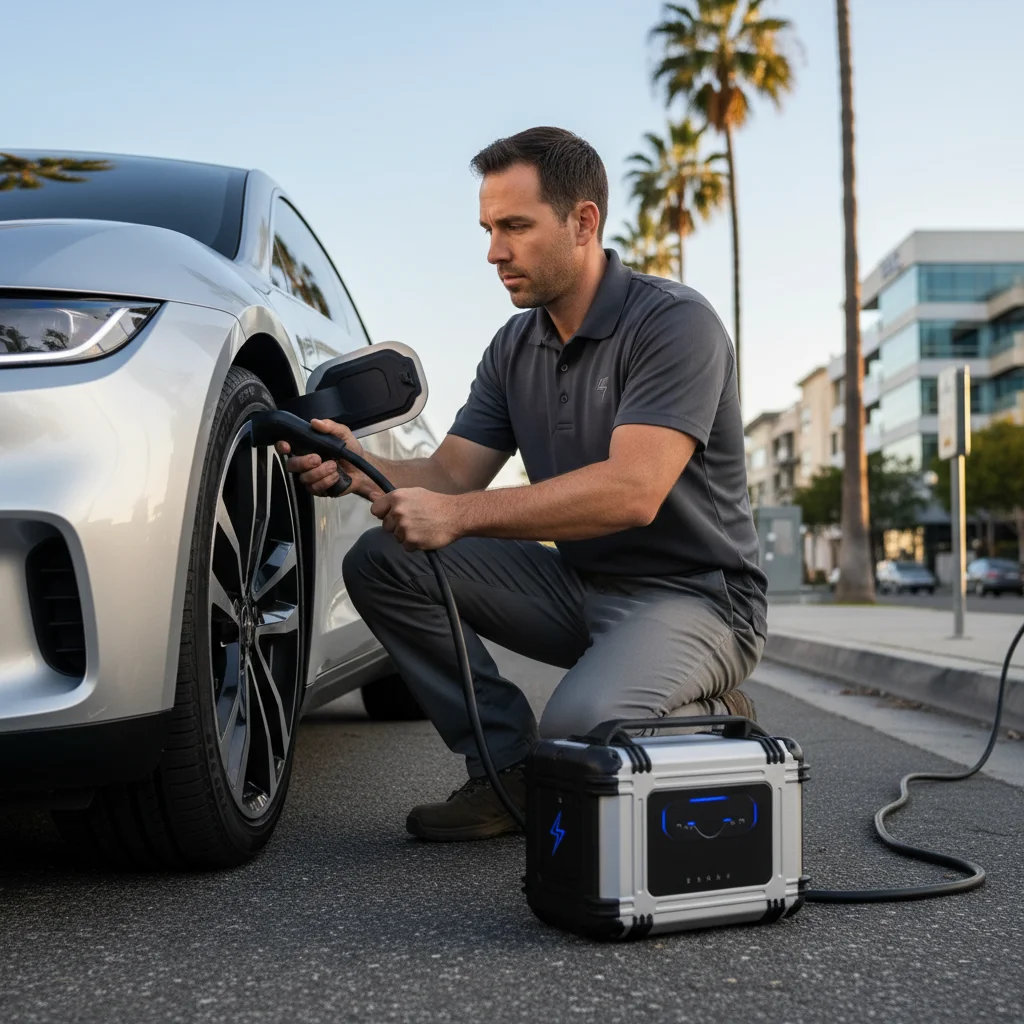
A long dwell is a heat-and-time story at the bumper. The car used energy while you were inside. Mobile EV charging is how an operator adds range at the stall.
What valley heat does to miles you thought you had
NWS Las Vegas numbers at KLAS are blunt. The average July high at that station is 104.5F. About 78 days a year hit 100F or more. About 9.4 days hit 110F or more. The all-time record high is 120F on July 7, 2024. Annual precipitation around the valley is 4.18 inches. Monsoon season runs through July and August. Flash flooding hits washes and underpasses in those months. The urban heat island warms the airport 5 to 15F over outlying areas. The east valley and downtown can run up to 11F hotter than the rim. Henderson sits around 1,867 feet, a bit below the broader valley floor. The valley floor runs about 2,000 to 2,920 feet.
Range loss in heat is documented, with attribution. Recurrent Auto found about 5% range loss at 90F. The same work found 17 to 18% loss at 100F. Air conditioning drew 3 to 5 kW to cool a hot cabin. Holding an already-cool cabin took about 1 kW. AAA in May 2026 measured 8.5% range loss at 95F. That same AAA test measured 39.0% loss at 20F. Geotab found hot-climate batteries degrade about 0.4% per year faster. Phoenix-style desert heat was the worst case in that work. No Tesla-published range-loss figure turned up for this page. This site won’t invent a Tesla number to fill that gap.
That math is why a full garage charge still fails a Green Valley afternoon. You spent miles on cabin cooling in a Galleria lot. You spent more on the climb toward Anthem. The dash still showed a comfortable number at 10am.
Empty pack, or a 12V that won’t wake the car
Not every stall is an empty high-voltage pack. EVs still carry a 12V battery for locks and computers. After a long hot sit, the car may not unlock. The screens stay dark even if the pack still holds range. Operators in the network jump or replace a dead 12V on site. They also bring a 240V Level 2 source to the car. That’s a native NACS plug for Tesla, plus a CCS or J1772 adapter. A typical add is 10 to 20 miles of range. That add takes 15 to 30 minutes of charging. That’s charging time at the car, never an arrival window. Tesla and every major EV brand are in that mix. If the 12V is the fault, a pack charge won’t wake the car. If the pack is empty, a 12V jump won’t add highway miles. The operator sorts that at the bumper before anything else. A house battery is a different Henderson question. That split is in Home backup power vs calling EV rescue in Henderson.
Green Valley isn’t the west rim, and it isn’t the Strip
Summerlin sits around 3,500 feet, rising toward 4,400 near Red Rock. Henderson sits around 1,867 feet on this side of the valley. Green Valley lives on that lower Henderson shelf. The stall here isn’t the Red Rock scenic loop. It’s a shop lot, a campus visitor stall, or the south climb into Anthem. Paradise and Winchester hold the Strip and Harry Reid International Airport. The airport was renamed from McCarran on December 14, 2021. The airport site doesn’t publish EV charging in parking, so this page won’t guess. Green Valley’s pattern stays simpler: you charged at home, then the day spent the buffer.
I-215 and CC-215 stay free, like every other highway in Nevada. There’s no toll road and no transponder anywhere in the state. I-15 has HOV lanes from Silverado Ranch to the Spaghetti Bowl. Those lanes need two-plus occupants, 6-8am and 4-6pm weekdays. The federal single-occupant EV HOV exemption expired on September 30, 2025. An EV still needs a second person in those hours.
What club roadside and the freeway patrol actually publish
Most club and insurer plans grew up around gas cars. A dead EV often gets a tow offer first. Many EVs need a flatbed so the drivetrain isn’t rolling. A tow moves the car, and it doesn’t put energy in the pack. Non-consent tow rates in Nevada are operator-filed tariffs. The Nevada Transportation Authority regulates them under NAC 706.408. There’s no single statewide maximum on those tariffs. This site doesn’t publish a tow rate for any operator. Tow operators need an NTA certificate under NRS 706.4463 and related sections. A still-hooked vehicle can be released at the original location. The operator’s set release fee applies in that case. Ask for that fee before you sign anything.
On a valley freeway, the NDOT Freeway Service Patrol covers the most-traveled stretches. Quality Towing runs that patrol, sponsored by GEICO. Hours are 5:00am to 8:30pm, seven days a week. The stop is free to motorists on those covered freeways. The patrol handles tire changes, jump starts, fuel, minor fire suppression, and traffic control. It clears about 55,000 incidents a year statewide. About 31,500 of those are in Las Vegas. None of NDOT’s published FSP materials mention electric vehicles. They also don’t mention EV charging or EV-specific service. That’s an observed absence in the published materials. The patrol doesn’t advertise EV charging in those materials. Don’t read that as a claim the patrol can’t help an EV.
If you’re disabled on a highway, NRS 484B.440 applies. A vehicle that can’t avoid stopping is exempt from the no-stopping rule. The statute doesn’t set a time limit on how long it may remain. NRS 484B.443 lets law enforcement remove a disabled or abandoned vehicle. On freeways and primary highways, abandoned is 24 hours. On other roads, a vehicle is treated as abandoned after 72 hours. The owner pays for that removal, and this page doesn’t quote a figure. Nevada 511 and nvroads.com report conditions, closures, and cameras. The Nevada State Police Highway Patrol dispatches rotation tows via Autura. The cell shortcode for that dispatch is *647. Highway Patrol Southern Command answers at (702) 486-4100.
What a Charge Pro LV match actually looks like
Stay with the car if that’s the safer choice. Keep hazards on, and stay out of the live lane. Then you call the referral line from the car. Give a make, model, and a pin you can describe. Green Valley pins are often a garage at The District. They can also be a row at Galleria at Sunset. Other common pins are a shoulder on the Anthem climb. Visitor lots near Nevada State University show up too. Charge Pro LV matches you with an independent operator. That operator quotes before starting, and you accept or you don’t. Nobody at Charge Pro LV sets that quote.
On site, the operator checks the 12V first if the car won’t wake. If the high-voltage pack is the problem, they connect the 240V Level 2 source. You don’t need a full battery on the shoulder. You need enough miles to reach home. You can also aim for a public plug you already planned to use. Out-of-charge recovery is that short add, not an overnight fill. If the car needs a shop, towing is a separate decision. This brand doesn’t own a wrecker or a yard. An NTA-certificated tow company does that work. Confirm the destination and the tariff before the hook goes on.
What to do in the first minutes
If you can still roll a short distance, get out of traffic. A parking aisle at The District beats a through lane on the rim. If you’re already at zero, stay put. Don’t creep on the last bar until you’re in a worse spot. Check whether the car is silent because the 12V died. Dark screens and dead locks with a recently full pack point that way. A zero-mile display after the Anthem climb points at the big pack. Either way, don’t keep cycling the start button.
If you’re on I-11 or US-93 toward Boulder City, that’s a free highway. Use Nevada 511 for closures and camera views. If a patrol truck stops, take the safety help they offer. Ask whether they can jump a 12V. Don’t assume they brought a Level 2 source. Their published materials don’t advertise a Level 2 source. If a monsoon cell hits, underpasses and washes can flood. Don’t sit in a dip while you wait. Move to higher pavement if you can still roll. A house battery doesn’t move a car that’s already in a Galleria lot. That’s the split in the Henderson backup post linked above. Rescue at the bumper is for the car that already left the garage.
Nearby Henderson streets that share this pattern
Green Valley doesn’t sit alone on this Henderson map. Anthem is the climb at the south rim. Lake Las Vegas is the longer east reach. Whitney Ranch and Inspirada are the newer south hills. The same home-charge-then-short pattern shows up in all four. I-215 and the US-93/I-11 launch are the usual ways out. There’s no toll on any of those roads. If you’re staging a dam day from a Green Valley driveway, plan the return. Hoover Dam’s crest sits at 1,232 feet. Boulder City sits around 2,510 feet on that same run. Railroad Pass sits around 2,360 feet on the way. Elevation isn’t the whole story on a July afternoon. Heat and cabin cooling do as much work as the grade.
Keep a buffer on the routes you actually drive
Green Valley’s daily map is short on paper. Heat makes those same miles feel longer than the map. The District to Anthem is a climb, not a flat errand. Green Valley to Lake Las Vegas is an east run off Lake Mead Parkway. Use the car’s trip planner before you leave the garage. Add the grade, the AC, and the sit. Recurrent Auto’s 17 to 18% loss at 100F is a planning number. It isn’t a promise for your pack. AAA’s 8.5% at 95F is another measured point. Cabin cooling in a black lot in July can outrun both.
Plug in on the NV Energy window when you’re home. The overnight fill is still the habit that covers most weekdays. Confirm the current rider with NV Energy before you count on it. If you skip a night, then sit at the shops, you’re back in this pattern. Nevada’s Clean Cars rules are in force from model year 2025. That’s LEV III plus ZEV for new models. More new EVs will keep showing up in these garages. The stall pattern doesn’t change with those new plates. It’s still a home charge, then heat, then a climb.
Frequently asked questions
What if I charged at home and still stalled in Green Valley?
That’s the usual Green Valley call after a full garage night. An overnight fill on NV Energy’s window doesn’t buy the Anthem climb. It also doesn’t buy a three-hour sit at The District. An operator adds 10 to 20 miles at the car. They can also wake a 12V that died in the heat. Charge Pro LV only makes the match. The operator quotes you before anything starts.
How much range does a roadside charge add?
Operators typically add 10 to 20 miles in 15 to 30 minutes of charging. That’s time on the cord, not a clock on when a truck shows up. You don’t get a full pack on the shoulder. You get enough to reach home, or a plug you already meant to use.
Does Charge Pro LV send its own truck?
Charge Pro LV doesn’t send a brand-owned truck. It’s a referral line, not a fleet. Independent operators bring a 240V Level 2 source. They carry a NACS plug and CCS or J1772 adapters. They quote you first and bill you directly. The brand doesn’t own the equipment, and it doesn’t employ the technician.
When a Green Valley home charge still runs short, you need help at the bumper. Call (702) 935-4699 to get matched with a local operator. Charge Pro LV serves every city in the county, including this Henderson neighborhood.