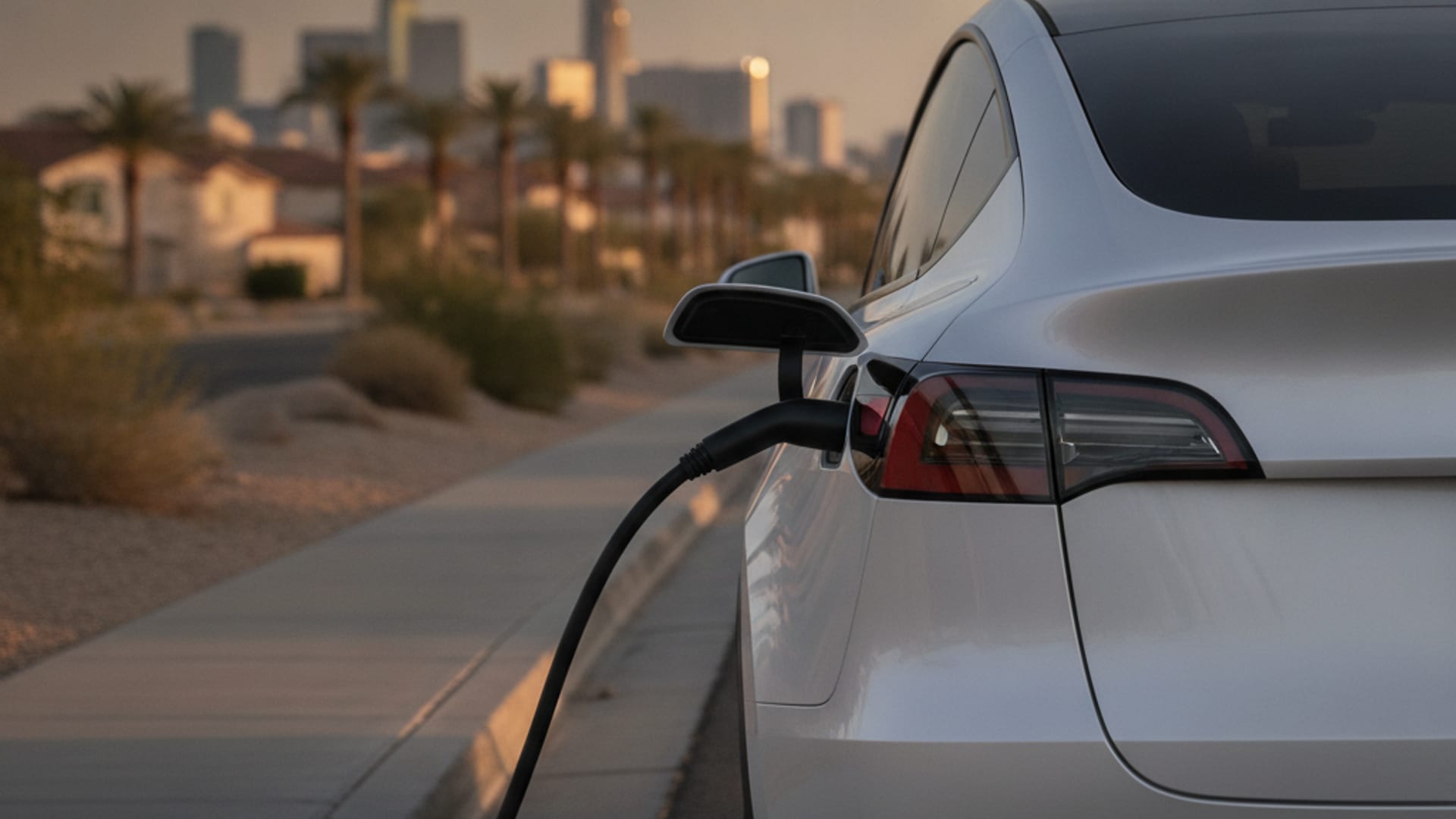
Your sister in Sunrise Manor lets you plug into the garage outlet. The cable sits there overnight. The dash shows six miles added by morning. That cable is doing exactly what a Level 1 charger does. The math is the math, and the valley heat is part of it.
What Level 1 actually delivers
Level 1 charging uses a standard 120V household outlet. The car draws about 1.4 kW from a 15A circuit. The U.S. Department of Energy’s AFDC EV charging page lists Level 1 at about 4 to 5 miles of range per hour on a typical EV. That number is the floor in mild conditions.
The same AFDC page lists Level 2 at 240V and about 25 to 35 miles of range per hour, depending on the onboard charger and the vehicle. That is roughly five to seven times the Level 1 rate. The gap matters when you cannot leave the car plugged in for two days at a time.
A driver who plugs in at 9pm and leaves at 7am gets ten hours. At 4 to 5 miles per hour, that is 40 to 50 miles of indicated range. In valley heat, the climate control cuts into that. The math that worked in Portland does not work in Henderson.
Why the valley heat cuts the math down
NWS Las Vegas publishes the climate record. The average July high is 104.5F. About 78 days a year hit 100F or more. About 9.4 days hit 110F or more. The record high is 120F, set on July 7, 2024. The east valley can run up to 11F hotter than the rim. Sunrise Manor sits in that hotter bowl.
Recurrent Auto measured the heat penalty. About 5 percent range loss at 90F. About 17 to 18 percent at 100F. Cooling a hot cabin draws 3 to 5 kW, versus about 1 kW to hold temperature. AAA, in May 2026, measured 8.5 percent range loss at 95F. None of those numbers are Tesla-specific. Tesla has not published a hot-weather loss number we could verify.
The math gets worse when the cabin starts cold. A car that sits in a Henderson lot at 110F for an hour comes back to a 140F cabin. The first ten minutes of cooling pull close to 5 kW. That draw comes out of the same 1.4 kW the Level 1 cable can deliver. The pack drains before the cable catches up.
A driver who commutes 35 miles each way in the valley, parks outside, and only has a Level 1 outlet at the relative’s garage will lose ground most weeks in July and August. The morning after a hot night, the cable has added less than the climate system would have spent.
Why most valley apartments do not have a 240V plug
Census data puts about 22.9 percent of Sunrise Manor housing before 1980 and 53.1 percent of Winchester housing before 1980. A 1970s apartment complex was not built around a 240V car circuit. The panel that ran the original air handler usually does not have a spare two-pole breaker slot.
Clark County’s Title 30 now requires EV-ready wiring in new construction. It does not reach back and rewire a walk-up that already exists. A renter who wants a Level 2 home charger has to negotiate with the property owner, who has to negotiate with the panel, which may need a service upgrade before a new circuit.
NV Energy serves the urban core of the valley. The utility publishes a Residential Managed Charging Program and a Residential Electric Vehicle Recharge Rider (REVRR). REVRR is a time-of-use rate with an EV charging window from 10:01pm to 8:00am. That helps a homeowner with a Level 2 circuit. It does not put a 240V outlet in a rental garage. The NV Energy EV programs page lists the current rider terms.
Apartment renters in Sunrise Manor, Winchester, Paradise, and East Las Vegas often have no Level 2 path. The Level 1 cable at the relative’s house is the best they can get on the home side. That keeps the public charger as the primary source of range.
The practical alternatives for an apartment driver
The first move is to count the miles honestly. A driver who does 35 miles a day needs about 750 miles of range a month. A Level 1 cable at home can deliver about 1,200 miles in 30 days, if the climate penalty did not exist. With the heat penalty, it cannot. The math fails before June.
The second move is to use a public Level 2 stall at the workplace. NV Energy lists multifamily charging programs that some complexes participate in. If the workplace has a charger that runs the day, that covers most of the commute. The home Level 1 then covers the weekend errands.
The third move is to call a mobile operator. Charge Pro LV is a referral line that connects stranded drivers with independent local mobile rescue operators. The operator brings a 240V Level 2 source to the apartment lot. A typical session adds 10 to 20 miles of range in 15 to 30 minutes of charging. That is charging time, not how long the operator takes to arrive.
The fourth move is to time the cabin pre-cool. Plug the Level 1 cable in. Pre-cool the cabin while the cable is connected, before unplugging. The pack uses grid power through the DCDC converter for that. The cabin cools without spending pack range.
What the brand you call can and cannot do
Charge Pro LV does not own trucks, employ technicians, or perform the work. The operators it connects you with bring a 240V Level 2 source and the right adapter for your connector. They add 10 to 20 miles at the car. They quote you before starting and bill you directly.
The pros we connect you with are licensed and insured. They work in apartment lots, in resort garages, and on private property. Mobile EV charging covers the typical apartment-driver call. EV roadside assistance covers the broader rescue pattern.
For the broader pattern, see Level 2 240V charging, home versus roadside and EV charging levels for stranded drivers. For the city-by-city coverage map, see EV charging in Sunrise Manor and EV charging in Winchester.
When Level 1 is the wrong answer
Level 1 is the wrong answer when the daily drive exceeds the cable’s overnight output. That happens before June in the east valley for most daily commuters. The math is the math. Level 1 is also the wrong answer when the car sits outside in summer and the cabin pre-cool fights the cable.
A driver who runs out of range on a Monday commute needs a Level 2 source at the lot. The mobile operator is the fastest path for a single day. A Level 2 circuit at the apartment complex is the long-term fix. The property owner is the one who approves the work.
Frequently asked questions
How many miles per hour does Level 1 add?
AFDC lists Level 1 at about 4 to 5 miles of range per hour on a typical EV. Valley heat cuts into that number because the climate control draws from the same 1.4 kW the cable delivers.
Can Level 1 fully charge an EV overnight?
In mild conditions, a 10-hour overnight Level 1 session adds about 40 to 50 miles. In Las Vegas Valley heat, the cabin pre-cool and the climate penalty reduce that. A driver who needs more than 30 miles a day will not keep up on Level 1 alone.
Is a Level 1 charger safe to use every day?
Yes, a Level 1 charger on a 15A household circuit is safe for daily use. The car draws about 1.4 kW, well below the circuit’s rating. Run the cable on a dedicated outlet if you can. Avoid extension cords. Avoid shared circuits with other large loads.
Why does my car charge slower on Level 1 in the heat?
The car does not slow the Level 1 rate. The cabin and battery thermal management draw from the same circuit. In a 100F-plus valley night, that draw leaves less for the pack. The cable is doing what it always does. The car is using more for cooling.
Will NV Energy install a Level 2 outlet at my apartment?
NV Energy does not install outlets inside a private residence. The utility serves the home with the existing service. A Level 2 outlet is a property-owner decision and a licensed electrician’s install. NV Energy publishes EV programs on its clean-energy page.