Your Model 3 rolled to a stop on I-15 southbound near Primm. The dash said zero miles. The cabin fans spun down. The hazard lights still blink. You pulled to the right shoulder when the car started losing power. Stay with the car. You are covered by Nevada law, and a mobile operator can add 10 to 20 miles.
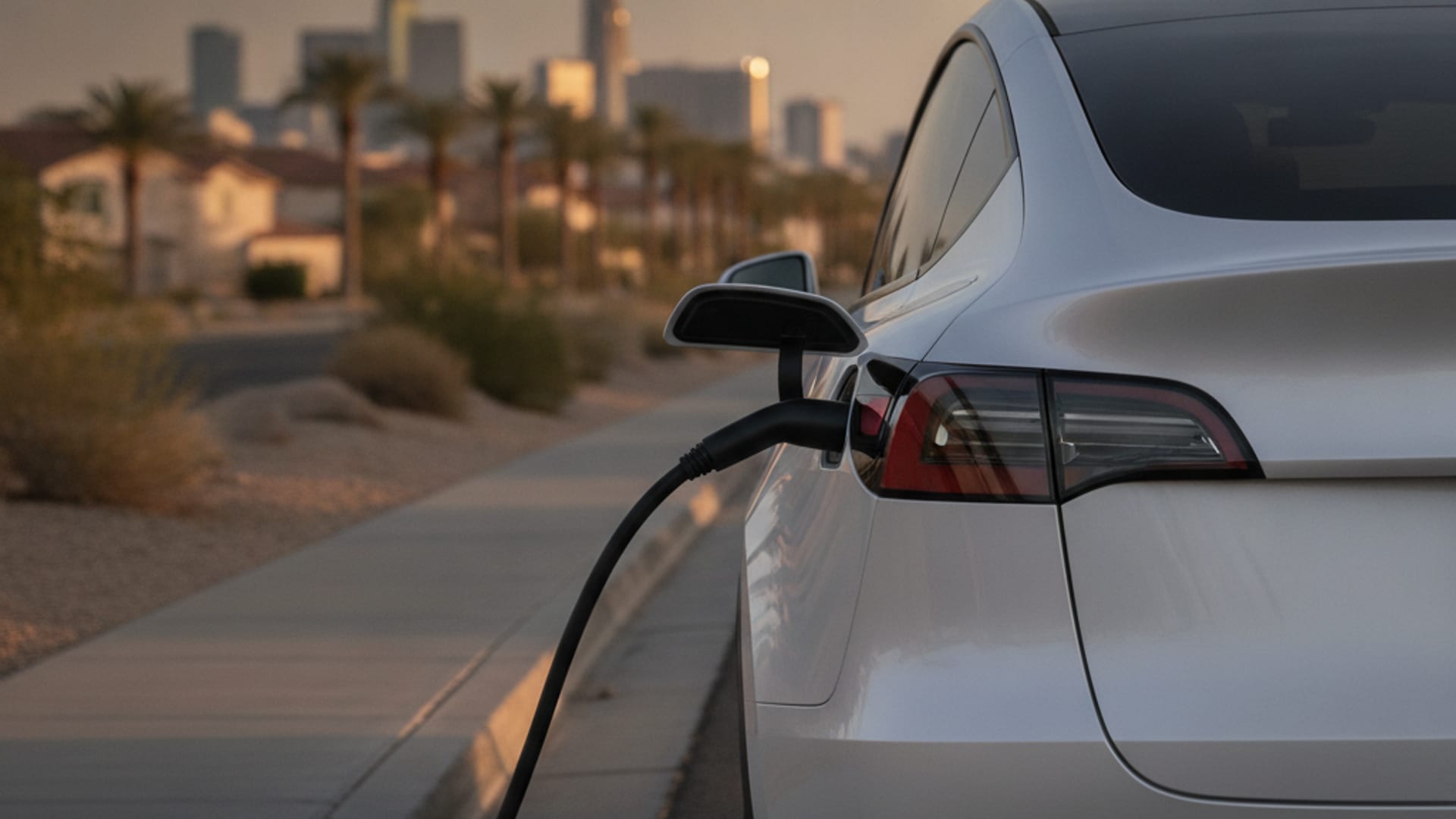
First, stay with the car
NRS 484B.440 lets a disabled vehicle stay when it cannot avoid stopping. The statute sets no time limit on how long it may remain. The driver does not have to abandon a car that will not move. Standing outside a stranded car on a freeway shoulder is more dangerous than sitting inside it.
Get as far right as you can. Set the parking brake. Turn on the hazard lights. If you have a reflective vest, put it on. Stay in the car with the seatbelt on if you are on a freeway shoulder. Exit away from traffic if you must get out, and stay on the high side of the car.
Call for help before you walk along the shoulder looking for a signal. The phone usually works in the valley. Use hands-free. Stay inside if traffic is moving past you at speed.
The NRS 484B.443 abandoned-vehicle statute is the one to know about the 24-hour freeway clock. A quick call keeps the car out of that window. The NDOT freeway page has the patrol hours and routes.
Nevada law on disabled vehicles and tow operators
NRS 484B.440 says a vehicle disabled so it cannot avoid stopping is exempt from the no-stopping-on-highway rule. The statute sets no time limit. A driver who cannot move the car may leave it where it stops while help is on the way.
NRS 484B.443 lets law enforcement remove a disabled or abandoned vehicle. A vehicle is treated as abandoned after 24 hours on freeways and primary highways, and 72 hours on other roads. The owner pays removal. The point is that a quick call to a mobile operator keeps the car out of that 24-hour window.
NRS 706 governs tow operators in Nevada. Operators need an NTA certificate. They must release a still-hooked vehicle at the original location for the operator’s set release fee. The driver can ask for the car back at the side of the road before it leaves. A non-consent tow is a regulated process, not a free hook.
A driver who calls a mobile operator instead of a hook avoids the tow in the first place. The operator brings a 240V Level 2 source and adds range. The driver drives off under their own power. No hook, no storage lot, no release fee.
What the NDOT Freeway Service Patrol covers
NDOT’s Freeway Service Patrol covers the most-traveled Las Vegas valley freeways. Quality Towing operates it, and GEICO sponsors it. The patrol runs 5:00am to 8:30pm seven days a week. It is free to motorists.
The patrol handles tire changes, jump starts, fuel, minor fire suppression, and traffic control. The patrol does not advertise EV charging in its published materials. A driver with a flat tire or a drained 12V gets the patrol. A driver with a dead traction pack needs a mobile operator who brings a Level 2 source.
The patrol clears about 31,500 incidents a year in Las Vegas, and about 55,000 statewide. That is the heaviest incident clearance operation in Nevada. It is also not an EV rescue service. Knowing which the patrol covers saves a wrong phone call.
The patrol is also a freeway service, not a surface-street service. A driver stuck on Maryland Parkway, on Boulder Highway, or in a Henderson neighborhood is not on the patrol’s route. A mobile operator is the right call for those streets.
What a mobile operator brings to that shoulder
A mobile operator carries a 240V Level 2 source and a native NACS plug for Teslas. A typical session adds 10 to 20 miles of range in 15 to 30 minutes of charging. That is charging time. It is not how long the operator takes to arrive.
Ten to twenty miles is enough to roll off the shoulder. It is enough to reach the next Supercharger, the next EA stall, the next ChargePoint site. It is enough to limp home if the home charger is there. The car drives away under its own power.
Charge Pro LV is a referral line. It matches stranded EV drivers with independent local mobile rescue operators. It performs no work, owns no trucks, and employs no technicians. It does not set prices or publish hours. The pros we connect you with are licensed and insured. The operator quotes you before starting and bills you directly.
The pros also carry CCS or J1772 adapters for non-Teslas. A Model 3 is a NACS plug. A Model Y is a NACS plug. A Model S and Model X are NACS. A Cybertruck is NACS. A Ford Lightning or a Rivian is CCS. A Mustang Mach-E is CCS. The adapter is on the truck.
The valley-specific routes where this happens
I-15 southbound past the Spaghetti Bowl is the longest run. A driver aiming for the California line who missed a charge stop at Primm rolls to a stop near the state line. Primm is the last public charger before the climb. Past that, it is a long shoulder until Baker.
I-15 northbound through North Las Vegas is the urban stretch. A driver who skipped a charge stop at the Mesquite rest area runs short before the Speedway interchange. The shoulder is wide. The traffic is heavy. Stay inside.
US-95 toward Indian Springs is the long empty run. A driver aiming for Tonopah or for the Test Site gate who misjudged the pack ends up on a shoulder with no nearby services. The shoulder is wide. The cell signal is thinner. Stay with the car and call for help.
CC-215 around the west valley is the loop. A driver who took the long way around from Summerlin to Henderson uses more range than the same trip on I-15. The shoulder exists but is shorter than the freeway shoulder.
Boulder Highway, Lake Mead Boulevard, and Tropicana Avenue are surface streets. None of them get the NDOT patrol. A mobile operator is the only rescue path on those streets. Out-of-charge EV recovery is the service page for those calls. Tesla roadside rescue covers the broader freeway-shoulder pattern.
The right order of operations
Pull as far right as possible. Set the parking brake. Turn on the hazards. Stay in the car with the seatbelt on. Call (702) 935-4699. Tell the operator the model, the connector, the location, and the direction of travel. Tell the operator whether the cabin is on or off.
If the car is off, leave it off. The 12V will drain if the cabin stays on. The traction pack is already at zero. The 12V is what keeps the hazards blinking. Save it.
If you can safely exit the car on the high side, do so. Stay on the high side, away from traffic. Do not stand in the travel lane or on the fog line. The patrol will not stop on a live freeway shoulder to swap a battery.
If the patrol shows up, ask whether they handle EV charging. NDOT’s published materials do not mention EV charging. The patrol will set up flares and call for a tow if needed. A mobile operator with a Level 2 source is the right tool for the dead-pack case.
For the broader picture, see out of charge on I-15 south to Primm, out of charge at the Primm state line, and EV roadside assistance.
For long-haul desert stops, see EV roadside help in Sandy Valley. For airport-lot stalling where Uber roadside may not help, see Uber roadside vs a mobile charge at Harry Reid.
Frequently asked questions
Can I leave my Tesla on a freeway shoulder in Nevada?
Yes, NRS 484B.440 lets a disabled vehicle stay when it cannot avoid stopping. The statute sets no time limit. A driver who cannot move the car may leave it at the shoulder while help is on the way. Law enforcement can remove a vehicle after 24 hours on a freeway under NRS 484B.443.
Will the NDOT Freeway Service Patrol charge my Tesla?
No, NDOT’s published Freeway Service Patrol materials do not mention EV charging. The patrol handles tire changes, jump starts, fuel, minor fire suppression, and traffic control. A mobile operator who brings a Level 2 source is the right call for a dead traction pack. The patrol can set up flares and call for help if it shows up first.
How many miles can a mobile operator add to my Tesla?
A typical mobile session adds 10 to 20 miles of range. That takes 15 to 30 minutes of charging. The number is charging time, not how long the operator takes to arrive. Ten to twenty miles is usually enough to reach the next public charger or to limp home.
Do I need to be in the car while the operator charges it?
No, you do not need to be in the car. The operator brings the cable to the charge port, opens it, and starts the session. Stay nearby on the high side of the shoulder. Do not stand in the travel lane. The operator will tell you when the session is done.
What if I have no cell signal on the shoulder?
A driver with no cell signal should stay with the car and keep the hazards on. The NDOT Freeway Service Patrol will drive past if it is on that freeway and the hours are right. A road service sign or a call box may also be within walking distance on parts of the shoulder. Do not walk on the freeway to find a signal.