A low pack at Lake Las Vegas is a return-trip problem. You left the valley floor and sat in Henderson heat. Then you asked the car for the miles back toward the Strip. EV roadside assistance in Lake Las Vegas means help at the bumper. That’s a mobile charge, or a 12V jump if the car won’t wake. Charge Pro LV connects you with independent local operators. They quote before any work starts. They bill you directly.
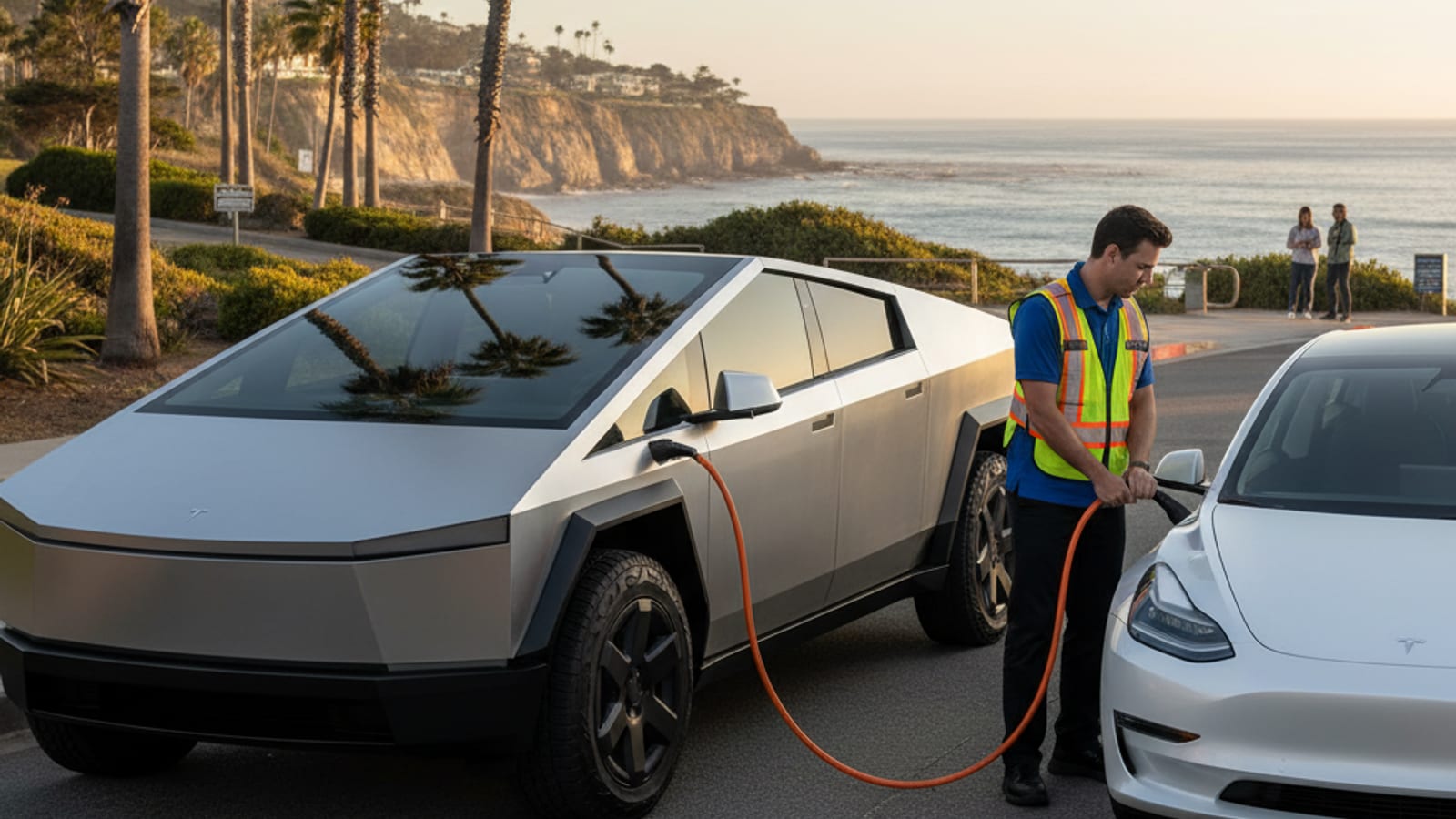
Lake Las Vegas is not its own Census place. This page won’t print a population. Those figures roll into Henderson. What you can pin down is the setting. The enclave sits on the east edge of Henderson, off Lake Mead Parkway, in ZIP 89011. It’s a resort and residential pocket. Visitors treat it like a short outing from Paradise or the Strip. On a July day, that outing spends range the dash still showed at breakfast.
The lake is a side trip, not the valley floor
Henderson sits at about 1,867 feet. The broader valley floor runs about 2,000 to 2,920 feet. You’re still on desert pavement. You’re still a real drive from the metro core. You’re not on Las Vegas Boulevard. You’re in a planned lake community on the Henderson shore. Resort lots and neighborhood streets don’t behave like a freeway shoulder.
Charge Pro LV serves the Las Vegas Valley, including this Henderson pocket. We don’t own trucks, a yard, or a warehouse. We don’t employ technicians. We don’t set prices. We don’t publish arrival times. We match stranded EV drivers with independent mobile rescue operators. The operator who takes the job quotes you first.
People run short here for ordinary reasons. They left a Strip garage with a “probably enough” percent. They ran cabin cooling all the way out Lake Mead Parkway. They circled for a gate. They sat through a meal while sentry features kept drawing. Then the car had to get back into the metro. That’s when the estimate on the dash stops matching the day you drove.
If you want the community page for this ZIP, use the Lake Las Vegas charging guide. For the parent city around it, EV roadside assistance in Henderson is the neighboring write-up. This post stays on the lake pocket. Dispatch runs longer than the valley core. A visitor day can end short of charge, with the city a real distance back.
Lake Mead National Recreation Area sits on the same east side of the valley. A resort lunch and an NPS shoreline stop can stack without looking like a road trip. If you also ran the Nevada shore, the pack you saved for home may already be spoken for. Treat that as extra miles. Don’t treat it as leftover miles.
You didn’t start in the City of Las Vegas
A lot of lake visitors slept in Paradise or Winchester. Those are unincorporated Clark County. The Strip is not inside the City of Las Vegas. Sphere is in that unincorporated core. Allegiant Stadium is in Paradise. You may have rolled out of a resort garage and through Henderson. Then you turned onto Lake Mead Parkway without entering city limits. The return still has to recross that same metro.
That geography matters because the car doesn’t care what you called the morning. It cares about heat, idle time, and the drive back. Harry Reid International Airport is also in Paradise. Whether airport parking has EV charging is not verified on the airport’s own site. This page doesn’t claim it.
Heat on the Henderson shore spends the range you counted on
NWS Las Vegas records at the airport tell you why a lake afternoon is hard on an EV. The average July high is 104.5F. About 78 days a year hit 100F or more. About 9.4 days hit 110F or more. The all-time record high is 120F, set on July 7, 2024. Annual rainfall is only 4.18 inches. Monsoon season is July and August. Flash flooding hits washes and underpasses. A stalled car in standing water is a tow problem, not a charge problem.
The east valley can run up to 11F hotter than the rim. The airport itself runs 5 to 15F warmer than outlying areas. Lake Las Vegas is an east-Henderson pocket. You’re not getting Summerlin’s higher, slightly milder rim. Summerlin sits about 3,500 feet. It rises toward 4,400 feet near Red Rock. This shore is lower and hotter. It’s farther from the west-valley neighborhoods people treat as home base.
Range studies put numbers on the heat, with attribution. Recurrent Auto found about 5% range loss at 90F and 17 to 18% at 100F. Air conditioning can draw 3 to 5 kW to cool a hot cabin. Holding an already-cool cabin is closer to 1 kW. AAA, in May 2026, measured 8.5% range loss at 95F. No Tesla-published range-loss figure turned up. This page won’t invent one.
That’s how a visitor “had enough this morning” and still stalls after dinner. The car wasn’t lying at 9 a.m. The cabin never cooled off. Accessories kept drawing. The return toward the Strip is where remaining range goes.
If you’re already stopped, don’t sit there guessing about public plugs. Charging inventory for Clark County could not be confirmed from a live NREL/AFDC station feed. Electrify America’s public roll-up is statewide, not a Lake Las Vegas list. This page won’t invent a stall count, a Supercharger name, or a mileage to the next plug. If the car won’t move, mobile EV charging at the bumper doesn’t depend on a stall you haven’t confirmed.
If the car is already stopped, treat it as disabled
Nevada law is clearer than a dashboard warning. Under NRS 484B.440, a disabled vehicle that can’t avoid stopping is exempt from the no-stopping-on-highway rule. The statute sets no time limit on how long it may remain. That doesn’t mean you should linger in a live lane. It means you’re not automatically in the wrong for being unable to roll.
NRS 484B.443 is the clock people forget. Law enforcement may remove a disabled or abandoned vehicle. On freeways and primary highways, a vehicle is treated as abandoned after 24 hours. On other roads, that window is 72 hours. The owner pays for removal. Don’t wait to learn which clock you’re on.
If you’re in a resort lot or a private drive, a different tow rule can apply. Private-property tows in Nevada require posted signs and a 48-hour warning sticker under NRS 706.4463 through 4479. Don’t assume a courtesy wait if signs are posted.
Tow operators need a Nevada Transportation Authority certificate. Non-consent tow rates are operator-filed tariffs under NAC 706.408. There’s no single statewide maximum on this site. No dollar figure belongs here. A still-hooked vehicle can be released at the original location for the operator’s set release fee. Confirm that fee with the tow company. Don’t guess it from a blog.
The NDOT Freeway Service Patrol covers the most-traveled Las Vegas Valley freeways. Quality Towing operates it, and GEICO sponsors it. Hours are 5:00am to 8:30pm, seven days a week. It’s free to motorists. The patrol handles tire changes, jump starts, fuel, minor fire suppression, and traffic control. It clears about 55,000 incidents a year statewide, and about 31,500 of those in Las Vegas. None of NDOT’s published FSP materials mention electric vehicles, EV charging, or EV-specific service. That’s an observed absence in the brochure. It isn’t a claim the patrol can’t help an EV. On a local Lake Las Vegas street, don’t wait on a freeway patrol built for I-15 and the beltway.
Nevada 511 and nvroads.com report closures, cameras, and road conditions. The Nevada State Police Highway Patrol dispatches rotation tows through Autura. The cell shortcode is *647. Southern Command is (702) 486-4100. Use those if you’re blocking a highway lane. Use a mobile charge if the car only needs energy to leave under its own power.
There’s no toll road anywhere in Nevada. I-15, I-215, US-93, US-95, and I-11 are free. That’s one less surprise on the drive back.
What the operators we send actually do at the car
When the high-voltage pack is the problem, a flatbed is the long way around. Many EVs shouldn’t be flat-towed. Some need a flatbed or dollies so the drive units don’t spin. Charging on site skips that argument. The car stays where it sits. Power comes to the port.
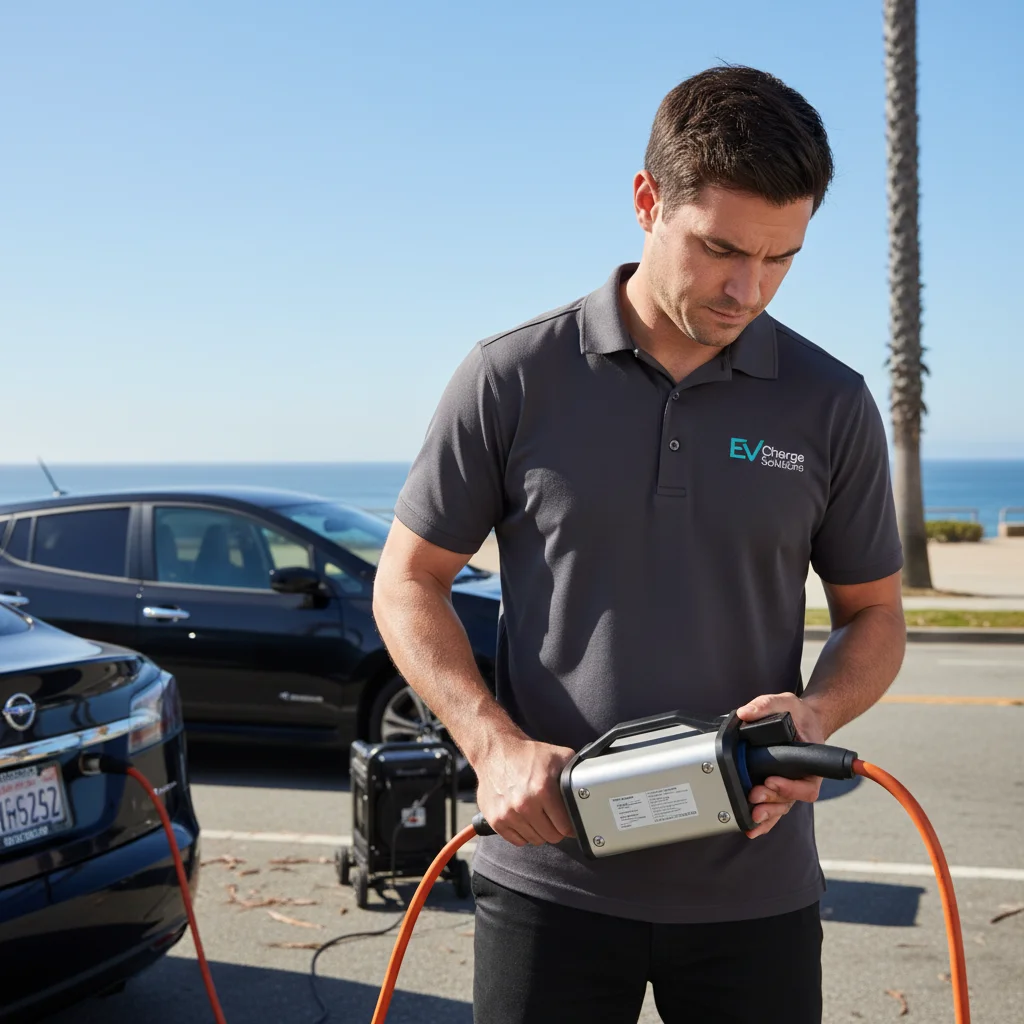
The operators in this network bring a 240V Level 2 source to the car. Tesla drivers get a native NACS plug. Other EVs get a CCS or J1772 adapter. That covers Tesla and every major EV brand on the road here. This is charging time, not a promise about when someone arrives. In 15 to 30 minutes of charging, the typical add is 10 to 20 miles of range. That’s usually enough to get off the enclave. From there you drive toward a place you already trust. That might be home, a hotel garage, or a public stall you confirm in your own app.
A mobile charge isn’t a full top-off. The point is enough energy to drive with the HVAC still running. Valley heat already taxed the battery. A short Level 2 session is how you leave.
Charge Pro LV doesn’t perform the work. The pros we connect you with are licensed and insured. We also don’t publish arrival windows. Lake Las Vegas is a longer dispatch than the valley core. Traffic on Lake Mead Parkway changes the wait. So does the number of operators already on jobs. The operator who accepts the call tells you what they can do. Then they quote before they start.
If you’ve stalled in this same pocket before, read how a mobile charge gets you home from Lake Las Vegas. It walks the get-moving version of this day.
Empty pack, or a 12V that won’t wake the car
A lot of dead-looking EVs at the lake aren’t empty. They sat in heat. The 12-volt battery gave up. The traction pack may still have tens of miles. The car just won’t unlock, wake, or close the contactors. Lights stay dark. The app looks lost. That’s a 12V job, not an out-of-charge job.
Every modern EV uses a small 12V battery to boot computers, pumps, and latches. Tesla does. So do Hyundai, Ford, Rivian, Chevy, and Mercedes. Heat is hard on that little battery. Cabin overheat protection, scheduled preconditioning, and sentry-style cameras all keep modules alive while you eat. After a long sit, the 12V is the part that quits first.
Geotab found hot-climate high-voltage packs degrade about 0.4% per year faster, with Phoenix-style desert heat as the worst case. That study is about the traction pack, not the 12V. The roadside lesson still holds. Desert heat is rough on every battery in the car.
Operators in this network can jump a dead 12V on site. They can replace one when that’s the right fix. If the dash showed a low traction-battery percent before it went dark, say that when you call. If you had plenty of indicated range and the car still went mute, say that too. The Tesla 12V battery jump path is for the wake-up failure. A Level 2 session is for a pack that’s actually empty. Mixing those up wastes a visit.
Don’t keep jumping the same 12V all summer and calling it solved. If it dies again after a jump, the battery is telling you it’s done. Replacement is a parts-and-labor question for the operator or a shop.
What to do while you wait, without making the stall worse
Stay out of live traffic. If you’re on Lake Mead Parkway and the car can still creep, get fully out of the lane before it dies. If it can’t move, hazards on, people away from the pavement. NRS 484B.440 covers a disabled stop. It doesn’t cover standing in a travel lane.
Tell the operator your exact setting. A resort lot, a residential street in 89011, and the parkway are three different jobs. Make, model, and what the screen is doing all help. Tesla uses NACS. Most other new EVs use CCS. Some older ones use J1772. You don’t need the adapter name. The operator will.
Nevada is an all-party consent state for telephone recordings under NRS 200.620 and NRS 200.650. The forwarding line plays a recording-consent notice. Stay on the line through that prompt.
Don’t have a friend flat-tow the car with a strap. Don’t treat a gas-car jump pack on the 12V posts as a charge for the traction battery. They’re different systems. AAA and insurer roadside plans may send a tow. They may not send a 240V source. Factory roadside is a separate policy from a local operator who bills you on site. For this stall, start with one fork. Either the car can take a Level 2 charge where it sits, or it needs a 12V wake-up first.
Neighboring Henderson miles that finish off a low pack
Lake Las Vegas doesn’t sit alone. Green Valley, Anthem, and Whitney Ranch / Inspirada are the Henderson communities people treat as almost there. “Almost” is not a charge. Railroad Pass and Boulder City sit farther along the lake-and-dam direction. Railroad Pass is about 2,360 feet. Hoover Dam’s crest is 1,232 feet. Boulder City sits about 2,510 feet. Those are verified elevations for the wider east-valley run. This page won’t invent a grade percent for Lake Mead Parkway.
I-11 and US-93 are the free roads toward the dam and Boulder City. If your next stop is Boulder City rather than a Henderson garage, the utility changes. Boulder City Utilities is a municipal electric utility, not NV Energy. It’s powered largely by Hoover and Glen Canyon hydro. NV Energy, Nevada Power Company, serves Henderson and the rest of the core valley. Don’t call the wrong utility about a home rate if you’re actually in Boulder City.
If your short lake day also tagged Lake Mead NRA, you’ve stacked two east-side outings. A Lake Mead day trip without enough charge to return is the same class of stall. Pick the page that matches the road you’re on. Don’t assume the next city will save a pack that’s already at the warning line.
Henderson landmarks on the way back are easy to over-trust. Galleria at Sunset is a real mall. Dignity Health St. Rose Dominican and Henderson Hospital are real campuses. Nevada State University is in Henderson. None of that is a promise of an open charger in the lot. Plan the car. Confirm a stall in an app while you still have moving range.
Once you’re rolling, NV Energy is the utility at home
If you live in 89011, or you’re staying with someone who does, the home utility is NV Energy. Nevada has no retail electric choice. Question 3 lost in 2018. NV Energy publishes a Residential Electric Vehicle Recharge Rider. That’s a time-of-use rate with an EV charging window from 10:01pm to 8:00am. There’s also a Residential Managed Charging Program, with a handbook revised July 29, 2026. NV Energy lists residential charging-station incentives and multifamily charging by name. The Lower Income EV Rebate closed June 30, 2023. This site doesn’t publish dollar amounts for any of those. Confirm current terms on nvenergy.com.
Nevada has no state EV purchase rebate or tax credit. That’s a confirmed absence. Nevada also has no EV-specific registration surcharge at the DMV. Clark County’s Title 30 code requires EV-ready wiring in new construction. A Level 2 home charger needs an electrical permit. Charge Pro LV doesn’t pull permits and doesn’t install wall units. We connect you with roadside rescue. Home charging is your utility, your electrician, and your building.
Overnight at a resort isn’t the same as a home EVSE. If you didn’t plug in, morning heat and cabin protection can take more percent than you budgeted. If the car won’t start at checkout, check the 12V first. Then ask for a mobile charge if the pack is actually low.
Frequently asked questions
What EVs can get help at Lake Las Vegas?
The operators we connect you with handle Tesla and every major EV brand. They bring a native NACS plug for Tesla. Non-Tesla cars use a CCS or J1772 adapter. If your dash still lights up, you’re usually looking at a Level 2 top-up of 10 to 20 miles. That’s in 15 to 30 minutes of charging. If the car is dark, start with the 12V.
Does a mobile charge replace a tow off Lake Mead Parkway?
Often it can, when the car will accept a charge and you only need enough range to leave. A tow is the right tool when the car can’t take power, a wheel is damaged, or a live lane has to be cleared. NTA-certified towers handle the hook. Confirm any release fee with that tower. Charge Pro LV doesn’t tow and doesn’t set tow tariffs.
What should I check before I call?
Say whether the car is on a local street, a resort lot, or the parkway. Note the indicated percent, or that the screen is dead. Mention a long hot sit, and whether you already tried the app. If you’re blocking a freeway lane, Highway Patrol at *647 comes first. For a quiet lot and a low pack, ask for a charge at the car.
A stalled EV at Lake Las Vegas is usually a hot side trip that spent the return. The pros we send can add range at the bumper, or wake a 12V so the car will move. Call (702) 935-4699 and we’ll connect you with an independent local operator who quotes before starting.