Your EV died on Lake Mead’s Nevada shore, and you need help at the car. Charge Pro LV connects stranded drivers with independent local mobile rescue operators. This is a long dispatch past Boulder City, not a city-lot hop. Thin park roads and the Railroad Pass return leave no casual turnaround.
The Nevada shore sits past Boulder City
The Nevada shore of Lake Mead is inside Lake Mead National Recreation Area. That’s an NPS site past Boulder City, on ZIP 89005 roads. You’re well past a resort garage once you’re on the shore. You’re on recreation-area pavement after a day at the water.
Hoover Dam sits at 1,232 feet on the Bureau of Reclamation crest. Boulder City sits near 2,510 feet above sea level. Railroad Pass sits near 2,360 feet on the way home. The Las Vegas Valley floor runs about 2,000 to 2,920 feet. That drop toward the dam spends range on the way in. The climb back spends range even when the map looks short.
A lot of drivers leave Henderson or the valley with a comfortable estimate. They add a Boulder City stop they didn’t plan. They walk the dam overlook and lose track of the clock. They run boat-ramp errands that weren’t in the morning plan. By late afternoon the pack is thinner than the morning plan. That’s a Lake Mead day-trip pattern, not a mystery failure.
Boulder City isn’t NV Energy territory, even though the valley is. Boulder City Utilities is the city’s own municipal electric utility. It’s powered largely by Hoover and Glen Canyon hydro. If you’re still in town, that matters for a home plug. Once you’re out on the shore, it doesn’t move the car for you.
Heat, cabin cooling, and hours at the water
NWS Las Vegas records an average July high of 104.5F. About 78 days a year reach 100F or more. About 9.4 days a year reach 110F or more. The official all-time high is 120F, set on 2024-07-07.
Recurrent Auto found about 5% range loss at 90F. Loss rose to 17 to 18% at 100F. Air conditioning drew 3 to 5 kW to cool a hot cabin. AAA, in May 2026, measured 8.5% range loss at 95F. Don’t treat those figures as Tesla numbers. Tesla didn’t publish a range-loss figure we could cite.
A lake day stacks that heat with extra drain. Climate control runs while you wait for a ramp. Accessories stay on while gear comes out of the cargo area. You might circle looking for shade that isn’t there. Cell coverage is thin on this Nevada shore. You may not notice the estimate falling until you’re already parked.
Monsoon months are July and August across the valley. Flash flooding hits washes and underpasses when a storm builds. A single storm can still close a park road. Check Nevada 511 and nvroads.com for closures and cameras.
Railroad Pass is the second trip
The water is the destination for most of these trips. The drive home is a second trip, not a cooldown. You climb back toward Boulder City after hours at the shore. Then you go through Railroad Pass toward Henderson and the rest of the valley. If the pack is already low, that grade is where the stall becomes real.
Drivers treat the last miles as a buffer for the shore. They forget the return still asks for energy. There’s no casual U-turn once you’re out here. An operator who takes this call is committing to a long run. Read the Railroad Pass empty-pack guide if you’re already on that climb.
Nevada doesn’t have toll roads, express lanes, or transponder systems. I-15, I-215, CC-215, US-93, US-95, and I-11 are all free. That keeps the route simple on paper, not in energy. It doesn’t flatten Railroad Pass, and it doesn’t shorten the dispatch.
Thin roads, thin signal, and sitting still
Park roads here run narrow, with tight places to wait. Boat traffic and day visitors share the same pavement. If the car stops, pull as far from the travel lane as you can. Turn on hazards if the 12V still has life.
Cell coverage is thin on the Nevada shore. A call may drop before you finish the pin. A map may not refresh when you need it. Don’t drain the phone hunting for a signal you don’t have. Send a location pin while you still can. Then stay with the car unless you’re in an unsafe spot.
NRS 484B.440 covers a vehicle that’s disabled and can’t avoid stopping. It’s exempt from the no-stopping-on-highway rule in that statute. The statute doesn’t set a time limit for how long it may remain. NRS 484B.443 still lets law enforcement remove a disabled or abandoned vehicle. On freeways and primary highways, a vehicle is treated as abandoned after 24 hours. On other roads, that window is 72 hours. The owner pays removal under that statute, not the dispatcher. This site doesn’t publish a dollar figure for that bill.
Nevada State Police Highway Patrol dispatches rotation tows through Autura. The cell shortcode is *647, and Southern Command is (702) 486-4100. Nevada 511 and nvroads.com stay up for conditions, closures, and cameras.
The NDOT Freeway Service Patrol covers the most-traveled Las Vegas Valley freeways. Quality Towing operates it, and GEICO sponsors it. Hours are 5:00am to 8:30pm, seven days a week. It offers tire changes, jump starts, fuel, minor fire suppression, and traffic control. It clears about 55,000 incidents a year statewide. None of NDOT’s published FSP materials mention electric vehicles. The patrol doesn’t advertise EV charging in those materials. Don’t wait on a valley freeway program if you’re sitting on a recreation-area road.
Empty pack or a dead 12V
Not every dead-looking EV is out of traction-battery energy. A hot sit can kill the 12V while the pack still holds range. The screens stay dark, and the doors may not wake. The car looks finished from the outside, even when it isn’t. A jump or a 12V replacement on site can bring it back.
An empty pack is a different failure from a dead 12V. The car may still boot and show a zero. It just won’t take you through Railroad Pass. That’s when you want energy delivered at the bumper.
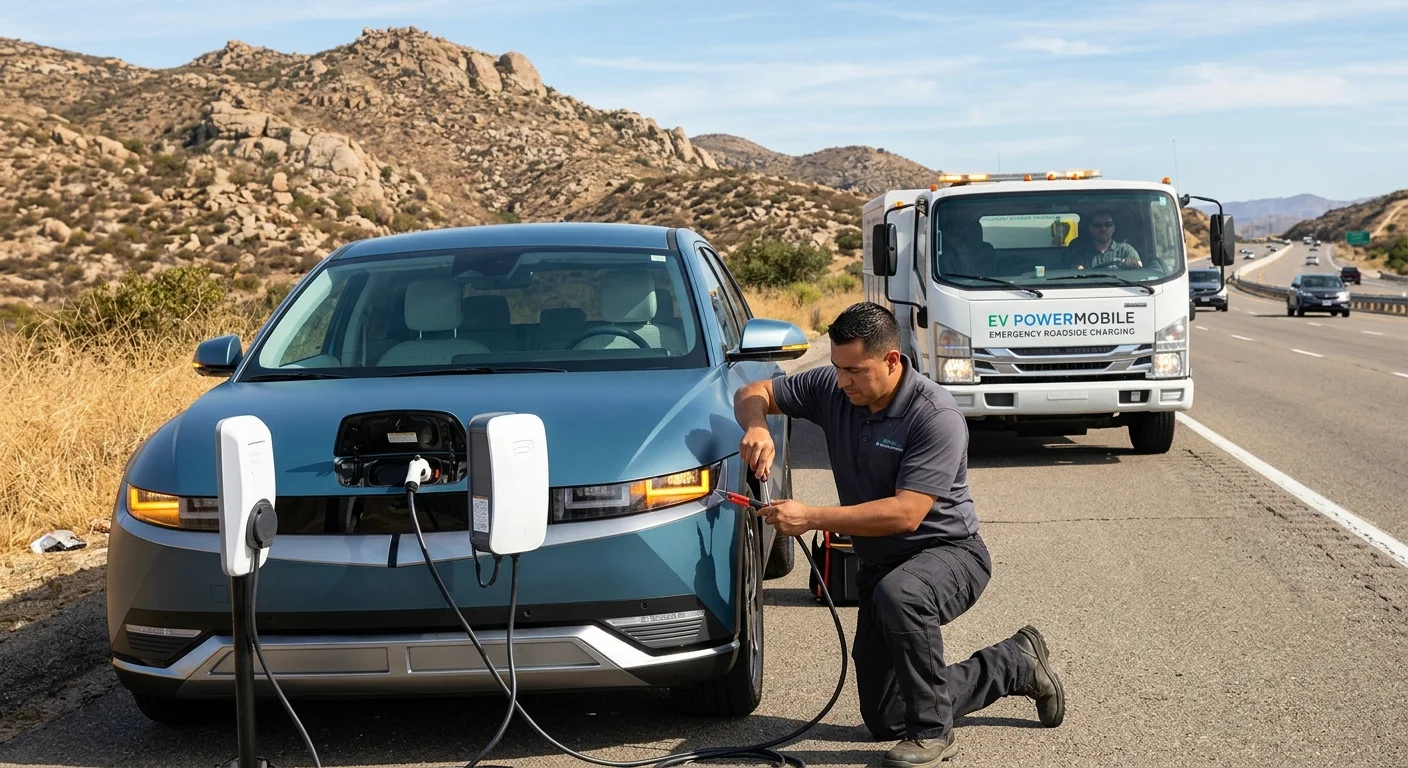
The operators Charge Pro LV connects you with handle both jobs. They bring a 240V Level 2 source to the car. Tesla drivers get a native NACS plug at the port. Other EVs use a CCS or J1772 adapter. They typically add 10 to 20 miles in 15 to 30 minutes of charging. That’s charging time, never an arrival time. They also jump or replace a dead 12V on site. They handle Tesla and every major EV brand.
EV roadside assistance is the call when you don’t know the failure yet. Mobile EV charging is the call when the pack is the problem. Out-of-charge recovery is the call when you’re at zero and still have to climb.
Charge Pro LV is a referral line, not a shop. It matches you with independent local operators for this dispatch. It performs no work and owns no trucks. It employs no technicians and sets no prices. It promises no arrival time and holds no licence. The operator quotes you before starting any work. The operator bills you directly, not through the referral line.
Charge at the car, or hook the car
A mobile charge keeps the car where it sits. You add enough range to drive toward Boulder City or onward through Railroad Pass.
A tow is a different job with different rules. Tow operators in Nevada need a Nevada Transportation Authority certificate. That’s NRS 706.4463, 706.4467, 706.4469, 706.4477, and 706.4479. Non-consent tow rates fall under NAC 706.408 as flat-rate, operator-filed tariffs. There’s no single statewide maximum in that code. This site doesn’t publish a tow rate for that reason. The Authority doesn’t post one number for every truck.
A still-hooked vehicle must be released at the original location. That release is for the operator’s set release fee. Confirm the current fee with the tower before you authorize the hook. Don’t guess a number from a forum post.
Towing a car with no 12V adds extra steps. The car may not roll into gear the way a gas car does. A mobile charge or a 12V wake can avoid that mess. If you do tow, you’re still choosing a destination after the hook. This page doesn’t guess where you’ll plug in after that.
What to do before you call
Stay with the car if the spot is safe. Keep hazards on if the 12V allows it. Save phone power for the dispatch, not for a dead map refresh. Note landmarks the operator can use from your seat. Name the dam side or the Boulder City approach if that’s what you see. Read a ramp name off a sign in front of you.
If the car still rolls, move it farther off the travel lane. Don’t try a long limp on a wish and a downhill. Railroad Pass isn’t a limp you can bluff. It’s a climb back toward the valley.
If screens are dark, treat it as a 12V problem until proven otherwise. If the car is awake and range is gone, treat it as an empty pack. Either way, the operator quotes on site before work starts.
How to get an operator on this shore
This isn’t a Strip-lot dispatch, and it isn’t a Henderson grocery-run stall. Tell the operator you’re on the Nevada shore of Lake Mead, past Boulder City. Mention Railroad Pass if that’s the return you still have to make. Mention thin cell if your call keeps dropping.
We’ll connect you with a local operator who quotes you before starting. Call (702) 935-4699 when you’re ready to do that.