EV roadside assistance in Paradise starts with the 12-volt battery. Harry Reid lots and resort garages hold cars for days. Owners are inside the property or already on a flight. Valley heat then drains the small battery that runs locks and computers. Charge Pro LV connects you with a local operator. That operator can jump the 12V at the stall. They can also add a Level 2 charge where the car sits.
The Strip and the airport are in Paradise
Paradise is unincorporated Clark County. It isn’t inside the City of Las Vegas. Harry Reid International Airport sits here. The Strip sits here too. So does Allegiant Stadium. About 186,178 people live in this census place, per ACS 2019-2023. Local ZIPs include 89109, 89119, 89120, 89121, 89123, and 89169.
A stall people call Las Vegas often isn’t in the city. You may be in a Terminal 1 deck or a Long Term row. You may be in a resort self-park stack. Many drivers picture a flatbed off Las Vegas Boulevard. That’s the wrong first move when the car won’t wake.
Winchester sits next along this corridor. Downtown Las Vegas is farther in than a Strip walk feels.
Heat plus a long sit is the usual stall
KLAS records show why parked EVs fail here. The average July high is 104.5F. About 78 days a year reach 100F or more. About 9.4 days reach 110F or more. The all-time record high is 120F, set on July 7, 2024. The airport runs 5 to 15F warmer than outlying parts of the valley.
An EV in Economy or Remote Lot parking can sit through all of that. A resort valet can hold a car through a multi-day stay. Cabin modules and connected apps still draw on the 12-volt pack. After enough idle hours, the locks fail. Screens stay black.
A Tesla left three days with a dead 12V won’t wake. Other brands fail the same way after a long, hot sit. The high-voltage pack can still hold miles. The small battery is what’s empty.
If you’re in airport parking, start with Tesla dead in Harry Reid long-term parking. If you’re in a hotel garage, read dead in a Paradise resort lot.
Event nights add the same idle clock. Allegiant Stadium holds Raiders and UNLV crowds. The car sits in heat while you’re inside. That isn’t a story about missing plugs. It’s a story about a 12V that ran down in the stall.
Tell a dead 12V from an empty pack
From the curb they look alike. They aren’t the same job.
Turtle mode and a range warning point to a low traction pack. A car that still unlocks is usually in that camp. You may have a short reserve after the gauge hits zero. That’s a charge job. A car that won’t unlock points to the 12V. Some models won’t open the charge door. Some won’t shift to neutral.
Don’t treat a silent EV as a simple tow. A car that can’t go into neutral is a drivetrain risk on a hook. A 12V jump is the smaller first step. What happens when an EV’s 12-volt battery dies walks through the signs. For Teslas, Tesla 12V battery jump is the matching service.
A low pack and a dead 12V can both be true. Days in 100F heat can empty both. The operator checks the small battery first. Then they see whether the pack can take a 240-volt charge.
Harry Reid parking: use the airport’s own lot names
Call the facility what the airport calls it. The airport’s own names are Terminal 1 and Terminal 3. They also use Short Term, Long Term, and Economy. Remote Lot, Cell Phone Lot, and Reservation Parking round out the list. Airport parking offers battery jump starts and tire inflation at (702) 261-5122. That’s the lot’s published jump line. Use it if you’re in those facilities.
If that jump doesn’t wake the EV, you still need an EV-aware operator. The airport site doesn’t publish EV charging as a confirmed amenity. This page won’t repeat third-party charger maps as fact. Don’t plan around a plug you can’t confirm. Plan around the car where it sits.
The Cell Phone Lot is a short wait by design. Long Term and Economy are multi-day sits. Those decks are where a 12V dies. Have the row letter and number before you call.
Resort self-park and valet along Las Vegas Boulevard
Self-park is a level and a stall number. Valet is a ticket and a stack you may not walk into. Have both ready when you call. Bring the property name. Stay near the car if the garage is gated.
The move people want is a flatbed on Las Vegas Boulevard. A car that won’t roll still needs the 12V awake first. If the pack is empty, the charge happens in the stall. If the pack is fine, the jump happens in the stall.
Private-property tows follow Nevada statute. Tow operators need a Nevada Transportation Authority certificate under NRS 706.4463. Private-property tows need posted signs and a 48-hour warning sticker in covered cases. The owner pays removal if the vehicle is taken. Confirm the posted rules on that garage wall.
NRS 484B.440 covers a vehicle that can’t avoid stopping on a highway. NRS 484B.443 lets law enforcement remove a disabled or abandoned vehicle. A vehicle is treated as abandoned after 24 hours on freeways and primary highways. On other roads the mark is 72 hours.
If you stall on the approach roads
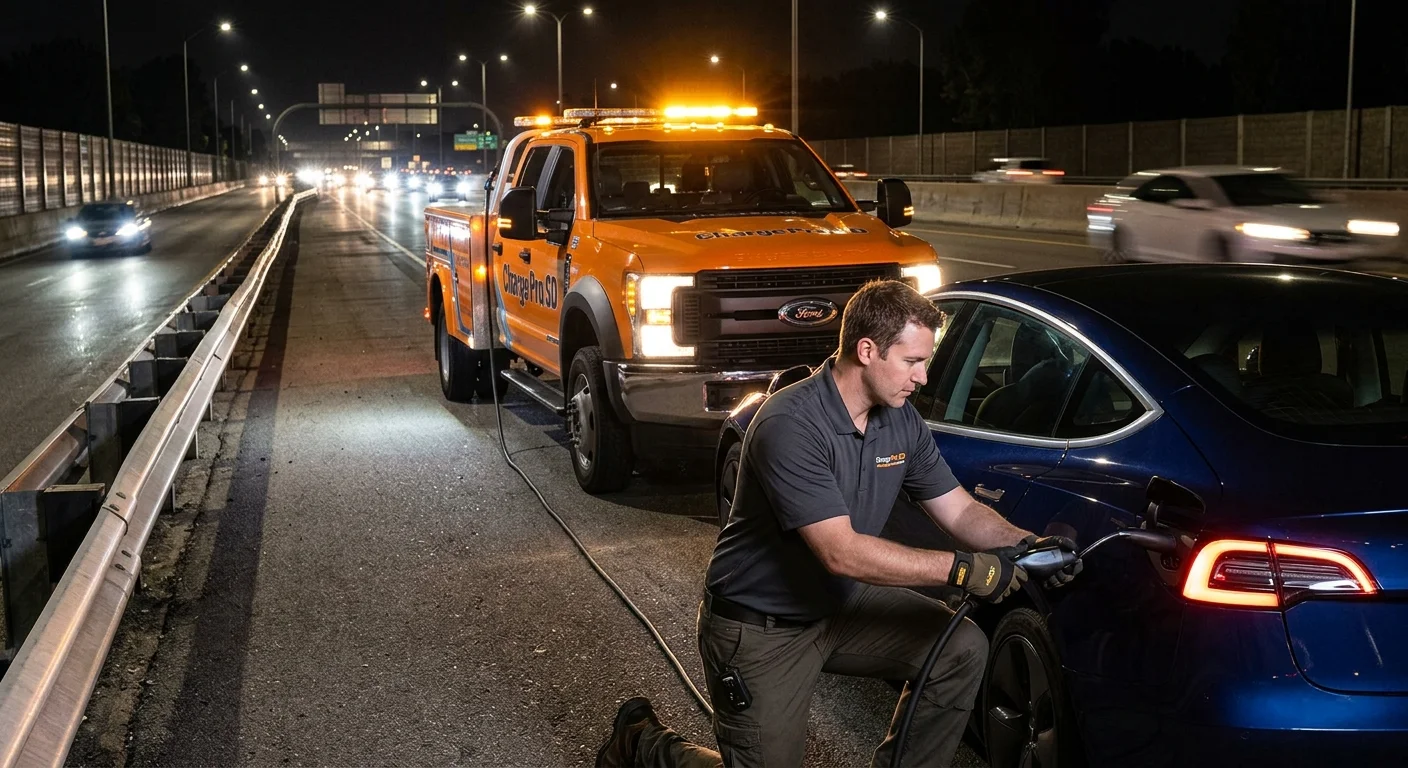
Coast to a shoulder if you’re still moving. Turn hazards on if they still work. Stay belted inside on a freeway. Don’t push an EV. The pack makes these cars too heavy for a safe shove.
Call 911 if you’re blocking I-15, I-215, or a Boulevard lane. You want the scene controlled before anyone works on the car.
NDOT’s Freeway Service Patrol covers busy valley freeways from 5:00am to 8:30pm. It runs seven days a week. It offers tire changes, jump starts, fuel, and traffic control. None of NDOT’s published patrol materials mention EV charging. Treat that truck as scene help. Don’t treat it as an advertised mobile Level 2 source.
What a Paradise operator does at the stall
Charge Pro LV is a referral line for the Las Vegas Valley. It matches stranded EV drivers with independent local operators. It performs no work and owns no trucks. It employs no technicians and sets no prices. It promises no arrival time and holds no license.
You leave a location, make, model, and callback number. The line matches that to an operator covering Paradise. The operator quotes you before any work starts. They bill you directly.
The pros we connect you with jump or replace a dead 12V on site. They can also bring a 240-volt Level 2 source to the car. Teslas take a native NACS plug. Other EVs use a CCS or J1772 adapter. A Level 2 session typically adds 10 to 20 miles of range. That takes 15 to 30 minutes of charging. That’s charging time, never an arrival time.
The goal isn’t a full pack in the garage. It’s enough range to leave Harry Reid or the resort stack. Then you drive to a charger you choose. EV roadside assistance is the umbrella. Out-of-charge recovery is the empty-pack path. Local notes live on the Paradise EV page.
Check the pack before you roll onto I-15
A jumped 12V can hide a low traction pack. Recurrent Auto found about 5% range loss at 90F. It found 17 to 18% loss at 100F. Air conditioning can draw 3 to 5 kW to cool a hot cabin. Don’t treat those numbers as Tesla’s. No Tesla-published range-loss figure turned up.
If the 12V dies again the next morning, stop jumping it. That’s a replacement conversation, not another jump.
When this is the call to make
Call when the car won’t unlock in Long Term parking. Call when valet brings back a silent EV. Call when turtle mode leaves you stuck in self-park. Call before a property starts a tow you didn’t ask for.
Charge Pro LV serves Paradise and the rest of the Las Vegas Valley. Call (702) 935-4699. The operator quotes the work before they start.