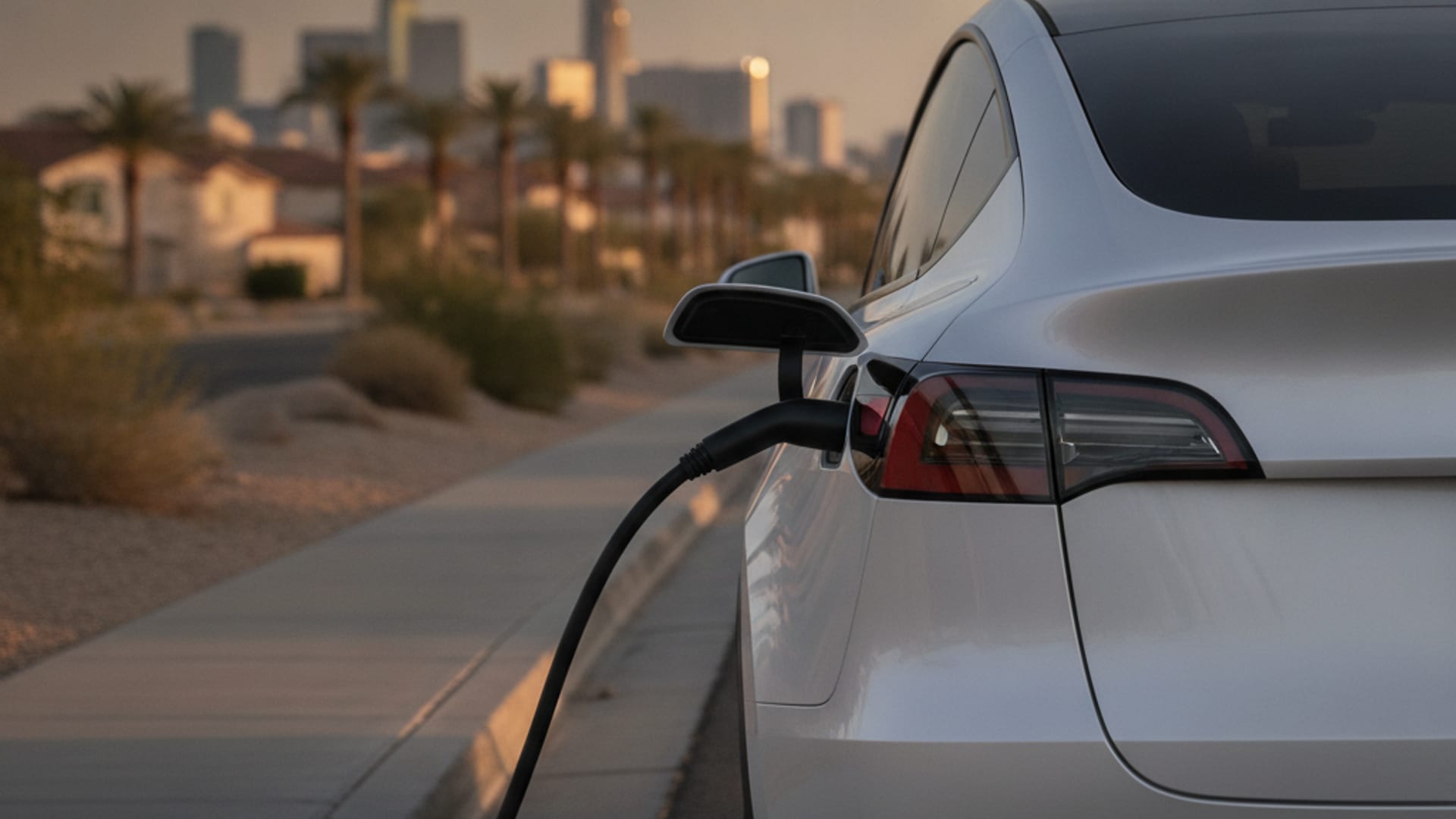
Your Prologue sat three weeks in a Sun City Aliante garage while you were out of state. You walk out with the key fob, pull the handle, and nothing. The screens stay black. The traction pack still shows a usable state of charge on the app, but the car will not wake up. A Prologue that won’t start after a long valley park is almost always the 12V, and a mobile jump or on-site 12V swap is usually the right fix before a flatbed.
Why the Prologue’s 12V goes flat first
The Prologue is a General Motors Ultium vehicle wearing Honda badging. The traction pack is the big battery that drives the wheels. A separate 12V auxiliary battery powers the modules that close the high-voltage contactors. Without that 12V wake-up, the traction pack cannot connect to the car. The big pack can sit at 80 percent, and the Prologue still will not move.
Heat is what drains a parked 12V in this valley. NWS Las Vegas puts the average July high at 104.5F, with about 78 days a year at or above 100F and about 9.4 days at or above 110F. The official all-time record is 120F, set on July 7, 2024. Lead-acid chemistry ages fastest at high temperature, and the 12V sits under the hood or in the cabin with no airflow. A week of 100F overnights will push a marginal 12V below the wake threshold.
The 12V also feeds parasitic draw. The keyless entry, alarm, telematics module, and the body control module all stay awake in tiny ways. NV Energy territory covers the Las Vegas Valley, so a Prologue parked outside an Enterprise home with no Level 2 charger is also running the HVAC timer in some trims. None of that wakes the car if the 12V is below about 8 volts.
What the dead 12V looks like from the driver’s seat
A flat 12V mimics a dead traction pack. You press the start button and nothing happens. The dashboard is dark. The center screen is black. The key fob does not unlock the doors, or it locks once and refuses to release. The phone app says the car is online but shows no door state change, or it shows offline entirely. These are 12V symptoms, not traction pack symptoms.
A real traction pack fault usually throws a check-engine or a propulsion error message. The screens light up, then warn you. If the screens never wake, the 12V is the prime suspect. That distinction decides what kind of help you call: a jump start versus a flatbed tow.
You can confirm with one reading if you have a multimeter. A healthy resting 12V reads 12.4 to 12.7 volts. Below about 11.8 volts, the modules cannot run. Below about 10 volts, the pack will not close its contactors at all.
What the operator brings to a no-start Prologue
Charge Pro LV is a referral line. It matches stranded drivers with independent local mobile EV rescue operators. It performs no work, owns no trucks, and employs no technicians. The operator quotes you before starting and bills you directly. The pros we connect you with are licensed and insured.
For a 12V no-start, the operator brings a lithium jump pack rated for 12V automotive use. That pack clamps onto the under-hood jump points. The Prologue wakes, the contactors close, and the traction pack takes over. From that point, the car’s own DC-DC converter recharges the 12V while you drive. A typical 12V jump takes minutes, not an hour. The car usually starts, then drives away.
Some 12Vs will not take a jump. They are sulfated, drained below recovery, or simply old. A dead 12V that won’t hold a charge is a different job: an on-site 12V swap. Operators carry common 12V group sizes for the Prologue and similar Ultium vehicles. They pull the old battery, seat the new one, and re-sync the battery management module. The traction pack never has to leave the car.
If the operator finds the traction pack actually empty when the car wakes up, that becomes mobile EV charging instead. A Level 2 source delivers 10 to 20 miles of range in 15 to 30 minutes of charging time. That is enough to clear the garage, reach a working stall, or get home. The 12V and the empty pack are different fixes, and the operator picks based on what the car shows when it wakes.
The Prologue 12V in the valley, season by season
A Prologue parked at a Summerlin home or a Boulder City driveway has a milder life than one in Winchester or Sunrise Manor. The east valley and downtown run up to 11F hotter than the rim during the urban heat island effect. Henderson sits near 1,867 feet. Summerlin sits near 3,500 feet and climbs toward 4,400 near Red Rock. Higher elevation means cooler nights and a faster 12V recovery between drives.
Summer is the worst season, but valley winters also punish a parked 12V. NWS Las Vegas puts the average January low at 37F with about 10 freeze nights a year. A lead-acid 12V loses a chunk of its cranking amps at freezing temperatures. A 12V that limped through August can refuse to wake in December.
The best protection is also the simplest: drive the Prologue at least once a week for 20 minutes. A short trip is enough to top up the 12V. A trickle charger that mounts through the 12V posts is the next step for any car that sits more than two weeks. Both are cheaper than a mobile call.
When the Prologue is parked somewhere a flatbed cannot reach
A flatbed is the wrong tool for a 12V problem. The Prologue can drive away once it wakes. That matters when the no-start happens inside a parking structure, behind a locked gate, or in a tight Sun City garage. A flatbed needs ramp clearance. A jump pack just needs space to open a hood.
For a Prologue parked at a Convention Center lot, behind a Town Square garage gate, or in a Sun City Anthem driveway, a mobile operator is usually the faster answer. They show up with the right jump pack, the right 12V group size, and a way to read what the wake-up looks like. They can also tell whether the 12V is worth saving or needs a swap in place. That decision does not need a tow truck.
NDOT’s Freeway Service Patrol covers the busiest Las Vegas Valley freeways. Hours are 5:00am to 8:30pm, seven days a week. Quality Towing operates it, and GEICO sponsors it. The patrol does not advertise EV charging, and an apartment garage is not a freeway shoulder. The patrol will not appear in a parking structure. For 12V help off the freeway, a mobile operator is the path.
When the right answer is a flatbed instead
A flatbed is the right call when the traction pack itself has thrown a critical error, when the car shows a high-voltage isolation fault, or when the 12V is good but the modules still will not wake. The Nevada tow law under NRS 706 requires an NTA-certified operator, and a still-hooked vehicle can be released at the original location for the operator’s set release fee. Tesla roadside rescue operators and non-Tesla EV rescue operators in the valley know how to load an Ultium vehicle properly.
For Prologues and other Ultium SUVs, all four wheels need to come off the pavement on a flatbed. A two-wheel tow with the rear on the ground can light up the traction pack error and leave you with a much bigger repair. Make the flatbed the choice when the job is moving, not waking.
A no-start Prologue in the Las Vegas Valley is more often a 12V problem than a traction pack problem. Try the wake first, then call (702) 935-4699. We connect you with an independent operator who quotes the job before starting. Tell them whether the screens ever light up. That answer decides jump versus tow.
Frequently asked questions
How do I tell if the Prologue 12V is dead versus an empty pack?
If the screens never light up, the fob won’t unlock the doors, and the phone app shows the car as offline or stuck, the 12V is almost always the fault. An empty traction pack usually leaves the dash lit with a low state-of-charge warning before the car refuses to move.
Can a Honda Prologue be jump started like a regular car?
Yes, but only through the under-hood jump points, not the traction pack studs. A standard 12V lithium jump pack or a donor 12V battery wired to those posts will wake the modules. Never connect a charger to the high-voltage orange cables.
Will the new 12V need to be programmed at the dealer?
A 12V swap on the Prologue usually needs a battery management reset, not a dealer tool. A mobile operator can run the relearn through the car’s own diagnostic menu after the new battery is seated. A dealer visit is only needed if the battery management module has stored a permanent fault.
How long does a 12V last in valley heat?
Most Ultium 12V batteries last two to four years in the Las Vegas Valley. Heat, short trips, and long parked stretches all shorten that. A trickle charger or a weekly drive is the cheapest way to add a season.