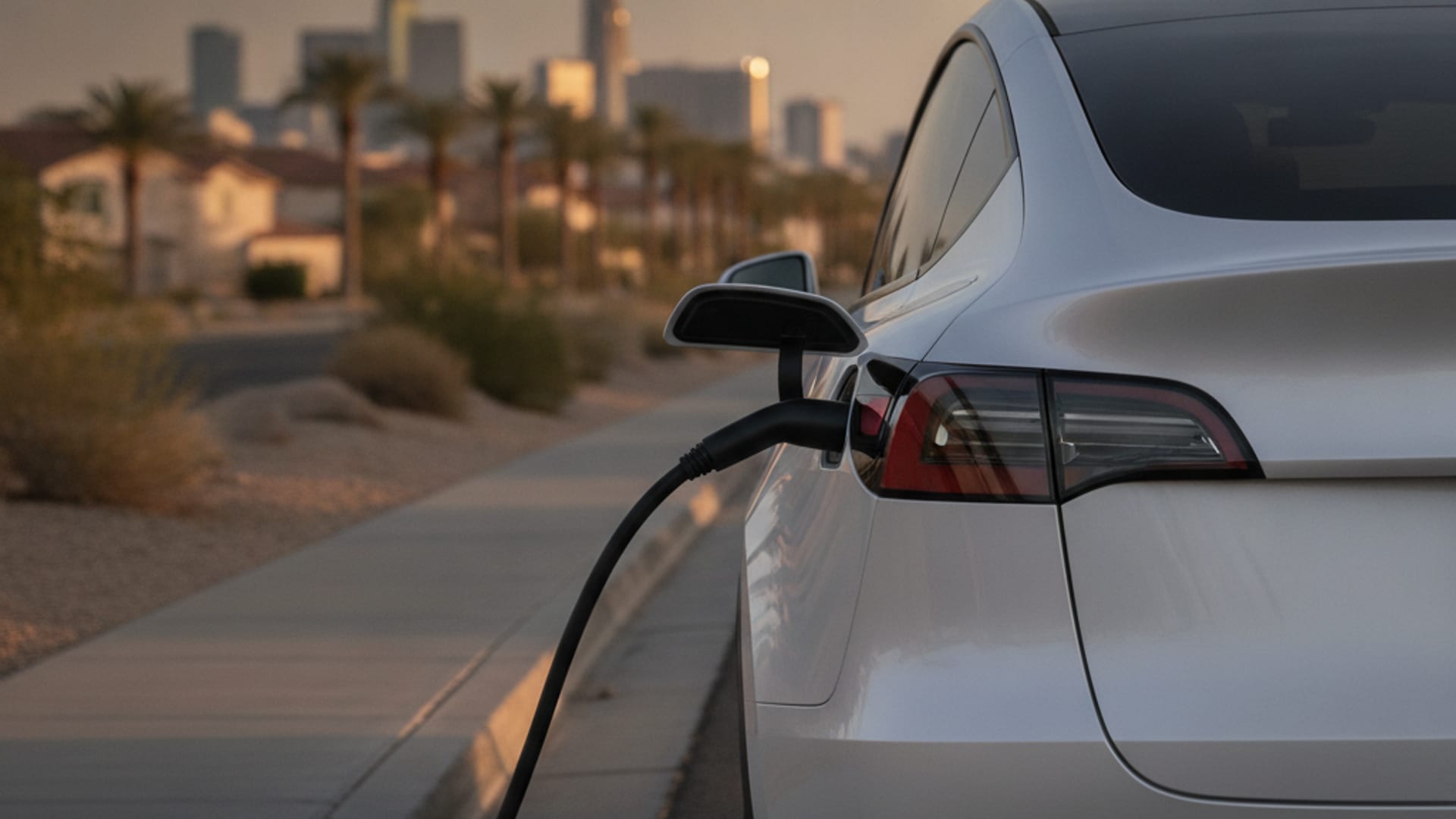
You pulled out of a Boulder City driveway at 90 percent and the dash said 312 miles. Three hours later, in 105F heat on the I-15 near the Spaghetti Bowl, the same car says 184 miles and the cabin is running cool. The same car, the same car, the same daily charge, and the real-world range walked out the door. A Tesla charge lasts shorter in the Las Vegas Valley than the sticker claims, and the gap is heat, not the pack.
What the EPA window actually measures
The EPA range on a Tesla window sticker is a multi-cycle lab test. It blends city and highway runs, mild temperatures, and a controlled climate. The numbers come out looking like a Model 3 Long Range at about 341 miles or a Model Y Long Range at about 330 miles. None of those numbers were measured at 104.5F with the AC blasting for an hour before the test driver walked in.
That does not make the EPA number wrong. It makes the EPA number a yardstick, not a valley promise. Treat the sticker as the maximum the pack can deliver under ideal conditions. Treat every other number as a discount on that, and the size of the discount depends on heat, speed, and accessories.
NV Energy territory covers the Las Vegas Valley. The utility publishes a Residential Electric Vehicle Recharge Rider (REVRR) time-of-use rate with a charging window of 10:01pm to 8:00am. That is the right time to fill the pack. The number of miles you keep from that overnight charge is what this post is about.
Heat takes range before you turn a wheel
NWS Las Vegas puts the average July high at 104.5F. About 78 days a year reach 100F or more. About 9.4 days reach 110F or more. The all-time record is 120F, set on July 7, 2024. The Las Vegas airport weather station runs 5 to 15F warmer than outlying areas, and the east valley and downtown can run up to 11F hotter than the rim. A Tesla parked at the airport for a week cooks harder than the same car parked at a Centennial Hills driveway.
Recurrent Auto put numbers on what heat does to an EV pack. About 5 percent range loss at 90F. That rises to 17 to 18 percent at 100F. AAA, in May 2026, measured 8.5 percent range loss at 95F. The range hit is not just from cooling the cabin. The pack itself is less efficient at higher temperatures. Heat pumps and resistive heaters both draw extra power to manage cabin and pack temperature.
Tesla has not published a single hot-weather range-loss number we could verify. The company publishes a Range Assurance feature, an estimated consumption curve, and trip-planner behavior. None of those is a citable claim about how many miles disappear at 105F. The third-party studies above are the better reference.
Cabin cooling is the bigger thief. Recurrent Auto found AC drawing 3 to 5 kW to cool a hot cabin, versus about 1 kW to hold a temperature once it’s there. A Model Y that has been sitting in a Strip hotel garage all afternoon can burn 1 to 2 kWh just bringing the cabin down to 72F. That is 4 to 8 miles of range spent before the first turn signal.
What “how long does a Tesla charge last” really means
Most valley drivers ask the wrong question. The right question is not how long a charge lasts in clock time. A 100 percent overnight REVRR charge will sit at 100 percent until you unplug. The question is how many miles the energy in the pack can deliver today, on valley roads, in valley heat, with valley speeds.
A Model 3 Standard Range Plus, with a 60 kWh pack and about 220 miles of EPA range, will lose roughly 35 to 50 miles of that in 100F days with steady AC use. A Model Y Long Range, with about 75 kWh and 330 EPA miles, will lose closer to 50 to 70 miles. A Cybertruck, with a 123 kWh pack, will lose 60 to 100 miles. None of those are Tesla’s published numbers. They are third-party studies plus valley experience.
Cold weather cuts range the other way. Recurrent Auto found about 70 percent of maximum range retained at 20F and 78 percent at 32F. AAA, in May 2026, measured 39 percent range loss at 20F. Cold also extends the time the cabin takes to reach temperature, which is why winter mornings see longer preheat cycles. The valley’s winter is mild by national standards. Average January low is 37F with about 10 freeze nights. Winter range loss in Las Vegas is real but smaller than the summer hit.
Speed, grade, and wind all stack on top of temperature. A 75 mph cruise on US-93 toward Mesquite, with AC running and a headwind, can pull 20 to 30 percent more energy per mile than a 55 mph run through town. The grade up to Railroad Pass, near 2,360 feet, will eat more energy going up than the same distance on flat ground.
Day shapes that change the answer
A daily Henderson commute with mixed surface streets uses about 15 to 25 percent of a full charge on a normal 100F day. Add a Strip errand and a school pickup, and you can climb to 35 percent. A round trip to Primm at highway speeds, with casino parking and a return trip into the urban heat island, will use 50 to 70 percent of a full charge on a Model Y.
Day shapes also change how much you should keep in reserve. A driver who plans around a home Level 2 charger can roll into a driveway at 10 percent and plug in. A driver who relies on a workplace stall or a public post needs a 20 percent cushion to handle a stall outage. The cushion matters more in heat, because the car’s own thermal management draws energy even when it sits.
The right planning tool is the car’s built-in energy app. Set the destination, let the car predict arrival state of charge, and assume the prediction is optimistic by 10 to 15 percent on a 100F day. That buffer is what catches a heat wave.
What to plan around on the worst days
On the worst valley days, the answer to “how long does a Tesla charge last” gets shorter. A 110F day with a cabin precool cycle, a 75 mph highway stretch, and a return trip into downtown can eat 60 percent of a full charge on a mid-size Tesla. A driver who usually plans a 200-mile daily loop on a single overnight charge may need a midday top-up to make it.
Two habits make that easier. First, precondition the cabin while still plugged in. NV Energy’s REVRR window handles the cost. The car pulls the energy from the wall, not from the pack. Second, plan the errands in a loop with a known charger at the center, instead of a long out-and-back.
When the plan still falls short, mobile EV charging is the on-site answer. An operator brings a 240V Level 2 source to the parking stall and adds 10 to 20 miles of range in 15 to 30 minutes of charging time. That is enough to clear a hotel garage, reach a working stall, or get home. EV roadside assistance covers the same coverage map.
A Tesla charge in the Las Vegas Valley lasts longer than the EPA window would suggest if you precondition, drive a steady 55 mph, and avoid peak cabin heat. It lasts shorter than the window if you take a Model Y on a Primm run at 75 mph in 110F air. Plan around the day, not the sticker. When the day outruns the plan, call (702) 935-4699. We connect you with an independent operator who quotes the job before starting.
Frequently asked questions
Does heat really shorten a Tesla charge that much?
Yes. Recurrent Auto measured about 5 percent range loss at 90F and 17 to 18 percent at 100F, with cabin cooling drawing 3 to 5 kW. AAA measured 8.5 percent loss at 95F in May 2026. Those numbers are the third-party benchmark for what heat does.
Should I keep my Tesla at a higher state of charge in summer?
Storing the pack at 100 percent in 100F heat adds wear. Storing it at 80 percent is the recommended long-term balance for a daily driver. For trips, charge to 90 or 100 percent and use the buffer in the first hour of driving. Tesla’s own guidance favors that pattern in any temperature above 70F.
Does cold weather also reduce range?
Cold does. Recurrent Auto found about 70 percent of maximum range retained at 20F. AAA measured 39 percent range loss at 20F. Valley winters are milder, with an average January low of 37F and about 10 freeze nights a year. The valley’s winter range hit is real but smaller than summer’s.
Does driving faster really matter that much?
Yes. Air drag scales with the square of speed, so 75 mph costs roughly 45 percent more energy per mile than 55 mph. On a Primm or Mesquite run, the highway speed is the second-biggest range factor after the cabin AC.