A Model Y sat nine days in Harry Reid long-term parking while you were in Florida. You land at Terminal 3, walk to the car, pull the handle, and the car does not respond. The phone app says offline. The fob does nothing. The airport sits drain the Tesla 12V until the Tesla will not unlock. A 12V jump is the right fix when the traction pack still has energy and the 12V has gone flat.
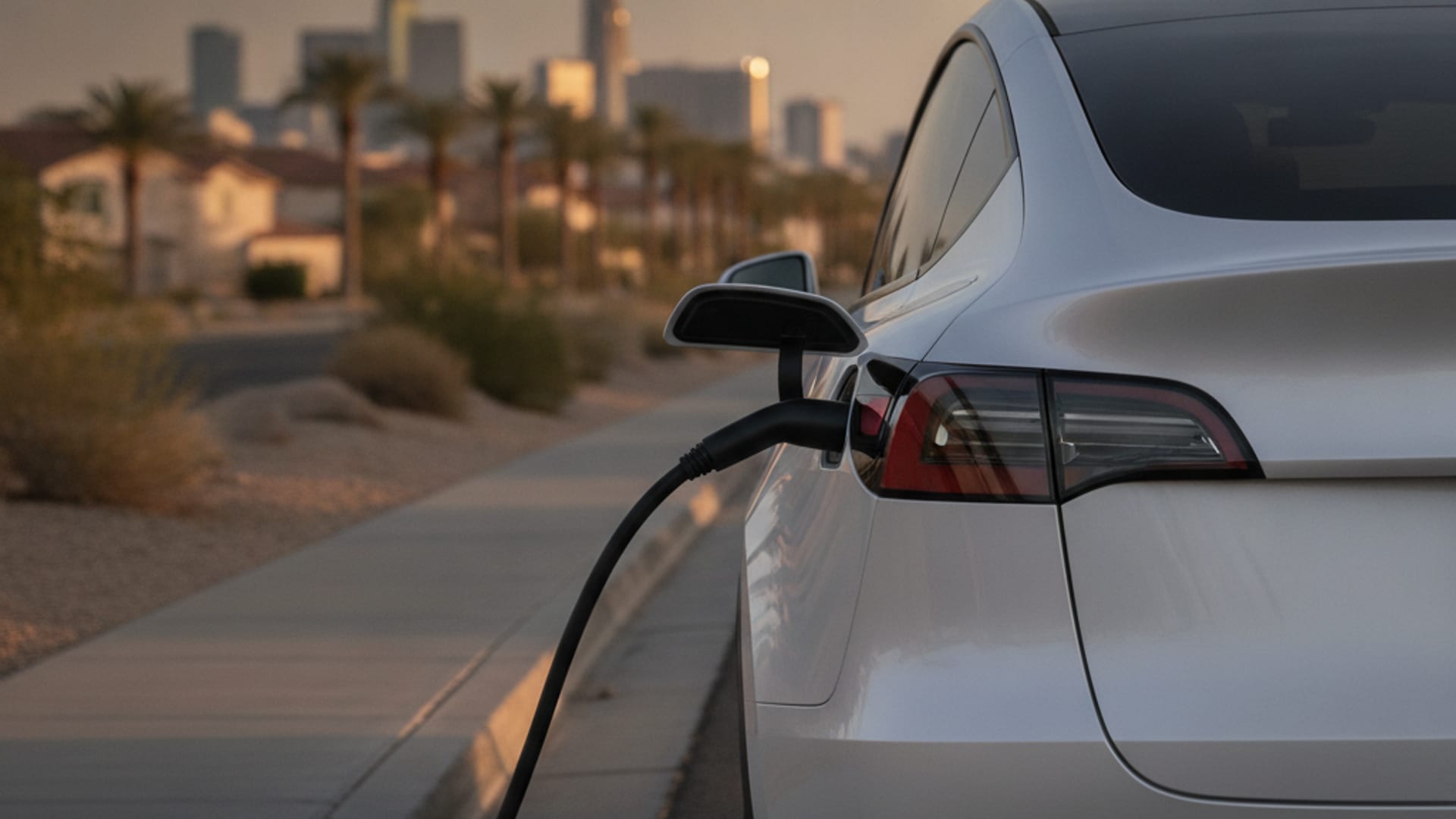
Why a Tesla 12V goes flat at the airport and the resort
Every modern Tesla uses a 12V lithium-ion auxiliary battery on the Model 3 and Model Y, and a 12V lead-acid battery on the older Model S and Model X. The 12V powers the modules that close the high-voltage contactors. Without it, the car cannot wake. The traction pack can sit at 80 percent and the Tesla still will not move.
A long airport or casino parking stay is the perfect 12V drain. The car sits in the open or under a covered structure with no shore power. The Sentry Mode, if left on, draws a steady current. The cabin overheat protection cycles the fan. The 12V lithium-ion battery has a lower self-discharge rate than lead-acid, but a sustained draw over nine days is more than a small 12V can support.
NWS Las Vegas puts the average July high at 104.5F. About 78 days a year reach 100F or more. About 9.4 days reach 110F or more. The all-time record is 120F, set on July 7, 2024. The heat accelerates any 12V’s internal wear. The Las Vegas airport weather station runs 5 to 15F warmer than outlying areas. A Model Y in uncovered long-term parking at Harry Reid soaks more heat than the same car in a Sun City Anthem garage.
The result is the same: a Tesla that will not unlock, will not answer the fob, and shows as offline in the app. The traction pack is fine. The 12V is the problem.
How to confirm the 12V is the fault
The Tesla 12V symptoms are consistent. The door handles do not present. The fob does not lock or unlock. The phone app shows the car as offline or stuck in the last known state. Pressing the brake pedal does nothing. The dash is dark. No clicking from the front trunk.
A driver can also try the manual key release. Most Tesla key cards and fobs have a mechanical backup. Pull the manual key from the fob, slide it into the door pillar, and turn. The door unlocks mechanically but does not wake the car. The driver gets inside but the screens stay dark.
A working traction pack with a flat 12V is the classic split. The phone app shows the state of charge before the 12V goes flat. If the last reading shows a usable range, the 12V is the fault, not the pack.
How to access the Tesla 12V jump points
The Tesla 12V jump points are under the hood. On the Model 3 and Model Y, open the frunk by double-pulling the hood release inside the cabin, or by using the frunk button on the key fob when the 12V still has some charge. The jump points sit on the driver’s side near the firewall with a red plastic cover.
On the Model S and Model X, the 12V lives under the hood in a different location, with the same red cover convention. The owner’s manual shows the exact location for each model year. The high-voltage orange cables are clearly marked and never the place to clamp.
A driver with a low 12V may not be able to open the frunk from the cabin. The cabin button needs the 12V to work. The fob button needs the 12V to work. The hood can be opened manually with a hidden release in the front bumper area. The owner’s manual shows the location.
How a Tesla 12V jump works
The jump uses a 12V lithium jump pack rated for automotive use, or a donor 12V battery from another car. Red clamp on the red post. Black clamp on the black post or a clean chassis ground. The Tesla wakes as soon as the 12V crosses about 11 volts.
Once the Tesla wakes, the contactors close and the traction pack takes over. The DC-DC converter recharges the 12V during the drive. A 30-minute drive restores the 12V to a usable state. A short trip does not.
The jump itself takes minutes. The clamps sit, the modules wake, and the screens light up. The driver can put the car in drive and leave the spot. The full job, including the diagnosis, is faster than a tow.
When the right answer is a 12V swap
A 12V that needed a jump is past saving. A Tesla 12V lithium battery is rated for about 5 to 7 years in a mild climate, less in the valley. A Tesla 12V lead-acid on the older Model S and Model X is rated for 3 to 5 years. A 12V that needed a jump at the airport is usually a 12V that needed a swap yesterday.
Mobile operators carry the right 12V group sizes for the Tesla model line. They swap on site, run the battery management relearn, and confirm the wake cycle is clean. The driver leaves with a new 12V, not a dead one waiting to fail again.
A driver who parks at Harry Reid for more than two weeks at a stretch should consider a 12V swap before the next trip. The cost is small compared to a missed flight and a tow. The convenience is real.
What an operator brings to a Strip or airport stall
Charge Pro LV is a referral service that connects stranded EV drivers with independent local mobile rescue operators. For a Tesla 12V stall at Harry Reid, a Strip resort, a Town Square garage, or a Sun City garage, the operator brings the right jump pack, the right 12V group sizes, and the diagnostic gear to read the wake-up.
The operator quotes the job before starting. The quote covers the dispatch, the equipment, and the operator’s time. The pros we connect you with are licensed and insured. The operator bills the driver directly at the curb.
A Tesla 12V stall at the airport is a known scenario for valley operators. The right jump pack and the right 12V group size are in most trucks. A driver who calls (702) 935-4699 and describes the symptoms gets the right operator in the rotation.
What a Tesla driver can do to prevent the next stall
Disable Sentry Mode when the car sits for more than a few days. Sentry Mode is the largest steady draw on a parked Tesla 12V. The cabin overheat protection also draws power. Both can be turned off in the car’s settings menu.
Park in covered parking when possible. Covered parking at the airport or a Strip resort garage keeps the cabin cooler and the 12V cooler. The cost of covered parking is small compared to a 12V jump.
Use the Tesla app’s scheduled departure feature to preheat or precool the cabin before the driver arrives. That lets the system pull energy from the wall instead of from the 12V. A driver who plugs in at home on the NV Energy REVRR window (10:01pm to 8:00am) and schedules the departure can arrive at a ready car with a healthy 12V.
A Tesla 12V jump in the Las Vegas Valley works the same way as a 12V jump on a gas car, with the discipline of clamping only the 12V posts. Airport and resort sits drain the Tesla 12V until the car will not unlock. A mobile operator handles the jump plus the diagnosis at the curb. When the fob will not answer, call (702) 935-4699 and we connect you with an independent operator who quotes the job before starting.
Frequently asked questions
Can I jump a Tesla 12V myself?
Yes, with a 12V lithium jump pack rated for automotive use or a donor 12V battery. Red clamp on the red post under the hood. Black clamp on the black post or a clean chassis ground. Never clamp to the high-voltage orange cables.
Where are the Tesla 12V jump points?
On the Model 3 and Model Y, the 12V jump points are under the frunk on the driver’s side near the firewall with a red plastic cover. On the Model S and Model X, the 12V is under the hood in a different location. The owner’s manual shows the exact location for each model year.
How long does a Tesla 12V last in the valley?
A Tesla 12V lithium battery lasts about 5 to 7 years in a mild climate. The Las Vegas Valley heat cuts the lifespan by 20 to 30 percent. A 12V lead-acid on the older Model S and Model X lasts about 3 to 5 years in the valley. Heat, Sentry Mode draws, and long parking sits are the biggest factors.
Can a Tesla 12V be replaced at the curb?
Yes, for many Tesla models. Mobile operators carry common 12V group sizes and can swap on site. A battery management relearn is required after a swap. The operator runs the relearn through the car’s diagnostic menu. A dealer visit is only needed if the battery management module has stored a permanent fault.