You’re south of Jean on I-15. The dash was honest when you passed the state-line casino. It’s not honest now. The climb and the headwind spent what you thought was margin. Mobile EV charging in Jean is for the shoulder where the climb took the last miles.
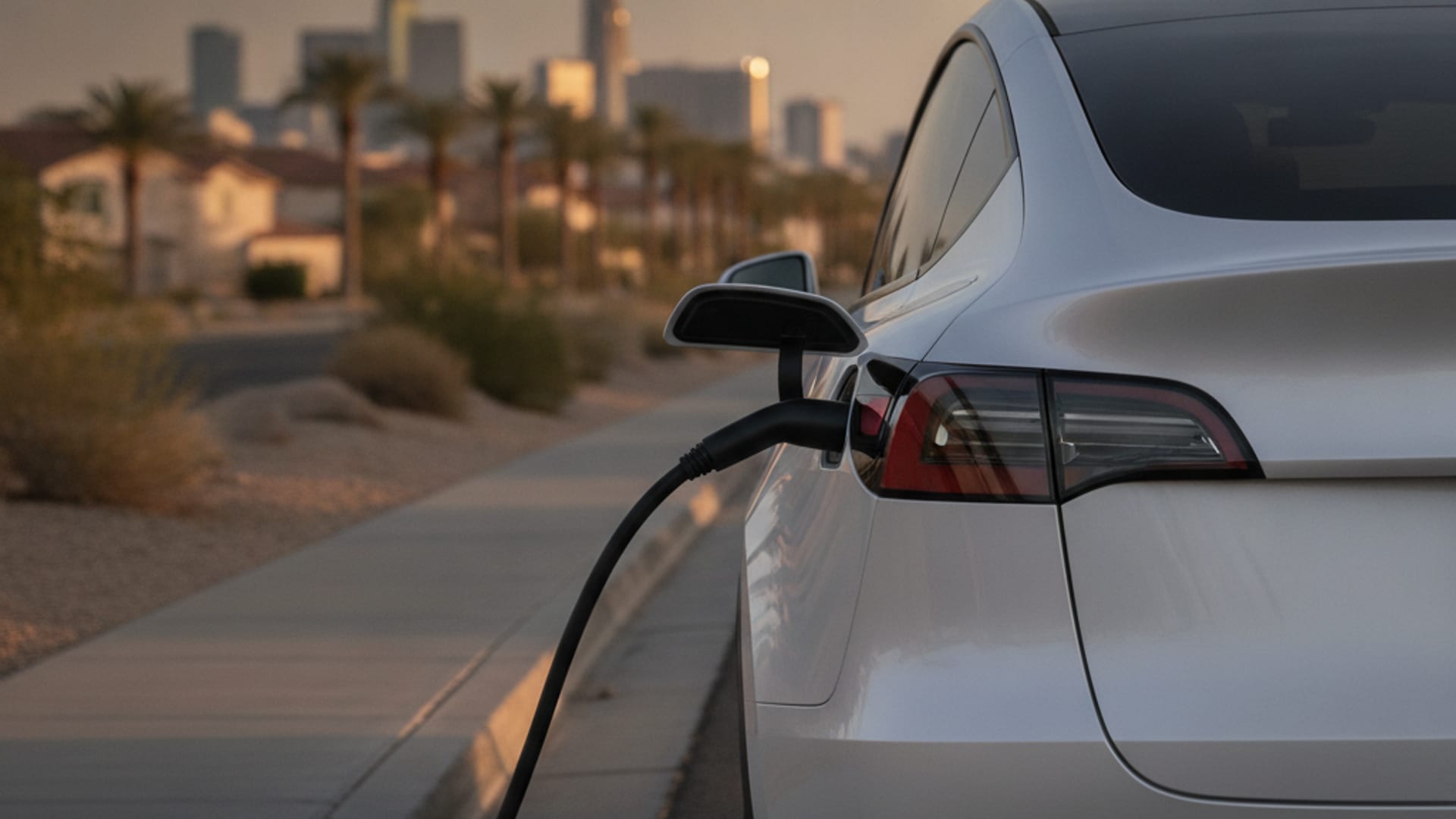
Why the Jean climb is the trap
Jean sits at about 2,841 feet on southbound I-15. Primm sits at about 2,618 feet. The valley floor sits about 2,000 to 2,920 feet. The climb is short in miles and long in temperature. Heat and a desert headwind have a long, open run between Jean and Primm. Drivers headed for Los Angeles often stage their last Nevada charge in Primm. A headwind can erase that plan. So can 110-degree heat on the long climb.
NV Energy serves Jean and Primm. That fact helps at a house later. It does not add miles on I-15. The pack on the dash is a memory of slower valley miles, not highway miles. Open highway, a headwind, and 100F cabin cooling spend that buffer fast.
NWS Las Vegas numbers at the airport make the heat plain. The average July high is 104.5F. About 78 days a year reach 100F or more. About 9.4 days reach 110F. The all-time record high is 120F, set July 7, 2024. Recurrent Auto found about 5% range loss at 90F. At 100F, the same work showed 17 to 18% loss. Cooling a hot cabin can pull 3 to 5 kW. AAA, in May 2026, measured 8.5% range loss at 95F. No Tesla-published range-loss figure was located for this page. We are not assigning Tesla a number the company did not publish.
The estimate on the dash is a memory of the last miles. If those miles were slower city streets, the estimate runs high. South of Jean, cabin cooling and a headwind spend that buffer fast. Eighteen percent becomes eleven. Eleven becomes seven. You are still in Nevada. The car is already in a hole.
For the area itself, the EV charging in Jean hub covers the local service picture.
Get off the travel lane and stay put
If the car cannot hold highway speed, treat it as a disabled stop. NRS 484B.440 covers a vehicle disabled so it cannot avoid stopping. That vehicle is exempt from the no-stopping-on-highway rule. The statute sets no time limit on how long it may remain. That is not an invitation to wait all night. NRS 484B.443 lets law enforcement remove a disabled or abandoned vehicle. On freeways and primary highways, a vehicle is treated as abandoned after 24 hours. The owner pays removal.
Pull off at the next legal pull-off. Stay with the car if it’s safe. Don’t stand in the lane. I-15 is moving at highway speed behind you. A shoulder with hazards on is far safer than a five-minute gamble trying to roll one more mile.
NDOT’s Freeway Service Patrol covers the most-traveled valley freeways from 5:00am to 8:30pm. Quality Towing operates it, GEICO sponsors it. NDOT’s published patrol materials don’t mention EV charging. I-15 from Jean to Primm isn’t on the patrol’s published routes. The patrol won’t appear on a lonely shoulder.
Mobile EV charging is the work for that shoulder. The operator we connect you with brings a 240V Level 2 source to the car.
What an operator brings to that shoulder
Charge Pro LV is a referral line. It matches stranded EV drivers with independent local mobile rescue operators. It performs no work, owns no trucks, and employs no technicians. It doesn’t set prices or publish hours. The operator quotes you before starting, then bills you directly. The pros we connect you with are licensed and insured.
Operators bring a Level 2 source to the car. Tesla drivers get a native NACS plug. Other brands get a CCS or J1772 adapter. A typical session adds 10 to 20 miles of range in 15 to 30 minutes of charging. That number is charging time. It isn’t how long anyone takes to arrive.
Ten to twenty miles is enough to clear the climb to Primm or to turn around and reach a working charger in Jean or Primm. Don’t bet that buffer on the long climb toward Mountain Pass. Use it before the climb.
If the car won’t wake at all, the 12V is the suspect. A Tesla 12V battery jump handles that case. The traction pack still has the same range. You drive.
Stay legal on the shoulder
Don’t set up camp on the shoulder. The clock starts the moment the car stops moving on its own power. NRS 484B.443 lets law enforcement remove a vehicle after 24 hours. The owner pays removal.
Don’t cross the median. Don’t flag down passing trucks. Don’t walk into the travel lane. Stay on the shoulder, on the side away from traffic if you can. Hazards on. Stay belted if traffic is moving close.
For the Primm side of this climb, EV charging in Primm covers the local service picture. Primm sits at the state line at about 2,618 feet. Charge Pro LV serves the Las Vegas Valley, including Primm. It does not serve Baker, Barstow, or Mountain Pass.
Skip the scavenger hunt
Skip the hunt if any of these is true.
The pack is below ten percent and you’re already on the climb. You don’t have a confirmed working charger within reach on I-15. The temperature is over 100F and the headwind is on. The next exit is miles away.
In any of those cases, the cheapest mile is the one that comes to you. Call (702) 935-4699 and Charge Pro LV will connect you with an independent operator. That operator quotes the job before it starts.
Frequently asked questions
Does heat reduce EV range on the climb?
Yes. The pack works harder on a sustained grade, and cabin cooling spends more power in 100F air. Recurrent Auto found about 17 to 18 percent range loss at 100F. The climb doesn’t help.
Can a mobile charge add real range on the shoulder?
A mobile Level 2 source adds about 10 to 20 miles of range in 15 to 30 minutes of charging time. That’s enough to clear the climb to Primm or to turn around and reach a working charger in Jean.
What if the car won’t wake?
That’s a 12V problem, not a pack problem. Ask the operator for a jump. The traction pack still has the range it had when you parked.
Will the Freeway Service Patrol appear on the shoulder?
No. The patrol covers the most-traveled valley freeways. I-15 from Jean to Primm isn’t on the published routes. NDOT’s materials also don’t advertise EV charging.