You typed “mobile EV charging near me” because the gauge just went amber. You’re somewhere in the Las Vegas Valley. A referral line connects you with an independent local operator who brings a Level 2 source to the car. That’s the job. Here’s how it actually works.
What “near me” means in the Las Vegas Valley
The valley is forty places in nine regions. The Strip Corridor, East Las Vegas, Henderson, West Valley, North Las Vegas, Southwest, Lake Mead, I-15 South, and the Desert Mountains are all on the map. Each has its own housing stock, heat exposure, and charger density. The whole metro is one service area, but “near me” depends on where the car is parked right now.
Charge Pro LV operates across the valley and out to the periphery. NV Energy serves most of the metro, including Las Vegas, North Las Vegas, Henderson, Paradise, Winchester, Spring Valley, Enterprise, Sunrise Manor, Summerlin, and Whitney. Valley Electric Association covers Blue Diamond, Indian Springs, and Sandy Valley. Overton Power District No. 5 serves Moapa Valley, Overton, Logandale, Moapa, Bunkerville, and Mesquite. Boulder City Utilities powers Boulder City from Hoover and Glen Canyon hydro. The referral line matches drivers to operators in each area.
Don’t assume one phone number covers the whole valley from a single dispatch yard. Independent operators stage near their service zones. The line routes the call to whoever is closest to the car.
What an operator brings to your stall
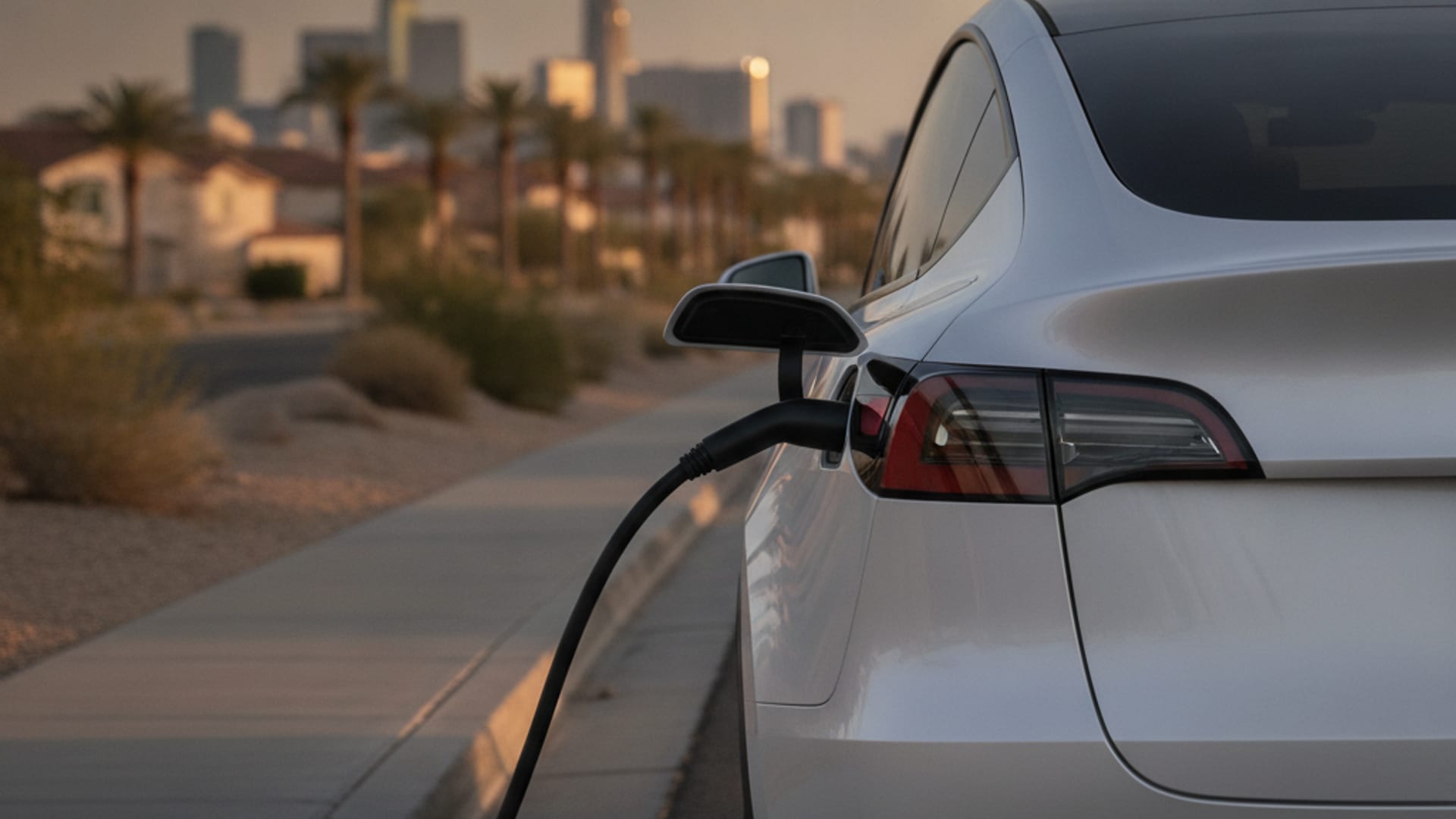
Mobile EV charging is a 240-volt Level 2 session at the car. A typical session adds 10 to 20 miles of range in 15 to 30 minutes of charging. That number is charging time. It isn’t how long anyone takes to arrive. Ten to twenty miles is usually enough to clear a metered parking stall, leave a parking garage, or reach a working charger on the next block.
Tesla drivers get a native NACS plug. Other brands get a CCS or J1772 adapter through the operator. The right connector matters. The operator we connect you with shows up with both, in case the car is a guest vehicle.
Charge Pro LV itself is a referral line. It matches stranded EV drivers with independent local mobile rescue operators. It performs no work, owns no trucks, and employs no technicians. It doesn’t set prices or publish hours. The operator quotes you before starting, then bills you directly. The pros we connect you with are licensed and insured.
The 240-volt session lives at the stall where the car already sits. You don’t move the car. You don’t tour the valley looking for a green-light kiosk. The work happens where the failure happened.
Decide if it’s a charge or a jump
Two failures feel the same from the curb. The dash is dead and the gauge reads zero, or the doors won’t unlock and the car won’t ready. Those are different jobs.
If the traction pack has energy and the 12V is dead, the operator brings a 12V source. A Tesla 12V battery jump wakes the car. The traction pack still has the same range. You drive.
If the traction pack is at zero, the operator brings a Level 2 source. Mobile EV charging is the work for that stall. You stay in park, the operator connects, and the pack climbs 10 to 20 miles in 15 to 30 minutes.
If you’re not sure which failure you have, describe the dash to the operator on the phone. They’ll bring both tools and pick the right one at the curb.
For an overview of how the local picture works, the EV roadside assistance guide for the Las Vegas Valley lays out the regional breakdown.
Stay legal while you wait
Pull as far off the travel lane as you can. Hazards on. Stay belted if traffic is moving around you. Don’t stand in the lane.
NRS 484B.440 covers a vehicle disabled so it cannot avoid stopping. It’s exempt from the no-stopping rule. NRS 484B.443 lets law enforcement remove a vehicle after 24 hours on a freeway or primary highway. A 24-hour clock starts the moment the car stops moving on its own power.
Private-property tows follow NRS 706. Posted signs and a 48-hour warning sticker are required. Don’t assume a failed charger in an apartment lot gives you the right to camp overnight. The property manager can still have the car moved.
NDOT’s Freeway Service Patrol covers the most-traveled valley freeways from 5:00am to 8:30pm. Quality Towing operates it, GEICO sponsors it. The patrol is free to motorists for tire changes, jump starts, fuel, minor fire suppression, and traffic control. NDOT’s published patrol materials don’t mention EV charging. A trailhead, an apartment lot, or a resort garage isn’t a freeway shoulder.
When the local network isn’t enough
The valley is growing fast. Nevada had about 85,600 EVs and 16,100 plug-in hybrids registered on 2025 vintage data, per AFDC and NREL. The Nevada DMV reported over 80,000 EVs statewide in May 2026. The public charger network hasn’t kept up with that growth. StorageCafe’s index ranked Nevada about 6th among states.
A driver who can’t reach a working public stall on the remaining range needs a charge at the car. That’s the job out-of-charge recovery covers. The operator brings energy to the port.
Heat is doing real work on the pack. NWS Las Vegas shows an average July high of 104.5F at the airport. About 78 days a year reach 100F or more. About 9.4 days reach 110F. Recurrent Auto measured about 17 to 18 percent range loss at 100F. Cabin cooling can pull 3 to 5 kW on a hot day. That margin you thought was safe isn’t.
When to call
Skip the scavenger hunt if any of these is true.
The pack is below ten percent and you don’t have a working stall confirmed in your remaining range. You already tried a second stall in the same lot and both failed. You have a shift, a school pickup, or a timed errand you can’t slide. It’s late and you don’t want to keep relocating the car.
In any of those cases, the cheapest mile is the one that comes to you. Call (702) 935-4699 and Charge Pro LV will connect you with an independent operator. That operator quotes the job before it starts.
Frequently asked questions
What does mobile EV charging actually deliver?
A 240-volt Level 2 session at the car. A typical session adds 10 to 20 miles of range in 15 to 30 minutes of charging time. That is enough to clear most stalls and reach a working fast charger.
Do you serve my part of the valley?
The referral line covers all nine regions. NV Energy serves most of the metro. Valley Electric Association, Overton Power District No. 5, and Boulder City Utilities serve the outlying areas. The line routes the call to the closest independent operator.
Will the operator quote before starting?
Yes. The operator quotes the job before any work begins. Charge Pro LV sets no prices. The operator does.
Can you handle a 12V jump too?
Yes. If the dash is dead but the pack has range, ask for a 12V jump. The operator brings both tools and picks the right one at the curb.