A Polestar 2 sits silent at the Skye Canyon trailhead parking lot. The driver walked the petroglyph loop at Red Rock and came back to a car that won’t take a charge from the lone J1772 pedestal in the lot. The cables in the back are CCS and J1772. None of them are NACS. A Tesla-only rescue truck would be useless here.
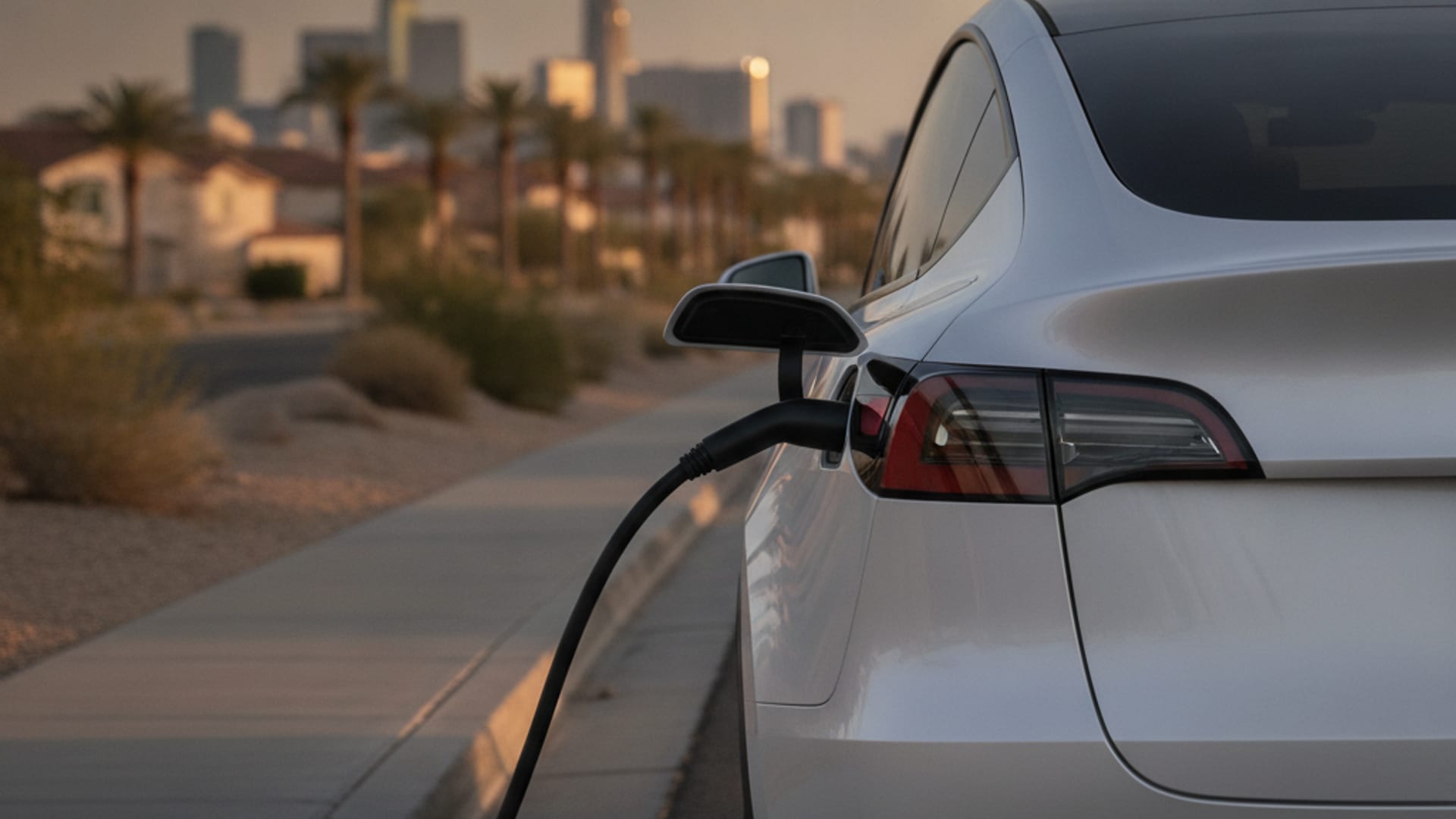
Skye Canyon sits above the rest of the valley
Skye Canyon is in the far northwest of the Las Vegas Valley, well past Centennial Hills and Tule Springs. The community climbs up toward the foothills of the Sheep Range. Elevations reach about 3,500 to 4,400 feet toward the rim. That altitude means slightly cooler nights but the same punishing summer days. The NWS Las Vegas record shows an average July high of 104.5F at KLAS, and the higher ground here doesn’t save a parked car from morning heat by much.
Public charging in Skye Canyon is sparse. A few J1772 pedestals sit at parks, trailheads, and the community center. CCS fast chargers are a longer drive into Centennial Hills or down the 215 beltway. A driver who planned to top off after a hike and finds a dead kiosk is now hunting chargers on a thin pack, far from any familiar stall. That’s the scenario where a Tesla-only rescue truck won’t help.
The connector problem is real and it’s specific
Tesla uses the NACS connector natively. Every other major EV brand in 2026 uses CCS1 for DC fast charging and J1772 for Level 1 and Level 2. A few older cars still use CHAdeMO. A rescue operator who rolls up with only NACS cables can help a Model 3, a Model Y, or a Cybertruck. They cannot help a Polestar 2, a Ford Mustang Mach-E, a Hyundai Ioniq 5, a Rivian R1S, a Chevy Equinox EV, or a BMW i4.
The local operators this line connects drivers with are vetted for connector coverage. They carry CCS1 adapters that mate with a Tesla-port mobile charger, J1772 adapters that handle every plug-in hybrid and Level 2 EV, and the CHAdeMO adapter for the small number of older Leafs still on the road. When the operator arrives, ask which adapters are on the truck before quoting the job.
The other thing to ask is whether the operator’s Level 2 source is a 240V outlet with at least 30 amps. A typical portable Level 2 EVSE puts out about 7 to 9 kW. That’s enough to add 10 to 20 miles of range in 15 to 30 minutes of charging for most cars. Charging time is what takes the minutes, not the arrival.
Why the trailhead stall is usually the failure point
Public chargers at trailheads and parks in the valley see hard use. They get direct sun, dust, monsoon moisture, and dozens of drivers a week yanking the same handle. Cables get dropped. Connector pins get bent. The cabinet electronics cook in summer. The network handshake that authorizes a session can fail without warning.
A driver who assumes the kiosk works until they try it is now stranded. The fix on site is energy delivered to the car, not a charge at a working stall the driver can no longer reach on a thin pack. A typical Skye Canyon run to the nearest reliable fast charger is about 15 minutes of driving on US-95. That’s 15 minutes the driver no longer has.
Non-Tesla EV rescue is the service line for this case. Mobile EV charging covers the energy delivery, with the right adapter for the connector in the car. EV roadside assistance in Skye Canyon gives the local context for this community.
What the operator actually does at the car
When the operator arrives, the first question is which connector the car takes. The driver should know, but the operator carries a flashlight and can confirm. Polestar 2 sits on the CCS1 standard, with a J1772 inlet for Level 2. A Hyundai Ioniq 5 is the same. A Ford Mustang Mach-E uses CCS1. A Chevy Bolt uses CCS1 on later model years and CHAdeMO on earlier ones. Knowing the connector decides which adapter the operator reaches for.
Next, the operator confirms the 12V state. A car that won’t unlock may have a dead 12V, not a flat traction pack. The jump is a separate job from the charge. A car that wakes but won’t move on a flat pack needs energy, and that’s the longer part of the visit.
For the charge itself, the operator runs a portable Level 2 cable from the truck to the car’s port. The session takes 15 to 30 minutes. The operator doesn’t leave during that time, and the driver stays with the car. When the dash shows enough range to reach a working public charger, the session ends. The driver signs off and bills the operator directly. Charge Pro LV doesn’t quote the work or take payment.
What to have ready before you call
Have the model and year of the car ready. Polestar 2 first edition, Hyundai Ioniq 5 SEL, Ford Mustang Mach-E Premium, those details matter. Have the current state of charge if the dash still works, even an estimate. Have the address of where the car is parked. Skye Canyon’s streets are well-marked but the trailhead lots are not on every map app.
If the car is in a private community lot, ask the property manager before calling. Some Skye Canyon HOAs restrict commercial vehicles. Most operators drive unmarked vans, but it’s worth checking.
Have the connector type if you know it. CCS1, J1772, CHAdeMO, NACS. The wrong adapter means the operator can’t help, and you don’t want to wait for a second truck. The operator can also confirm the connector at the car before any work starts.
When to skip the public stall and call right away
If the kiosk is marked unavailable in the charging app and the connector looks damaged, stop trying it. If the same network failed at a different stall earlier in the week, the cabinet is the problem, not the cable. If the car is already at 10 percent or below, every minute spent troubleshooting the kiosk is a mile the driver can’t recover.
These are the calls where waiting makes the situation worse. The operator should come to the car with the right adapter, not to the kiosk. The job is energy at the car, not a working stall the driver can no longer reach.
NDOT’s Freeway Service Patrol runs 5:00am to 8:30pm seven days a week on the busiest valley freeways. It helps with tire changes, jump starts, fuel, minor fire suppression, and traffic control. It doesn’t advertise EV charging. A trailhead lot isn’t a freeway shoulder, either.
When the car is in the Skye Canyon lot and the kiosk won’t help, call (702) 935-4699. Charge Pro LV will connect you with a local operator who carries CCS and J1772. The operator quotes the work before any of it starts.
Frequently asked questions
Will a Tesla rescue truck help my Polestar or Hyundai?
Not by default. Tesla uses NACS natively. Most other EVs use CCS1 for DC fast and J1772 for Level 2. Confirm the operator carries the right adapter before quoting the work.
How much range does a mobile charge add?
A typical portable Level 2 session adds 10 to 20 miles of range. Charging time runs 15 to 30 minutes for most cars. Charging time is the clock, not the dispatch time.
Can the operator also jump my 12V if the car won’t unlock?
Yes. Most operators carry portable 12V packs designed for EV auxiliary systems. A dead 12V can lock the doors and keep the contactors from closing.
What does Charge Pro LV cost?
Charge Pro LV is a referral line. We connect you with an independent local operator. The operator sets the price and bills you directly.
The NRS 706 statutes cover tow and private-property rules in Nevada. The NDOT Freeway Service Patrol page describes the patrol’s hours and coverage. The U.S. DOE AFDC connector guide explains the difference between NACS, CCS, and J1772.