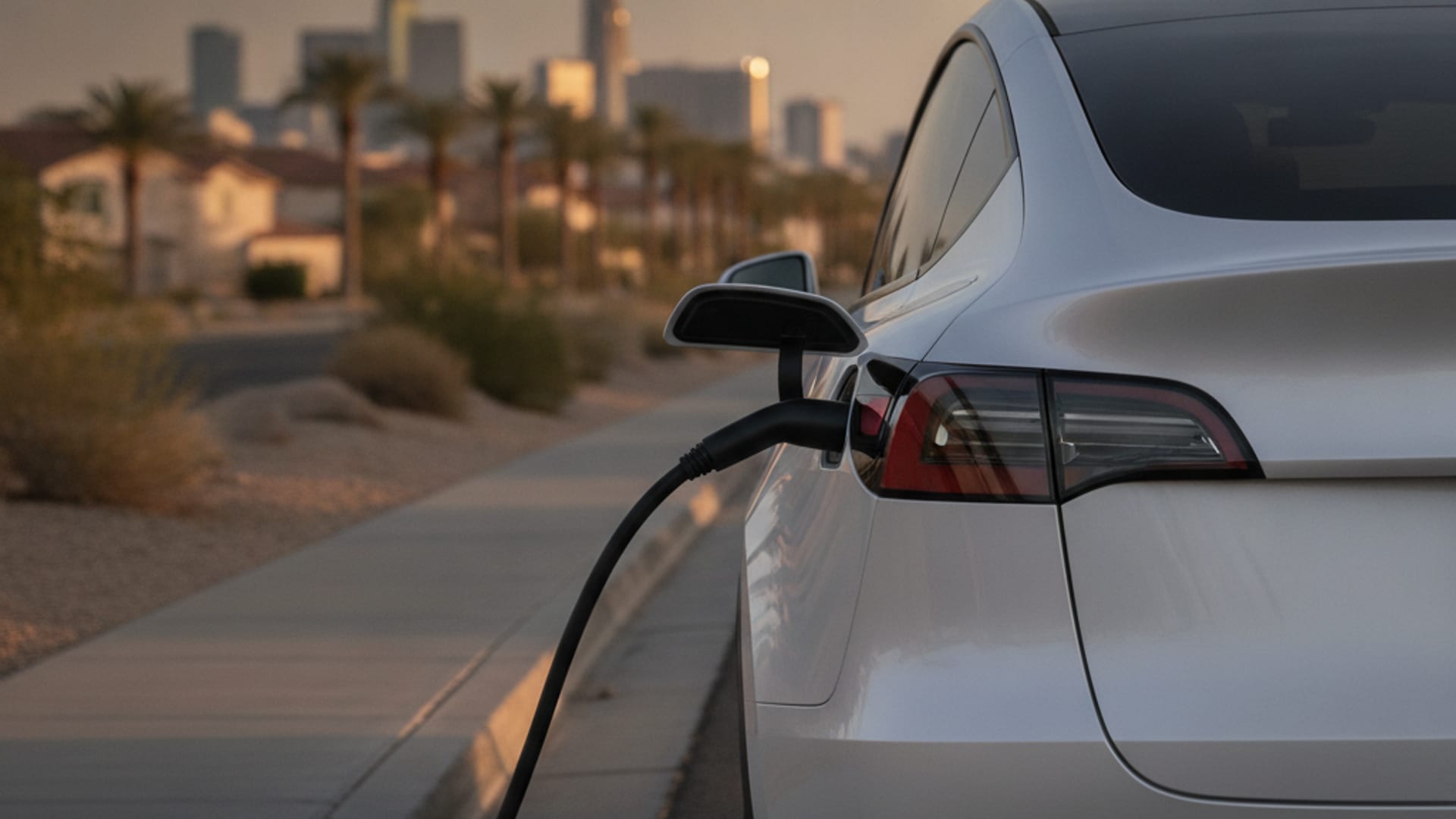
A driver walks out of a Henderson grocery store to find a stranger with a dead Honda Civic asking if anyone can help with a jump. The driver has a Tesla Model 3 with a 12V lithium-ion battery that’s already working hard in 110F heat. The Model 3 has a 12V outlet. The driver has jumper cables. The natural instinct is to help. The right move is to say no and explain why.
A Tesla’s 12V is small and stressed in valley heat
A Tesla’s 12V auxiliary battery is smaller than the battery in most gas cars. Model 3 and Model Y in 2021 and later use a 12V lithium-ion battery. Earlier Model S, Model X, and some Model 3 units used a 12V AGM lead-acid battery. Either way, the capacity is closer to a motorcycle battery than to a gas car’s starter battery.
The official NWS Las Vegas record shows an average July high of 104.5F at KLAS, with about 78 days a year at or above 100F. The east valley and Henderson can run up to 11F hotter than the rim. A Tesla’s 12V sits under the hood or under the frunk carpet, where ambient temperatures can exceed 140F during a summer afternoon. Tesla’s own service documentation notes that 12V batteries in hot climates fail more often than in mild ones.
A 12V battery that has been cycling hard in valley heat has a fraction of its rated capacity. Pulling 200 amps out of it to crank a gas car’s starter can drop the Tesla’s 12V below its locked-out threshold. The Tesla may go dark right next to the gas car it was trying to help. Now there are two disabled cars in the parking lot.
What happens when the donor Tesla runs out of 12V
The Tesla’s 12V powers the contactors that connect the high-voltage traction pack to the motors. When the 12V drops below threshold, the contactors stay open. The traction pack is fine. The Tesla can’t ask for it. The dashboard goes dark. The handles stay flush. The fob does nothing.
This is the same failure that strands a Tesla in a Summerlin lot at 6pm on a 110F day. It’s also the failure that can be triggered by trying to use the Tesla as a donor for a gas car. The driver who meant to help ends up with two dead cars and a longer recovery.
The Tesla can sometimes wake back up after a few minutes of rest. The 12V battery management system may reset once the load goes away. Often it doesn’t, and the Tesla needs a smart-booster jump from a portable pack or a non-Tesla donor. Either way, the Tesla now needs the help it was trying to give.
The mechanical mismatch matters too
A gas car’s starter draws 150 to 250 amps for a few seconds. A Tesla’s 12V is rated for steady accessory loads of 30 to 50 amps and brief peaks of about 100 amps. The starter draw is on the edge of the Tesla’s 12V capacity.
A gas car with a weak battery will crank for 10 to 15 seconds while the driver holds the key. The Tesla’s 12V will sag. The battery management system will trigger a low-voltage warning. The Tesla may shut down accessory circuits to protect the 12V.
The cables also matter. Cheap jumper cables have undersized wire that drops voltage over the length. A premium cable set rated for 400 amps is closer to what the gas car actually needs. The Tesla’s 12V posts are buried under trim in many model years.
When a Tesla can help another EV safely
A Tesla can jump another EV’s 12V safely because the load is much smaller. Modern EVs use 12V lithium-ion or AGM batteries similar to a Tesla’s. The donor Tesla connects to the recipient’s posts, and the 12V bus recharges over 10 to 15 minutes. The Tesla’s 12V sags slightly but doesn’t drop below threshold. Both cars wake up.
A Tesla can also charge another EV’s traction pack through a CHAdeMO adapter or a CCS adapter on newer vehicles. The session takes longer than a gas car’s jump because the energy is going into a battery, not just starting a motor. The Tesla’s range drops by 20 to 30 percent of the recipient’s pack size.
A Tesla can tow another EV with a flatbed. Tesla Service does this regularly. An independent tow operator can do it as well. The flatbed keeps all four wheels off the pavement. Tesla roadside assistance coverage in the valley covers the OEM side of the same workflow.
None of these workflows involve a gas car. The gas-car jump is the one scenario where a Tesla is a poor donor.
What to do when a stranger needs a jump
The first thing is to ask whether the car is an EV or a gas car. The jump workflow is different. The next is to ask whether the driver has roadside assistance through AAA, GEICO, the dealership, or a credit card benefit. Most drivers carry some form of roadside coverage.
If the driver has no coverage and the car is a gas car, the right move is to call AAA or GEICO. Both route to a contracted battery service with a wait of usually less than an hour.
If the driver has no coverage and the car is an EV, the right move is to call Charge Pro LV at (702) 935-4699. The line connects EV drivers with operators who carry the right adapters and the right smart boosters.
Why this is a valley problem, not a national one
The Las Vegas Valley’s heat and the high density of Teslas make this scenario more common than it would be in Portland or Minneapolis. The 12V in a valley Tesla is also more stressed than it would be in cooler climates. The same jump that might work in Seattle can fail in Henderson in August.
Recurrent Auto’s hot-climate work shows measurable range loss at 100F. AAA measured 8.5 percent range loss at 95F. Those numbers describe the traction pack. The 12V is in worse shape under the same heat.
For the broader context, how to jump start a Tesla 12V in the valley walks through the right tool. Tesla 12V battery failure in desert heat is the background on why the 12V fails here in the first place.
Frequently asked questions
Can a Tesla jump start a gas car?
Technically yes, but it’s a poor donor. The Tesla’s 12V is smaller than the gas car’s starter battery. A failed jump can drop the Tesla’s 12V below threshold and strand both cars. Use AAA or GEICO for a gas-car jump.
What about jumping another EV?
A Tesla can jump another EV’s 12V safely. The load is similar and the donor 12V is sized for it. Use a smart booster or another EV as the donor.
Why does my Tesla’s 12V fail in summer?
Heat accelerates every chemical reaction inside a 12V battery. Watch for low-voltage warnings and book service promptly.
Can I damage my Tesla by jumping a gas car?
Yes. A gas car starter can pull 150 to 250 amps, beyond the Tesla’s 12V capacity. The donor Tesla can end up with a dead 12V.
The NWS Las Vegas climate page has the official KLAS temperature record. Geotab’s battery-degradation work explains the hot-climate numbers. The Tesla Support page on 12V batteries covers the model-year differences.
Call (702) 935-4699 when an EV needs help. Charge Pro LV connects EV drivers with operators who carry the right smart boosters and the right adapters. The operator quotes the work before it starts.