A Tesla that won’t unlock after a 100F park is usually tesla 12v battery failure. It’s not a dead drive pack. The small battery kept the doors, screen, and pack relay alive. Valley heat makes that accessory load routine.
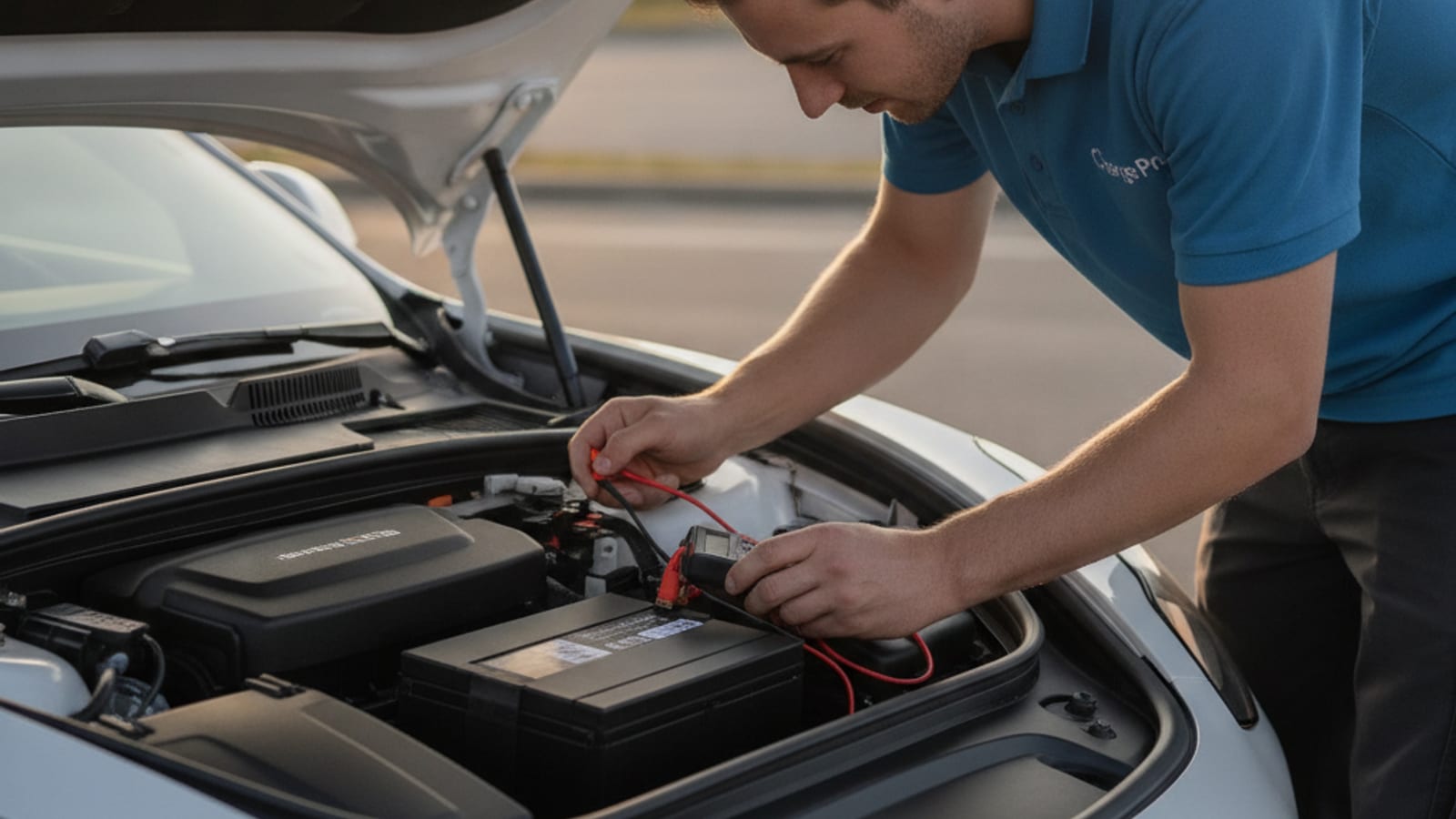
100F is a normal valley day, not a spike
The National Weather Service at KLAS puts the average July high at 104.5F. About 78 days a year reach 100F or more. About 9.4 days reach 110F. The all-time record is 120F, set on 2024-07-07. That’s the climate the 12V lives in.
Harry Reid International Airport runs 5 to 15F warmer than outlying ground. Downtown and the east valley can run up to 11F hotter than the rim. A Tesla in Sunrise Manor or Winchester can bake harder than one in Summerlin, which sits near 3,500 feet. Henderson sits around 1,867 feet.
Winchester has some of the oldest housing in the valley. Census tables put 53.1% of its stock in the older-age bands used as a garage-age proxy. A 12V that sat in a closed garage through a 104F afternoon is already working hard.
Accessory load is the wear you can actually cite
Recurrent Auto measured about 5% range loss at 90F. At 100F the loss rose to about 17 to 18%. Cabin air conditioning drew 3 to 5 kW to cool a hot interior. Holding that cabin once it was cool used about 1 kW.
AAA, in May 2026, measured 8.5% range loss at 95F. That study is about the drive pack, not the 12V. Don’t treat it as a Tesla-published range figure. Tesla didn’t publish one we could confirm.
The useful part for tesla 12v battery failure is the accessory stack. Climate, screens, and body computers still need 12-volt power to stay awake. The high-voltage pack can’t close its own contactors if the 12V is flat.
No verified 12V heat-failure percentage turned up for this page. So we don’t invent one. Accessory load rises at 100F. The valley spends weeks there. The 12V keeps those modules alive while you’re parked.
Cabin Overheat Protection and Sentry Mode, if you left them on, are parked loads Tesla describes in the car. We couldn’t confirm a published drain figure for either one. The car stayed busy in a lot that hit 100F. The small battery paid for it.
What the 12V is still doing in a Tesla
Do Teslas have a 12V battery is the short answer: yes. It doesn’t crank an engine. It still runs the car’s low-voltage world.
It powers door-handle motors, including the pop-out handles on a Model S. It powers trunk and frunk latches. It powers the main display and the network modules. It powers the battery-management relay that lets the drive pack feed the motors.
That last job is why a full pack can sit unused. The contactors stay open. The app goes quiet. The handles stay flush. The car looks dead.
A Model X still needs 12-volt power for the falcon-wing door motors. We couldn’t confirm a per-model complaint share we’d stand behind.
Tesla later moved many Model 3 and Model Y cars to a lithium 12V. Older Model S and Model X cars, and early Model 3 cars, used a lead-acid 12V. That hardware change is Tesla’s. A local wear study by chemistry wasn’t located. KLAS averages a January low of 37F, with about 10 freeze nights. Lead-acid cells lose capacity in that cold. The everyday wear here is still heat.
How tesla 12v battery failure shows up here
The usual scene is a parking lot, not I-15. The car sat through a Paradise resort day. Or it sat in long-term parking at Harry Reid. Or it sat on a surface lot off Fremont after dinner downtown.
You walk up. The handles don’t present. The screen stays black. The phone key does nothing. Sometimes the app warned you first. “12V battery low” is Tesla’s own phrasing. If you still have that alert, treat it as a live fault. Don’t plan a Red Rock Canyon scenic loop on it.
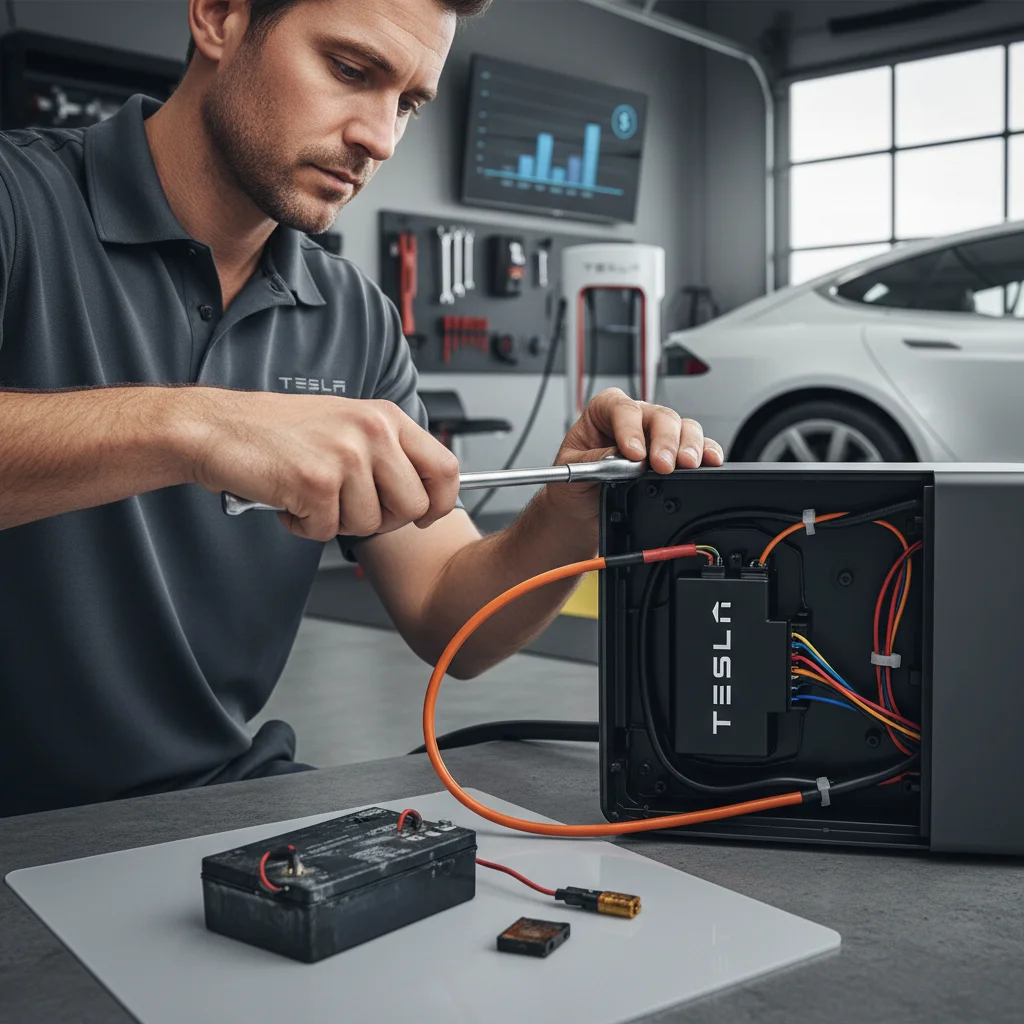
Dark car or empty pack: two different stalls
A dark Tesla is almost never the high-voltage pack by itself. Pack trouble usually still wakes a screen. You may see a range drop, a warning, or limited drive. The car still talks to you.
How to tell a Tesla 12V is dead in valley heat walks that split. Jump the 12V port. If the car wakes and still shows pack charge, the small battery failed. The pack didn’t.
If the car wakes and the pack is empty, that’s a different call. You need range at the bumper, not a 12V wake. Charge Pro LV is a referral line. The operators we connect you with bring a 240V Level 2 source to the car. They typically add 10 to 20 miles of range in 15 to 30 minutes of charging. That’s charge time, not a promise of when someone arrives.
What you can try at the car
Tesla publishes a 12V jump point on most cars. On a Model 3 or Model Y it sits under the hood, front right. On a Model S or Model X it sits in the frunk area near the firewall.
Use that port. Don’t put jumper clamps on the charge port. Don’t try to feed another car from the Tesla’s drive pack.
How to jump start a Tesla 12V in the valley covers the port and the sequence. A jump that wakes the car is a test. It isn’t a repair. If it woke only on a jump, plan a replacement.
Airport parking at Harry Reid offers free battery jump starts at (702) 261-5122. That’s the airport’s published lot service, not Charge Pro LV.
NDOT’s Freeway Service Patrol covers the busiest valley freeways from 5:00am to 8:30pm. It advertises jump starts. None of NDOT’s published patrol materials mention EV charging. Confirm on scene. Don’t assume they’ll work a Tesla 12V.
NRS 484B.440 lets a disabled vehicle stay when it can’t avoid stopping. That statute sets no time cap. NRS 484B.443 lets officers treat a vehicle as abandoned after 24 hours on freeways and primary highways. On other roads the mark is 72 hours.
What the public files don’t prove
Owner forums talk about overnight sits and firmware updates. We couldn’t confirm those as measured local rates. We also searched for a verified NHTSA share of Tesla complaints that name the 12V. No figure we’d publish turned up for this page. Search the complaint file yourself at nhtsa.gov if you want the raw rows.
Replacement price is the other gap. No verified Tesla 12V parts or labor figure is published here. Charge Pro LV doesn’t set prices. The operator quotes you before work starts and bills you directly.
A home charge on NV Energy, which serves most of the valley, doesn’t keep a failed 12V healthy by itself. Boulder City residents are on Boulder City Utilities, not NV Energy. A battery that won’t hold voltage still needs replacement.
How to care for an EV battery through valley heat is mostly pack care. The 12V still wants shade when you can get it.
If the car stays dark
Call a Tesla service path if you want the factory channel. Or call a local operator for a 12V jump or replacement at the car. Tesla 12V battery jump is the service page for that work.
Charge Pro LV doesn’t own trucks and doesn’t employ technicians. We match you with independent mobile rescue operators in the Las Vegas Valley. They handle Tesla and every major EV brand. They can jump or replace a dead 12V on site when that’s the job.
If you’re already stuck, call (702) 935-4699. We’ll talk through whether the car is dark, locked, or empty, then connect you with an operator. For more valley context, start at EV charging in the Las Vegas Valley.
Frequently asked questions
What does tesla 12v battery failure look like after a hot park?
The car is fully dark. Handles stay in. The screen stays off. The app doesn’t wake it. If a 12V jump brings the display back and the pack still shows charge, the small battery failed.
Can I jump a Tesla 12V from another vehicle?
Yes, if you use the Tesla 12V jump port and a standard 12-volt source. Don’t use the charge port. Don’t jump from another EV’s drive pack.
Does a jump permanently fix tesla 12v battery failure?
No. A jump is a wake test. If the 12V is worn, the car can go dark again. Replacement is the actual repair. The operator quotes that work before they start. We don’t publish a parts price or a labor clock.