You topped off at home in North Las Vegas and aimed north. The pack read fine on the 215. You detoured through Aliante to grab coffee. The dash now reads single digits. Mobile EV charging in Aliante is for the staging ground before the loneliest run in the valley.
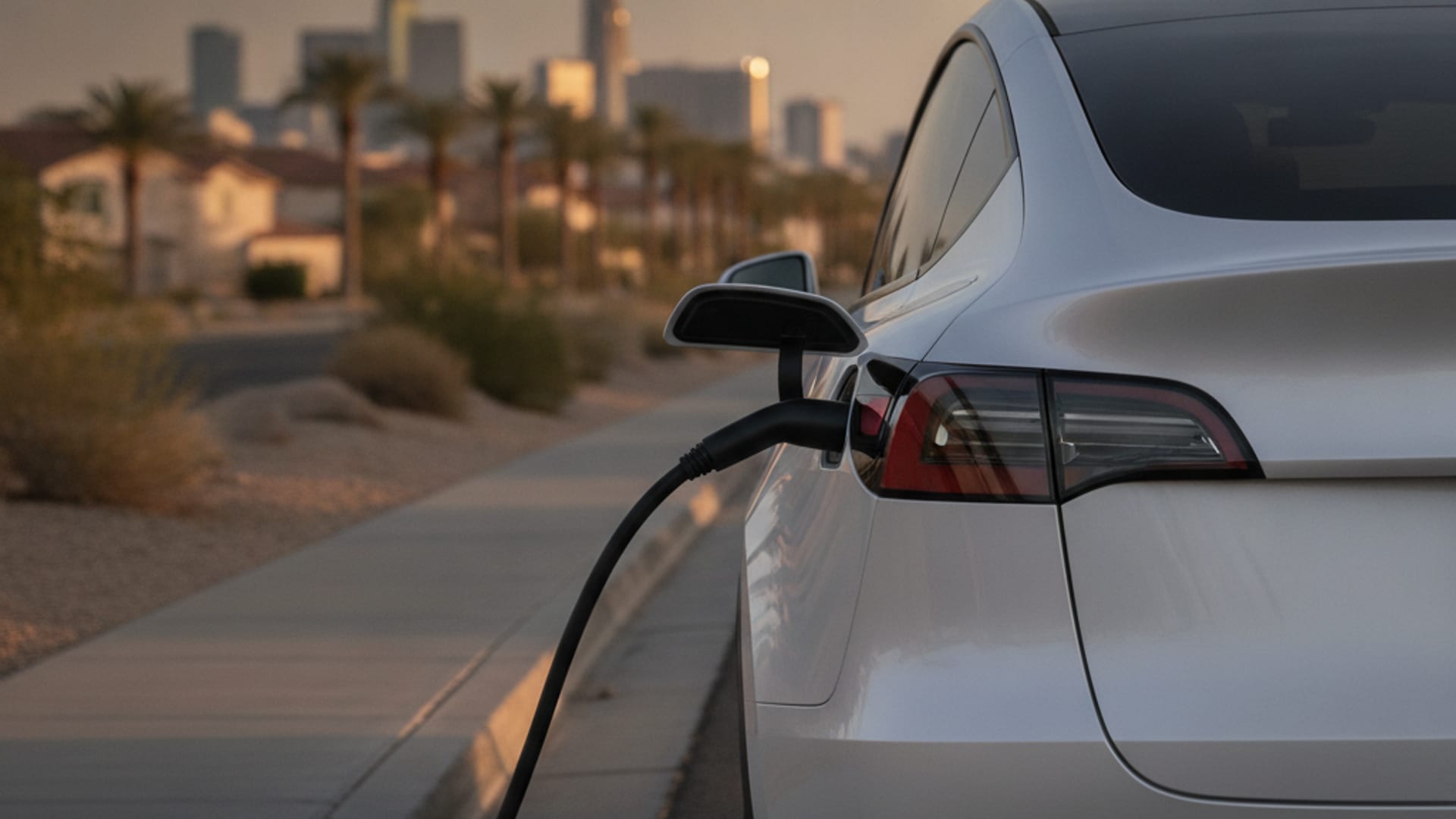
Why Aliante is the last easy stop
Aliante sits in the North Las Vegas region, north of the 215 Beltway and west of I-15. The community runs up against open desert. North of it, the next stop is Indian Springs at about 3,169 feet. After that, US-95 runs toward Beatty and Tonopah. There’s no town of any size until Tonopah. There’s no charger inventory on that stretch that could be verified from station databases on the research date. Drivers who run north know this is the staging lot, and they know it’s also the last one.
NV Energy serves Aliante through its North Las Vegas territory. The utility publishes a Residential Managed Charging Program and time-of-use rates for home Level 2 charging. Those help at a house later. They don’t add miles to a pack at the curb of a coffee shop.
A driver who planned to charge in Indian Springs or Mesquite and finds the public stalls full or offline is now in a hole. The pack on the dash is a memory of city miles, not highway miles. Northbound US-95 runs through open desert. The headwind works on the pack the whole way.
Heat and headwind on the north run
NWS Las Vegas data puts the average July high at 104.5F at the airport. About 78 days a year reach 100F or more. About 9.4 days reach 110F or more. The all-time record high is 120F, set July 7, 2024. The north valley runs a few degrees cooler than the east valley, but the headwind on US-95 is constant. Cabin cooling can pull 3 to 5 kW on a hot day.
Recurrent Auto measured about 5 percent range loss at 90F and 17 to 18 percent at 100F. AAA, in May 2026, measured 8.5 percent range loss at 95F. The estimate on the dash is a memory of the last miles. If those miles were slower city streets, the estimate runs high. Open highway, a headwind, and 100F cabin cooling spend that buffer fast.
A driver who started in Henderson and staged at Aliante is past the easy bail-out. The next legal pull-off is fifteen miles north. After that, it’s longer. Don’t keep rolling on a guess.
For the area itself, the EV charging in Aliante hub covers the local service picture.
Stay put and bring energy to the port
If the pack is already this low, treat it as a disabled stop. NRS 484B.440 covers a vehicle disabled so it cannot avoid stopping. It’s exempt from the no-stopping rule. NRS 484B.443 lets law enforcement remove a vehicle after 24 hours on a freeway or primary highway. US-95 is a primary highway.
A 24-hour clock starts the moment the car stops moving on its own power. Don’t sit on the shoulder hoping for a miracle. Move to a legal pull-off or a parking lot. Hazards on. Stay with the car if it’s safe.
NDOT’s Freeway Service Patrol covers the most-traveled valley freeways from 5:00am to 8:30pm. Quality Towing operates it, GEICO sponsors it. NDOT’s published patrol materials don’t mention EV charging. US-95 north of the beltway isn’t on the patrol’s published routes. The patrol won’t appear on the Aliante frontage road.
Mobile EV charging is the work for that staging lot. The operator we connect you with brings a 240V Level 2 source to the car.
What an operator brings to that parking lot
Charge Pro LV is a referral line. It matches stranded EV drivers with independent local mobile rescue operators. It performs no work, owns no trucks, and employs no technicians. It doesn’t set prices or publish hours. The operator quotes you before starting, then bills you directly. The pros we connect you with are licensed and insured.
Operators bring a Level 2 source to the car. Tesla drivers get a native NACS plug. Other brands get a CCS or J1772 adapter. A typical session adds 10 to 20 miles of range in 15 to 30 minutes of charging. That number is charging time. It isn’t how long anyone takes to arrive.
Ten to twenty miles is enough to reach a working charger in North Las Vegas, or to limp home and plug into a Level 1 outlet overnight. Don’t bet that buffer on US-95 headwinds. Use it inside the valley.
If the car won’t wake at all, the 12V is the suspect. A Tesla 12V battery jump handles that case. The traction pack still has the same range. You drive.
Skip the second tour
Skip the scavenger hunt if any of these is true.
The pack is below ten percent and you don’t have a confirmed working stall within reach. You’ve already tried a second stall or a second network in the same area. You have a meeting, a flight, or a timed errand you can’t slide. The headwind is on and the day is over 100F.
In any of those cases, the cheapest mile is the one that comes to you. Call (702) 935-4699 and Charge Pro LV will connect you with an independent operator. That operator quotes the job before it starts.
Frequently asked questions
Does a mobile charge add enough range to reach a real charger?
A typical Level 2 session adds 10 to 20 miles in 15 to 30 minutes. That’s enough to reach a working fast charger in North Las Vegas or to limp home to a Level 1 outlet.
Why is Aliante a risky staging ground?
The next stops north are Indian Springs and Tonopah. Public charger inventories on US-95 north of the beltway could not be verified. The headwind is constant. The bail-out distance is long.
What if the car won’t wake?
That’s a 12V problem, not a pack problem. Ask the operator for a jump. The traction pack still has the range it had when you parked.
Will the Freeway Service Patrol appear on the Aliante frontage road?
No. The patrol covers the most-traveled valley freeways. The Aliante frontage road and US-95 north of the beltway aren’t on the published routes. NDOT’s materials also don’t advertise EV charging.