A hot Paradise resort lot can kill an Audi Q4 e-tron 12V battery. The drive pack can still show range. The cabin goes dark. The handles stay flush. The car won’t wake. The miles you thought you had are still in the pack. The small AGM battery is what dropped out. Nothing moves until that 12V system comes back.
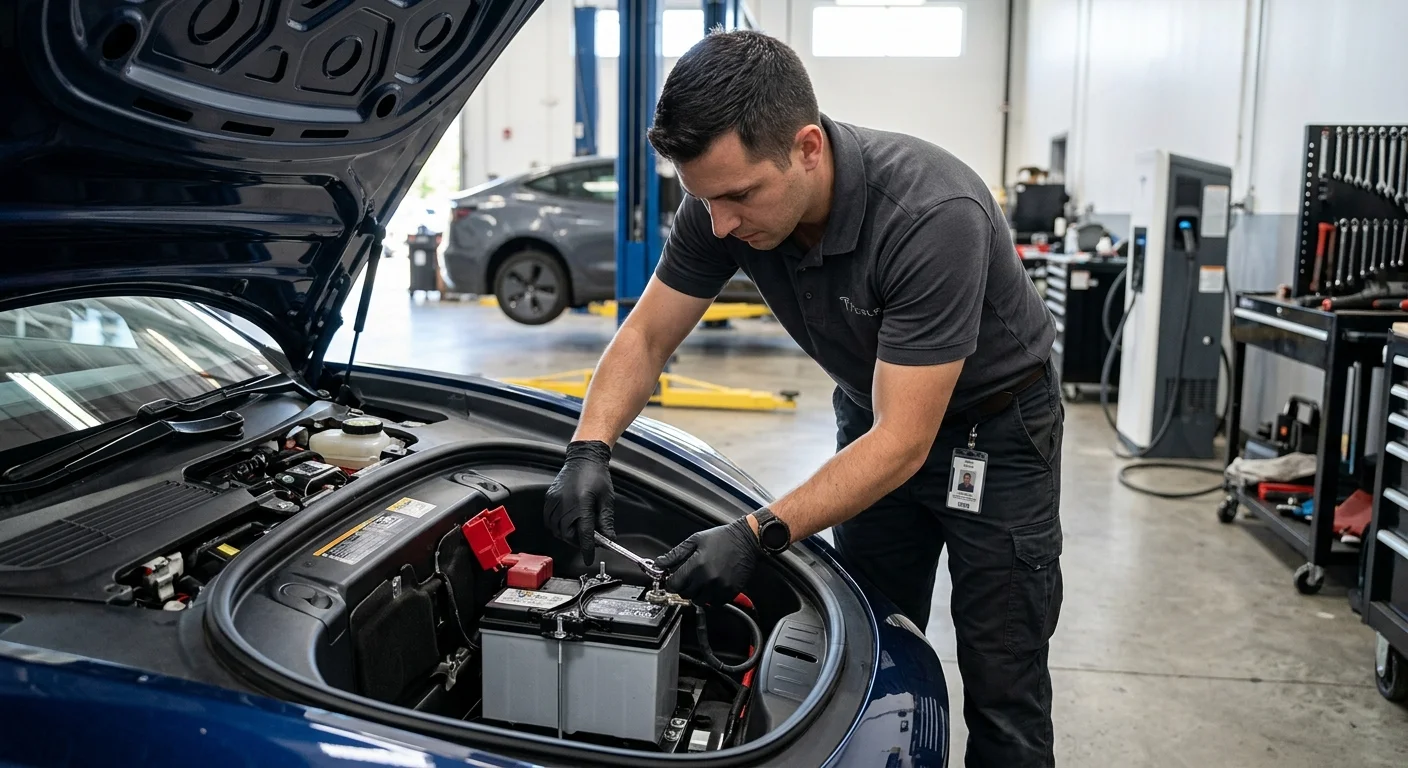
A dark cabin with range left is a 12V stall
This isn’t an empty-pack story. The Q4 e-tron’s 12V battery runs the computers, locks, and contactors. Those contactors connect the high-voltage pack to the motors. When the 12V falls under threshold, the switches stay open. You can have commuting range on paper and a car that acts like a brick.
Valley heat makes that drop more likely. The National Weather Service at KLAS lists an average July high of 104.5F. About 78 days a year reach 100F or more. About 9.4 days reach 110F or more. The record high is 120F, set on 2024-07-07. Harry Reid International Airport sits in Paradise. It runs 5 to 15F warmer than outlying ground. Downtown and the east valley can run up to 11F hotter than the west rim.
The Q4 doesn’t fully sleep in that soak. Modules, telematics, and connected services keep a light draw on the 12V. The AGM pack lives under the trunk floor, on the right, under trim. A closed trunk in a Paradise or Winchester lot is an oven. A long show or a late checkout can drain it. So can a week in airport long-term parking.
The traction pack feels the heat too, but that’s a different failure. Recurrent Auto found about 5% range loss at 90F and 17 to 18% at 100F. Cabin cooling after a hot soak drew 3 to 5 kW in that work. AAA, in May 2026, measured 8.5% range loss at 95F. Don’t treat those as Tesla figures. Tesla didn’t publish a matching number we could cite. They describe the big pack. Your Q4 can still sit with usable traction miles and a dead 12V.
Summerlin sits about 3,500 ft, rising toward 4,400 ft near Red Rock. It runs cooler than the Strip corridor. If you parked in Paradise, on the Strip, or at the airport, start with the 12V. A resort-lot EV that won’t wake follows the same pattern on other brands.
Make sure the badge is a Q4 e-tron
Audi prints “e-tron” on more than one architecture. The Q4 e-tron and the Q4 Sportback e-tron sit on Volkswagen’s MEB platform. This guide is for those two. The older e-tron, the Q8 e-tron, and the e-tron GT use other layouts. Their 12V battery sits in a different place. Their jump posts aren’t the same. From the driver’s seat the stall looks identical: dark screens, pack still charged. Read the model name before you open the hood.
MEB is also the bones of the VW ID.4. The failure mode matches. The 12V feeds every low-voltage circuit. When it sags, the car can’t close the high-voltage contactors. ID.4 12V failures in desert heat walk through that shared drain. What happens when an EV 12V dies in the valley is the same physics without the Audi badge.
How you’ll know it’s the 12V, not a frozen screen
The MMI stays black. There’s no boot art and no loading pulse. A crashed screen still has power behind it. A dead 12V doesn’t.
Flush handles never come out. The Q4 uses electric actuators. With no 12V they stay hidden. The fob does nothing. It still sends a radio signal. The receiver in the car needs 12V to answer. A warning may have shown up first. “12V battery: charge low” and “Start system fault” are the common lines. If that text is on the MMI today, treat it as a shop trip. Waiting until the cabin goes dark leaves you in a valet lane with no handles.
Open the door when the car won’t listen
You still have a metal key. Pop the release on the back of the Audi fob and slide the blade out. On the driver’s door, look under a small cover on the lower edge of the handle recess. That slot takes the blade. Turn it. The latch should release.
Inside, pull the hood lever under the left side of the dash. Don’t start tearing trunk trim in a resort drive aisle. The 12V AGM sits under that right-side trunk floor. You can’t reach it cleanly for a jump without pulling panels. Audi put remote jump posts up front for a dark car.
Jump the front posts, not the trunk battery
Raise the hood and stay on the driver’s side near the windshield. A red cap is the positive post, usually by the brake fluid reservoir. The negative is a bare bolt or a marked ground strap on that same side. Those are the only points you should clip.
The ID.4 puts its remote posts on the passenger side, near washer fluid. If you watched a VW video, flip sides. The rest of the idea matches.
Use a donor car or a pack designed for this. Red lead to the donor positive, then red to the Q4’s red cap. Black lead to the donor negative, then black to the Q4 ground. Don’t put the black clamp on the trunk battery. Let the donor idle about 10 minutes. Then try to power the Audi. When the MMI lights and the handles extend, remove the leads in reverse order.
How to jump start an EV in desert heat is the slower walkthrough if you’ve never done this. A slipped clamp on the wrong metal can take out a module. If that risk isn’t for you, wait for an operator.
A waking cabin isn’t the repair. A jump is a bridge. Plan on replacement if the 12V failed in heat. Get it load-tested after it wakes.
Same MEB drain, Audi-specific details
Both the Q4 and the ID.4 hide an AGM 12V under the right trunk floor. Both go fully dark and need the front remote posts. Audi’s posts sit on the driver’s side. VW’s sit on the passenger side. Flush Audi handles and retractable VW handles both stay put without 12V. Both fobs hide a key blade. The slot sits in a slightly different recess on each handle.
Early model years show up in owner reports more often. For the Q4 that cluster is MY2022 and MY2023. For the ID.4 it’s MY2021 and MY2022. Later cars aren’t magic. Heat still cooks an AGM in a trunk.
Ask an Audi dealer whether your VIN has a 12V charge-management update. Confirm what’s on the service record. Don’t guess from a forum post.
Resort lots, airport decks, and freeway shoulders
The stall follows the sit. Cars bake on asphalt and in structures. That’s the whole recipe.
Paradise holds the Strip corridor and Harry Reid. Neither is inside the City of Las Vegas. Both sit in unincorporated Clark County. You can lose a 12V at Sphere, T-Mobile Arena, or MGM Grand Garden Arena. A long afternoon at the Las Vegas Convention Center does the same. Town Square on the south Strip edge is open pavement with the same heat.
Airport parking uses the airport’s own names. The names are Terminal 1, Terminal 3, Short Term, Long Term, and Economy. There’s also Remote Lot, Cell Phone Lot, and Reservation Parking. July at KLAS is brutal on a parked EV. The airport publishes free battery jump starts and tire inflation at (702) 261-5122. That’s a conventional 12V boost. Ask the booth if they’ll work the front posts on a Q4. Don’t assume they will. The airport’s own site doesn’t publish EV charging for those lots, so this page doesn’t claim it either.
Allegiant Stadium parking after a Raiders or UNLV date is a long, hot sit. Winchester’s lots pick up that extra east-valley heat. Henderson sits lower, about 1,867 ft, and still cooks in July. If the Q4 dies on I-15, I-215, CC-215, or US-95, NRS 484B.440 applies. It covers a vehicle disabled so it can’t avoid stopping. The statute sets no time limit for remaining there. NRS 484B.443 still lets law enforcement remove a disabled or abandoned vehicle. On freeways and primary highways, abandoned treatment can start after 24 hours. On other roads it’s 72 hours. The owner pays the removal. Nevada has no toll roads and no express-lane transponders. I-15, I-215, US-93, US-95, and I-11 are free. You’re not in a pay lane. You’re in traffic. Hazards on. Stay out of live lanes.
Nevada 511 and nvroads.com post conditions, closures, and cameras. The Nevada State Police Highway Patrol, formerly Nevada Highway Patrol, dispatches rotation tows through Autura. Cell shortcode is *647. Southern Command is (702) 486-4100.
NDOT’s Freeway Service Patrol covers the busiest valley freeways from 5:00am to 8:30pm, seven days a week. Quality Towing operates it. GEICO sponsors it. It’s free to motorists. Published help includes tire changes, jump starts, fuel, minor fire suppression, and traffic control. Statewide it clears about 55,000 incidents a year, about 31,500 of them in Las Vegas. None of NDOT’s published FSP materials mention electric vehicles, EV charging, or EV-specific service. That’s an advertising silence. It isn’t a claim that the patrol can’t help an EV. A 12V jump may still be in the toolkit. Ask before anyone starts a tow.
Call an operator if you don’t want to clip cables
A donor car isn’t always next to you in a valet stack. Charge Pro LV is a referral line for the Las Vegas Valley. It matches stranded EV drivers with independent local mobile rescue operators. It performs no work, owns no trucks, and employs no technicians. It doesn’t set prices or promise an arrival time. The operator quotes you before starting and bills you directly. The pros we connect you with are licensed and insured.
Non-Tesla EV rescue is the Q4 path. The operator we send brings 12V jump leads and knows the MEB posts. Operators can jump or replace a dead 12V on site. A fresh AGM in the lot gets you out of the aisle.
If the traction pack is low too, ask for a charge at the bumper. Operators bring a 240V Level 2 source. For a Q4 they use a CCS adapter. Typical add is 10 to 20 miles of range in 15 to 30 minutes of charging. That clock is charge time, never a promise of when the truck appears. Mobile EV charging is that second job.
A flatbed is a last resort if the car can wake. Nevada tow operators need a Nevada Transportation Authority certificate under NRS 706.4463 and related sections. Non-consent tow rates are operator-filed tariffs under NAC 706.408. There’s no single statewide maximum, and no rate is published here. Confirm the rate with the tower before you sign. If the car’s already hooked, NRS 706.4467 requires a release at the original spot. You pay that operator’s release fee.
Cut the next dark-cabin surprise
You can’t move July. You can change the sit.
Don’t leave the Q4 parked for two or three weeks without a drive or a plug. MEB cars keep sipping 12V while they rest. A home charge session tops up the 12V while it fills the pack. If the property has no plug, take a short drive during the stay.
Precondition the cabin while you’re still plugged in when you can. That avoids the 3 to 5 kW cooldown blast Recurrent Auto measured after a hot soak. It saves traction range. It also means fewer modules leaning on a weak AGM the moment you unplug.
Replace a weak 12V when a shop’s test says so. Don’t wait for a third jump.
If you’re still in the lot with a dark Q4, skip the forum thread. Call (702) 935-4699 and we’ll connect you with a local operator. Describe the property, the dark MMI, and whether the handles are flush. Get the quote before any clamps go on.
Frequently asked questions
How do you jump a Q4 e-tron with a dead 12V battery?
Open the driver’s door with the key blade in the fob if the handles won’t extend. Pull the hood release inside. Clip to the driver’s-side remote posts, red cap for positive, marked ground for negative. Let the donor idle about 10 minutes, then wake the Audi. Disconnect in reverse. Have the battery tested after the jump.
Why are the door handles flush when the pack still has range?
The handles are electric actuators. They need 12V to extend. The traction pack can’t run them while the contactors stay open. Use the metal blade in the fob. The slot sits under a cover in the driver’s handle recess.
Who helps a Q4 e-tron in the Las Vegas Valley?
Charge Pro LV refers you to an independent operator for a 12V jump or replacement. Ask for a CCS top-up if the pack is low. The operator quotes you on site and bills you directly. On a freeway in patrol hours, ask NDOT’s Freeway Service Patrol if a 12V jump is available.