Roadside help can jump an EV if the 12-volt battery failed. A jump doesn’t refill the high-voltage pack that moves the car. NDOT’s Freeway Service Patrol lists jump starts on valley freeways. Its published materials don’t advertise charging that pack.
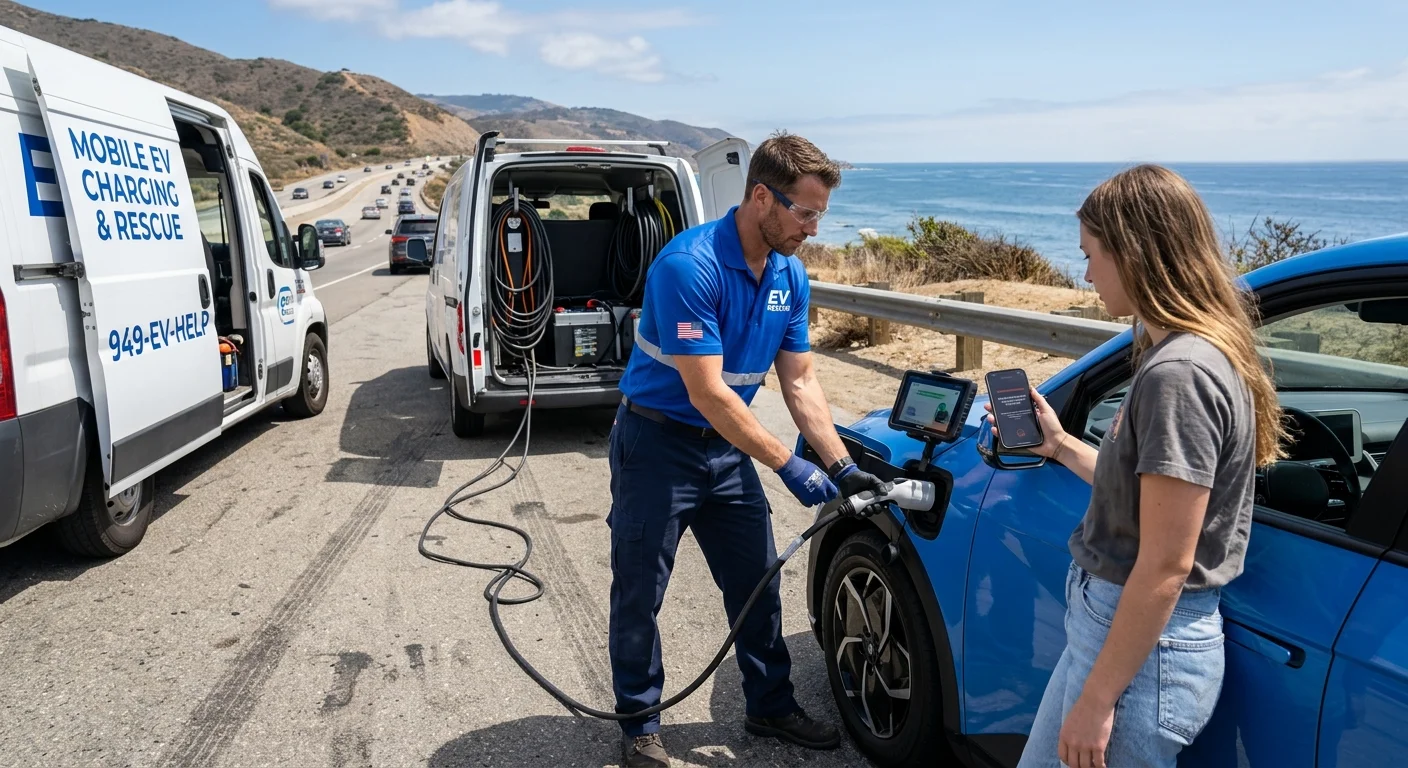
NDOT’s patrol lists jumps, not a pack charge
The NDOT Freeway Service Patrol covers the busiest Las Vegas Valley freeways. Quality Towing operates it, and GEICO sponsors it. Hours run from 5:00am to 8:30pm, seven days a week. The stop is free to motorists on those routes.
They list tire changes, jump starts, and fuel. The program clears about 55,000 incidents a year statewide. About 31,500 of those are in Las Vegas.
Fuel doesn’t help an empty EV pack at all. A jump doesn’t either, if the pack is the part that’s empty. NDOT’s public patrol pages don’t mention electric vehicles. They also don’t mention EV charging anywhere in those pages. Treat that as a silence in the brochure, not a ban on stopping. A patrol truck on I-15 may still try a jump. It isn’t selling a charge into the traction battery.
The same split shows up off the freeway. Harry Reid parking offers free battery jump starts and tire inflation at (702) 261-5122. That’s a 12-volt service at the airport lots in Paradise. It isn’t a published charge for the traction pack.
Nevada 511 and nvroads.com show closures and cameras. Nevada State Police Highway Patrol dispatches rotation tows at *647. Neither listing advertises mobile Level 2 charging at the car.
On a shoulder, NRS 484B.440 covers a vehicle that can’t keep moving. The statute doesn’t set any sit-time limit. NRS 484B.443 still lets officers remove a disabled car. On freeways and primary highways, abandonment can start after 24 hours. You’re on the hook for that removal bill. Don’t treat the stall like a parking space.
Nevada doesn’t have toll roads, express lanes, or transponders. I-15, I-215, CC-215, US-93, US-95, and I-11 stay free. None of that tells you which battery failed.
The 12-volt battery isn’t the pack
Your EV keeps a small 12-volt battery for boots, locks, and contactors. The traction pack under the floor drives the motors. They fail in different ways, and they need different help.
A flat 12-volt can make the whole car look dead. Screens stay dark, locks may not release, and drive won’t engage. The pack can still hold range after that. Independent operators in this network jump or replace that 12-volt battery on site.
An empty traction pack is a different stall. The dash may still wake on that stall. You might see a zero, or a charge warning. A jumper cable doesn’t add any driving miles. The operator then looks at a mobile charge or a tow.
People call both stalls dead, and that word hides the fork. Give the last percent you saw, and read every alert exactly. Say whether the car unlocked, and whether it entered drive.
Tesla, Hyundai, Ford, Rivian, and Chevy don’t share one jump map. The owner’s manual for that model year is the authority. Don’t copy another car’s clamp points from a video. For a Tesla-style 12-volt stall, start with Tesla 12V battery jump. For the wider split, read what happens when an EV’s 12V dies in the valley.
Heat in this valley knocks the small battery first
NWS Las Vegas puts the average July high at 104.5F. About 78 days a year reach 100F or more. About 9.4 days a year reach 110F or more. The record high is 120F, set on 2024-07-07. The airport heat island runs 5 to 15F warmer than outlying ground.
That’s why a car can sit full and still refuse to wake. It happens in long-term parking at Harry Reid. It happens in an event lot at Allegiant Stadium. In those lots, the 12-volt battery took the heat. The traction pack may still have miles left.
Heat also spends pack miles once you’re moving. Recurrent Auto found about 5% range loss at 90F. It found 17 to 18% loss at 100F. Don’t treat that study as Tesla’s own figures. Tesla hasn’t published a range-loss number we can cite.
Climbs on the west rim spend pack miles too. Summerlin sits near 3,500 ft and climbs toward 4,400 near Red Rock. Those climbs don’t diagnose a 12-volt failure on their own. They do explain a low pack after a day that started with range.
If the pack is empty, skip the jump request. Ask the matched operator about mobile EV charging. Operators in this network bring a 240V Level 2 source to the car. Teslas take a native NACS plug on that visit. Other EVs use a CCS or J1772 adapter. Charging time is typically 15 to 30 minutes for about 10 to 20 miles. Count that as charging time on the plug. It isn’t an arrival time for the truck.
Give the operator facts, not a guess
Start with make, model, and model year, because Tesla isn’t a procedure. A Model 3 and a Model X don’t share one 12-volt layout. Then give the last state of charge on the display. If the screen is black, say that instead of guessing.
Read each warning word for word on the screen. Don’t paraphrase an electrical-system alert as a dead battery. If several alerts show, read each one aloud. Describe the behavior you can see from the seat. Say if the key was recognized at all. Say if drive is available when you try.
Name a real pin, not Las Vegas as a blob. I-15 at Silverado Ranch isn’t US-95 near Indian Springs. The Strip sits in unincorporated Paradise and Winchester. Harry Reid sits in Paradise, not the City of Las Vegas. Say the place you’re actually sitting in now.
Mention access before anyone rolls out to you. A gate code or a parking structure changes the job. For the 12-volt how-to, use how to jump start an EV without hurting the 12V. It still doesn’t replace the manual for your car.
Skip the jump when the pack is the problem
An empty traction battery is the wrong job for a jump. A pair of jumper cables won’t refill that traction pack. That’s the fork between a mobile charge and a tow. Read AAA or a mobile charger when your EV is empty for that fork.
A jump also may not fit when the alerts don’t point at 12-volt failure. Crash damage and monsoon water in the port change the job. Don’t wrap those signs in a battery story.
NDOT’s patrol is a freeway program with published hours. It isn’t a driveway service for a dead pack in Henderson. GEICO is the published sponsor of that patrol. That still isn’t a promise your insurer will charge the high-voltage battery. For that overlap, read Geico roadside for a dead EV in the Las Vegas Valley. The matched operator quotes you before starting work. That operator bills you directly for the work.
We connect you. We don’t jump the car
Charge Pro LV is a referral line for the Las Vegas Valley. We match stranded EV drivers with independent local mobile rescue operators. We don’t hold a trade license, and we don’t own trucks or equipment. We don’t employ technicians, and we don’t set prices. We don’t promise when a truck arrives on scene.
You give the model, the alerts, the last percent, and the pin. We pass that request along to an operator. The operator decides whether a 12-volt jump, a pack charge, or a tow fits. You contract with that operator, and you pay that operator. Get the work, the quote, and the terms before anything starts.
If you want a network starting point, use EV roadside assistance. Call (702) 935-4699 when your EV won’t start on the road. Ask for an operator who can sort jump versus charge.