You are three miles into the Scenic Loop and the gauge shows 4 percent. The next climb sits in front of you, the timed-entry window is closing, and there is no charger on the loop. A dead EV on the Red Rock scenic loop is a different rescue than a Strip self-park stall. Here is the right next step.
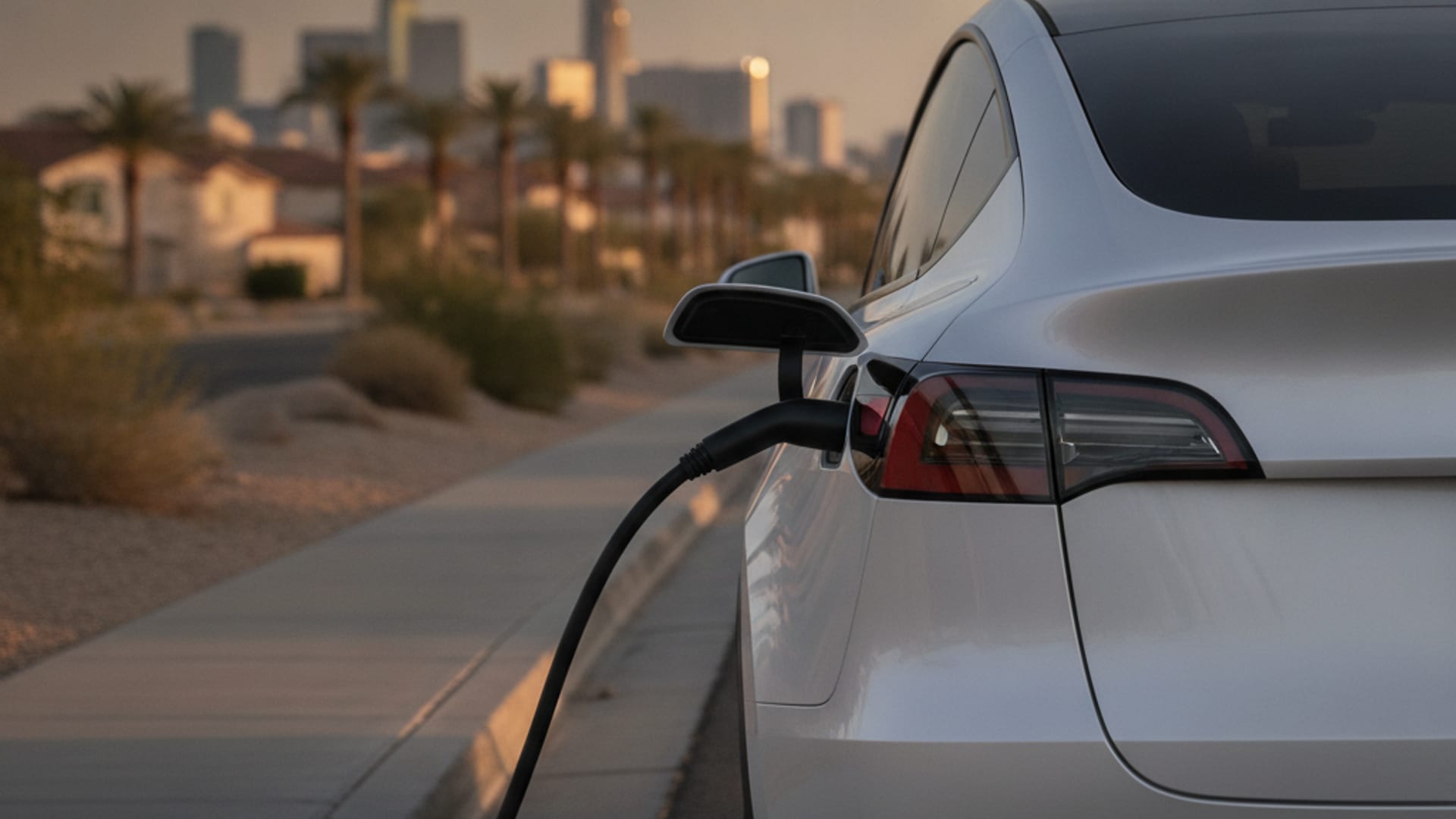
Why the loop is a 13-mile budget, not a drive
The Scenic Loop runs about 13 miles one way through Red Rock Canyon National Conservation Area. BLM manages the area. Timed-entry reservations run October 1 through May 31. The road climbs and falls as it winds through the Calico Hills. The first three miles include a steady grade that takes energy the rest of the loop does not return.
Summerlin already sits near 3,500 ft. The land keeps climbing toward about 4,400 ft near Red Rock. A driver who left home at 90 percent has spent 10 to 15 percent before the loop entrance. The loop adds another 10 to 15. The math is unforgiving in summer.
NWS Las Vegas averages a July high of 104.5F at KLAS. About 78 days a year reach 100F. The all-time record is 120F, set on July 7, 2024. The west rim runs cooler than the airport, but the rim still bakes in afternoon sun. Cabin cooling on the climb draws 3 to 5 kW, per Recurrent Auto’s measurements. That load is on top of the grade.
What a Red Rock stall actually looks like
The loop has narrow shoulders in places and wide pull-outs in others. A car that stops on a climb often rolls back to the nearest pull-out before the driver sets hazards. A car that stops in a low spot between climbs may be blocking the lane. That is the moment to get out of the vehicle and away from the travel lane.
NDOT’s Freeway Service Patrol covers the busiest Las Vegas Valley freeways from 5:00am to 8:30pm. Quality Towing operates it and GEICO sponsors it. The published patrol covers tire changes, jump starts, fuel, minor fire suppression, and traffic control. It does not advertise EV charging. The Scenic Loop is not a state freeway. That patrol does not cover it.
NRS 484B.440 lets a disabled vehicle stay when it cannot avoid stopping. The statute sets no time cap. NRS 484B.443 lets law enforcement remove a vehicle treated as abandoned. On freeways and primary highways the mark is 24 hours. On other roads it is 72 hours. The owner pays removal. A car on the Scenic Loop will sit. It will not be removed overnight by BLM unless it blocks the lane.
What to do in the first ten minutes
Set hazards. Get out of the vehicle on the uphill side if the road has a grade. Move past the shoulder line. Do not stand downhill of a parked car on a slope. Carry water. The shade at a pull-out is partial at best.
Call the loop’s exit number if you have it. Call the BLM Red Rock visitor center for non-emergency help. For a medical emergency, dial 911. For a vehicle that will not move, the right call is the mobile rescue line.
Charge Pro LV connects stranded EV drivers with independent local mobile rescue operators. The operator brings a 240V Level 2 source to the pull-out. A typical session adds 10 to 20 miles of range in 15 to 30 minutes of charging. That is charge time, not an arrival clock. Charge Pro LV does not promise an arrival time. The operator quotes the work before they start.
For the loop approach, EV roadside assistance in Blue Diamond is the page for the launch town west of the Strip. EV charging and rescue in Summerlin and Red Rock covers the west-rim pattern from Summerlin.
Why the climb from Blue Diamond matters
The last settlement before the loop is Blue Diamond, a tiny village on SR-159. The ACS 2019-2023 figures put the village population at about 270. Valley Electric Association serves Blue Diamond, not NV Energy. The community sits at a higher elevation than Summerlin and a much higher elevation than the valley floor.
A driver who underjudged the climb ends up short at Blue Diamond on the way back. That is the most common valley staging area for the loop. It also produces the most common rescue call: a car that completed the loop on fumes and stalled before reaching SR-159.
If you stall in Blue Diamond, stay with the car if it is safe. Set hazards. Call the local line. The operator reaches Blue Diamond from the west side of the valley faster than a Las Vegas Strip-based tow. For the broader pattern, EV roadside assistance in Summerlin South covers the upper village stalls.
What the operator brings to a scenic loop call
A mobile rescue operator arrives with a 240V Level 2 source and the adapters the loop drives need. Tesla drivers use a native NACS plug. Other brands use a CCS or J1772 adapter. The operator brings the plug that matches the port on the stalled car.
Charge Pro LV is a referral line. It does not own trucks or chargers. It does not employ technicians. It does not hold a trade licence. The operator you reach quotes the job before they start and bills you directly. The pros in the network are licensed and insured.
A typical 15 to 30 minute charge adds 10 to 20 miles of range. That is enough to roll back to SR-159, to Blue Diamond, or to the first working charger the car can reach on flat ground. The climb out of the loop is the part that needs reserve, not the run down the loop. The operator’s job is to give you that reserve without a tow.
Mobile EV charging is the service page for that work. For the broader 12V risk that also stalls cars on the loop, what happens when an EV 12V dies in the valley explains the same pattern on the Strip.
How to leave for the loop without becoming this call
Top off the pack at home before you go. The wall plug is cheaper than the mobile operator. Leave Summerlin or Summerlin South with a real buffer, not a hopeful one. Treat the loop as its own budget of miles.
Precondition the cabin while still plugged in. Spend grid power, not pack miles. Open the windows for the first mile, then close them and run the compressor. That sequence reduces the peak load on the pack.
Watch the consumption number, not just the percentage. If the miles per kilowatt-hour drops below what the car shows on flat ground, the climb is doing more work than the estimate predicted. Slow down. Steady speeds spend less energy than hard launches, even in an EV.
Monsoon season runs July and August. Flash flooding hits the loop and SR-159. Detours in monsoon rain add miles on a thin pack. Check NWS Las Vegas forecasts before you drive out. For more on the loop and the BLM reservation window, BLM Red Rock Canyon is the managing agency’s page.
When the gauge hits single digits and you are still on the loop, do not gamble on the next pull-out. Set hazards, get uphill of the car, and call (702) 935-4699. Charge Pro LV connects you with an operator. For more on the valley map, start at EV charging in the Las Vegas Valley.
Frequently asked questions
Is there an EV charger on the Red Rock Scenic Loop?
No public EV charger sits on the loop. BLM manages the road. Top off at home or at a Strip garage before you drive out. Treat the loop as its own trip, not a stop between two larger towns.
What should I do if my EV dies on the Scenic Loop?
Set hazards, get uphill of the car if the road has a grade, and call (702) 935-4699. An operator brings a 240V Level 2 source to your pull-out. Charge Pro LV does not promise an arrival time. The operator quotes the work before they start.
Can NDOT’s Freeway Service Patrol help on the Scenic Loop?
NDOT’s patrol covers the busiest valley freeways. The Scenic Loop is not a state freeway. That patrol does not cover it. A mobile rescue operator is the path for an EV stall on the loop.
How much range does a mobile Level 2 charge add on the loop?
A typical session adds 10 to 20 miles in 15 to 30 minutes of charging. That is charge time, not arrival time. It is usually enough to reach Blue Diamond or SR-159 from a low pull-out.