July in the Las Vegas Valley is the real electric vehicle battery maintenance problem. NWS Las Vegas, at KLAS, records an average July high around 104.5F. About 78 days a year hit 100F or more. The east valley and downtown can run up to 11F hotter than the rim. Care here means following your maker in that heat island, not a mild-climate checklist.
The valley is one metro and several heat maps
NWS climate for this metro comes from Harry Reid International Airport in Paradise. That airport sits in unincorporated Clark County, not the City of Las Vegas. The urban heat island there runs 5 to 15F warmer than outlying areas. Pavement, resort towers, and stalled Strip traffic hold extra heat after sunset.
East-valley neighborhoods sit in the hotter slice. Whitney, Sunrise Manor, and Winchester take more of that island than the mountain rim. A car parked all afternoon in those lots starts the commute with a hot cabin. The pack is already working to stay in its temperature band.
The west rim is a different afternoon. Summerlin sits around 3,500 ft, rising toward 4,400 ft near Red Rock. The valley floor sits about 2,000 to 2,920 ft. Downtown Las Vegas and Paradise sit on the hotter floor. None of those elevations give you a verified miles-per-degree penalty. They explain why two valley cars see different cabin temps after the same errand.
We won’t invent a life-loss number for any one neighborhood. A pack that lives in the east-valley heat island needs a closer look. Check the maker’s heat settings more often than you would on the rim.
Independent tests, not a Tesla range chart
Cabin cooling is the first hit you feel. Recurrent Auto found about 5% range loss at 90F. The same study found 17 to 18% loss at 100F. Cooling a hot cabin drew 3 to 5 kW. Holding an already-cool cabin drew about 1 kW. AAA, in May 2026, measured 8.5% range loss at 95F. Those figures come from those labs. We didn’t find a Tesla-published range-loss number, so we won’t pin one on Tesla.
Longer wear is slower and harder to feel. Geotab found hot-climate batteries degrade about 0.4% per year faster than milder climates. Phoenix-style desert heat was the worst case in that dataset. About 9.4 days a year hit 110F or more here. The all-time record high is 120F, set on 2024-07-07. A Las Vegas July sits in that desert class.
Those studies still aren’t your car. Cell chemistry, age, charge habits, and parking all change the result. Use them as a reason to open the owner’s app. Don’t use them as a countdown to replacement.
Your maker still owns the charge-limit advice
Tesla, Rivian, Ford, Hyundai, Chevrolet, and Kia each publish their own traction-battery rules. Charge caps, scheduled charging, software updates, and service intervals differ by model. They also differ by cell chemistry. Makers change that guidance in the app. A blog can’t freeze it for you.
We can’t confirm one degradation rate for every EV in Clark County. We can’t confirm one percent to stop at. No source we checked publishes a single number that covers every pack. If a page tells you heat costs a specific share of battery life, it’s guessing. Your owner’s manual is the document written for your chemistry.
For tire rotations and cabin filters, use our EV maintenance schedule for desert owners. This article stays on the pack, the 12V, and valley heat.
Parked heat is a 12V problem as often as a pack problem
People say the battery died when they mean two different parts.
The traction pack is the large one. It shows as range on the dash. When it’s low, you still get warnings. The car usually keeps moving until the estimate hits the floor. That’s an empty-pack event.
The 12V battery is the small one. It runs locks, the screen, and the computer that wakes the high-voltage system. When the 12V fails, the car can look dead with a full traction pack. The display stays black. The car never starts, because the low-voltage side has no power.
July parking is hard on that small battery. A long sit in a Paradise resort lot cooks the cabin. So does a downtown garage or an east-valley driveway. The 12V still supports always-on electronics while you shop. Fine at lunch and silent at 6 p.m. means start with the 12V. Don’t assume pack damage yet. Tesla 12V failure in valley heat covers that split for Tesla owners. Other brands fail the same way: dark cabin, recent healthy range, no wake.
A depleted traction pack on I-15, I-215, or US-95 is a charging problem. A dead 12V in a driveway is a jump or replacement on site. Mixing those up is how people request a tow they didn’t need. It’s also how they request a charge that can’t wake a dark car.
Night charging is pack care on NV Energy’s clock
NV Energy, as Nevada Power Company, serves most of this valley. Las Vegas, North Las Vegas, Henderson, and Paradise sit on that map. So do Winchester, Spring Valley, Enterprise, Sunrise Manor, Summerlin, and Whitney. Boulder City has its own municipal utility, powered largely by Hoover and Glen Canyon hydro. Valley Electric Association serves Blue Diamond, Indian Springs, and Sandy Valley. Overton Power District No. 5 serves Moapa Valley, Overton, Logandale, and Moapa. Those last groups shouldn’t use NV Energy’s EV pages as their rulebook.
NV Energy names a Residential Electric Vehicle Recharge Rider. The EV charging window runs from 10:01pm to 8:00am. The Residential Managed Charging Program is active. Its handbook was revised 2026-07-29. This site doesn’t publish rebate dollars. Confirm the current rider on nvenergy.com before you change a schedule.
Finishing a charge in overnight air still helps pack temperature the next afternoon. A high state of charge through a 104F peak is what makers warn against. The exact percent cap is in your app, not here.
Plan the route you can finish, not a stall count
Public charging inventory for Clark County isn’t something we could verify. The NREL station API was in a DNS outage on 2026-09-18. Tesla’s site blocked automated access. This page won’t guess a charger count. It also won’t estimate how far the next plug sits.
Plan the physics you can see. Precondition the cabin on plug power when you can. Then the 3 to 5 kW cooling load doesn’t come from the pack at pull-out. Leave a buffer on any 100F day. Grades spend range even when the map looks short. The Red Rock scenic loop is 13 miles and still climbs. Kyle Canyon Road climbs toward Mount Charleston, where the town sits around 7,506 ft. I-15 south through Jean toward Primm is heat plus a headwind on many afternoons. Lake Mead National Recreation Area and Hoover Dam sit lower, then you climb home.
Check a live charging map before you commit to those runs. Treat a listing as a listing, not a guarantee the stall works. If you’re already thin, stretch remaining range in valley heat covers the in-car steps. That’s a last-miles habit. It isn’t a plan for leaving empty.
Monsoon months are July and August. Flash flooding hits washes and underpasses. A wet charge port after a storm is a different problem than heat. Dry the port and follow the maker before you plug in.
Empty pack, dead 12V, or a shop visit
The next call depends on which battery failed.
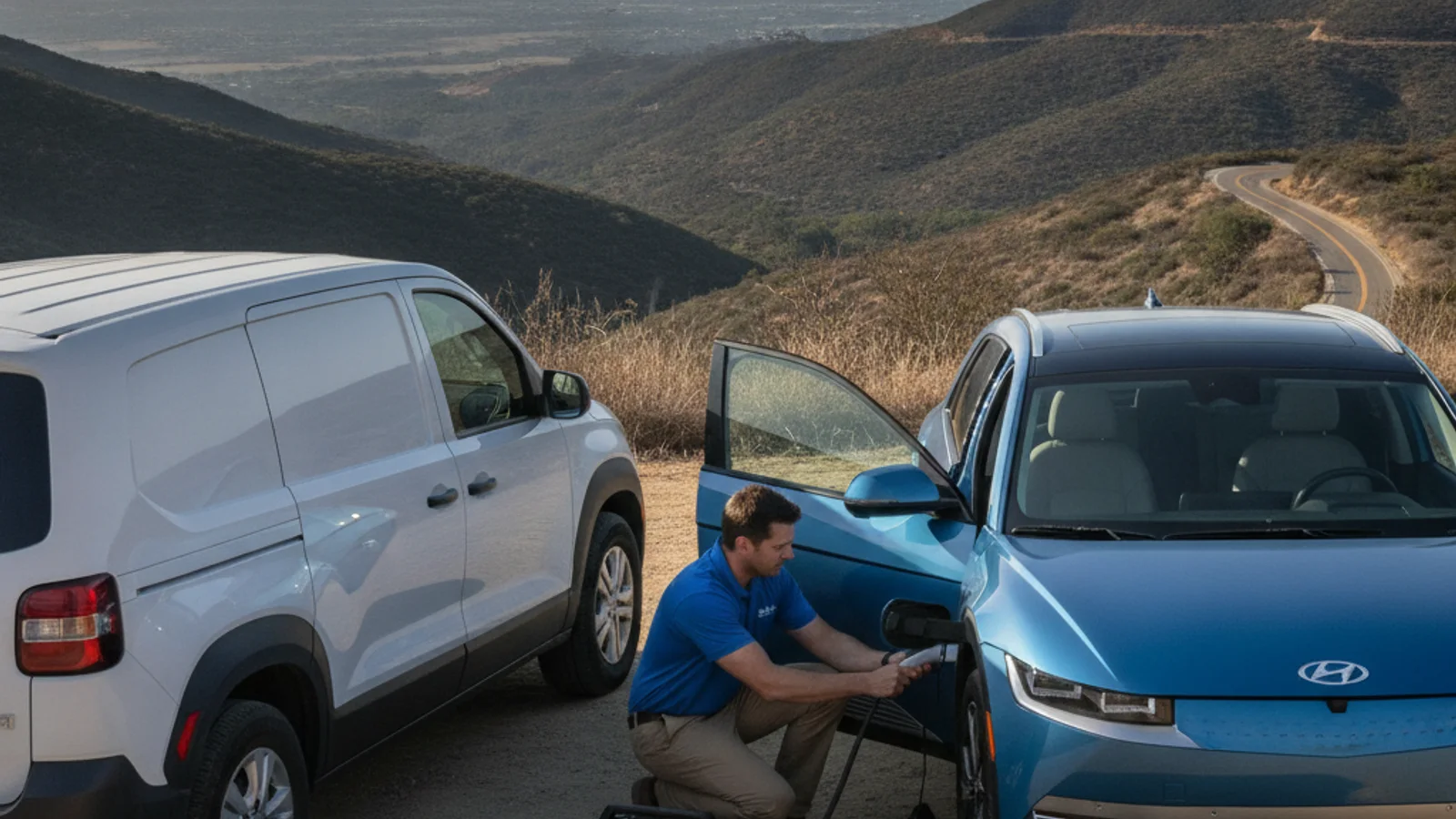
If the traction pack is empty and the car is reachable, that’s on-site charging. Charge Pro LV is a referral line. It matches you with independent local mobile rescue operators. It doesn’t own trucks or employ technicians. Operators bring a 240V Level 2 source to the car. They use a native NACS plug, or a CCS or J1772 adapter. They typically add 10 to 20 miles in 15 to 30 minutes of charging. That’s charging time only. Nobody here promises an arrival clock. The operator quotes before work starts and bills you directly. Use out-of-charge recovery when the pack is the issue.
If the car won’t wake and the 12V is the likely cause, that’s a jump. A 12V swap at the car is the other on-site path. EV roadside assistance is the request for that. The high-voltage pack often never enters the job.
If the car charges, drives, and wakes, a roadside call isn’t the diagnostic. A state-of-health test or warranty read belongs at the maker’s service center. Roadside work gets you moving. It doesn’t replace a dealer diagnostic.
NDOT’s Freeway Service Patrol runs on the busiest valley freeways. Hours are 5:00am to 8:30pm, seven days a week. Quality Towing operates it. GEICO sponsors it. Published FSP materials don’t advertise EV charging. The patrol still does jumps, tire changes, and traffic control. NRS 484B.440 exempts a vehicle disabled so it cannot avoid stopping. NRS 484B.443 lets law enforcement remove a disabled or abandoned vehicle. On freeways and primary highways, a vehicle can be treated as abandoned after 24 hours. On other roads it’s 72 hours. Nevada 511 and nvroads.com show closures and cameras.
If you’re already stuck in the heat
An empty pack after a 104F day is usually empty, not failed. A dark car after a long hot sit is often the 12V. Sort that before you request a wrecker.
If the traction battery is depleted in the Las Vegas Valley, that’s a rescue call. If the car won’t respond and you suspect the 12V, that’s a rescue call too. Call (702) 935-4699 and we’ll connect you with a local operator. They quote on scene. They bill you directly.