You’re stuck on a valley shoulder and the car won’t move. The EV battery types that matter right now aren’t cell names on a spec sheet. They’re the traction pack that stores drive energy. They’re also the small 12-volt system that wakes the car. Pack chemistry can change what a roadside operator may do after that split. It doesn’t replace the split.
Start with the two batteries every EV carries
Every electric car in the Las Vegas Valley has two battery systems. They do different work.
The traction battery is the big pack under the floor. It feeds the motor. It’s the one you charge at home or at a public plug. Drivers usually mean this pack when they say “EV battery.”
The other system is the 12-volt battery. It doesn’t move the car. It runs computers, locks, lights, and the screen. It also runs the relays that connect the main pack. If that small battery fails, the car can go dark. A full traction pack can still sit underneath, unused.
That’s the roadside split. An empty traction pack is an energy problem. A dead 12-volt is a wake-up problem. Get that wrong and the operator starts the wrong job.
Heat makes both systems louder here. NWS Las Vegas records an average July high of 104.5F. About 78 days a year hit 100F or more. About 9.4 days hit 110F. The all-time record at the official site is 120F. It was set on July 7, 2024. The airport can run 5 to 15F warmer than outlying areas. The east valley and downtown can run up to 11F hotter than the rim. A pack that looked fine leaving Summerlin can sag after a sit. Paradise and Winchester lots hold that extra heat.
Tesla drivers can start with Tesla looks dead: is it the 12V or the high-voltage pack?.
What pack chemistry can change once you’re already stuck
Search results love chemistry names. NMC. LFP. NCA. Lead-acid 12-volt. Lithium 12-volt. Those labels are real. They aren’t a diagnosis by themselves.
Charge Pro LV has no verified table of pack voltage or cell mix. Capacity figures aren’t verified here either. If you need those numbers, use the current owner’s manual. The automaker’s own specs are the other safe source. We won’t invent them.
Here’s what chemistry can still change on site.
Traction chemistry can change how a hot pack accepts a charge. Valley heat already cuts range. Recurrent Auto found about 5% range loss at 90F. The same work found 17 to 18% loss at 100F. AAA, in May 2026, measured 8.5% range loss at 95F. None of those figures come from Tesla. Tesla hasn’t published a range-loss number we can cite.
That doesn’t tell an operator which cell supplier built your pack. It does tell them a hot pack may take energy slower. That happens after a long sit in the sun. The plug on the car still decides the adapter. Many Teslas take a native NACS plug. CCS or J1772 adapters cover most other EVs. Chemistry doesn’t swap the port.
The 12-volt chemistry split is more immediate. Some Teslas now use a lithium 12-volt battery instead of a lead-acid one. A jump that’s fine on one type can be wrong on the other. Newer Model 3 and Model Y owners hit this after a hot park. Start with New Model 3 or Y lithium 12V is dead: what valley owners should do. Don’t copy a jump video from a different year.
Non-Tesla layouts vary too. A Rivian, a Mustang Mach-E, and a Hyundai Ioniq don’t share Tesla jump points. That’s why non-Tesla EV rescue is its own call, not a Tesla variant.
Chemistry talk belongs in the call once the operator knows which battery failed. It doesn’t belong as the first thing you read while traffic passes.
Read the car, not a chemistry thread
Two facts do more work than any spec sheet. Name the exact vehicle. Repeat the dashboard message word for word.
Give make, model, and model year. Jump points and service modes change across years from the same brand. “It’s a Tesla” isn’t enough. A Model 3 lithium 12-volt isn’t a Model S lead-acid 12-volt.
Then read the screen, if it still lights. A range readout at empty, or “0 miles,” points at the traction pack. A black screen points at low-voltage. So does a handle that won’t present. So does a message that names the 12-volt or auxiliary battery. “It just died” tells an operator almost nothing. “The screen went black in the Allegiant Stadium lot” tells them a lot.
Note what still works. Interior lights and the phone app run on the 12-volt system. So do the key fob and the charge-port door. If some of those still answer while the car won’t drive, say so.
Local setting matters for access, not for chemistry. The Strip and Harry Reid International Airport sit in unincorporated Clark County. That’s Paradise and Winchester, not the City of Las Vegas. A stall on I-15 or I-215 is on a free road. So are CC-215, US-95, and I-11. Nevada has no toll lanes. An empty pack on that shoulder is still an empty pack. A dark 12-volt in a Henderson garage is still a 12-volt.
Elevation changes the load after you roll again. The valley floor sits about 2,000 to 2,920 feet. Summerlin sits near 3,500 feet and rises toward 4,400 near Red Rock. A climb spends energy. It doesn’t change which battery type failed on the shoulder.
Charge the pack, wake the 12-volt, or move the car
Once the vehicle and the message are clear, most calls fall into three buckets.
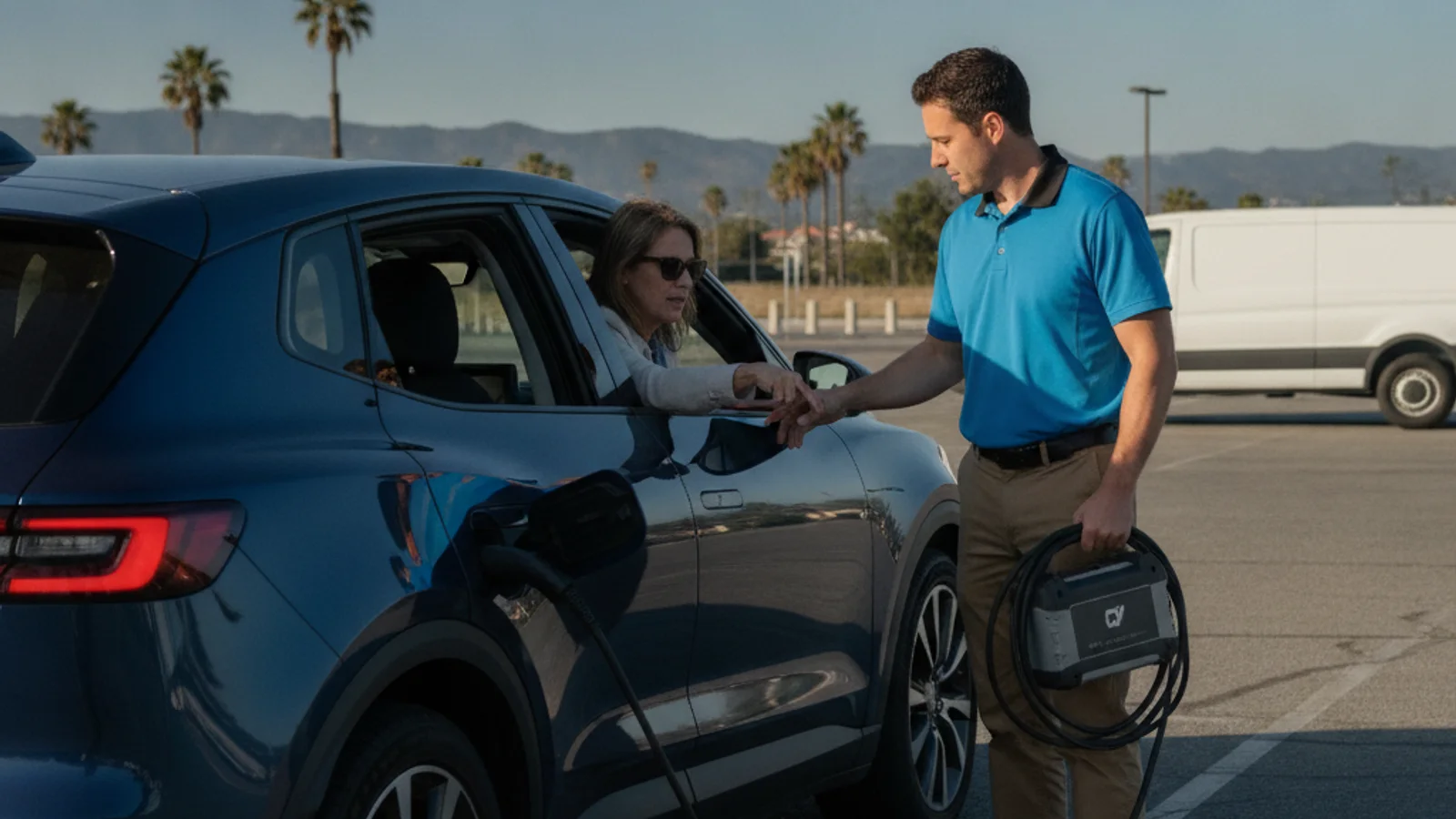
Mobile charging fits when the traction pack is empty and the car can be reached. The operators we connect you with bring a 240V Level 2 source to the car. They typically add 10 to 20 miles of range. That takes 15 to 30 minutes of charging. That’s charging time. It’s never an arrival time. The operator quotes you before starting and bills you directly. See mobile EV charging for that path.
A jump may fit when the 12-volt has failed. The maker has to allow a jump on that model. Some cars have a jump point in the frunk or behind a cover. Others don’t. Confirm the step with the operator first. Check the owner’s manual before anyone clips a cable. Read What happens when an EV’s 12-volt battery dies in the valley.
Transport fits when the cause is unclear. It fits when gear can’t reach the car. It also fits when the maker sends you to a shop. Ask if the operator is unsure. A referral that starts with “we don’t know yet” is better than a guess.
NDOT’s Freeway Service Patrol covers the busiest valley freeways. Hours run 5:00am to 8:30pm, seven days a week. Quality Towing runs it. GEICO sponsors it. It’s free to motorists. NDOT’s published FSP materials don’t advertise EV charging or EV-specific service. That’s not the same as saying the patrol can’t help an EV.
If you’re disabled on a highway, NRS 484B.440 applies. It exempts a vehicle that can’t avoid stopping. The statute sets no time limit. NRS 484B.443 lets law enforcement remove a disabled or abandoned vehicle. On freeways and primary highways, a vehicle is treated as abandoned after 24 hours. On other roads it’s 72 hours. The owner pays removal. Don’t sit there guessing chemistry while that clock runs.
Nevada 511 and nvroads.com report conditions, closures, and cameras.
Confirm model steps in the manual
This article stays general on purpose. It can’t tell you where your jump posts sit. It can’t decode every warning string. It can’t say whether your maker allows a roadside 12-volt jump.
The current owner’s manual is the first check. Tesla’s service docs, Rivian’s owner resources, and each brand’s support line are next.
NV Energy serves most of the valley. Boulder City Utilities serves Boulder City. Valley Electric Association serves Blue Diamond, Indian Springs, and Sandy Valley. Overton Power District No. 5 serves Moapa Valley, Logandale, and Moapa. None of those utilities set the chemistry in your pack.
After you’re rolling again, start at the Las Vegas Valley EV charging hub.
If you can’t tell which battery type failed, say that on the call. An honest unknown is a better start than a chemistry guess.
Call when the car won’t wake or won’t take a charge
Call when the EV won’t power on. Call when it won’t charge. Call when a warning shows and you can’t classify it. The matched operator uses the vehicle details and the exact message. They sort charging, a jump, or a tow from there. Charge Pro LV is a referral line. It matches stranded drivers with independent local mobile rescue operators. It doesn’t own trucks. It doesn’t send employees to the car. The operator you’re matched with quotes before work starts.
The valley’s EV roadside assistance page walks that triage. Call (702) 935-4699 and we’ll connect you with a local operator.