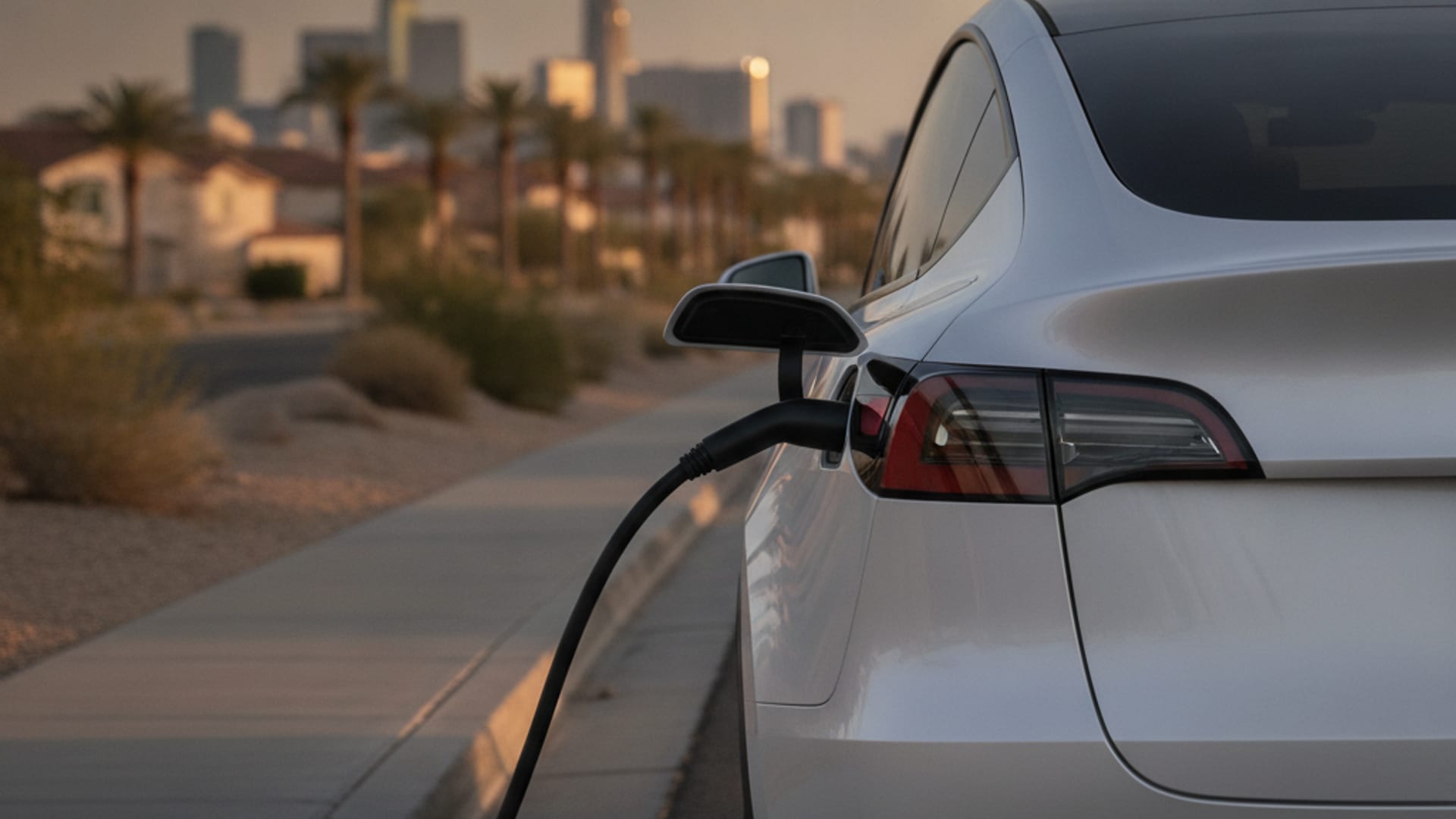
Your Tesla is dark in a Henderson driveway after a 105F day. The handles will not present. The screen is off. The phone key says the car was last seen this morning. Two failures can produce that scene, and the field test that separates them does not require a tool.
Why two failures can look the same
A Tesla runs a high-voltage pack for the drive motors. The same pack feeds a DC-DC converter that keeps the 12-volt system topped off. The 12-volt system powers door handles, screens, body computers, and the contactors that close the high-voltage bus.
A 12V that drops below its working voltage opens the contactors. The drive pack stays charged. The car cannot use it. The handles stay flush. The screen stays black. The car looks dead.
A drive pack that hits zero also produces a dark scene, but for a different reason. The contactors stay closed. The screen does not light. The handles do not present, because the 12V is also asleep from sitting without the DC-DC converter running.
In both cases, the car looks dead from the outside. The fix is not the same. The 12V needs a jump or a replacement. The drive pack needs a mobile Level 2 charge.
What valley heat does to each
NWS Las Vegas averages a July high of 104.5F at KLAS. About 78 days a year reach 100F. About 9.4 days reach 110F. The all-time record is 120F, set on July 7, 2024. The urban heat island adds 5 to 15F at Harry Reid. Downtown and the east valley can run up to 11F hotter than the rim.
The 12V lives the harder life in heat. Lead-acid cells lose capacity in heat faster than they lose it in cold. Tesla moved many Model 3 and Model Y cars to a lithium 12V around 2021. Both chemistries still age in heat. Cabin Overheat Protection and Sentry Mode draw the 12V during a long park. Tesla does not publish a published drain figure for either, so we do not quote one.
The drive pack holds less energy in heat, but it does not fail from sitting. Recurrent Auto found about 5 percent range loss at 90F and 17 to 18 percent at 100F. AAA, in May 2026, measured 8.5 percent range loss at 95F. Those are range losses, not pack failures. A pack that is at zero after a long sit was probably at zero before the sit.
The field test that separates the two
Step one is the screen. Press the brake pedal. If the screen wakes and shows a state of charge, the 12V is alive. The drive pack might still be the problem, but the 12V is not.
Step two is the app. Open the Tesla app on the phone. If the app still talks to the car, the network and the 12V are alive. The app is the cleanest signal because it depends on the cellular modem, which depends on the 12V.
Step three is the handles. Walk up with the phone key or the fob. If the handles present on approach, the body controller is awake. The 12V is healthy. The drive pack might still be empty, but the 12V is not.
Step four is the 12V jump. Use the documented jump points under the hood. On a Model 3 or Model Y, the jump points sit front right. On a Model S or Model X, the jump points sit in the frunk area near the firewall. If the jump wakes the screen and the drive pack shows charge, the 12V was the failure.
Do Teslas have a 12V battery is the short answer for any reader who has not met the small battery yet. The field test above is the next chapter.
When the 12V is the failure
The jump wakes the car. The screen lights. The handles present. The drive pack shows charge. The 12V was the failure. Plan a replacement, because the 12V that went flat once will go flat again, often sooner than the next long park.
Charge Pro LV is a referral line. It matches stranded EV drivers with independent local operators. The operator brings a portable jump pack and a replacement 12V for the common service. They quote you before they start and they bill you directly.
The pros in the network are licensed and insured. They handle Tesla and every major EV brand. They work in Strip self-park decks, in Henderson driveways, and at Harry Reid lots. The 12V jump is one of the most common calls in the metro.
For the broader picture, EV 12V battery replacement signs lists the warnings that show up before a full failure. Tesla 12V battery jump is the service page that explains the same procedure for any modern EV.
When the drive pack is the failure
The jump wakes the car. The screen lights. The handles present. The drive pack shows zero. The drive pack was the failure. The 12V is healthy. The right move is mobile Level 2 charging at the car.
The operator brings a 240V Level 2 source with a native NACS plug. A typical session adds 10 to 20 miles of range in 15 to 30 minutes of charging. That is charge time, not arrival time. Charge Pro LV does not promise when the operator arrives. The operator quotes the work before they start.
Charge Pro LV is a referral line. It does not own trucks or chargers. It does not employ technicians. It does not hold a trade licence. The operator you reach quotes the job before they start and bills you directly.
For the broader pattern, Tesla out of battery on a valley road covers the empty-pack case on the highway. Out of charge recovery is the service page for that work.
When both fail at once
A Tesla that sat through a long park with both the 12V and the drive pack at zero needs both fixes. The 12V comes first. The drive pack comes second. The operator handles both in sequence.
The 12V jump wakes the body controller. The operator seats a replacement 12V. The operator then brings the 240V Level 2 source and adds range to the drive pack. Both jobs are quoted separately. Confirm the numbers before the operator starts.
This pattern is rare in the Las Vegas Valley. Most dark Teslas in heat are 12V failures, not pack failures. The drive pack holds energy through a long park if it started with energy. The 12V does not.
A short plan for valley heat
Turn off Cabin Overheat Protection when you can. Turn off Sentry Mode when you can. Both settings draw the 12V faster than a typical overnight sit. The 12V still has a small parked load, but a smaller one.
Watch for the early warning signs. A sluggish wake, a slow screen, a hesitation in the handles. Those are the 12V asking for help before it goes dark. Tesla 12V warning signs before a valley stall covers that slow failure.
For more on the climate, the NWS Las Vegas climate page and the Recurrent Auto heat-loss data are the open sources.
When the car is dark and you cannot tell which failure it is, call (702) 935-4699. Charge Pro LV connects you with a local operator. For the broader valley map, start at EV charging in the Las Vegas Valley.
Frequently asked questions
How do I tell if my Tesla 12V is dead or the drive pack is empty?
Check the screen. If the screen wakes and shows a state of charge, the 12V is alive. If the screen is dark, the 12V is the working theory. A jump at the documented jump points confirms the diagnosis.
Can a Tesla drive pack fail from sitting in the heat?
A drive pack does not fail from sitting. It holds energy through a long park if it started with energy. Heat reduces range by about 5 percent at 90F and 17 to 18 percent at 100F, per Recurrent Auto. Those are range losses, not pack failures.
What should I do if both the 12V and the drive pack are dead?
The 12V comes first. The operator jumps or replaces it. Then the operator brings a 240V Level 2 source to add range to the drive pack. Both jobs are quoted separately. Confirm the numbers before the operator starts.
How long does a Tesla 12V last in a Henderson driveway in summer?
A 12V in a Henderson driveway in summer can fail in three to five years. Heat accelerates 12V wear. NWS Las Vegas counts about 78 days at or above 100F. Watch for warning signs before any long park.