EV roadside assistance in Mount Charleston is help on the Kyle Canyon climb. The run up SR-157 spends pack before you reach town at about 7,506 feet. Summit cold on freeze nights then takes more range than the descent gives back. Charge Pro LV is a referral line for stranded drivers. We match you with an independent mobile operator at the car.
Why this summit run spends pack on the way up
Mount Charleston is a small Spring Mountains resort community. Census ACS 2019-2023 figures put the population at 518. The ZIP is 89124, and the town sits at about 7,506 feet. Charleston Peak stands at 11,916 feet above it. The Las Vegas Valley floor is about 2,000 to 2,920 feet. SR-157 through Kyle Canyon is the road that connects those elevations. You’re climbing thousands of feet in one sitting. That’s a hard pull for any EV pack.
The United States Forest Service manages the Spring Mountains National Recreation Area here. People drive up for cooler air, trees, and a break from valley heat. The start of that trip is still desert-hot. NWS Las Vegas numbers at KLAS set the baseline. The average July high is 104.5F. About 78 days a year reach 100F or more. Recurrent Auto found about 5% range loss at 90F, and 17 to 18% loss at 100F. Air conditioning can draw 3 to 5 kW to cool a hot cabin, versus about 1 kW to hold it. You can spend a chunk of pack before the grade even steepens.
AAA, in May 2026 testing, measured 8.5% range loss at 95F. That’s another independent figure, not a Tesla claim. No Tesla-published range-loss number turned up for this site. Don’t plan the mountain on a window-sticker mile count. Plan it on a climb plus weather. Regen on the descent is real, but it’s not a refund. Gravity helps on the way down. It doesn’t repay heater load, climb work, and a cold soak. Drivers stall when they budget the round trip as if those were equal.
Freeze nights at the top undo the downhill miles
Valley winter looks mild on paper. The average January low at KLAS is 37F, with about 10 freeze nights a year. Mount Charleston town sits thousands of feet higher than that airport. A verified summit thermometer reading wasn’t in the research, so treat the top as colder than the valley log. Recurrent Auto found about 78% of maximum range retained at 32F. That share falls to about 70% at 20F. AAA measured 39.0% range loss at 20F in the same 2026 work. Cabin heat, defrost, and a cold pack all spend energy while you sit. The downhill run can’t print those miles back.
That’s the Mount Charleston pattern in plain words. You climb, you park, and a freeze night thins the morning range. The display looked fine at dusk. It doesn’t look fine after a freeze night. If you’re already low, call before the car hits zero. The mobile EV charging the operator brings is a 240V Level 2 source. Typical added range is 10 to 20 miles. Charging time is typically 15 to 30 minutes. That clock is plug time, never an arrival time. It’s often enough to get off the mountain, and it’s not a charge to full.
Older housing is common in this community. ACS 2019-2023 data shows 61.9% of homes built before 1980, the oldest share in the valley figures cited here. Cabin wiring varies, so confirm the outlet before you count on an overnight charge at a house. NV Energy serves Mount Charleston. If you charge at a cabin, NV Energy names a Residential Electric Vehicle Recharge Rider. The published EV charging window is 10:01pm to 8:00am. Confirm the current rider with NV Energy. Don’t treat that window as a roadside fix. A stalled car on SR-157 still needs a source at the pin.
Chain control, 511, and a disabled EV on the grade
Winter on this corridor is more than cold air. NDOT posts situational chain control on the reader boards. Check Nevada 511 and nvroads.com before you leave the valley. Those feeds report conditions, closures, and cameras. Chains change traction and speed, and they change how much pack the same miles will spend. A slow, chained climb is a longer pull on the battery.
If the car is already stopped, Nevada traffic law is specific. NRS 484B.440 lets a disabled vehicle stay when it can’t avoid stopping. The statute sets no time limit for that stop. NRS 484B.443 lets law enforcement remove a disabled or abandoned vehicle. A vehicle is treated as abandoned after 24 hours on freeways and primary highways. The window is 72 hours on other roads, and the owner pays removal. Don’t treat a mountain pullout as overnight parking.
The NDOT Freeway Service Patrol covers the busiest Las Vegas valley freeways. Hours are 5:00am to 8:30pm, seven days a week, and it’s free to motorists. Published FSP materials don’t advertise EV charging. That’s an observed silence, not a claim the patrol can’t help an EV. For an empty pack, you still want a mobile Level 2 source at the car. Nevada State Police Highway Patrol can be reached at cell shortcode *647.
SR-157 is still a long grade with weather in the mix. For a pack that already hit empty on this climb, read empty EV on Kyle Canyon Road. For Tesla-specific notes on the same corridor, see Model Y roadside help on Kyle Canyon.
Empty pack, or a 12V that won’t wake the car
Not every dead EV on this run is out of range. Cold, short trips, and accessory load can flatten the 12-volt battery. The high-voltage pack may still hold miles. The car just won’t wake, unlock, or go into gear. Independent operators in this network jump or replace a dead 12V on site. They handle Tesla and every major EV brand. Tesla uses a native NACS plug for a pack charge. Non-Tesla EVs use a CCS or J1772 adapter. Don’t guess which failure you have if the dash is dark. Tell the operator what the car is doing. A 12V wake and an empty-pack charge are different visits.
A tow is its own path. Tow operators in Nevada need a Nevada Transportation Authority certificate under NRS 706.4463 and related sections. Non-consent tow rates are operator-filed tariffs under NAC 706.408. There’s no single statewide maximum published here, so confirm any tow price with the company before you hook. If the car can take a charge, adding range at the pin often keeps you out of a yard.
What the operator brings, and what this brand never does
Charge Pro LV doesn’t own trucks, employ technicians, or set prices. It holds no license, publishes no business hours, and promises no arrival time. The independent operator quotes you before work starts. That operator bills you directly.
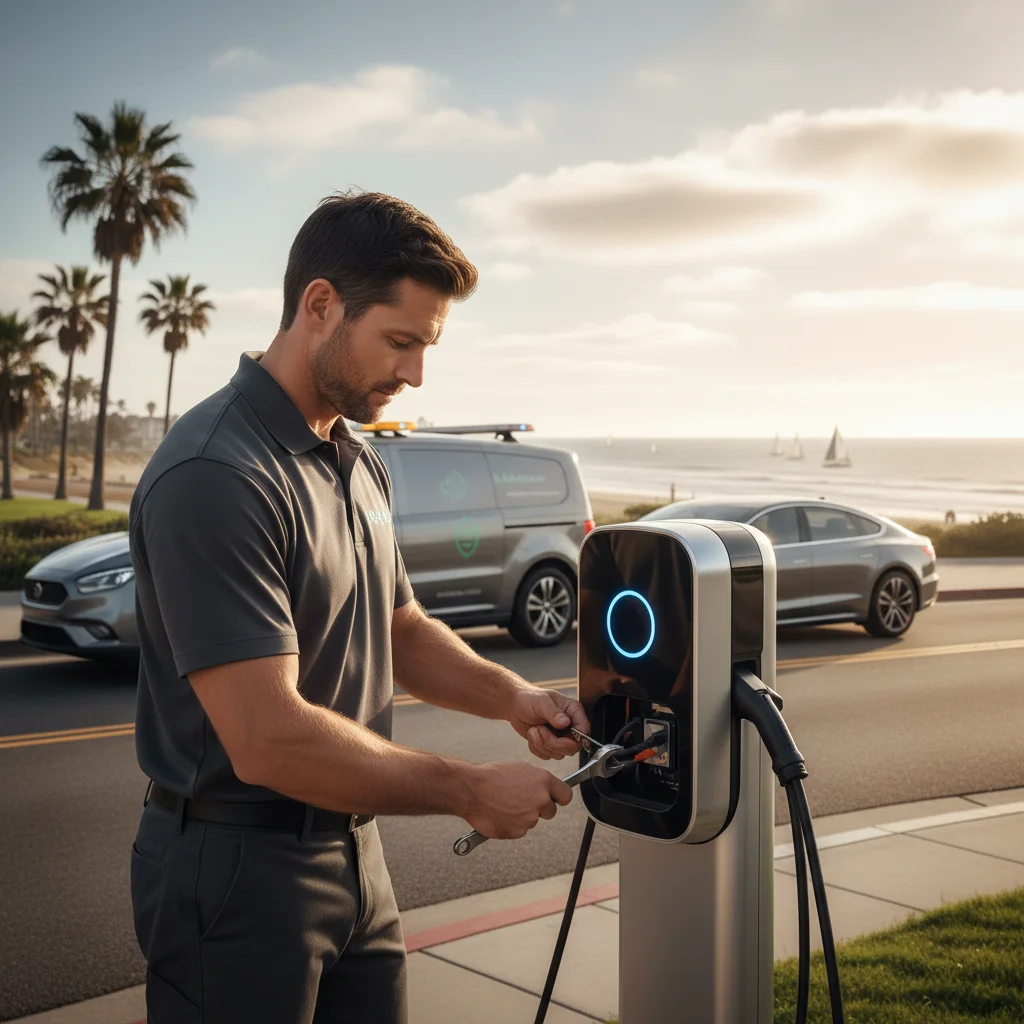
What they typically bring is a 240V Level 2 source at the car. Typical added range is 10 to 20 miles in 15 to 30 minutes of charging. Again, that’s charging time only. If you’re still rolling and the estimate is falling, slow down. Drop climate load if you can do it safely. Use how to stretch remaining range before the car stops. Out-of-charge recovery is the service for a pack at zero. EV roadside assistance covers the broader stall, including a 12V that won’t wake.
We serve Mount Charleston as part of the Las Vegas Valley. Local notes for this community live on the Mount Charleston page. You still have to budget the elevation.
Leave the valley with a round-trip plan
Charge in the valley before you point the car up SR-157. Don’t start the climb on a thin buffer. Heat on the floor spends miles, the grade spends more, and a freeze night at the town spends more again. Navigation that assumed a warm, flat loop will lie to you here. Add margin for heater load if you’ll stay after dark. Check nvroads.com if winter boards might show chains.
If you live in an older cabin, test the home circuit on a night that isn’t a trip night. A dead car on the road is a different problem than a slow overnight charge.
If the car stops, stay with it if you can do so safely. Use NRS 484B.440 as the rule for a disabled stop. Call the referral line and give a clear pin. The operator confirms the quote with you. You decide before any cable goes on.
Does Charge Pro LV cover Mount Charleston?
Yes, Mount Charleston is in the Las Vegas Valley service area. Charge Pro LV is a referral line. We match you with an independent operator at your pin. That operator quotes you before starting and bills you directly. The brand doesn’t own trucks or set prices.
Why doesn’t the descent give the climb back?
The climb to about 7,506 feet is a long, sustained pull. Regen on the way down recovers some energy. It doesn’t repay heater load, a cold pack, or the work already spent. Freeze nights at the summit make the gap wider. Budget the round trip as climb plus weather, not as an even out-and-back.
Empty pack or a dead 12V: what should I tell the operator?
Say whether the car will unlock and whether the dash lights. A dark car with a pack that still shows miles is often the 12V. A car that drives until the estimate hits zero is an empty pack. Operators jump or replace a 12V on site. They can also add Level 2 range through NACS, CCS, or J1772. Don’t wait for the last bar on a mountain grade.
If you need that match, call Charge Pro LV at (702) 935-4699. The operator quotes the work before anything starts.