An empty EV on Kyle Canyon Road needs a precise SR-157 pin. You’re on the climb toward Mount Charleston, not a valley lot. Elevation and empty road make turning around a real problem. Share your direction, dash messages, and access details. A local operator then quotes a mobile charge or a tow.
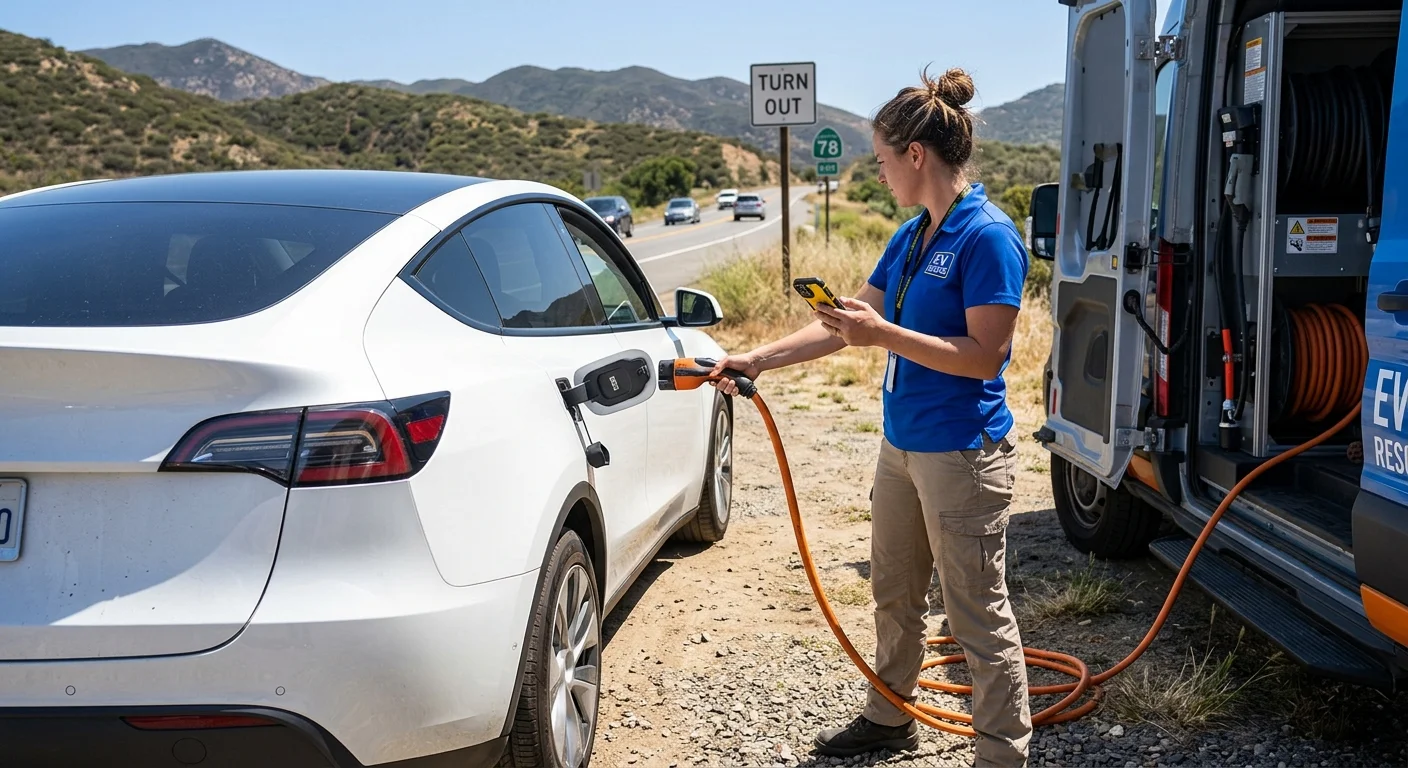
The climb toward Mount Charleston is a different stall
Kyle Canyon is the SR-157 run into the Spring Mountains National Recreation Area. The valley floor sits about 2,000 to 2,920 feet. Mount Charleston town sits about 7,506 feet. That gain is why a full-looking pack can empty on the grade. Maps may show ZIP 89124 along this corridor.
Range drops fast on this grade. That’s the local stranding pattern, not a guess about plugs. Heat on the valley floor can already cut range before you start the climb. Recurrent Auto found about 5% range loss at 90F. It found 17 to 18% loss at 100F. AAA measured 8.5% range loss at 95F. Those are study figures, not Tesla-published numbers. No Tesla range-loss figure could be confirmed.
Snow and chain conditions show up on the Mount Charleston approach. Nevada 511 and nvroads.com report closures, cameras, and current conditions. Check them before you keep climbing on a thin pack.
There’s a long stretch of empty road between the valley and Mount Charleston. Few cars and few turnouts make a U-turn a poor plan. If the car is already stopped, stay with a clear location report. Don’t spend the last bar hunting a better shoulder you can’t reach.
Our Kyle Canyon roadside page covers Model Y help on this same climb. The Kyle Canyon charging hub is the local landing page for this corridor.
Make the scene safe before you talk recovery
Your first problem is traffic, not the battery percent. If the EV is already off the travel lane, say so. If it isn’t, describe the lane, grade, and sightlines before you try another move.
This page can’t tell you to stay inside, exit, or roll the car. Stopping places on SR-157 differ, and no verified shoulder playbook exists for this climb. Immediate danger means you call 911 and follow the people who arrive.
Don’t assume the next turnout is reachable. A car at zero may not complete another pull-off. Report whether it still selects drive, steers, or releases the parking brake. Don’t test those if the test would put anyone in the lane.
Nevada law addresses a disabled stop. NRS 484B.440 exempts a vehicle that can’t avoid stopping from the no-stopping-on-highway rule. The statute sets no time limit for that stop. NRS 484B.443 still lets law enforcement remove a disabled or abandoned vehicle. The abandoned clock is 24 hours on freeways and primary highways. It’s 72 hours on other roads. Confirm with the officer which clock applies here. If the vehicle is removed, the owner pays that removal.
NDOT’s Freeway Service Patrol covers the valley’s busiest freeways, not this mountain climb. None of the patrol’s published materials mention EV charging. That’s an observed silence, not a claim they can’t help. For Kyle Canyon, Nevada State Police Highway Patrol is the dispatch path. Use cell shortcode *647, or Southern Command at (702) 486-4100.
If an officer or road worker is already there, tell the operator. Repeat any move-or-remove order you’ve been given. That order can close off a charge-in-place plan.
Pin one spot on SR-157, not the whole canyon
Kyle Canyon is a long canyon, not a parking space. An operator needs one stopping place.
Share what you can actually read:
- SR-157, said as it appears on the sign
- Up toward Mount Charleston, or down toward the valley
- The nearest named road, trailhead, or signed junction
- A live map pin from your phone
- Whether you’re in the lane, a turnout, or private property
- Which side of the pavement you’re on
Read labels as printed. Don’t invent a mile marker you can’t see. If the app and the sign disagree, send both.
Side of the road matters on a two-lane mountain alignment. A pin can sit close and still send help to the opposite bank. Mention barriers, snow berms, closed gates, and separate driveways when you can see them. Don’t assume a closed access is a public turnout.
The Mount Charleston rescue guide is the summit-side companion. Use it if you’ve already reached the town and still can’t move.
Copy the dash. Don’t diagnose the pack yourself
A silent EV hasn’t told you which battery failed. Empty traction pack and dead 12-volt look similar from the shoulder.
Useful notes include:
- Displayed percent or estimated miles
- Any out-of-energy wording
- Any low-voltage warning
- Whether the main screen stays on
- Whether doors and the charge port still respond
- Charging, electrical, or system-fault text
Open the car’s app if it still connects. Missing app data isn’t a diagnosis. Report what it shows and when it last updated. A screenshot preserves wording that later vanishes.
If the car reports low voltage, say that. Don’t call it an empty drive battery unless the car also reports depleted charge. A zero-charge message isn’t a 12-volt failure either. Keep the two stories separate.
Don’t open panels or try a guessed jump from another car. The matched operator confirms the vehicle and the right response. Charge Pro LV doesn’t diagnose the car and doesn’t do the roadside work.
Independent operators in this network handle Tesla and every major EV brand. They can jump or replace a dead 12-volt on site when that’s the fault. They can also bring a 240-volt Level 2 source to the car. Tesla cars use a native NACS plug. Other EVs use a CCS or J1772 adapter. Tell the operator the make, model, year, and port type.
For the charge-versus-jump-versus-tow fork, see charge, jump, or tow when the EV dies.
Describe the last stretch of access
A correct pin still hides the last approach. SR-157 is a mountain two-lane with turnouts, gates, and winter clutter. Say how equipment would actually reach the charge port.
Tell the operator whether the car is:
- Beside a live travel lane
- In a marked turnout or a pull-out
- Behind a gate or on private land
- Nose-in or tail-out relative to the access
- Blocked by snow, another vehicle, or a fixed object
Report space around the charge port. Name the port’s side if you know it. Don’t roll the EV just to make room.
Mention locked doors, a missing key, or crash damage. Say if a tire is flat or the wheels won’t roll. If the ground isn’t yours, say whether you can admit the operator.
Ask the operator to confirm the connector and the charging output before you accept. Don’t assume every mobile unit fits every EV. Confirm equipment, access, and the quote with the operator who would do the work.
Pick a mobile charge or a tow, then stop guessing
Mobile charging is one recovery path, not the default. The operator has to see whether the car can take energy where it sits. Ask the operator to confirm connector, output, and whether a tow is cleaner.
Don’t treat a charge as a set number of miles. Operators in this network typically add 10 to 20 miles of range. That takes 15 to 30 minutes of charging at the car. That’s charging time, never an arrival time.
A tow enters when the car won’t accept a charge. Tow operators in Nevada need a Nevada Transportation Authority certificate. Non-consent rates are operator-filed tariffs under NAC 706.408. There’s no single statewide maximum on this site. Confirm loading method, destination, and price with the tow provider.
If a charge is the plan, name the next place you’re trying to reach. Don’t rely on an unconfirmed plug. This page doesn’t publish charger inventories or distances to a plug. A public station list couldn’t be verified at research time. For a charge brought to the bumper, use mobile EV charging. For an empty-pack recovery decision, use out-of-charge recovery.
When to call Charge Pro LV
Call when the EV has stopped on Kyle Canyon Road. You need an operator to weigh a mobile charge or a tow. Charge Pro LV is a referral line. It matches stranded EV drivers with independent local mobile rescue operators. It holds no license, owns no trucks, and performs no work. The operator quotes you before starting and bills you directly. The pros we connect you with are licensed and insured.
Call (702) 935-4699 and we’ll connect you with a local EV rescue operator.