When your EV is already empty, EV charging levels decide what can still help. In the Las Vegas Valley, roadside Level 2 is usually the fit. It typically adds 10 to 20 miles of range. That takes 15 to 30 minutes of charging time. That window is charging time, not an arrival promise.
What EV charging levels actually mean
An EV charging level is the kind of power the pack can take. Level 1 and Level 2 send AC. DC fast charging sends DC instead. The DOE Alternative Fuels Data Center is the spec source used here. Your car still caps what it will accept. Heat and elevation change the result on valley roads.
Level 1 uses a 120-volt outlet
Level 1 runs on 120V AC, the voltage of a household outlet. DOE lists about 1.9 kW and a J1772 connector. It adds about five miles of range per charging hour. Eight hours can add about 40 miles on a midsize EV. Pack size, charge state, and temperature move the result. A spare outlet on a Paradise loading dock isn’t a rescue plan. Confirm the circuit and the owner’s manual before you plug in.
Level 2 is 240-volt AC, including at the car
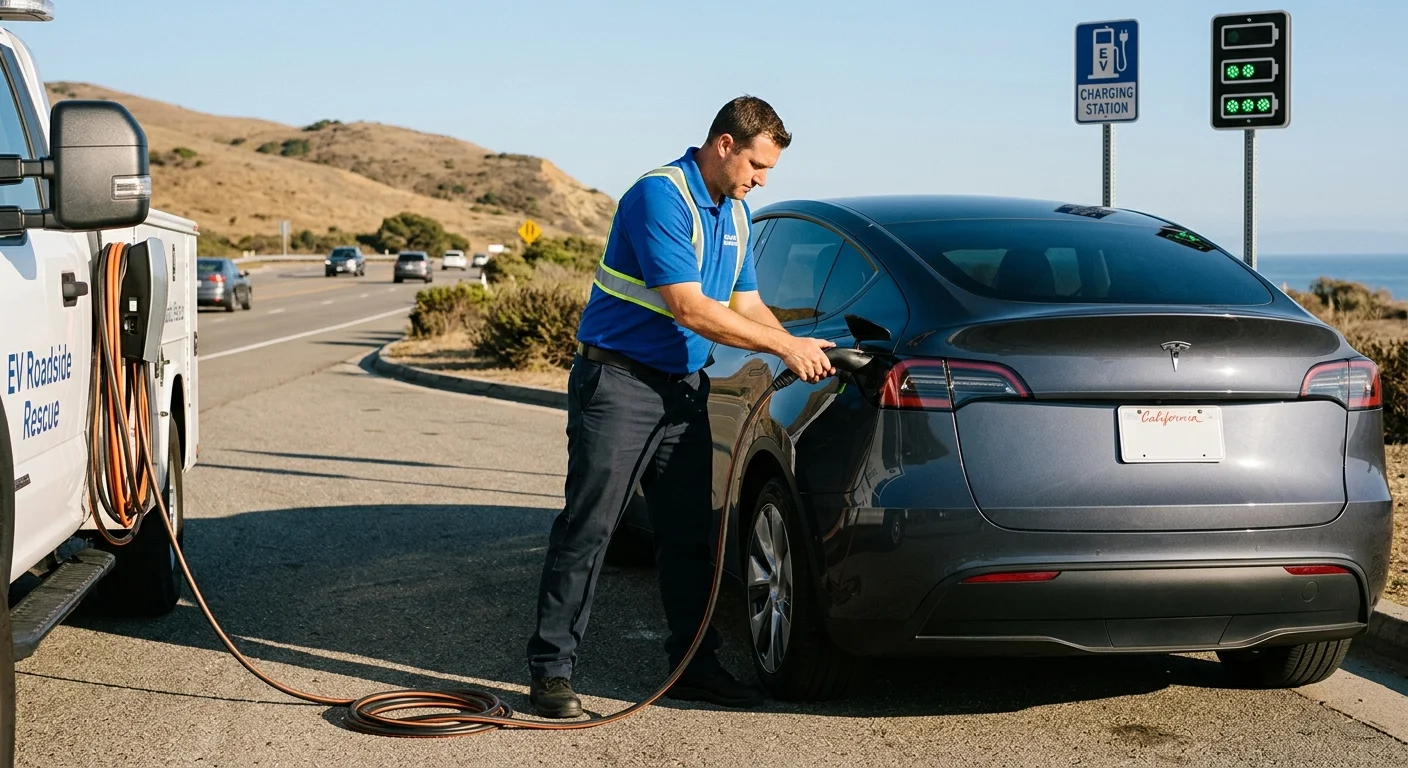
Level 2 uses 240V at home, or 208V in some commercial setups. DOE lists 2.9 to 19.2 kW. The residential standard is 7.2 kW. That’s about 25 miles of range per charging hour. Connectors include J1772 and J3400, also called NACS, on Teslas. Independent operators who come to a stalled car bring a 240V Level 2 source. Teslas take a native NACS plug. Other brands take a CCS or J1772 adapter. A typical rescue connection adds roughly 10 to 20 miles in 15 to 30 minutes of charging. It describes the size of the charge, not anyone’s arrival. If your usual backup is a wall unit, read when 240-volt charging at home isn’t an option.
DC fast charging is the public high-power stall
DOE lists equipment up to 500 kW. It may add about 100 to more than 200 miles in 30 minutes. Connectors include CCS, CHAdeMO, and J3400. DC fast charging sits at fixed public sites. It doesn’t follow you onto every I-15 or US-95 shoulder.
What can actually help once you’re already stopped
Speed only matters after you have a safe, compatible source. The 120-volt cable in the trunk doesn’t turn a freeway shoulder into a charging bay. Level 1 can fit a long sit in a legal spot with a dedicated, confirmed circuit. Don’t treat an unknown outlet as approved because the plug fits.
Level 2 is the roadside fit when the traction pack is empty and the car will take AC. The operator confirms the connector, the output, and the quote before starting. That session is mobile EV charging.
DC fast charging helps when you can still drive to a compatible public stall. If the pack is already at zero, that stall waits until the car can move. For that fork, see rapid charger near me, or a mobile rescue.
Start with the dash, not the chart. An empty traction pack points to charging or out-of-charge recovery. A car that won’t wake may be a 12V issue.
Why valley heat and climbs shrink what a level buys
NWS Las Vegas lists an average July high of 104.5F. About 78 days a year reach 100F or more. The record high is 120F, set on 2024-07-07. The airport heat island runs 5 to 15F warmer than outlying areas. East valley and downtown can run up to 11F hotter than the west rim.
Recurrent Auto found about 5% range loss at 90F and 17 to 18% at 100F. AAA, in May 2026, measured 8.5% range loss at 95F. None of those figures come from Tesla.
The valley floor sits about 2,000 to 2,920 feet. Summerlin sits about 3,500 feet and rises toward 4,400 near Red Rock Canyon NCA. Railroad Pass is about 2,360 feet on the Boulder City run. Mount Charleston town is about 7,506 feet. A Level 2 top-up can look fine on the Strip in Paradise. It can be a thin buffer on Kyle Canyon Road.
NV Energy serves most of the valley. Boulder City runs Boulder City Utilities, not NV Energy. Valley Electric Association covers Blue Diamond, Indian Springs, and Sandy Valley. Overton Power District 5 covers Moapa Valley, Logandale, and Moapa. NV Energy’s Residential Electric Vehicle Recharge Rider is a 10:01pm to 8:00am home-charging window. That overnight rate doesn’t help a car that died at noon in an Allegiant Stadium lot. Start with EV charging in the Las Vegas Valley.
The plug still has to match
The charging level doesn’t prove the plug will fit. J1772 is the common AC plug on Level 1 and Level 2. J3400, or NACS, is Tesla’s AC and DC standard. CCS adds DC pins to the AC inlet. Adapters vary by model year, so check the owner’s manual. Tell the operator the make, model, port, and dash message.
A Tesla on the Strip corridor and a CCS car in a Henderson lot aren’t the same call. Non-Tesla EV rescue exists because the adapter has to be on the truck. For the equipment itself, read what a mobile EV rescue truck brings to your car.
Harry Reid International Airport long-term parking isn’t the same as an I-15 shoulder near Silverado Ranch. A garage under a Paradise resort has height limits a Green Valley surface lot usually doesn’t. NDOT’s Freeway Service Patrol covers busy valley freeways from 5:00am to 8:30pm. It offers tire changes, jump starts, and fuel. Its published materials don’t advertise EV charging. The Nevada State Police Highway Patrol Southern Command takes *647, or (702) 486-4100.
When a mobile Level 2 session is the right next step
Mobile Level 2 fits when the traction pack is empty. The car has to accept the gear. Someone also has to reach it from a safe work spot. The goal is often just enough range to roll to a compatible public stall. Power, pack state, and temperature all move the result. Ask the operator what their equipment will do on your model.
Share make, model, displayed percent, connector, and the exact place. A dead car at the Las Vegas Convention Center is an access problem first. A car on the Red Rock 13-mile scenic loop is a heat and grade problem. So is one on the Lake Mead Nevada shore.
If the car is a hazard, call the authority that owns the road and follow their instructions. Don’t walk equipment across live lanes. NRS 484B.440 lets a disabled vehicle remain when it can’t avoid stopping. The statute sets no time limit. NRS 484B.443 still lets law enforcement remove a disabled or abandoned vehicle. On freeways and primary highways, abandoned treatment starts after 24 hours. On other roads it’s 72 hours, and the owner pays removal. There are no toll roads in Nevada. I-15 HOV lanes run from Silverado Ranch to the Spaghetti Bowl. They need two-plus occupants, 6-8am and 4-6pm weekdays. A solo EV doesn’t get an exemption.
Charge Pro LV doesn’t bring the power or do the charging. We match stranded drivers with independent local operators across the Las Vegas Valley. The operator quotes you before starting and bills you directly. We don’t set prices or arrival times.
When the car needs a move instead of a charge
A tow or recovery can fit when the port won’t take the connector. It also fits when the car won’t start charging, or the site isn’t safe for equipment. Those signs don’t prove a single fault.
Don’t copy another EV’s tow points. Confirm the method with the operator who will move the car. Nevada Transportation Authority rules cover tow operators. Non-consent tow rates are operator-filed tariffs under NAC 706.408. There’s no single statewide maximum published here.
Harry Reid parking sits in Paradise, in unincorporated Clark County. Airport parking offers battery jump starts and tire inflation at (702) 261-5122. Whether those lots have EV charging couldn’t be confirmed from the airport’s own site. Don’t count on a stall you haven’t seen in the lot. A jump from airport staff is a 12V service. It doesn’t refill a traction pack.
Call for a local operator
A mobile EV rescue operator may fit when the pack is empty. The car needs to be reachable, and Level 2 equipment has to match the port. If charging isn’t the right job, the operator can talk through recovery or a tow. Call (702) 935-4699 and we’ll connect you with a local operator.