A 240 volt EV charging station is Level 2 power at a parked car. In the Las Vegas Valley, many apartment drivers never get that plug. The pack then runs low away from the building. A mobile Level 2 charge at the car is the backup.
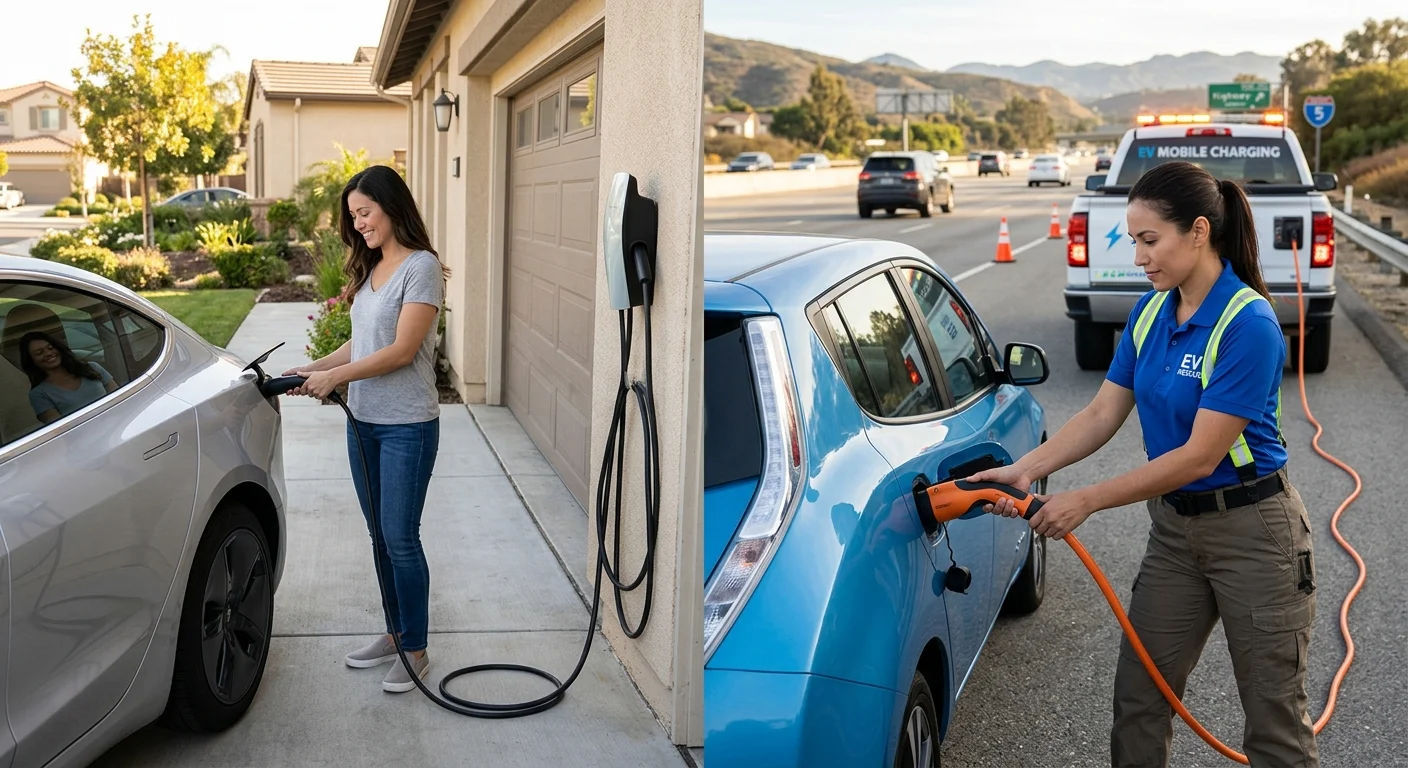
What Level 2 power is, and what it isn’t
Level 2 means 240-volt service in a residential setting. Voltage alone doesn’t set the charge rate. The circuit, the equipment, and the car all matter.
A home station is for planned overnight charging. You need a reserved stall and a circuit an electrician has approved. A roadside stop is a mobility problem. The car can’t reach a usable fixed plug. They don’t share the same gear or the same decision.
Level 1 uses a regular 120-volt outlet. It adds range much more slowly. Our note on whether a Level 1 charger is enough in valley heat covers that path.
Operators we connect you with typically add 10 to 20 miles. That takes 15 to 30 minutes of charging. That’s charging time at the car. It isn’t an arrival time. See EV charging levels for stranded drivers for how those categories change the call.
Why many valley rentals never get a home plug
Clark County Title 30 requires EV-ready wiring in new construction. Older buildings weren’t built under that rule. Winchester’s housing is among the oldest in the valley. More than half of that stock dates to earlier decades. That age is a panel and garage proxy, not a charging map. A licensed electrician still has to read the actual panel.
A renter in Sunrise Manor, Winchester, or Whitney may have no assigned 240-volt circuit. Confirm that with the property. A homeowner garage in Summerlin or Anthem is a different electrical world. The renter is often talking to a manager, not an electrician they hired.
Paradise holds Harry Reid International Airport and Allegiant Stadium. It’s unincorporated Clark County, not the City of Las Vegas. A resort-lot park in Paradise is one problem. A garage stall in Summerlin South is another.
Summerlin sits near 3,500 feet and climbs toward Red Rock. The valley floor runs about 2,000 to 2,920 feet. Henderson sits lower, around 1,867 feet. Elevation and heat both spend range.
NV Energy serves Las Vegas, North Las Vegas, Henderson, Paradise, Winchester, Spring Valley, Enterprise, Sunrise Manor, Summerlin, and Whitney. Boulder City runs its own municipal utility. Blue Diamond, Indian Springs, and Sandy Valley sit on Valley Electric Association. Confirm the utility on the bill before you ask about a home rate.
NV Energy publishes a Residential Electric Vehicle Recharge Rider. The named charging window is 10:01pm to 8:00am. It also lists Residential EV Charging Station Incentives and a Multifamily Charging program. Current rules live on nvenergy.com. Nevada has no state EV purchase rebate. No dollar figure for any incentive belongs here. Confirm every amount with the utility or the agency that offers it.
Permits decide the home path, not a referral line
A Level 2 home charger needs an electrical permit. Charge Pro LV doesn’t pull that permit. We don’t install stations, own trucks, or stock parts. We match stranded drivers with independent local operators.
The building department that covers the address sets the forms. Paradise and Winchester are unincorporated Clark County. Don’t use City of Las Vegas instructions for those streets. Confirm the current packet with the office that actually issues the permit.
Compare a home install with help at the car in home charger install versus mobile rescue. For panel capacity questions, see home panel upgrades for valley EV charging. Those are property jobs. They aren’t roadside jobs.
Ask the property who owns the stall, the panel, and the meter. A licensed electrician evaluates load, breaker space, and the proposed equipment. Charge Pro LV doesn’t make that property assessment.
Heat turns a missed overnight charge into a stall
NWS Las Vegas records an average July high of 104.5F. About 78 days a year hit 100F or more. About 9.4 days reach 110F. The airport heat island runs 5 to 15F warmer than outlying areas. The east valley and downtown can run up to 11F hotter than the rim.
Recurrent Auto found about 5% range loss at 90F. The same work found 17 to 18% at 100F. Cabin air conditioning can draw 3 to 5 kW to cool a hot interior. AAA, in May 2026, measured 8.5% range loss at 95F. Those figures are study results. They aren’t Tesla-published numbers.
A driver with only Level 1 starts a hot day closer to empty. So does a driver with no plug at all. That’s how a Whitney or Sunrise Manor commute becomes a shoulder stop. The missed charge is at the building. The stall is on I-15, I-215, US-95, or a resort lot in Paradise.
A day trip to Lake Mead NRA spends range you didn’t replace overnight. Red Rock uses timed-entry reservations from October 1 to May 31. Mount Charleston town sits about 7,506 feet. The climb from the valley floor is a hard draw. Leave with the energy you actually have, not the window-sticker range.
A car that sat through a game at Allegiant Stadium has been baking. If you left the apartment already thin, that lot is where the warning hits.
Harry Reid parking can jump a 12-volt battery at (702) 261-5122. Whether those lots offer EV charging isn’t on the airport site. Don’t treat a long-term stall as a home 240 volt EV charging station.
A wall outlet can’t help a car that’s already gone
A 240 volt EV charging station stays on the property. It can’t reach a car on I-15 between Silverado Ranch and the Spaghetti Bowl. Those HOV lanes are free. They still need two-plus occupants from 6-8am and 4-6pm on weekdays. Nevada has no single-occupant EV HOV exemption.
A nearby wall cord isn’t a charging plan. The plug can look familiar and still be the wrong circuit. The property owner, the circuit, and the car all have to line up. Don’t plug into a random building.
The pack may be too low to roll to a stall you already know. The car then needs energy where it sits. We don’t publish charger counts or distances. Confirm the stall you plan to use before you move.
A dead 12-volt battery can look like an empty pack. The car may not unlock or wake. Tell the operator the warnings on the screen. Adding traction energy won’t fix every fault.
Smoke, fire, a crash, or a live traffic lane is an emergency first. Call 911. NDOT’s Freeway Service Patrol covers the busiest valley freeways from 5:00am to 8:30pm. The patrol is free to motorists. Quality Towing runs it, with GEICO as sponsor. Published patrol materials don’t advertise EV charging.
If the car is still at the apartment, a failed wall box is an install question. If the car is away and can’t reach a plug, out-of-charge recovery is the service path.
What a mobile Level 2 stop can do
Mobile charging fits when the EV can accept compatible power where it sits. The goal is enough range to move. It isn’t a full home session. Operators typically bring a 240-volt Level 2 source. Tesla cars use a native NACS plug. Other brands use a CCS or J1772 adapter. Start that referral on the mobile EV charging page.
Share the make, model, year, connector, remaining charge, and exact location. Say whether the car can shift or steer. The matched operator quotes you before work starts. That operator bills you directly. Charge Pro LV sets no price and promises no arrival time.
Renters comparing a portable home battery with help at the car can read this apartment-plug guide.
Transport is the better path when the car won’t accept power. It also fits when the spot is unsafe for charging. Nevada law lets a disabled vehicle stay on the highway when it can’t avoid stopping (NRS 484B.440). After 24 hours on freeways, law enforcement may treat it as abandoned (NRS 484B.443). Tow rates are operator-filed tariffs under the Nevada Transportation Authority. There’s no single published maximum on this site. Ask the operator for the quote.
When to call
Call when the car can’t reach a usable charger. You need an operator to assess a mobile charge or a tow. Charge Pro LV is a referral line for the Las Vegas Valley. We connect you with licensed, independent local operators. We don’t perform the work. Call (702) 935-4699 and we’ll match you with a local EV rescue operator.