A Level 2 charger that trips the house breaker is rarely a random glitch. In the Las Vegas Valley, that trip usually means the circuit can’t hold the load. Older garage panels and shared 240-volt runs are common here. Stacked ground-fault gear and monsoon moisture show up too. A single trip can be coincidence. A trip that repeats in minutes is a message.
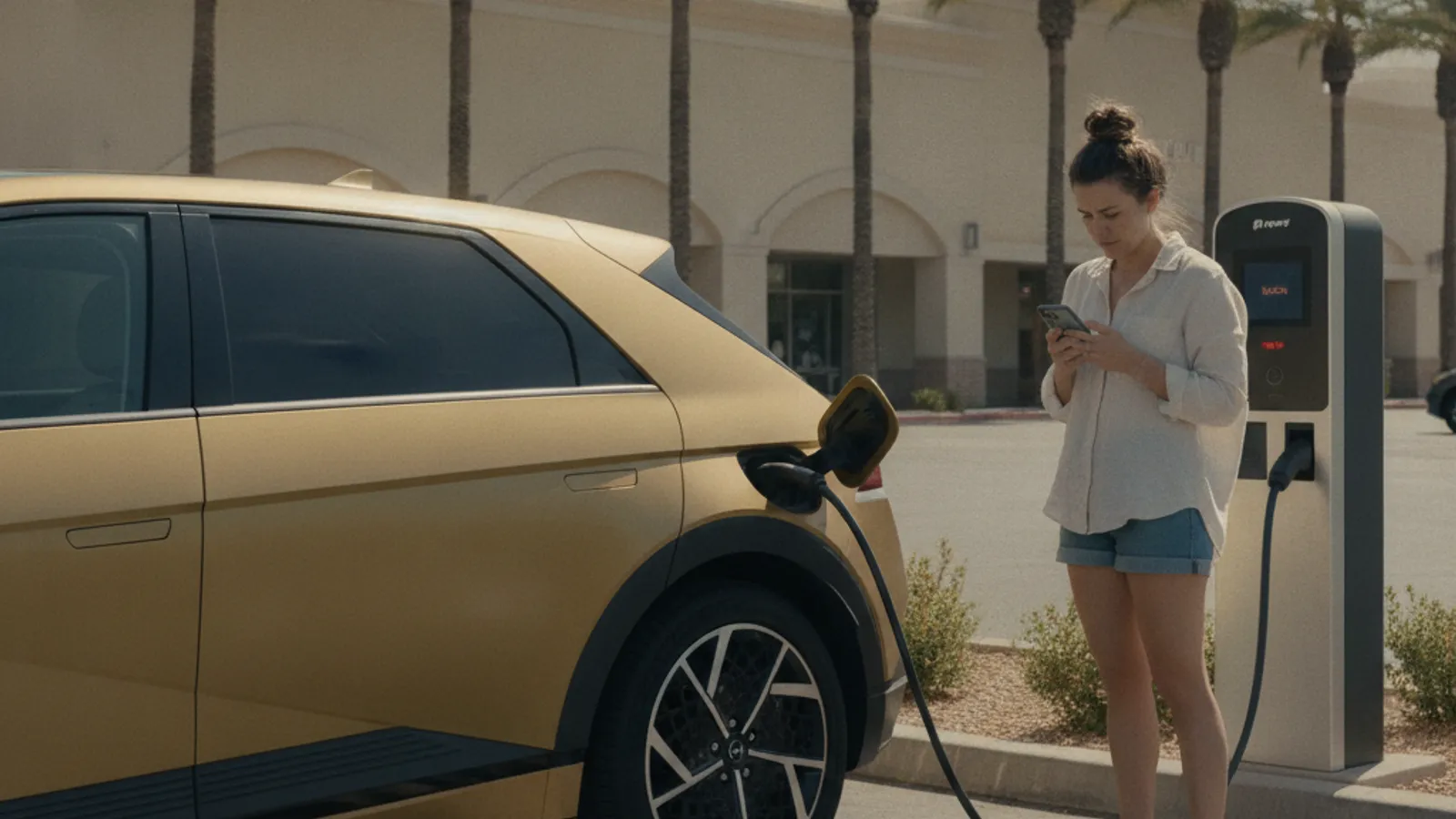
This is a circuit problem, not a car problem
Your EV wants a long, steady 240-volt draw. A dryer or a shop tool pulses on and off. A Level 2 session doesn’t. It holds that load for hours. If the breaker opens every time you start a charge, the circuit is talking. It can’t hold the load, or it’s seeing a ground fault.
Charge Pro LV doesn’t wire homes. We’re a referral line. We match stranded drivers with independent mobile rescue operators. Those operators don’t open your panel or pull a permit. They bring a 240-volt Level 2 source to the car. That adds range at the curb without touching house wiring. A licensed electrician owns the house-side fix.
Older valley houses, newer chargers
The Las Vegas Valley isn’t one housing stock. ACS 2019-2023 figures serve as a garage and panel-age proxy. Mount Charleston sits at 61.9 percent older housing. Winchester sits at 53.1 percent. Boulder City sits at 48.5 percent. Those garages were built for a tool bench and a gas car. They weren’t built for a dedicated EV circuit.
Summerlin sits near 3,500 feet and rises toward Red Rock. Newer tracts there more often meet Clark County Title 30 EV-ready wiring rules for new construction. Winchester sits in the east-valley heat island. The airport and downtown can run up to 11F hotter than the rim. An older garage there still has the same small panel.
A Level 2 home charger in Clark County needs an electrical permit. That’s Title 30, not a suggestion. If nobody pulled a permit, the run may share a dryer outlet or a shop subpanel. That’s a common reason the breaker opens after a charge has been running.
NV Energy serves most of the valley, including Las Vegas, North Las Vegas, Henderson, Paradise, Winchester, Spring Valley, and Enterprise. Boulder City has its own municipal utility. Blue Diamond, Indian Springs, and Sandy Valley sit on Valley Electric Association. Don’t call NV Energy for a Boulder City panel.
We can’t confirm a typical service size for those older tracts from published records. Older housing share is a proxy, not a reading of your panel label. Have the electrician check the bus rating and the spare slots. Confirm the current Title 30 permit rules with Clark County before anyone pulls wire.
Four causes valley owners actually see
A shared or undersized 240-volt run
Level 2 charging is a long, flat load. Most household gear isn’t. If the charger shares a circuit with a shop, a dryer, or a garage subfeed, the combined draw can open the breaker. Ten to 30 minutes of charging, then a trip, is the usual pattern. The lasting fix is a dedicated circuit sized for the charger’s amperage. That’s electrician work. It may include a panel upgrade if the existing service has no spare capacity.
Two ground-fault systems on one circuit
Most Level 2 EVSE units already watch for a ground fault. Many plug-in setups also sit on an external GFCI. The EVSE sends a small test current to ground to confirm an earth path. That tiny current can open the house GFCI even when nothing is leaking. Electricians often hardwire the station so the two protections aren’t stacked on a receptacle. That’s a known interaction.
Moisture after monsoon or sprinklers
Coastal salt air isn’t the valley’s problem. Desert irrigation and July-August monsoon splash are. The valley averages 4.18 inches of rain a year, but monsoon water still reaches uncovered outdoor outlets. An uncovered outlet on a Winchester side yard can wet out. So can a connector left on a pad after a storm. Let it dry. If it still trips on a dry day, call the electrician.
A fault inside the EVSE or cable
This is less common. The wall unit or the portable cable can fail inside and open the breaker every time it tries to deliver full power. If a different charger on the same outlet holds, the house wiring is less likely. If the same charger holds on a different known-good outlet, the equipment is the suspect.
Quick reference
| When it trips | Likely cause | Who handles it |
|---|---|---|
| Right at plug-in, every session | Ground fault, moisture, or a bad EVSE | Dry it, try another EVSE, then an electrician |
| After 10 to 30 minutes of charge | Undersized or overloaded circuit | Electrician |
| Only with another load on the same run | Shared circuit | Electrician |
| Only after monsoon splash or sprinklers | Wet outlet or connector | Dry first, electrician if it returns |
| With your cable, not with another EVSE | Faulty charging gear | Charger maker or a replacement unit |
What is safe to check yourself
Reset the breaker one time and watch the pattern. Look at the outlet and the plug for water, rust, or heat discoloration. Write down what else was running on that circuit. Don’t keep flipping the same breaker. Don’t pull the panel cover to chase wires. A repeating trip is protection. It’s not a nuisance you can out-wait.
If the car is already low while you wait on a house fix, stretch the remaining range.
The house fix and the car fix are different jobs
A licensed electrician diagnoses the circuit and pulls the Title 30 permit. Charge Pro LV doesn’t do that work. We don’t hold a contractor license. We don’t own trucks, a warehouse, or a parts inventory.
NV Energy publishes a Residential Electric Vehicle Recharge Rider with a 10:01pm to 8:00am charging window. There’s also a Residential Managed Charging Program. Those programs don’t repair a tripping breaker. Confirm current enrollment rules on nvenergy.com if you’re on Nevada Power. Boulder City residents should ask Boulder City Utilities, not NV Energy.
While that work is scheduled, you still need the car to move. When 240-volt charging at home isn’t an option, a mobile visit charges at the vehicle. Operators typically add 10 to 20 miles of range in 15 to 30 minutes of charging. That’s charge time at the car. It’s never an arrival time. They bring a native NACS plug, with CCS or J1772 adapters for non-Tesla EVs. The operator quotes you before starting and bills you directly.
If you’re weighing a repair ticket against a rescue, home charger repair versus mobile rescue walks through that split. Mobile EV charging is the path when the car has to leave before the panel work is done.
NWS Las Vegas records an average July high of 104.5F, with about 78 days a year at or above 100F. Heat doesn’t invent a breaker trip. Get the circuit fixed. Use a mobile charge if you can’t wait on the electrician.
Frequently asked questions
Is it safe to keep resetting a breaker that trips on Level 2?
No. The breaker is opening to protect the circuit. One reset to read the pattern is enough. If it trips again, stop and call a licensed electrician.
Can a bad charging cable trip the house breaker?
Yes. An internal fault in the EVSE or the portable cable can open the breaker on a healthy circuit. Try a different charger or a different outlet. If only one setup trips, replace that gear before you rebuild the panel.
Does Charge Pro LV install or repair home EV chargers?
No. Charge Pro LV is a referral line. We don’t wire panels, pull permits, or own trucks. The operators we connect you with charge the car on site. A licensed electrician handles the house circuit.
If the breaker won’t hold and the car still has to move, call (702) 935-4699. An operator will quote the mobile charge before any work starts.