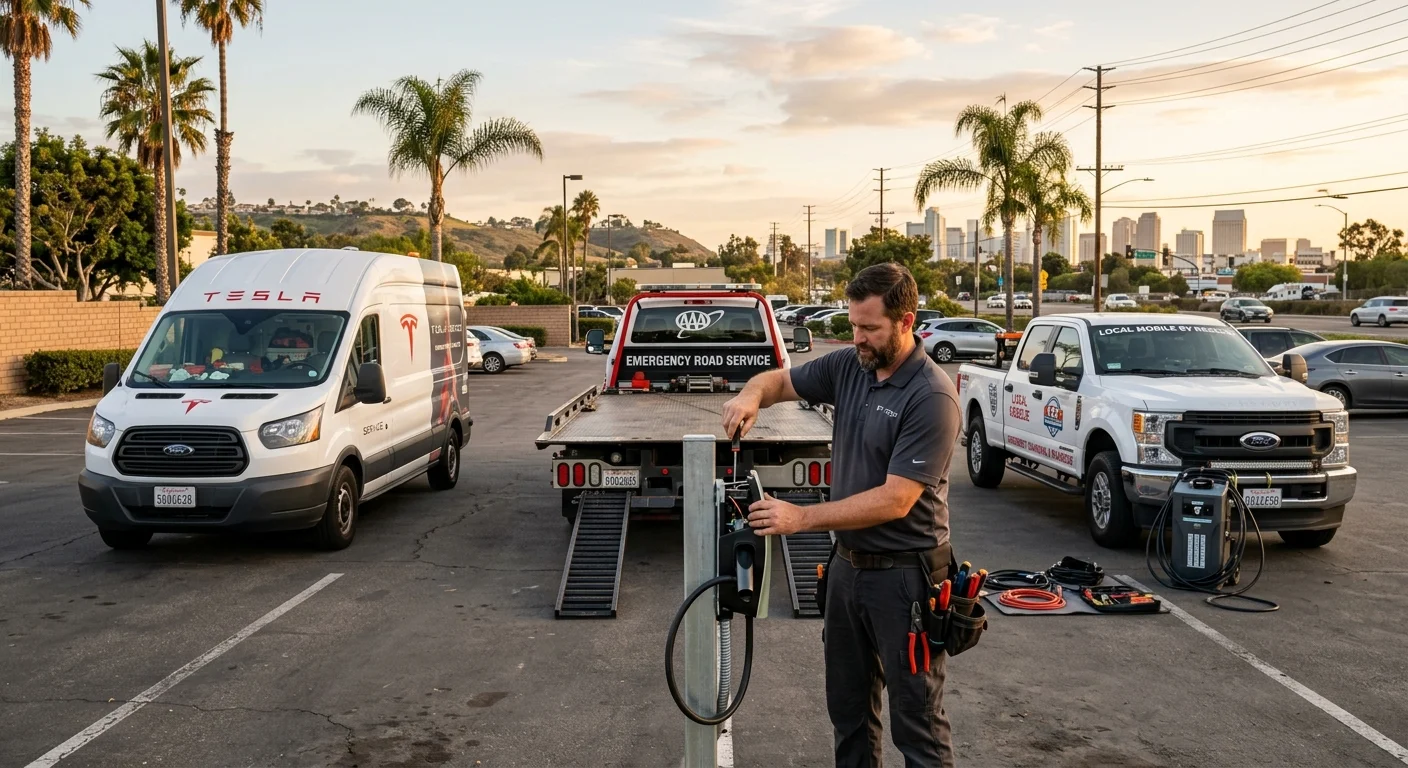
A Tesla that dies on I-15 still has a public truck in the mix. NDOT’s Freeway Service Patrol works the valley’s busiest freeways. Quality Towing runs that patrol. GEICO sponsors it. Hours run 5:00am to 8:30pm, seven days a week. The stop is free to the motorist. Patrol crews change tires, jump a 12V, add fuel, and hold traffic. None of NDOT’s published patrol pages mention EV charging. They don’t advertise a mobile charge. That’s why Tesla owners still compare private options. They want the best roadside assistance for Tesla that matches the stall. Tesla’s own channel is one. A club like AAA is another. A local operator who can add range at the car is the third.
What NDOT’s patrol publishes, and what it skips
NDOT’s Freeway Service Patrol is the truck many drivers already know. It covers the most-traveled valley freeways. Statewide it handles about 55,000 incidents a year. About 31,500 of those are in Las Vegas. The published list is tires, jumps, fuel, minor fire suppression, and traffic control. EV charging isn’t on that list. Treat that as an advertising gap. Don’t read it as proof the patrol can’t touch a Tesla. A jump start is still a jump start if the 12V is dead. Fuel does nothing for an empty pack. If you need miles in the high-voltage battery, look elsewhere. The patrol’s own materials don’t promise a charge. After 8:30pm the published patrol hours are over. Nevada State Police Highway Patrol can still dispatch a rotation tow through Autura. The cell shortcode is *647. Southern Command is (702) 486-4100. Road conditions sit on Nevada 511 and nvroads.com. For the Tesla-versus-patrol breakdown, read what Tesla roadside covers against NDOT patrol.
Heat is why a healthy Tesla still stalls
Valley heat is a NWS number, not a guess. The Las Vegas airport averages a 104.5F July high. About 78 days a year hit 100F or more. About 9.4 days hit 110F or more. The all-time record is 120F on 2024-07-07. The airport runs 5 to 15F warmer than outlying ground. East-valley and downtown pavement can run up to 11F hotter than the rim. Recurrent Auto measured about 5% range loss at 90F. At 100F that rose to about 17 to 18%. Cabin cooling drew 3 to 5 kW to knock heat down. Holding the cabin took about 1 kW. AAA’s May 2026 test measured 8.5% range loss at 95F. Tesla hasn’t published its own range-loss figure that we could cite. So we don’t. A Model 3 or Y can leave Summerlin with a comfortable buffer. It can still sit down on the Strip loop. The I-15 south run does the same thing. Summerlin sits near 3,500 ft and climbs toward Red Rock. Henderson sits near 1,867 ft. The valley floor is about 2,000 to 2,920 ft. Grade plus heat plus A/C is how an empty-pack stall happens here. A dead 12V is the other common stop. The car looks dead. The pack may still have miles. Desert heat wears that small battery. We walked through that in Tesla 12V failure in valley heat. Monsoon season is July and August. Washes and underpasses flash-flood. A car in standing water needs a tow, not a plug.
Tesla’s factory channel: confirm it in the app
Tesla’s own roadside is the first private number many owners try. Tesla publishes the terms in the car and on its site. A new Tesla often includes roadside through the warranty window. Confirm your car’s window in the Tesla app before you need it. Tesla’s desk knows Tesla diagnostics. They can send a Tesla-trained tech or an approved contractor. Owners use that channel for a flat or a lockout. They also use it for a tow toward a service stop. Teslas don’t carry a spare. Jack points are specific. A Tesla-aware tech matters for a tire on I-215. For an empty pack, Tesla’s published help is often a tow toward a Supercharger. It isn’t a Level 2 charge in the lane. That difference matters on a Paradise resort curb. An older Tesla may sit outside included roadside. Tesla sets those dates, not this site. Read the current write-up in Tesla roadside policy in 2026 for valley drivers. Don’t treat the factory channel as a promise of when someone arrives.
A club card is a tow net until you ask
AAA is the club Tesla owners name most. Other insurers sell roadside too. A club’s published strength is a contractor tow network. That network is useful when the car has to move a long way. It’s less useful if you only need miles in the pack. Some clubs sell EV add-on language. The dispatcher has to say whether they’re sending a charge or a hook. Ask that before you wait. A 12V jump may fit a club’s ordinary jump coverage. An empty high-voltage pack may not. We don’t publish AAA’s current add-on names, tow miles, or fees. Those terms change, and this site doesn’t carry them. Confirm EV charging with AAA on the membership you actually hold. Then compare that answer with a mobile charger when your EV is empty. The logo on the card doesn’t prove a NACS plug is coming.
A local operator adds range where the car sits
The third private option is an independent mobile rescue operator. Charge Pro LV is a referral line for that work. We match stranded Tesla drivers with local operators. We don’t hold a trade license. We don’t own trucks. We don’t employ techs. We don’t set prices. The operator quotes you before they start. They bill you directly. The pros we connect you with bring a 240V Level 2 source. Tesla owners plug in on a native NACS connector. Other EVs use a CCS or J1772 adapter. Typical charging time puts about 10 to 20 miles back. That takes 15 to 30 minutes of charging. That clock is charging time only. It isn’t an arrival time. They can jump or replace a dead 12V on site. They handle Tesla and every major EV brand. This is the Tesla roadside rescue path for miles or a 12V. It isn’t the path for a long tow. A club or Tesla may still be the better hook for a service-center tow. Operators here don’t replace a Nevada Transportation Authority tow. Use a certified tow when a hook is what you need.
The stall isn’t the same across the valley
The Strip and Harry Reid International Airport sit in Paradise and Winchester. Those are unincorporated Clark County, not the City of Las Vegas. A resort-lot stall is a curb, a garage ramp, and event traffic. Allegiant Stadium, Sphere, and the Las Vegas Convention Center create the same pattern. Harry Reid parking advertises free battery jumps and tire inflation at (702) 261-5122. The airport’s own site doesn’t publish EV charging we can confirm. So we don’t claim a charger there. North Las Vegas has the Motor Speedway lots and the I-15 run. Henderson has Railroad Pass toward Boulder City. Boulder City runs its own municipal electric utility, not NV Energy. West-rim drivers in Summerlin and Blue Diamond meet the Red Rock grade. Kyle Canyon Road climbs toward Mount Charleston. The town sits about 7,506 ft. I-15 south through Enterprise, Silverado Ranch, Jean, and Primm is a heat-and-headwind run. Nevada has no toll roads. I-15, I-215, US-95, US-93, and I-11 are free. I-15 does have HOV lanes from Silverado Ranch to the Spaghetti Bowl. Those lanes need two-plus occupants, 6-8am and 4-6pm weekdays. A single-occupant Tesla doesn’t get a pass. The federal EV HOV exemption expired on 2025-09-30. If you’re low, stay out of the HOV unless you have a passenger. NV Energy serves most of the valley. Hub geography for charging and rescue sits on EV charging in the Las Vegas Valley.
If you’re already stopped, Nevada law is specific
NRS 484B.440 covers a vehicle that can’t avoid stopping. That disabled car is exempt from the no-stopping-on-highway rule. The statute sets no clock on how long it may remain. Don’t read that as permission to camp. NRS 484B.443 lets law enforcement remove a disabled or abandoned vehicle. On freeways and primary highways, abandoned is 24 hours. On other roads it’s 72 hours. The owner pays removal. Tow operators need a Nevada Transportation Authority certificate. Non-consent tow rates are operator-filed tariffs under NAC 706.408. There’s no single statewide maximum on this site. We don’t print a tow bill. If a truck is already hooked, Nevada rules require a release at the original spot. That’s for the operator’s set release fee. Ask before you argue on the shoulder. Put triangles out. Stay out of the travel lane. Keep the hazards on. Then pick the private channel that matches the failure. Use Tesla for a factory tow path. Use a club for a long hook. Use a local operator for Level 2 miles and a 12V.
If you only keep one private number
Use the public patrol first when you’re on a covered freeway during published hours. After that, one private number means you accept a gap. Tesla’s channel is the one that knows the car. It’s also the one that may tow you toward a Supercharger. That isn’t the same as charging you in place. A club card is the one with a wide tow bench. It’s the weakest assumption if you need a plug at the bumper. A local operator is the one built around 240V at the car. They also jump a 12V. It’s the wrong tool for a long mechanical tow. Name the failure before you name the company. A flat tire is a tire job. A dark screen and dead locks are usually the 12V. A car that powers up and shows zero miles is an empty pack. Those three jobs don’t have the same best call. Newer cars still in Tesla’s published roadside window can start there. Empty-pack stalls on a Paradise curb need on-site Level 2. A dead 12V after a hot park in Winchester is a jump job. Match the failure to the truck that can fix it.
Make the call from the car
Open the Tesla app and read your roadside status. If you hold AAA or another club, ask the dispatcher a direct question. Ask whether they’re sending a charge or a tow. If the need is miles in the pack, a local operator is the match. A 12V that won’t wake is their job too. Charge Pro LV connects you with that operator. They quote before they start. Call (702) 935-4699 and we’ll make that match. We serve the Las Vegas Valley. The work, the truck, and the bill belong to the operator on scene.