A Model 3 in a Centennial Hills driveway wouldn’t wake up Sunday morning. The owner had driven it Friday. The big pack was at 70 percent on Friday’s screenshot. Sunday showed nothing on the dash. The tow truck was already being requested when the owner remembered reading about the 12V. A mobile operator jumped the 12V from the under-hood posts. The car woke. The owner drove to work instead of paying a flatbed.
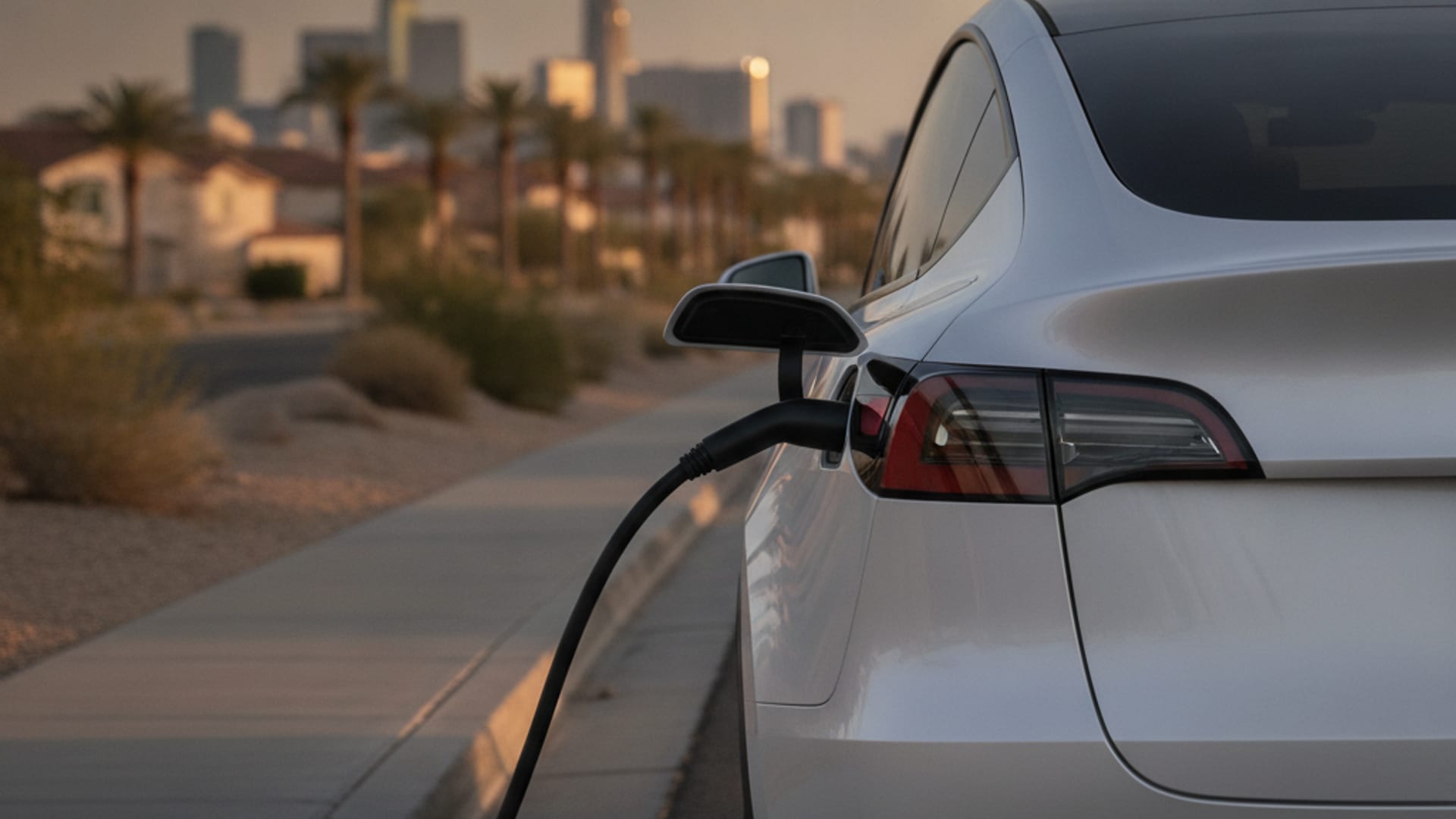
Two batteries, not one
A Tesla Model 3 has two battery systems. Most owners talk about “the battery” as if it’s one thing. The car has a high-voltage traction pack and a low-voltage accessory battery.
The traction pack sits under the floor. It’s a flat slab of lithium-ion cells, about 60 kWh in a Standard Range Plus or about 82 kWh in a Long Range. It powers the motor, the heat pump, and the DC-DC converter that charges the 12V. The pack is liquid-cooled. Coolant loops keep the cells in their operating window. Heat is a problem but a managed one.
The 12V sits in the front service area, under a plastic panel. Standard Range Plus and earlier cars used a lead-acid absorbed glass mat battery. 2021 and later cars in some markets use a lithium-ion 12V. The 12V runs the lights, the touchscreen, the door handles, the audio system, and the wake-up handshake that connects the traction pack to the rest of the car. The 12V has no thermal management. Heat cooks it.
In Las Vegas Valley summer, the 12V fails long before the traction pack. The NWS Las Vegas climate record puts the average July high at 104.5F, with about 78 days at or above 100F. A garage at 9am can sit at 100F. The 12V sits in that air.
How to tell which battery is the problem
The car gives signals. Learn them.
The traction pack is the problem when the car wakes up normally, the dash shows a low state of charge, and the car asks you to pull over. The motor may cut power as you drive. The screen may show a turtle icon. These are traction-pack warnings. The 12V is fine.
The 12V is the problem when the car won’t wake at all. No door handle extension. No key fob response. No screen. The Tesla app says “vehicle offline.” These are 12V symptoms. The traction pack may be at any state of charge, but you can’t reach it because the 12V can’t close the high-voltage contactors.
A third signal is a partial wake. The screen comes on, the car unlocks, but a warning reads “Low Voltage” or “12V battery needs service.” That’s a 12V at the edge of failure. It will not recover. It will get worse.
Do Teslas have a 12V battery? walks through the indicator lights and what each means. The simplest field check is to look at the 12V status in the Service menu on the touchscreen. A reading below 12.0V with the car awake means the 12V is failing.
Where the 12V jump posts are
The 12V jump posts are not the same as the 12V terminals. The posts sit under the hood, near the front service panel. They look like two small metal studs with red and black plastic covers.
Open the frunk. Look at the back wall, near the cowl. There’s a maintenance panel. Pull the cover. The posts are inside. The red post is positive, the black post is negative. The cover labels them.
Hooking up to the wrong point is dangerous. A direct connection to the 12V terminals bypasses the inrush limiter. The BMS can throw faults. A welding relay or a popped fuse becomes the next problem. The matched operator knows the difference. Tesla 12V battery jump covers the procedure and what to ask for.
Why a jump helps and a tow usually doesn’t
A flatbed will move the car, but it won’t fix anything. The car will arrive at the shop with the same dead 12V. The shop will charge or replace the 12V. You pay for the tow and the shop work. The car spends days off the road.
A mobile 12V jump, in contrast, fixes the symptom on the spot. The booster wakes the 12V long enough for the DC-DC converter to take over. The car drives away under its own power. You pay for one call instead of a tow and a shop visit.
If the 12V is beyond recovery, a mobile operator carries a replacement pack for the relevant year. The swap happens in the same lot. The car relearns the 12V serial number in a few minutes. You’re back on the road without a flatbed.
When the flatbed is the right answer
The flatbed is the right call when the traction pack is the failure point. A car that drives but loses power mid-block needs more than a jump. The matched operator will say so and arrange a transport.
A car that has been sitting dead for more than a week may need more than a jump. The 12V can drop below its recovery voltage. The BMS locks the pack. A shop has the equipment to revive it. Charge Pro LV matches drivers with operators who know the difference.
The matched operator also won’t try to jump a battery that is clearly damaged. A swollen or leaking 12V needs replacement, not a charge. The operator quotes the replacement before starting.
Related guides
For another angle on the same valley stall, see Tesla Model 3 pack replacement for valley owners.
Frequently asked questions
Where is the Tesla Model 3 12V located?
The 12V sits in the front service area, accessible by opening the frunk and removing the maintenance panel on the back wall. The jump posts are next to it.
Is the traction pack under the floor?
Yes. The traction pack is a flat slab of lithium-ion cells that sits under the floor between the front and rear axles. The pack is sealed and liquid-cooled. You won’t see it without lifting the car.
Why does the 12V keep dying in Las Vegas heat?
Heat accelerates calendar aging. A 12V that would last five years in mild climates may last two or three in the valley. The cell chemistry degrades faster at high ambient. There is no thermal management for the 12V.
Can the operator replace the 12V on the spot?
Yes, in most cases. The operator carries lithium 12V packs for newer cars and AGM packs for older cars. The swap takes about thirty minutes. The car relearns the new pack’s serial number.
Will the car throw warnings after the 12V swap?
A brief period of warnings is normal after a 12V swap. The BMS needs a few drive cycles to relearn the new pack. The warnings clear on their own. If they don’t clear within a day, the operator returns for a diagnostic.