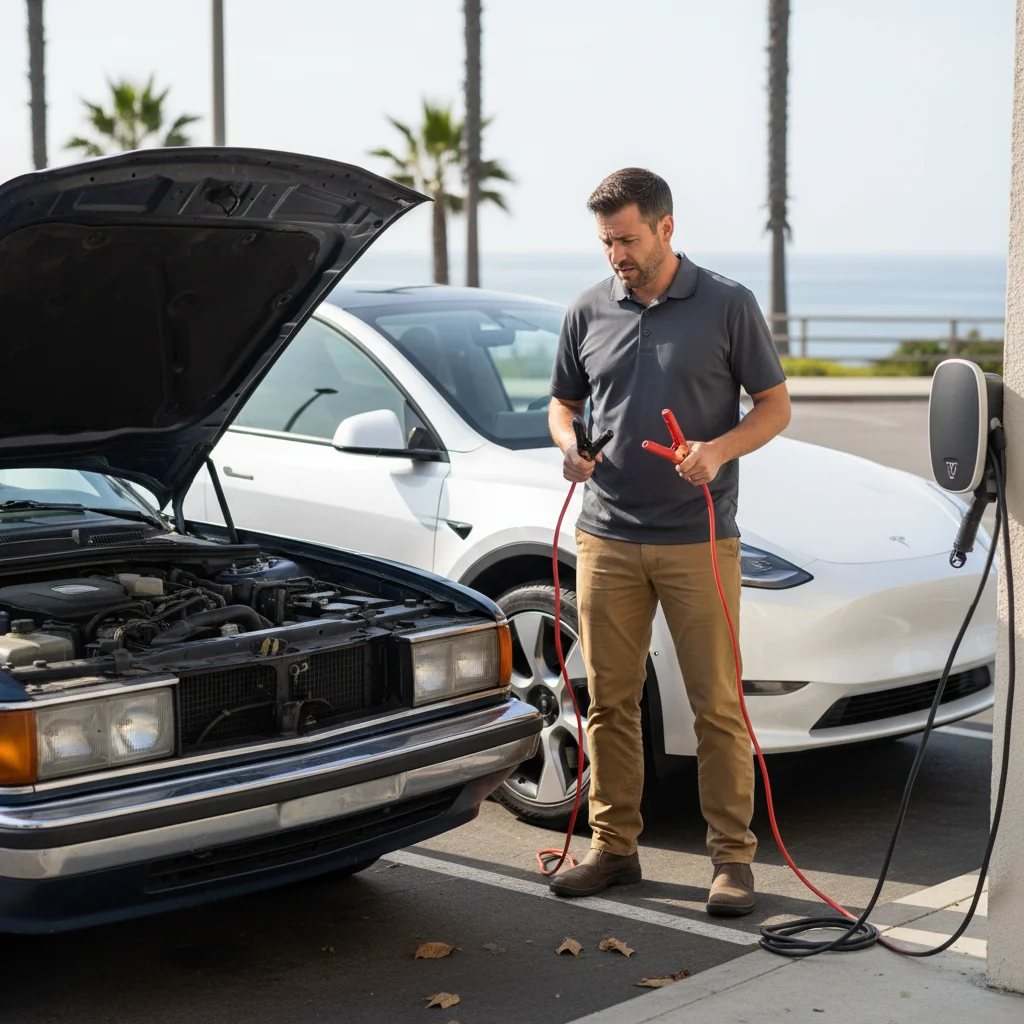
A Tesla can’t jump-start the car next to you. Its 12-volt system isn’t built to dump starter current into someone else’s battery. Las Vegas Valley heat already works that small battery hard. On an I-15 shoulder or a Paradise resort lot, keep the cables in the frunk.
Why people still reach for the cables
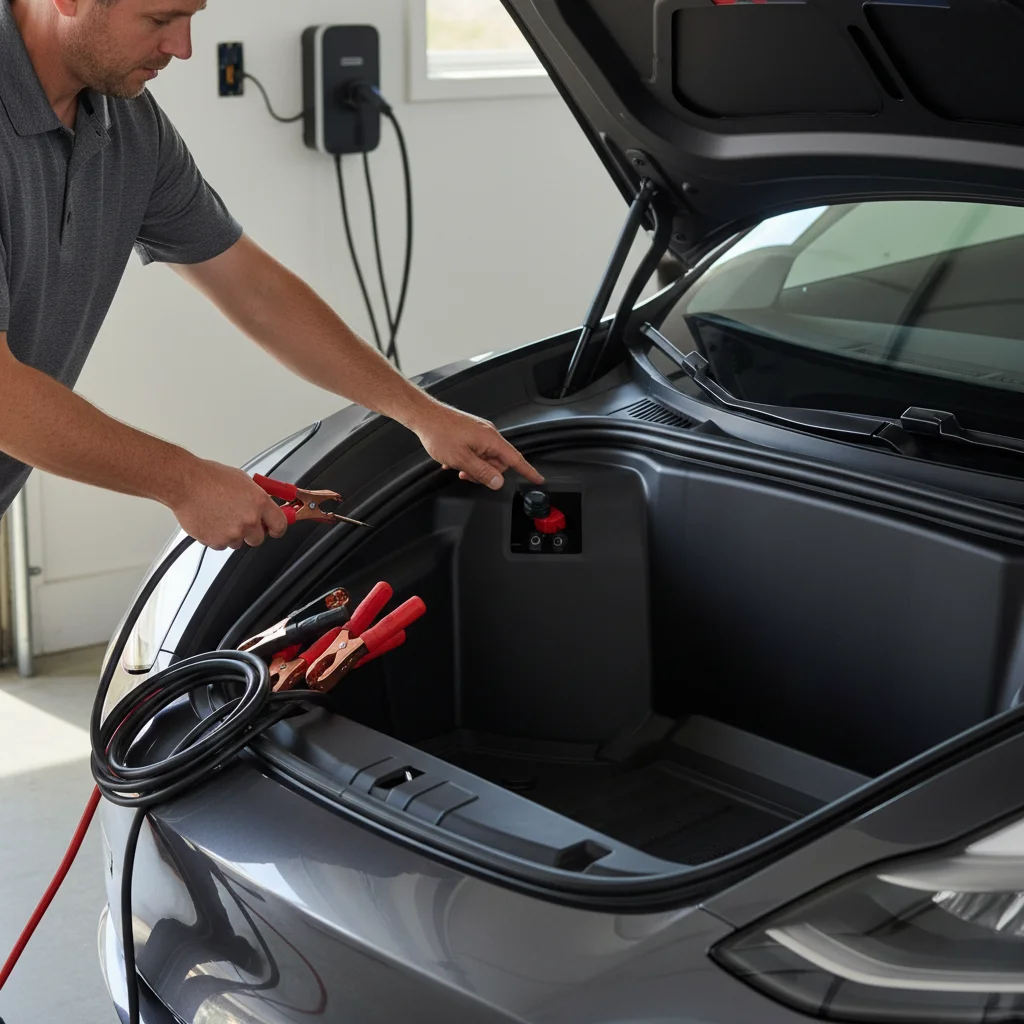
Gas-car culture taught a neighborly habit. Two hoods, two clamps, one crank. Teslas still hide a 12-volt battery up front, so the habit follows. You see posts under a frunk panel. They look like a donor tap. They’re not.
That 12V can fail. It can take a jump from an outside pack. It isn’t designed to give one. The terminals are an inbound wake-up path. An external source brings the computers back. Then the high-voltage pack can connect. Those posts aren’t a booster outlet.
The question stays common because the hardware looks familiar. A Model 3 in a Winchester garage can sit beside a Camry. The electrical jobs still differ. The local explainer is Do Teslas have a 12V battery, and why that matters here.
A gas 12V cranks. A Tesla 12V wakes the car
A conventional battery’s main job is brute cranking. It slams a huge current into a starter motor. Lead-acid packs in gas cars are built for that hit. They’re sized to spin a heavy engine until it fires.
A Tesla’s 12V is a low-capacity gateway. Older cars used a small lead-acid unit. Newer Model 3 and Model Y cars use a lithium 12V. They aren’t cranking batteries. The job is locks, lights, the screen, and the computers. It also closes the contactors. Those contactors connect the high-voltage pack to the drive unit. No 12V, no wake. No wake, no drive.
The high-voltage pack keeps that 12V topped off through a DC-to-DC converter. The system expects a steady, modest draw. It doesn’t expect a sudden dump into a dead gas battery. Clip your Tesla to a stalled sedan and you reverse that design.
What can go wrong is specific. The converter can see a surge it wasn’t built to pass in reverse. The 12V itself can be damaged by the draw. Control modules can sag or spike as voltage collapses. Tesla’s manuals warn that damage can follow. That’s architecture, not a scare line.
A longer failure walkthrough is in The risks of jump starting a gas car with a Tesla. Other EVs share the same 12V-as-gateway pattern. We cover that in Can your EV jump-start a gas car on a valley shoulder.
What Tesla actually printed in the manual
Tesla’s owner’s manuals walk you through receiving a 12V jump. They also tell you not to jump another vehicle with yours. Across Model 3, Model Y, Model S, and Model X, the notice is the same idea. Don’t use the car as a donor. Doing so can result in damage.
The frunk posts exist so an outside source can re-energize the low-voltage system. Once that system is up, contactors can close. Then the main pack can run the car. Power is meant to flow in. It isn’t meant to leave as a starter jolt.
A clip online of someone who “got away with it” isn’t a procedure. You don’t see the converter that failed later. You don’t see the module that threw faults after the next heat soak. Tesla wrote the warning because the hardware has a direction.
Valley heat already has that 12V in a bind
This is where a Las Vegas Valley stall isn’t a generic parking-lot story. NWS Las Vegas records an average July high of 104.5F. About 78 days a year reach 100F or more. About 9.4 days reach 110F or more. The all-time record is 120F, set on July 7, 2024.
Harry Reid International Airport sits in Paradise. It often runs 5 to 15F warmer than outlying areas. The east valley and downtown can run up to 11F hotter than the rim. A Tesla in a Winchester lot or airport long-term parking isn’t resting in cool air. Cabin electronics still sip from the 12V. The converter still tries to keep up.
Heat is also a range story. Don’t pin a Tesla-factory loss figure on it. No Tesla-published range-loss number turned up in the research for this page. Recurrent Auto found about 5% range loss at 90F and 17 to 18% at 100F. Air conditioning can draw 3 to 5 kW to cool a hot cabin. Holding a cooled cabin is about 1 kW. AAA, in May 2026, measured 8.5% range loss at 95F. Those studies aren’t a reason to treat your Tesla as a jumper box. They’re a reminder the car is already working.
A 12V that’s cooked through an afternoon in Enterprise or Sunrise Manor is a poor donor. Desert heat is a known 12V wear factor here. We walk through that in Tesla 12V failure in valley heat: what actually wears it out.
Shoulders, lots, and who actually jump-starts here
The valley isn’t one stall pattern. An I-15 stop near Silverado Ranch is live freeway heat. HOV lanes there run from Silverado Ranch to the Spaghetti Bowl. They need two-plus occupants, 6-8am and 4-6pm on weekdays. Nevada has no toll roads and no express transponders. I-15, I-215, CC-215, US-93, US-95, and I-11 are free. You’re still in a traffic stream. Clipping two electrical systems together in that stream is a bad plan.
NRS 484B.440 lets a disabled vehicle remain on the highway when it can’t avoid stopping. The statute sets no time limit. NRS 484B.443 still lets law enforcement remove a disabled or abandoned vehicle. On freeways and primary highways, it’s treated as abandoned after 24 hours. The owner pays removal. A jumper-cable experiment isn’t worth that sequence.
The Strip and Harry Reid sit in unincorporated Paradise and Winchester, not the City of Las Vegas. Airport parking publishes free battery jump starts and tire inflation at (702) 261-5122. That’s the airport’s own service for cars in those lots. It isn’t permission to use your Tesla as the donor.
NDOT’s Freeway Service Patrol covers the busiest valley freeways. Quality Towing operates it. GEICO sponsors it. Hours are 5:00am to 8:30pm, seven days a week, free to motorists. Published services include tire changes, jump starts, fuel, minor fire suppression, and traffic control. The patrol clears about 55,000 incidents a year statewide, about 31,500 in Las Vegas. None of NDOT’s published FSP materials mention electric vehicles, EV charging, or EV-specific service. That’s an advertising silence. Don’t read it as “the patrol can’t help an EV.” A gas car next to you may be a classic FSP jump. Your Tesla still shouldn’t be the source.
Nevada 511 and nvroads.com report conditions, closures, and cameras. Nevada State Police Highway Patrol Southern Command is (702) 486-4100. Those are the public channels. They don’t convert a Tesla into a booster pack.
The same no-donor rule holds after a Raiders or UNLV game at Allegiant Stadium. It holds on Strip resort lots too. Someone’s hood is up. Your frunk has cables. The answer is still no.
Help without tying the two cars together
Kindness doesn’t require a donor jump from your Tesla. A portable lithium jump pack is the tool built for a gas-car crank. Keep it in the frunk. Connect it to their battery. Leave your Tesla out of the circuit.
If you don’t carry a pack, help them call from a safe spot. Their insurer, a club, or NDOT’s patrol during published hours may fit a gas car. Stay out of live lanes. Offer a ride to shade or a pickup point if that’s safer. A lift costs your 12V nothing.
Don’t assume another EV is a safer donor. Most EVs use the 12V as a gateway the same way Teslas do.
When the Tesla that won’t start is yours
Your car can still need a 12V jump. That’s the inbound case Tesla documents. A dead 12V can black the screen, kill the handles, and leave the car inert. You might have seen a 12V service warning in the app first. A heat-soaked sit in Summerlin or Harry Reid long-term parking makes that more likely.
Receiving a jump isn’t the same as giving one. An external source wakes the gateway. Contactors can close. Then you can move the car, or have the 12V replaced. Doing the inbound jump wrong still risks damage. Follow your model’s manual. A valley-focused walkthrough is How to jump start a Tesla 12V when the car won’t wake.
If you’d rather not probe posts in 110-degree air, treat it as a roadside 12V job. Independent operators who work EVs bring a stable 12V source. They can jump on site. If the battery is cooked, they can replace it there. Charge Pro LV is a referral line. It matches stranded drivers with those operators. It doesn’t own trucks, hold a shop license, or set a price. The operator quotes you before they start and bills you directly. The pros we connect you with are licensed and insured.
An empty high-voltage pack is a different problem. A 12V jump won’t add traction miles. Operators can bring a 240V Level 2 source to the car. They use a native NACS plug. CCS or J1772 adapters cover non-Tesla EVs. That typically adds 10 to 20 miles of range in 15 to 30 minutes of charging. That’s charging time, never an arrival time. Local Tesla stall help is covered in EV roadside assistance in Las Vegas for a dead Tesla. The 12V-specific path is Tesla 12V battery jump.
If the 12V is dead, wake it first. A public plug doesn’t help a car that won’t close contactors. If the pack is empty, charge at the car or follow Tesla’s own recovery path.
If you’re disabled on a freeway, stay with the car when that’s safer. Use the public channels above. Tow operators in Nevada need a Nevada Transportation Authority certificate. Confirm any tow cost with the operator before they hook.
If your Tesla’s 12V is the problem, call from the valley. Don’t clip onto the car next to you. Call (702) 935-4699. We’ll connect you with an independent local operator who quotes before starting.
Frequently asked questions
Can a Tesla jump start another car?
No. Don’t use a Tesla as the donor. The 12V is a gateway battery, not a cranking pack.
Can a Tesla jump start a gas car in valley heat?
No. Heat already stresses that 12V. A donor jump adds a current dump it isn’t built for. Use a portable pack, or help them call roadside from a safe spot.
Can another car jump a Tesla?
Yes. A Tesla with a dead 12V can receive external power. Follow your model’s manual. Those posts are inbound. They aren’t a way to start the car beside you.