When an electric car died in the Las Vegas Valley, start with the dash. A confirmed empty pack points toward a charge at the car. Dark screens and dead locks often point toward a 12V jump. Either one can keep you off a Nevada tow hook. NRS 484B.440 lets a disabled vehicle sit on the highway. Read the message, then tell an independent operator where you are.
Read the dash before anyone hooks the car
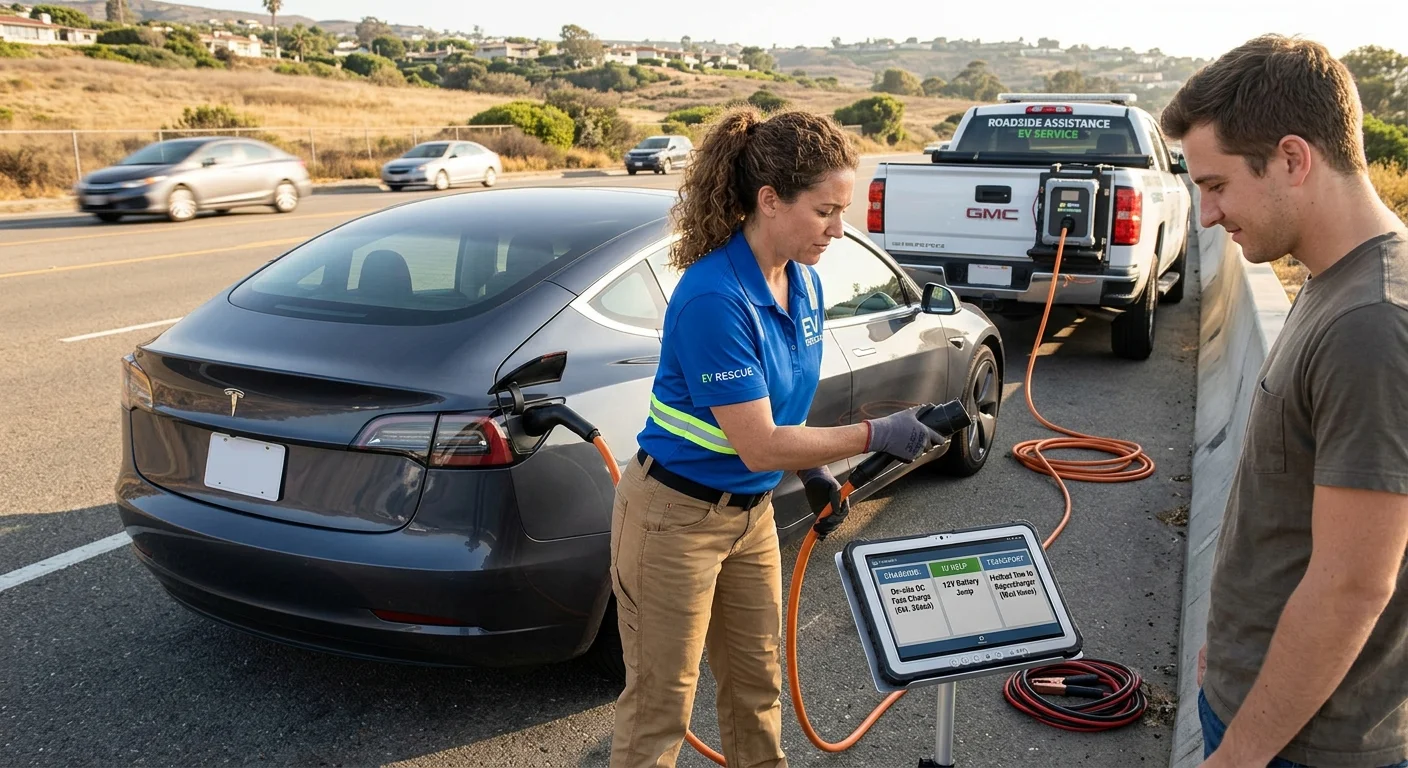
The word died isn’t a diagnosis, and two stalls rarely need the same truck. One driver sees a zero-range warning, and another finds black screens and silent locks. Read the display word for word, and report any remaining charge as written. Note whether the cluster, lights, locks, or app still respond. Don’t translate those clues into your own guess. Say whether the car quit while rolling or after a park.
July here averages a 104.5F high at the official Las Vegas station. About 78 days a year reach 100F or more. Recurrent Auto found about 5% range loss at 90F and 17 to 18% at 100F. Tesla didn’t publish a range-loss figure we could confirm. Heat also wears the small 12V that wakes the computers.
An empty pack warning supports a talk about out-of-charge recovery. Blank controls may lead the operator toward low-voltage help. That still isn’t permission to open a battery cover. Use the owner’s manual for your exact model year. If you don’t have it, say so before work starts. What happens when an EV 12V dies helps you list symptoms, not diagnose the car.
Nevada’s disabled-vehicle rules buy you a window
A charge or a 12V jump can keep this stall from becoming a tow. Act while the car’s still legally disabled, not abandoned.
NRS 484B.440 covers a vehicle that can’t avoid stopping. It’s exempt from the no-stopping-on-highway rule, and the statute sets no clock. That exemption isn’t a parking permit under the statute. Law enforcement can still order a removal under NRS 484B.443. A vehicle is treated as abandoned after 24 hours on freeways and primary highways. On other roads the window is 72 hours, and the owner pays that removal.
Tow operators need a Nevada Transportation Authority certificate. The cited sections are NRS 706.4463, 706.4467, 706.4469, 706.4477, and 706.4479. A still-hooked vehicle must be released at the original spot. The tower sets a release fee, and this site doesn’t publish it. Confirm that figure with the tower before you pay. Non-consent rates sit under NAC 706.408 as operator-filed tariffs. There’s no single statewide maximum on this page.
If a charge or jump gets you rolling, you may skip the hook. If the car can’t move, the 484B.443 clock still runs. Stay with the vehicle when you can, and keep hazards on.
Get out of live traffic before anyone diagnoses
Live traffic beats a diagnosis, so call emergency services if people are in danger. Follow their directions, and don’t use this page as a move-the-car script. If the car still responds, obey its warnings and the manual. Those sources say whether a short roll is allowed. If it won’t move, don’t invent a push, a roll, or a neutral release. Tell the operator the exact spot and which controls still work.
Precise valley pins change the whole rescue call. Northbound I-15 near Silverado Ranch beats a vague south-of-town note. Name I-215, CC-215, US-95 toward Indian Springs, or I-11 toward Boulder City. Nevada has no toll roads and no express lanes, so those freeways are free. I-15 HOV lanes run from Silverado Ranch to the Spaghetti Bowl. They need two-plus occupants on weekday morning and evening peaks. A single-occupant EV has no HOV pass in those hours. The federal exemption expired on September 30, 2025.
Name the setting without leaving a safe place. Include lane, shoulder, lot, driveway, curb, or garage. Mention gates, height bars, or security if a truck may not reach you.
The Strip and Harry Reid International Airport sit in unincorporated Paradise and Winchester. They aren’t inside the City of Las Vegas. A resort lot in Paradise has different access than downtown Fremont. Airport parking publishes free battery jump starts and tire inflation at (702) 261-5122. Whether those lots have EV charging isn’t confirmed on the airport’s own site.
If officers or a freeway patrol are on scene, their directions beat phone troubleshooting. The NDOT Freeway Service Patrol covers the busiest valley freeways. Hours are 5:00am to 8:30pm, seven days a week. Quality Towing runs it, GEICO sponsors it, and it’s free to motorists. Published help includes tire changes, jump starts, fuel, and traffic control. NDOT’s FSP materials don’t advertise EV charging or EV-specific service. That’s an observed silence, not a claim the patrol can’t stop. For road conditions, use Nevada 511 at nvroads.com. Nevada State Police Highway Patrol dispatches rotation tows through Autura. The cell shortcode is *647, and Southern Command is (702) 486-4100.
A roadside charge when the pack is actually empty
Talk charging when the traction battery looks depleted. Share the displayed level, the warning text, make, model, year, and charge-port status. The operator checks whether a mobile 240V Level 2 source can serve that car.
Operators in this network bring a 240V Level 2 source to the car. Teslas take a native NACS plug, and other brands use a CCS or J1772 adapter. Typical add is 10 to 20 miles in 15 to 30 minutes of charging. That’s charging time, not a promise of when someone arrives.
A charge at the car fits many valley stalls. That includes a hot wait at Allegiant Stadium. You can run short on Railroad Pass toward Boulder City, about 2,360 feet. Kyle Canyon Road toward Mount Charleston climbs to a town at about 7,506 feet. Red Rock Canyon’s 13-mile scenic loop spends range in the heat.
NV Energy serves most of the valley, and Boulder City runs its own municipal utility. Valley Electric Association covers Blue Diamond, Indian Springs, and Sandy Valley.
A blocked truck or a refused charge can rule out mobile charging. Compare those limits in mobile EV charging or a tow.
A 12V jump when the car won’t wake
Talk a jump only after low-voltage trouble looks likely. Dark screens, dead locks, and a silent app are clues, not a diagnosis. The operator should match your symptoms to the manufacturer’s steps. Don’t pick a jump just because the cabin is dark.
Valley heat is hard on that small battery. The east valley and downtown can run up to 11F hotter than the rim. Paradise and Henderson heat can drain the 12V with miles still left.
Don’t open covers from a generic video, and don’t copy another model’s jump points. Tesla and every major EV brand still need the approved path. Tesla 12V battery jump is the referral route for that job. The operator quotes you before any cables go on, and they bill you directly. If the 12V dies again after a wake-up, say that. Repeated jumps are a replacement talk, not another experiment on the shoulder.
A tow when on-site help can’t finish the job
Transport belongs in the first talk when roadside work isn’t suitable. That includes an unknown fault, a refused charge, or a manufacturer that requires a flatbed. Collision damage and a blocked access path belong there too.
The tow method must follow the current manual for that exact car. Don’t coach a driver on dollies, parking-pawl releases, or which wheels may roll. Give the tower the current manual for that car. Nevada tows of this kind need an NTA-certified operator. Private-property tows need posted signs and a 48-hour warning sticker. Owners get certified-mail notice within 15 days, or 21 days if the stop was crash-related.
A tow also adds storage, hook, and access steps a charge never does. What towing a dead EV adds walks through those extras. Confirm every item with the tower before you sign. This site publishes no dollar figures at all.
Charge a confirmed empty pack, then consider a manufacturer-backed 12V jump after confirmation. Use a tow when the car or the spot blocks on-site work.
How Charge Pro LV connects you
Charge Pro LV is a referral line for the Las Vegas Valley. We match stranded EV drivers with independent local mobile rescue operators. We don’t perform the work, and we don’t own trucks or equipment. We don’t employ technicians, set prices, or publish hours. We don’t promise when someone arrives, and we don’t hold a license.
The pros we connect you with are licensed and insured. They handle Tesla and every major EV brand. After we make the introduction, the operator reviews the car, the manual, and the spot. They tell you whether a charge, a 12V jump, or a tow fits. You contract with them and pay them directly. Ask for the scope, the current quote, payment terms, and credentials before you say yes. An unknown problem is a valid start with the operator. If the first service can’t finish, ask what the manufacturer requires next.
Call (702) 935-4699 and we’ll connect you with a local EV rescue operator.