A dead EV on a Las Vegas Valley freeway is not a simple hook. The cost to tow an EV here follows Nevada law. It follows operator-filed NTA tariffs. It also follows a 24-hour abandoned-vehicle clock on freeways. A roadside charge skips that whole stack. The car stays put, range goes in, and you drive it off.
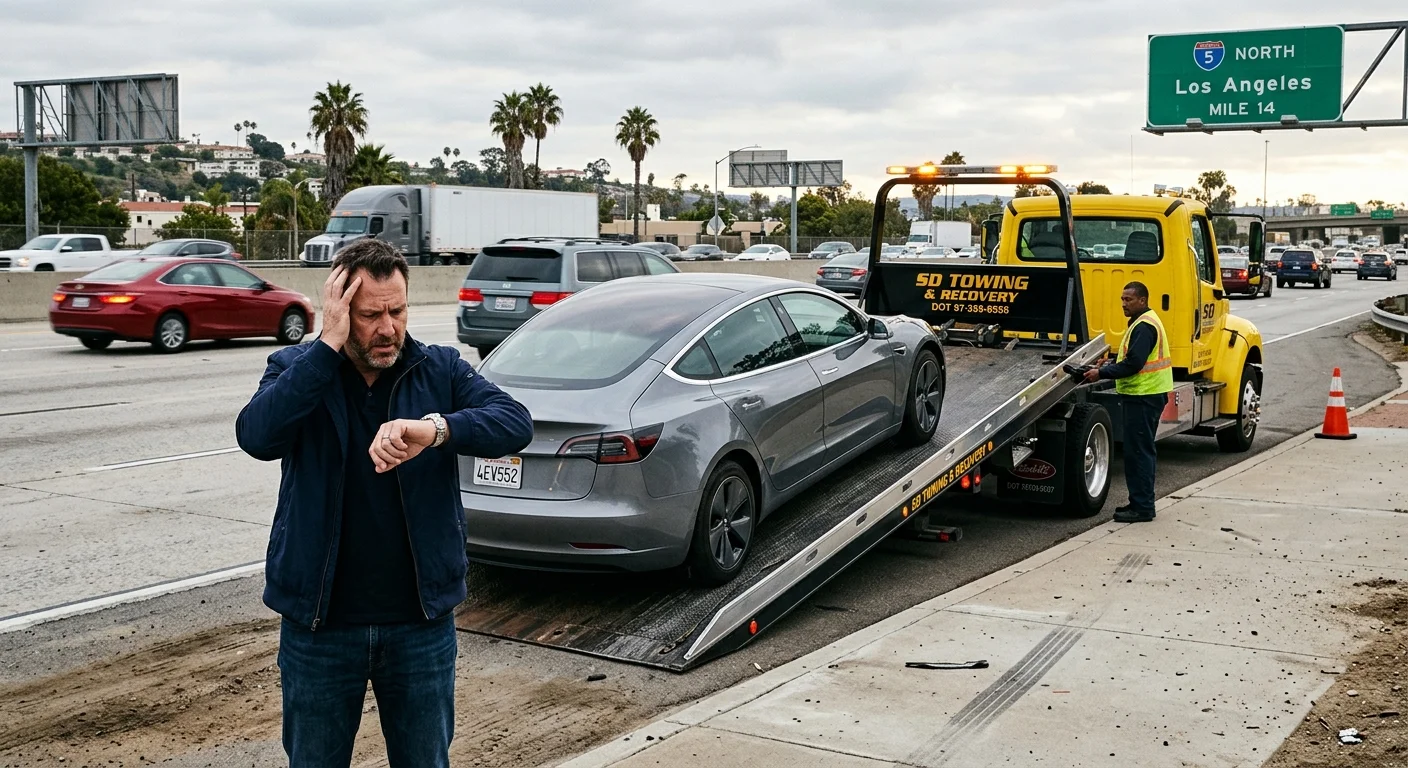
Nevada tow prices are filed, not posted here
There’s no statewide tow menu for a dead EV. Non-consent rates sit in NAC 706.408. They’re flat-rate tariffs each operator files with the Nevada Transportation Authority. There’s no single statewide maximum. This site publishes no dollar rates. A consent tow, the one you request, is a private quote. Get that number from the operator. Don’t take it from a blog.
Tow operators need an NTA certificate under NRS 706.4463 and the related sections. If the truck is already hooked, you can still stop the job. The operator must release the vehicle at the original location. That release has an operator-set fee. Ask for it before anyone starts the winch. We can’t print the figure. It isn’t a public statewide cap.
Nevada State Police Highway Patrol dispatches rotation tows through Autura. The cell shortcode is *647. Southern Command’s desk is (702) 486-4100. That path moves a disabled vehicle. It doesn’t charge an EV pack. NDOT’s Freeway Service Patrol covers the busiest valley freeways. Quality Towing runs it, and GEICO sponsors it. Hours are 5:00am to 8:30pm, seven days a week. It’s free to motorists. It handles tire changes, jump starts, fuel, minor fire suppression, and traffic control. NDOT’s published patrol materials don’t mention EV charging. That’s an advertised silence. It’s not proof the patrol can’t help an EV at all.
The 24-hour freeway clock is the part people miss
NRS 484B.440 covers a vehicle that can’t avoid stopping. You’re exempt from the no-stopping rule in that case. That statute sets no time limit. NRS 484B.443 is the clock. Law enforcement may remove a disabled or abandoned vehicle. On freeways and primary highways, the car is treated as abandoned after 24 hours. On other roads, the window is 72 hours. The owner pays the removal.
A sit on I-15, I-215, or US-95 is a legal job. It’s not only a mechanical one. Nevada 511 at nvroads.com shows closures and cameras if you need the road state. A neighborhood stall still matters. It just runs on the longer 72-hour window.
The Strip and Harry Reid sit in unincorporated Paradise and Winchester. That’s not the City of Las Vegas. A stall there is still a Clark County road problem. A stall on I-15 south through Enterprise toward Jean is a heat-and-grade problem. A stall in Summerlin sits higher, and often cooler, than downtown. The statute doesn’t care which neighborhood you’re in. The heat and the traffic do.
A mobile EV charge doesn’t start that removal path. The car never leaves the shoulder. You add range and roll it off yourself. That’s the difference the tow invoice doesn’t show.
Private lots have their own rules. Private-property tows need posted signs and a 48-hour warning sticker. Owners get certified-mail notice within 15 days. Crash-related tows get 21 days. A Paradise resort stall can go that way if the car sits. So can a downtown garage. Charging in the stall avoids the hook.
A tow relocates an empty pack but doesn’t fill it
Gas-car habit says the truck is the recovery. For an EV, the truck is a move. The high-voltage pack is still empty at the far end. You still need a working, compatible plug. If that stall is occupied, down, or the wrong connector, you’re still empty. Then you’re arranging another move.
This site won’t guess a charger count for Clark County. The live station inventory wasn’t verifiable when this was written. Name the plug you can confirm. Or skip the destination plug and charge on the shoulder.
Most Teslas with no power need a flatbed. All four wheels should leave the pavement. A wheel-lift or a dolly can load the motors and the pack. Read the Tesla no-power tow checklist for Nevada before straps go on. Other brands publish their own transport notes. Ask the operator to confirm the method first.
Flatbed work is a different ticket than a two-wheel lift. The operator’s NTA filing sets the non-consent piece. A consent job is the quote you accept. Ask for that quote before the truck moves. Nevada is an all-party consent state for phone calls. That’s NRS 200.620 and 200.650. If you record the quote, every party has to agree.
Heat turns a long sit into a worse sit
July in the valley averages a 104.5F high. About 78 days a year reach 100F or more. About 9.4 days reach 110F or more. The airport corridor runs 5 to 15F warmer than outlying areas. Downtown and the east valley can run up to 11F hotter than the rim.
You sit in that, and so does the pack. Recurrent Auto found about 5% range loss at 90F. The loss is 17 to 18% at 100F. Air conditioning can draw 3 to 5 kW to cool a hot cabin. Holding the cabin is closer to 1 kW. AAA in May 2026 measured 8.5% range loss at 95F. None of those figures come from Tesla. No Tesla-published range-loss number turned up.
A tow that then waits on a public stall keeps the pack empty. It also keeps you in that heat. A Level 2 charge at the bumper typically adds 10 to 20 miles. That add takes 15 to 30 minutes of charging. That’s charging time, not an arrival time. Those miles are often enough to leave the shoulder. Then you drive to a plug you already trust.
What a tow still doesn’t give you
A legal, flatbed tow still leaves gaps.
It doesn’t tell you if the 12V is the real failure. Plenty of “dead” EVs still have range in the pack. The 12V went to sleep. Towing a car that needed a jump is wasted motion. Check that first. The charge, jump, or tow fork is the short version.
It doesn’t stop the 24-hour clock until the car actually leaves. If the destination can’t take a charge, you’re still in the same legal story. You’ve only changed lots.
It doesn’t include Nevada tolls, because there are none. I-15, I-215, CC-215, US-93, US-95, and I-11 are free. I-15 HOV lanes from Silverado Ranch to the Spaghetti Bowl need two-plus occupants. Restricted hours are 6-8am and 4-6pm on weekdays. Those aren’t pay lanes. Don’t budget a transponder. Budget the tariff and a possible release fee. Budget a second move if the far-end plug fails.
It doesn’t bind two operators to the same number. NAC 706.408 is operator-filed. Two trucks can file two tariffs.
When charging at the car is the cleaner job
The operators we connect you with bring a 240V Level 2 source. It comes to the car. Teslas take a native NACS plug. Other EVs use a CCS or J1772 adapter. Typical add is 10 to 20 miles in 15 to 30 minutes of charging. They can also jump or replace a dead 12V on site.
That job doesn’t start an NTA hook. It doesn’t start the 24-hour abandoned-vehicle clock. It doesn’t put you on a rotation tow. You stay with the car. You get a quote before work starts. The operator bills you directly.
Charge Pro LV is a referral line. We match stranded drivers with independent local operators. We don’t own trucks, and we don’t set prices. We don’t hold a tow certificate. We don’t promise an arrival time.
Weigh that path against a tow in this valley note on charging or towing. For the quote itself, read how a mobile EV charging quote works.
A tow still makes sense when the car can’t roll. Shredded tires, crash damage, or a high-voltage fault belong on a flatbed. Charge at the car when the car can take power. You only need range, or a 12V wake. That’s the split.
If you’re already on the shoulder
Stay out of the travel lane. NRS 484B.440 covers a disabled stop. It doesn’t make the lane safe. Put the hazards on. If you’re on a freeway, Highway Patrol is *647. For the empty-pack version of this, see out of charge on a valley freeway.
Separate a dead 12V from an empty pack before you request a hook. Dark screens and a car that won’t unlock often point to the 12V. A car that’s awake at zero percent needs energy, not a jump.
Ask any tow operator three things before they hook. Do they hold an NTA certificate. Will this be a flatbed with four wheels up. What’s the quoted tariff or consent price. Include the release fee if you stop the job. Then ask where they plan to take the car. Ask whether that destination is a confirmed, compatible plug. If they can’t answer the last one, you’re buying a relocation. You’re not buying a recovery.
If you want the car charged where it sits, call (702) 935-4699. We connect you with a local operator. They quote you, they do the work, and they bill you.