A jump can wake a dark EV after a Las Vegas Valley heat soak. EV 12V battery replacement is the lasting fix after that heat jump. Another boost only buys a short window before the cell drops.
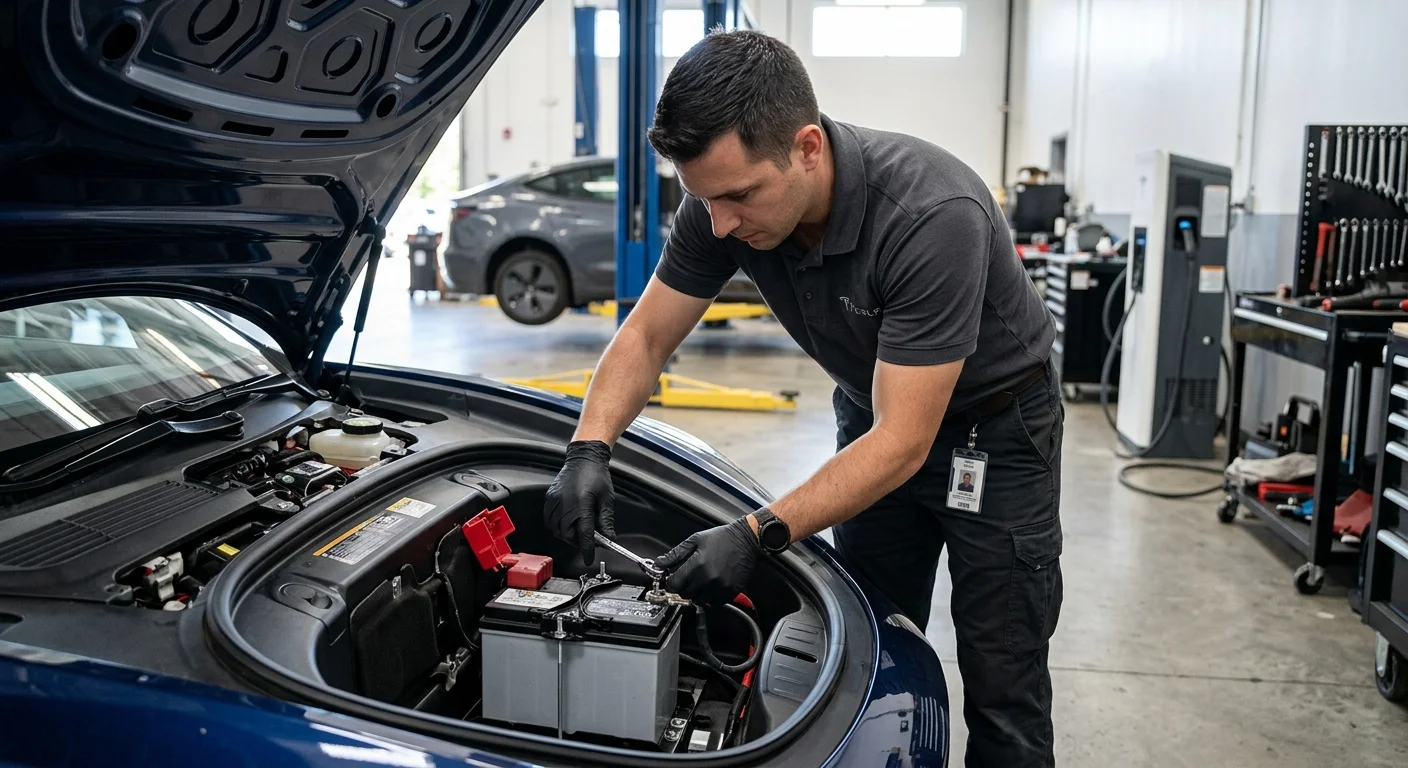
A valley jump is a bandage
July air here is hard on a small battery. NWS Las Vegas puts the average July high at 104.5F. About 78 days a year reach 100F or more. About 9.4 days hit 110F or higher. The official record reached 120F on July 7, 2024. Cabin plastic and frunk metal run hotter than that air reading.
Downtown and the east valley can run up to 11F hotter than the rim. The airport area often sits 5 to 15F warmer than outlying neighborhoods. A car that baked in Winchester isn’t a car that sat in Summerlin. Summerlin sits around 3,500 feet and climbs toward 4,400 near Red Rock. The valley floor is about 2,000 to 2,920 feet. Henderson sits near 1,867 feet. That spread changes how long a parked cabin stays an oven.
A weak 12V hates the soak. AGM cells cook in a closed front trunk. Lithium 12V packs in newer Teslas still age in desert heat. The car may wake after a jump, then sleep in the same hot box. The cell can’t hold the charge. You stall again in a resort garage or on I-215.
If the car died again after a boost, read your EV battery dies again after a jump. That repeat drop is the replacement flag.
The 12V is the gate, not the pack
The big battery moves the car. The small 12V runs the computers. It feeds door latches, screens, lights, and the contactors. Those contactors connect the high-voltage pack to the drive system. Without a healthy 12V, the car never wakes.
That’s why a dark EV often isn’t an empty pack. The dash stays black. The charge port won’t open. The app goes quiet. You can sit on a full traction battery and still go nowhere. The little battery lost the argument with heat.
What happens when an EV 12V dies in the valley walks through that black-screen stall. A jump opens the gate once. A worn cell lets it swing shut again as soon as the car sleeps.
Signs you need EV 12V battery replacement
A single glitch after a long sit can be a fluke. A pattern in valley heat usually isn’t. Watch what repeats after the cables come off.
It woke, then died again hours later
That’s the loudest signal. A sound 12V holds after a proper jump. A worn one drops as soon as the car sleeps. If you needed a boost this morning and the screens went dark after lunch, stop jumping it.
The dash already asked for a new 12V
Many Teslas show a 12V replacement message. Some BMWs say replace battery, then refuse to start. Other brands throw a low-voltage warning and a pile of odd codes. Those messages aren’t asking for another jump pack. They’re asking for a new cell.
Tesla wear in this climate is covered in Tesla 12V failure in valley heat. The lasting Tesla fix is in Tesla 12V replacement after desert heat.
Locks, handles, and the fob go flaky in the heat
You tap the fob twice and only one door answers. Tesla handles hesitate to present. Interior lights fade, and the screen boots slow, then blanks. Accessories are the 12V’s daily load. When they wobble in a hot Sunrise Manor driveway, the cell is tired.
The car won’t wake, even with miles showing
You press the brake and nothing happens. Drive mode never arrives. The traction battery still showed range in the app an hour ago. That mismatch is classic 12V. An empty pack and a dead 12V can look similar from the curb. The fix isn’t the same.
Random service warnings that come and go
Control units brown out and throw errors that don’t match. Brake, steering, camera, and charging faults can all appear. Then they vanish after a jump. That vanishing act is a clue. The modules were starved. They weren’t all broken at once.
Age plus a few desert summers
This page doesn’t publish a verified 12V lifespan in years. Shop tests and your owner’s manual beat a blog guess. What is verified is the climate the cell lives in. If yours is a few years old and already needed a jump this summer, replacement is the safer bet. Don’t keep proving the same failure on CC-215.
Why valley parking cooks the small battery
Cars sit here, and that’s the local pattern. A Tesla in Harry Reid long-term parking can sit through 100F days. Airport parking publishes free battery jump starts and tire inflation. The airport site doesn’t publish EV charging, so this page won’t claim stalls there. A jump in a long-term lot still leaves a weak 12V in the same hot box.
Resort lots in Paradise bake from late morning on. The Strip and the airport sit in unincorporated Clark County, not the City of Las Vegas. You can stall in a Paradise garage and still be outside city limits. The heat doesn’t care about the map line.
Game lots add long sits after the cabin was in climate control. Allegiant Stadium parking after a Raiders or UNLV night is a classic cool-down stall. The 12V has to hold computers through that swing from cool cabin to baked metal.
Older housing stock in Winchester, Boulder City, and Mount Charleston means more cars stored in older buildings. Census ACS 2019-2023 figures put Winchester’s older housing share at 53.1%. Boulder City is 48.5%, and Mount Charleston is 61.9%. This page can’t confirm how those garages are vented. It can say the housing is older. The cars still sit through the same 100F stretches.
Home charging doesn’t save a dying 12V by itself. NV Energy’s Residential Electric Vehicle Recharge Rider sets an overnight window from 10:01pm to 8:00am. That program is about the traction pack on a time-of-use rate. The 12V still has to boot the car so the pack can charge. If the 12V is dead, the overnight plug never gets a chance.
NV Energy serves most of the Las Vegas Valley. Boulder City runs Boulder City Utilities, not NV Energy. Blue Diamond, Indian Springs, and Sandy Valley sit on Valley Electric Association. Moapa Valley sits on Overton Power District Number 5. None of those utilities publish a 12V replacement rule. Your manual and a shop do.
What a jump actually buys you
A jump feeds the low-voltage bus so computers boot and contactors close. The high-voltage pack can then support the 12V while the car is awake. That’s why a jumped EV can often drive. It’s also why the stall returns after the car sleeps. Sleep cuts that support. The worn cell sits alone, and heat keeps draining it.
Never jump from the high-voltage system. Use the 12V jump points in the manual. Tesla, Rivian, and Mach-E all have labeled 12V posts or a bumper access point. Brands differ on the exact cover. The owner’s manual is the authority, not a blog checklist.
A jump is the right first move when you’re in a lane. NRS 484B.440 lets a disabled vehicle remain on a highway when it can’t avoid stopping. The statute sets no time limit. NRS 484B.443 still lets law enforcement remove a disabled or abandoned vehicle. On freeways and primary highways, abandoned treatment starts after 24 hours. On other roads it’s 72 hours. Get the car able to move, then deal with the cell.
NDOT’s Freeway Service Patrol covers the busiest valley freeways from 5:00am to 8:30pm, seven days a week. Quality Towing operates it, and GEICO sponsors it. It’s free to motorists. Published FSP work includes tire changes, jump starts, fuel, minor fire suppression, and traffic control. NDOT doesn’t advertise EV charging in those materials. A 12V jump on a gas-car pattern may still help some EVs. Don’t assume the patrol will treat your car like a mobile EV tech.
If you need the jump done with EV gear, the operators we connect you with handle Tesla 12V jumps and other brands. See Tesla 12V battery jump and how to jump start an EV in desert heat.
Replacement is the lasting 12V fix
Once the cell can’t hold a charge, rest in a cool garage doesn’t restore it. Rest in a Paradise parking structure does even less. Replacement is the repair. A second jump is delay.
This site doesn’t publish parts prices, labor rates, or shop averages. Those figures weren’t verified for valley shops, Tesla Service, Rivian, or Ford. Confirm the current part and labor quote with the installer before you pay. The operator who meets you on site quotes before starting too.
Tesla Model 3 and Model Y 12V packs sit under frunk trim on many years. Newer cars may use a lithium 12V instead of AGM. Rivian R1T and R1S still rely on a 12V auxiliary system. Ford Mustang Mach-E 12V location varies by year, often in the frunk or under a rear seat. Hyundai Ioniq 5, VW ID.4, BMW i4, and most other EVs follow the same logic. The small battery still gates the car. Access is brand-specific, and so is the part.
Charge Pro LV doesn’t replace batteries. It’s a referral line that matches you with independent local mobile rescue operators. Those operators can jump a dead 12V on site. They can also replace a dead 12V on site when that’s the right job. They quote before they start and bill you directly. They don’t work for this site.
If the high-voltage pack is also empty, a jump won’t add miles. Operators can bring a 240V Level 2 source to the car. Native NACS for Teslas, with CCS or J1772 adapters for other brands. That charge typically adds 10 to 20 miles of range in 15 to 30 minutes of charging time. That’s charge time, not a promise of when someone arrives. A 12V failure and an empty pack can stack. Say both symptoms when you call.
Driveway swaps aren’t always the right call
Some owners can change a 12V, and many shouldn’t. EVs often want a documented sleep or service mode before the 12V comes out. Wrong order can set errors, and it can bite you on a live bus. Locations hide under cowl plastic, under seats, or behind panels. Torque specs and battery type matter.
This page won’t walk a trim-removal recipe. Manuals change by year. A copied checklist from another market would be wrong here. Read your owner’s manual. If the steps aren’t clear, don’t guess. A mobile tech or a dealer bay beats a fried module. This site has no verified valley labor figure, and it won’t invent one.
If you do the work, isolate the old cell and recycle it. Don’t keep a failed AGM on a hot garage floor as a spare. If it already failed in this climate, it’s done.
If you’re already stuck on a valley road
Stay out of live traffic if you can, and use hazard lights. NRS 484B.440 covers a disabled stop you can’t avoid. Call from a safe spot.
If the screens are dark, treat it as 12V until proven otherwise. Try the app, then the mechanical door release in the manual. Don’t force a charge cable into a port that won’t unlock.
A jump that restores wake is your chance to move. Drive to a shop if the car stays stable. If voltage sags again in a few miles, don’t keep hopping it. That’s the replacement flag.
A stall on I-15 toward Jean or Primm is still a 12V problem if the car won’t wake. A stall on Railroad Pass toward Boulder City follows the same logic. Kyle Canyon Road toward Mount Charleston adds elevation, about 7,506 feet in town. Heat at the valley launch, then a climb, is a hard day for every system. Start with the 12V if the car is dark.
Who to call, and what they won’t promise
Charge Pro LV serves the Las Vegas Valley. It doesn’t hold a trade license, own trucks, or employ technicians. It sets no prices and publishes no hours. Independent operators do the work. The pros we connect you with are licensed and insured.
If you want a local operator for a 12V jump or an on-site replacement, call (702) 935-4699. The operator quotes before starting, and you decide. If you only needed a boost last month and the car is dark again after a heat day in Paradise, skip the third jump. Ask about replacement.