The screens came back after the jump. Then they went dark again while you sat there. Cabin cooling in valley heat can drain a jumped 12V in the same lot. That’s a battery dying after jump start, not a finished repair. The low-voltage system woke. The heat load then pulled it back down.
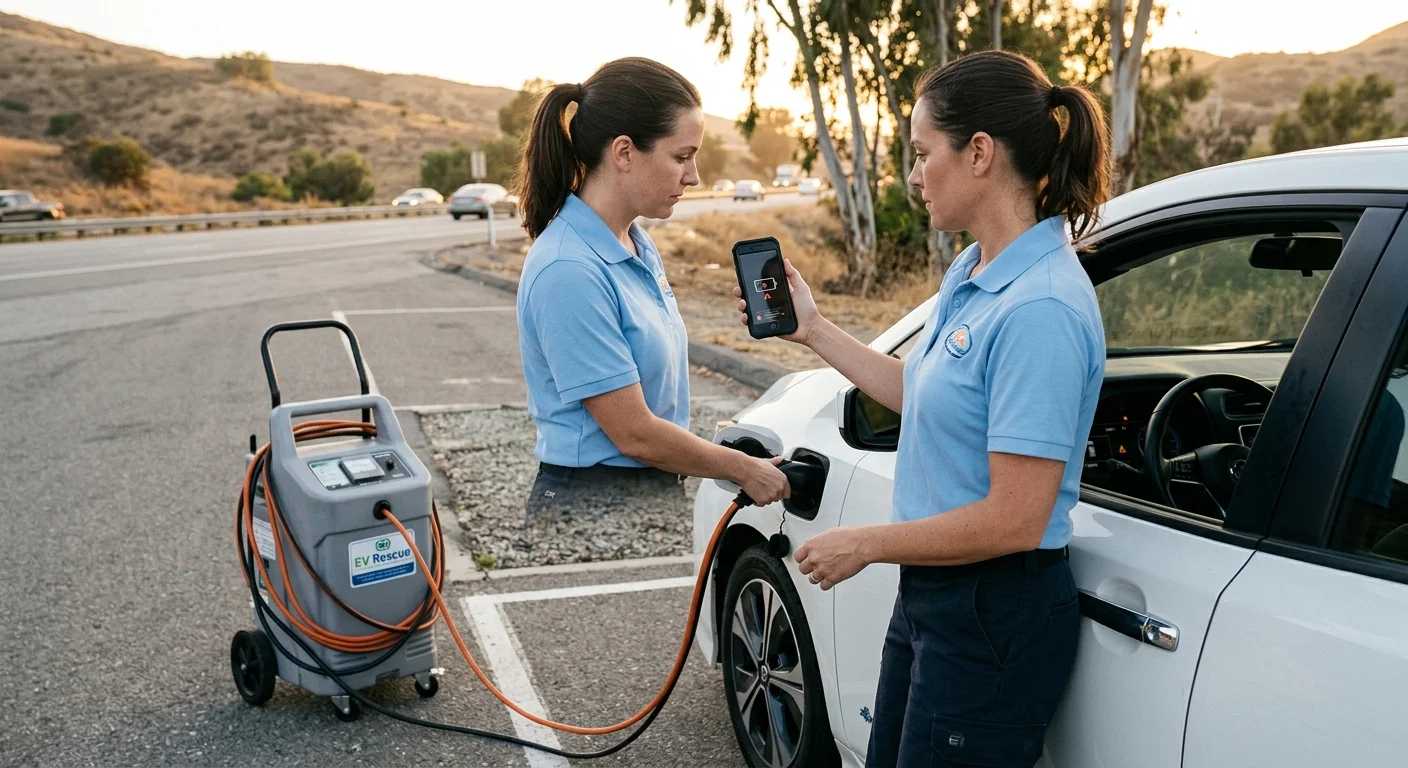
The jump woke the 12V, not the cabin load
On most EVs, a jump feeds the 12-volt battery. It doesn’t refill the traction pack. The 12-volt side runs doors, screens, computers, and climate. Those systems stay quiet while the car looks dead. They all come online together after a successful jump.
That’s when valley heat does the damage. Recurrent Auto measured cabin cooling at 3 to 5 kW. That’s the draw to cool a hot cabin. Holding that cabin later sits closer to 1 kW. The same heat still hits a weak 12-volt battery while you sit.
NWS Las Vegas lists an average July high of 104.5F. About 78 days a year reach 100F or more. About 9.4 days reach 110F. The all-time record high was 120F on July 7, 2024. The airport runs 5 to 15F warmer than outlying areas. East valley and downtown can run up to 11F hotter than the rim.
A jumped car in a Paradise resort stall is sitting in that island. Winchester and Sunrise Manor surface lots bake the same way. Downtown near the Fremont Street Experience isn’t milder. Summerlin sits around 3,500 feet and can run cooler than the floor. Henderson sits lower, around 1,867 feet.
You turn climate to max because the cabin is brutal. Screens and computers come back together. The jumped 12-volt pack tries to hold all of it. Then the dash goes dark again before you ever leave the stall.
Power returning once only proves voltage came back. It doesn’t prove the 12-volt battery can hold a desert heat load.
Write the heat sequence while it’s still clear
Don’t diagnose from the driver’s seat. Don’t start a second jump from memory either.
Put make, model, and model year at the top. Copy the exact warning text from the dash, screen, app, or key. Look for 12V, low voltage, propulsion, or charging language. Don’t translate that text into a theory. The original wording is what the next person needs.
Then list what still works: doors, dash light, app connection, shift, and charge screen. Say only what you observed.
Record cabin heat, climate use after the jump, fan setting, and whether the screens died during cool-down. That cabin-cooling timeline is the useful local fact.
If another person did the first jump, ask what they used. Write their answer. Don’t try to rebuild the steps from a clip. Your owner’s manual for this model year still controls the procedure. Some Teslas use a lithium 12-volt pack. Other EVs still use a conventional 12-volt battery. The allowed method isn’t interchangeable. Confirm it in the docs for your year.
Photograph the full display when you can. Don’t clear warnings to tidy the screen. An app screenshot helps if the dash is already dark.
Location has to be exact. “The valley” isn’t a stall number. Name Paradise, Winchester, or the City of Las Vegas. The Strip and Harry Reid International Airport sit in unincorporated Clark County. Give the lot name, garage level, gate instructions, or freeway direction.
A Town Square stall is a different handoff than a US-95 shoulder. An Allegiant Stadium lot after a Raiders game needs its own entrance note. A Fremont garage is a different handoff. A Las Vegas Convention Center event lot needs level detail.
A freeway stall has its own rules. NRS 484B.440 lets a disabled vehicle remain when it can’t avoid stopping. The statute sets no time limit. Law enforcement may still remove it under NRS 484B.443. On freeways and primary highways, it’s treated as abandoned after 24 hours. On other roads, that window is 72 hours. The owner pays removal. Give route, direction, and a visible marker anyway.
A second jump isn’t the default next step
Don’t treat another jump as automatic. Read the official procedure for your exact model year first. Connection points, covers, and allowed equipment change by brand. This article won’t give generic clamp steps. Those steps weren’t confirmed for every EV here.
Skip a repeat attempt if the manual says not to. Skip it if the helper can’t confirm they support this vehicle. Don’t turn it into trial and error. A second collapse after cabin cooling is already a data point. Repeating the same jump without the docs doesn’t add a diagnosis.
Tell the next operator the first jump already happened. Power returned. Then it failed again in the same place. Mention cabin cooling if you ran it. Share the photos and the timeline. Ask whether they handle your model and a low-voltage repeat before anyone connects hardware.
If you see smoke, damage, or another hazard, stop. Call emergency services. Don’t ask a bystander to improvise around the car.
For Tesla 12-volt wear in this climate, read Tesla 12V failure in valley heat. For the conversation before anyone talks replacement, see signs your EV 12V needs a replacement. Neither page replaces your vehicle’s own instructions.
Choose the help that fits this stall
Pick based on what the car can do right now.
Roadside help fits when the vehicle won’t wake, unlock, or move. Ask if the operator supports your brand. Ask if they work a 12-volt repeat after a jump. Charge Pro LV is a referral line. It matches stranded drivers with independent local operators. The brand doesn’t own trucks or employ technicians. The pros we connect you with are licensed and insured. The matched operator quotes you before starting and bills you directly.
A Tesla 12V battery jump is one path when the low-voltage system is the problem. EV roadside assistance covers the broader case when you’re not sure which battery failed. Drivers in other brands can start with non-Tesla EV rescue. The traction pack may also be low. Operators then bring a 240V Level 2 source to the car. That’s typically 10 to 20 miles of range in 15 to 30 minutes of charging. That figure is charging time, never an arrival time. They use a native NACS plug, or a CCS or J1772 adapter for non-Tesla EVs.
A service center fits when you need testing, a planned replacement, or manufacturer diagnostics. Send the same notes you prepared for roadside. Say the car died again after a jump. Say you ran cabin cooling in the lot. Let the shop decide what that means for your model year.
You may need both. An operator can address the stall in the lot. The shop still has to find why the 12-volt side collapsed. Confirm that split before work starts. If a tow comes up, follow the manufacturer’s current towing rules for your model. Tow operators in Nevada need a Nevada Transportation Authority certificate under NRS 706.4463. Non-consent rates are operator-filed tariffs, and no statewide maximum is published here. Confirm the current figure with the operator before you approve a hook.
Don’t choose help from the range number you remember from before the stall. Report that number as one observation. Recurrent Auto found about 5% range loss at 90F and 17 to 18% at 100F. AAA measured 8.5% range loss at 95F in May 2026. Those figures describe the traction pack in heat. They don’t diagnose your 12-volt failure. No Tesla-published range-loss figure was located. Don’t quote one.
The NDOT Freeway Service Patrol covers the busiest valley freeways. Hours are 5:00am to 8:30pm, seven days a week. Quality Towing operates it. GEICO sponsors it. It’s free to motorists. It advertises tire changes, jump starts, fuel, minor fire suppression, and traffic control. NDOT’s published FSP materials don’t mention electric vehicles or EV charging. That’s an advertising silence, not a claim the patrol can’t help an EV. If a patrol truck already jumped you, tell the next operator that sequence.
Harry Reid International Airport parking offers free battery jump starts and tire inflation at (702) 261-5122. A jump in Long Term or Economy can fail a second time. Treat that as a new event. Whether LAS parking has EV charging couldn’t be confirmed from the airport’s own site. Don’t plan around a stall the airport doesn’t publish.
Call with the lot details, not a guess
If the car is still dark after that second collapse, you need someone at the vehicle. Share make, model year, exact warnings, and the jump timeline. Say whether cabin A/C was running. Give the lot, garage level, or freeway direction.
For more on the 12-volt collapse itself, read what happens when an EV 12V dies in the valley. For procedure questions before anyone connects cables, see how to jump start an EV in desert heat.
Call Charge Pro LV at (702) 935-4699. We’ll connect you with a local operator. That operator quotes before work starts and bills you directly.