East Las Vegas apartments sit in a hotter heat island. Many of those buildings have no home plug at all. Packs often arrive already thin after a day commuting west. When those last miles won’t happen, you need a charge at the car. EV roadside assistance in east Las Vegas is a mobile rescue off the Strip, not a tow.
Heat, apartments, and a pack that’s already thin
The older central and east valley runs from downtown out toward Nellis. Housing stock is denser and older, and apartment buildings are common. Drivers with no home plug live on public charging. That’s how the buildings were wired, not a guess about public stalls.
Sunrise Manor is the east-valley core toward Nellis. The ACS 2019-2023 count is 199,099 residents. Hispanic or Latino share is 54.8 percent. About 22.9 percent of the housing was built before 1980. Older apartments and long commutes west into the city drive the calls.
NWS Las Vegas puts the average July high at 104.5F. About 78 days a year hit 100F or more. About 9.4 days hit 110F or more. The all-time record high is 120F, set on July 7, 2024. The airport runs 5 to 15F warmer than outlying areas. East valley and downtown blocks can run up to 11F hotter than the rim.
Recurrent Auto found about 5 percent range loss at 90F. At 100F the loss is 17 to 18 percent. Air conditioning can draw 3 to 5 kW to cool a hot cabin. AAA, in May 2026, measured 8.5 percent range loss at 95F. Don’t treat those as Tesla numbers. Tesla didn’t publish a range-loss figure we could confirm.
A pack that read fine downtown can end the day short of home. Those commutes cross the whole valley in heat. You’re sitting in heat with the AC on. You started the morning without a wall plug.
Off the Strip, with nowhere to plug in overnight
The Strip sits in Paradise and Winchester. Those are unincorporated Clark County, not the City of Las Vegas. East of that corridor, Sunrise Manor and the Nellis edge keep the apartment pattern. Winchester, Paradise, and the older Las Vegas core share it too. Winchester’s Hispanic or Latino share is 50.4 percent. About 53.1 percent of its housing was built before 1980.
Most stalled drivers here didn’t forget to charge overnight. The building never had a dedicated plug. You staged at a public stall when you could. Then you spent the rest of the day on leftover range. By late afternoon the gauge is already in the teens. The westbound commute, then the crawl back east, finishes it.
That bind is why Sunrise Manor apartment stalls show up so often. Whitney along Boulder Highway sees the same thin finish. The blocks around Nellis Air Force Base see it too. The base sits about eight miles northeast of the core. East-valley rescue near Nellis follows the same heat-and-apartment pattern.
NV Energy serves Las Vegas, Sunrise Manor, Whitney, and the valley core. It publishes the Residential Electric Vehicle Recharge Rider. The charging window is 10:01pm to 8:00am. It also runs managed charging and multifamily charging programs. Those help if a building ever gets wiring. They don’t move a car that already sits empty. Nevada has no state EV purchase rebate. Clark County Title 30 requires EV-ready wiring in new construction. A Level 2 home charger still needs an electrical permit. Older east-valley stock wasn’t built under that rule. About 22.8 percent of Las Vegas housing predates 1980.
When the apartment has no plug, the fork is simple. You either wait on building wiring, or you charge at the car. A home battery doesn’t roll a car that already hit empty.
Sunrise Manor, Whitney, and the Nellis edge
Sunrise Manor takes the valley’s hottest afternoons under that heat island. Working-class blocks, older apartments, and the run west into the city leave little margin. For the place page, start with Sunrise Manor.
Whitney sits between Sunrise Manor and Henderson. It follows Boulder Highway and Clark County Wetlands Park. Population is 46,268 per ACS 2019-2023. Hispanic or Latino share is 40.3 percent. About 12.2 percent of housing was built before 1980. Commuters funnel toward US-95 and the Boulder Highway corridor. A low pack here strands you short of home. EV roadside assistance in Whitney covers that pass-through in more detail.
Nellis and Sunrise aren’t a separate Census place. Don’t quote a population for those blocks. Base traffic, older housing, and east-valley heat stack together. A commuter headed across town starts with less margin than the trip computer shows.
Downtown adds a parked-night failure after a long Fremont sit. The Fremont Street Experience and Downtown Container Park hold a car through a long evening. Cabin cooling and sentry draw pull on the 12V. The traction pack can still have charge. The screens can still stay dark.
The incorporated City of Las Vegas wraps the northwest and central valley. ACS 2019-2023 puts the city’s population at 650,873. The Census 2024 estimate is 678,922. Hispanic or Latino share is 34.1 percent. Event lots and across-town commutes set the local stall pattern. Older central neighborhoods still carry the no-home-charging wiring.
Empty pack, or a 12V that cooked in the lot
Two failures look the same from the sidewalk, and the car won’t wake. Door handles may not present, and the screens stay black.
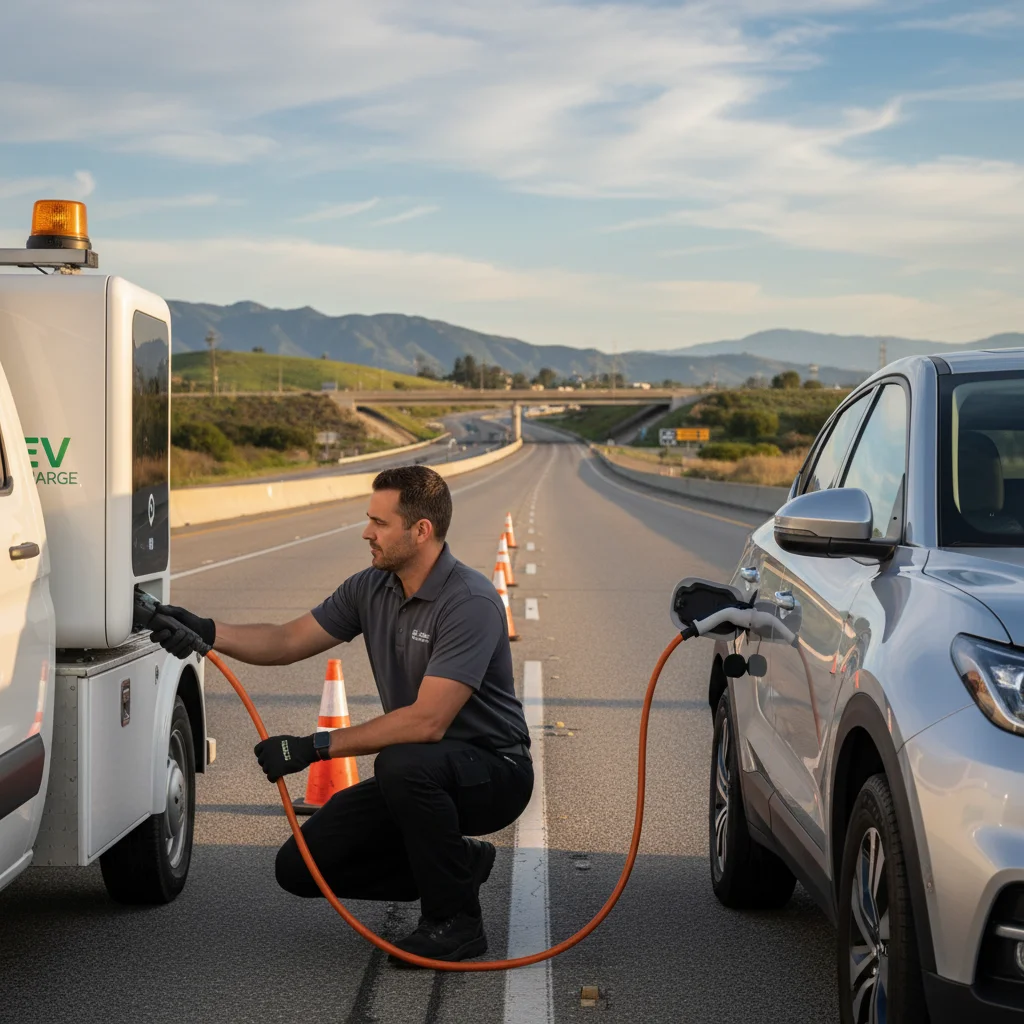
An empty high-voltage pack means you used the last miles. Heat-soaked range loss and a day with no home plug get you there. Independent operators bring a 240V Level 2 source to the car. Tesla gets a native NACS plug. Other brands get CCS or J1772 through an adapter. Typical add is 10 to 20 miles of range. That takes 15 to 30 minutes of charging at the car. That number is charging time, never an arrival time.
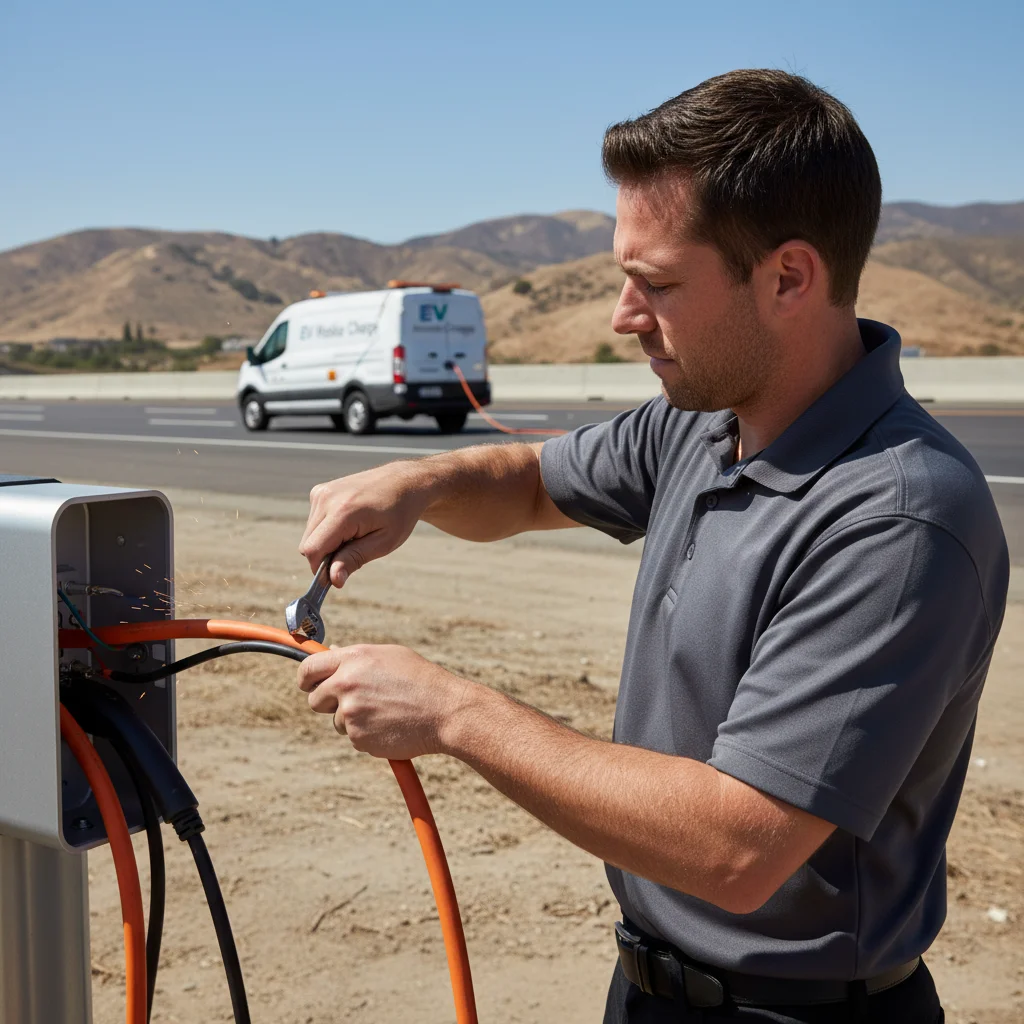
A dead 12V is the other east-valley stall. Heat wears the small battery that runs locks, computers, and contactors. The traction pack can still hold energy, but the car won’t use it. Operators can jump or replace that 12V on site. They handle Tesla and every major EV brand. If the car sat through a Fremont night, ask which battery failed. Dark screens don’t prove the pack is empty.
NDOT’s Freeway Service Patrol covers the busiest valley freeways. Hours are 5:00am to 8:30pm, seven days a week. Quality Towing operates it, and GEICO sponsors it. It’s free for tire changes, jump starts, fuel, and traffic control. It clears about 31,500 incidents a year in Las Vegas. None of NDOT’s published materials mention electric vehicles, EV charging, or EV-specific service. The patrol doesn’t advertise EV charging as a service. Nevada 511 and nvroads.com report conditions, closures, and cameras.
NRS 484B.440 exempts a disabled vehicle that can’t avoid stopping. The statute sets no time limit. NRS 484B.443 lets law enforcement remove a disabled or abandoned vehicle. On freeways and primary highways, that abandoned clock is 24 hours. Stay in the car with hazards on if it’s safe.
Nevada has no toll roads anywhere in the state. I-15, I-215, CC-215, US-93, US-95, and I-11 are free.
How a mobile rescue works here
Charge Pro LV is a referral line. It matches stranded EV drivers with independent local operators. It performs no work and owns no trucks. It employs no technicians and sets no prices. It also promises no arrival time on the call. The operator quotes you before starting, then bills you directly.
When you call
Give a location, make, and connector type. Say if you’re on a shoulder or in a tight apartment lot. Older east-valley lots can be tight on access.
When the operator arrives
They confirm state of charge and which battery is down. Then they connect Level 2 gear, or they jump the 12V. While the charge runs, you pick the next plug you can actually reach.
When you leave
You drive yourself out, with no flatbed and no storage lot. Mobile EV charging is the empty-pack path. A 12V jump is for the car that won’t wake.
Tesla factory roadside is a separate path, and AAA is another. A local operator is one more option when you’re already sitting in Sunrise Manor heat. Charge Pro LV doesn’t hold a contractor license and doesn’t do the work. The pros in the network are licensed and insured.
Don’t treat a tow as the first move unless the car can’t take a charge. Non-consent tow rates in Nevada are operator-filed tariffs. The Nevada Transportation Authority regulates them under NAC 706.408. There’s no single statewide maximum. No rate belongs on this page. Confirm any figure with the operator before you authorize a hook.
When to call
Call when the pack is too thin to finish the east-valley run home. Call when the 12V died in an apartment lot after a hot sit. Call from Boulder Highway in Whitney or from the Nellis edge. Call from a downtown lot after a Fremont night too. Charge Pro LV serves the Las Vegas Valley. Call (702) 935-4699 and you’ll be matched with a local operator. The operator quotes before they start.