Your EV is dying on I-15 south through Jean. You need a mobile operator to charge at the car. Heat and a southbound headwind eat the last miles before Primm.
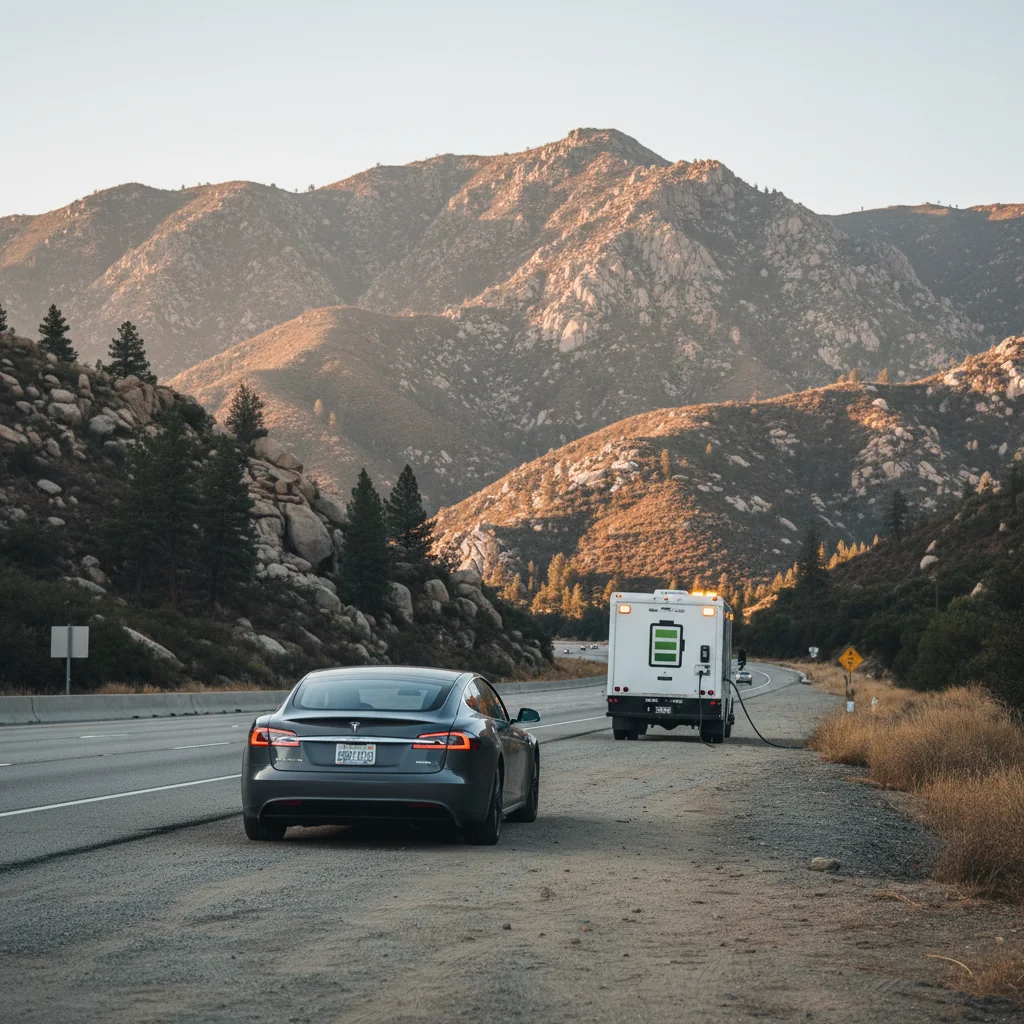
Jean is the last Nevada pause before Primm
Jean is a thin stop on I-15, about 25 miles south of the valley. Elevation at Jean sits around 2,841 feet on this climb. ZIP code 89019 is the one that covers this community. It’s not a separate Census place with its own count. You won’t find a tidy population figure to cite. What you’ll see is the last Nevada exit before Primm. That’s the California-bound run from the Las Vegas Valley.
Drivers leave the south valley with a number that looked fine. Then the southbound climb starts spending that number. Jean is where remaining miles stop matching the dash. You’re not imagining that drop on this stretch. Grade, heat, and a headwind stack on the same miles.
This isn’t a shaded parking stall in the valley. There’s no resort lot and little reason to linger. The shoulder is the workplace once you’re empty. If the pack is empty, you charge at the car. EV roadside assistance here means a plug brought to the car.
Why this climb eats a comfortable margin
Valley floor elevations run about 2,000 to 2,920 feet. Jean sits near the high end of that band at 2,841 feet. Primm sits lower than Jean, around 2,618 feet. Southbound you still climb into Jean before that drop. The motor works against gravity the whole way up.
A headwind on I-15 south makes that work worse. You can’t see wind on the range estimate. You feel it as a faster drop than the last city miles. The car’s guess was built on recent driving. Recent driving was probably flatter, slower, or cooler.
NWS Las Vegas lists an average July high of 104.5F. About 78 days a year hit 100F or more. About 9.4 days a year hit 110F or more. The all-time record high is 120F, set on July 7, 2024. Cabin cooling isn’t optional on that kind of pavement.

What heat does to the pack you still have
Recurrent Auto measured about 5% range loss at 90F. At 100F the loss rose to about 17 to 18%. Air conditioning drew 3 to 5 kW to cool a hot cabin. Holding a cooled cabin took about 1 kW. AAA, in May 2026, measured 8.5% range loss at 95F. None of those range figures come from Tesla itself. No Tesla-published range-loss number turned up in the record. Treat the dash as a guess trained on easier miles.
Geotab found hot-climate packs degrade about 0.4% per year faster. Phoenix-style desert heat was the worst case in that work.
Headwind, speed, and the southbound grade
Keep the car in a calmer drive mode if you still have motion. Speed on an open interstate is a quiet range thief. You don’t need a record run to Primm. You need the car to keep rolling with a margin. Watch energy use, not the remaining-miles guess on the dash. kWh per mile tells you the truth on this grade. If that number looks ugly, slow down now. If you’re already stopped, stop guessing and call for a charge.
Empty pack or a car that won’t wake
Two failures look the same from the shoulder. One is a high-voltage pack sitting at zero. The other is a 12-volt battery that won’t wake the car. Heat is hard on both on this climb. If screens are dead and nothing boots, start with the 12V. Operators can jump or replace a dead 12V on site. Tesla and every major EV brand still rely on that small battery. A pack with miles left still sits there if the 12V is out.
If the car is awake and the gauge is at zero, that’s empty. That’s an out-of-charge recovery on this Jean shoulder. Towing an EV that only needs miles is slower than a charge. Nevada tow rules are real once a hook is involved. You want the car rolling under its own power when that’s possible.
Read the I-15 south to Primm guide if you’re still rolling. Charging on the shoulder is the local move at Jean.
What the operator brings to a Jean stall
Charge Pro LV is a referral line, not a shop. It doesn’t own trucks, and it doesn’t employ technicians. It holds no license and sets no prices. Independent local operators do the work at the car. The operator quotes you before starting, then bills you directly.
What they bring is a 240-volt Level 2 source. Tesla drivers get a native NACS plug on that lead. Other EVs use a CCS or J1772 adapter. A typical session adds 10 to 20 miles of range. That takes 15 to 30 minutes of charging time. That’s charging time, not a promise of when someone arrives. Ten to twenty miles is often enough to leave this shoulder with a plan. It’s not a full pack, and it’s not a road-trip reset. It’s enough to reach a stop you choose after the car can move. Mobile EV charging is built for that kind of rescue.
The Jean charging page is there for local context. Use that page for place context when you can still browse. Call when the car is already sitting on the shoulder.
What NDOT will do, and what Nevada law allows
The NDOT Freeway Service Patrol covers the busiest Las Vegas valley freeways. Quality Towing runs it, and GEICO sponsors it. Hours are 5:00am to 8:30pm, seven days a week. The patrol handles tire changes, jump starts, fuel, and minor fire suppression. It also handles traffic control around a stall. It clears about 55,000 incidents a year statewide. About 31,500 of those are in Las Vegas.
None of NDOT’s published patrol materials mention electric vehicles. They also don’t mention EV charging or EV-specific service. The patrol doesn’t advertise EV charging on this corridor. Don’t read that as a claim that a patrol driver can’t help an EV. It means you shouldn’t wait on a mobile charge from that truck. Don’t treat that patrol as an EV charging plan at Jean.
NRS 484B.440 covers a vehicle disabled so it can’t avoid stopping. That stop is exempt from the no-stopping-on-highway rule. The statute sets no time limit on how long it may remain. NRS 484B.443 is the other clock you should know. Law enforcement may remove a disabled or abandoned vehicle. On freeways and primary highways, a vehicle is treated as abandoned after 24 hours. The owner pays for that removal if it happens.
You have a legal reason to sit while the car is truly disabled. You don’t have a weekend of free parking on I-15. Nevada 511 and nvroads.com report conditions, closures, and cameras. Check those if weather or a crash is part of the stall.
There are no toll roads anywhere in Nevada. I-15 is free through Jean, with no transponder needed. That doesn’t help the pack, and it doesn’t add range.
Leave the valley with a buffer this climb can spend
Don’t treat Jean as a casual extra 25 miles. It’s a climb in heat, often with a headwind. Charge to full before you leave the south valley. Pre-cool the cabin while you’re still plugged in. Grid power is the better source for that job.
Once you’re rolling, use a moderate climate setting. Recurrent’s cabin numbers show why that setting matters. Cooling a hot interior draws several kilowatts from the pack. Holding a cool cabin draws about one kilowatt. Starting already hot on I-15 south spends miles fast.
Stay in a calmer drive mode once you’re on the interstate. Skip hard launches from those south-valley ramps. Watch kWh per mile after you clear those last exits. If consumption spikes, you still have a choice. You can slow down, or you can stop and call before you hit zero.
If you’re heading for the state line, Primm is next after Jean. Don’t invent a charger map from memory on this run. Confirm your planned plug in the apps while you still have signal. Apps fail, and that’s when shoulder charging is the backup. The Primm page is the next named community on that southbound map.
If you’re already on the shoulder
Get the car as far onto the shoulder as it will go. Put the hazard lights on and stay out of travel lanes. If you can, stay with the vehicle on the shoulder.
Call Charge Pro LV at (702) 935-4699 for a local operator. We connect you with a local independent operator. That operator quotes the job before any charging starts. You’re not hiring a fleet you can’t see. You’re hiring the person who shows up with the plug.
Tell the operator you’re at Jean on I-15 south. Give the direction and the nearest mile marker if you have one. Say whether the car still wakes on its own. Say if it’s a Tesla or another brand. Say if you think it’s a dead 12V or an empty pack. That split changes what they bring to the car.
If the 12V is the problem, a jump may wake the car. If the pack is empty, you need those 10 to 20 miles added on site. Either way, don’t sit through a 24-hour abandoned-vehicle clock. Don’t wait on a patrol truck for a Level 2 charge. NDOT’s published patrol materials don’t advertise EV charging.
Jean looks empty because it’s a near-ghost stop. The road isn’t empty, even when the exit looks quiet. Freight and California-bound traffic still roll through Jean. Treat the shoulder as live highway, not a parking stall. Get the car movable, then get off the climb.