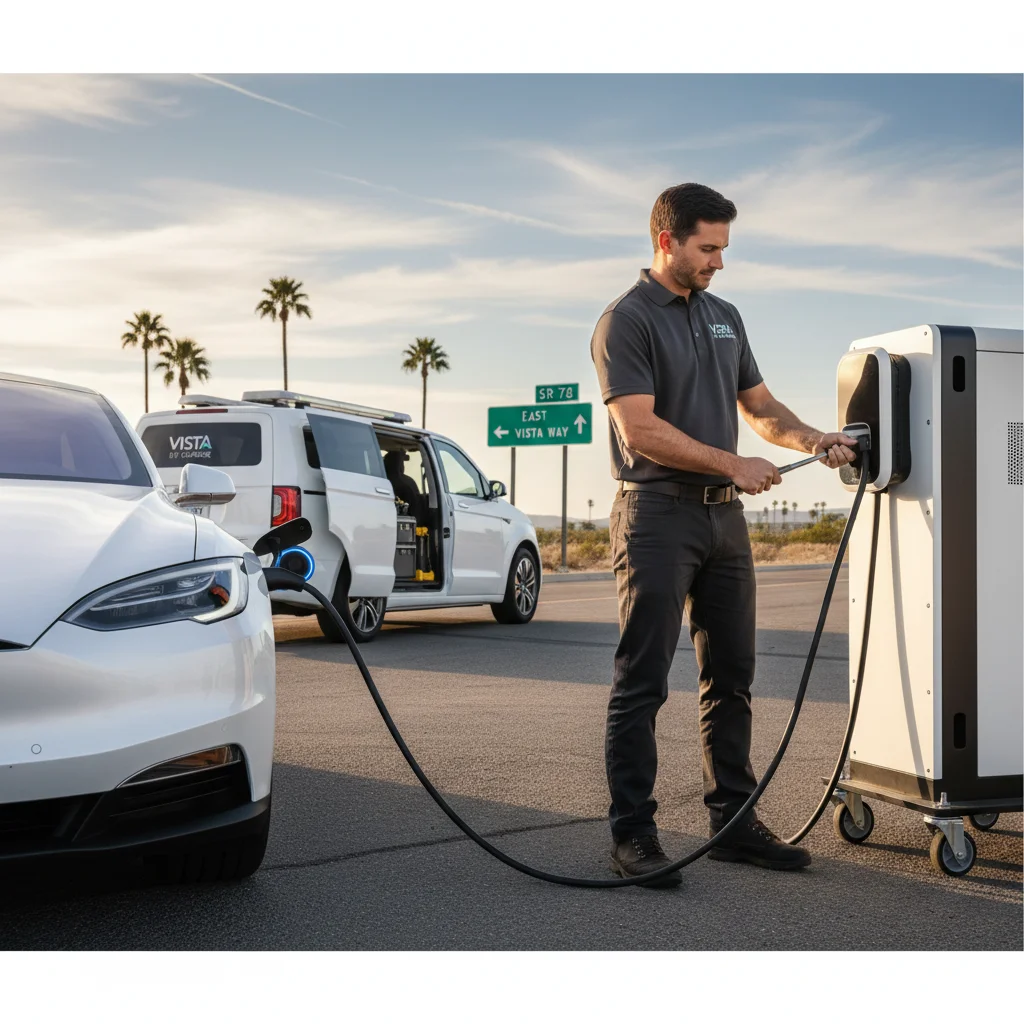
A low pack at Silverado Ranch is already aimed at I-15 south. That’s where the HOV lanes start. It’s the I-15 and 215 junction, not a side street. Commuters merge here for the south launch. Travelers stage here before the run toward Primm. Charge Pro LV is a referral line for the Las Vegas Valley. We connect you with an independent mobile rescue operator. That operator brings 240-volt Level 2 charging to the car. Teslas use a native NACS plug. Other EVs use a CCS or J1772 adapter. Typical charging adds 10 to 20 miles of range. That’s 15 to 30 minutes of charging, never an arrival time. That’s EV roadside assistance at the bumper. A tow isn’t the first tool for an empty pack.
The HOV start points you into southbound heat
Silverado Ranch isn’t a separate Census place. There’s no official town population to cite. The community sits in ZIP codes 89123 and 89183. The fact that matters is the freeway geometry. I-15 HOV begins here and runs to the Spaghetti Bowl. Restricted hours are 6 to 8am and 4 to 6pm on weekdays. You need two or more occupants in those windows. The federal single-occupant EV HOV authorization expired on September 30, 2025. An EV now needs two-plus occupants like any other car. If you’re solo, stay out of HOV in those hours. Nevada has no toll roads and no pay lanes. I-15, I-215, and CC-215 stay free. Occupancy is the only HOV rule.
Once you’re in that southbound stream, the next miles are desert air. Commuters are merging onto I-15 south. Travelers are staging for Primm. A thin pack at this merge is already pointed at heat. You’re not stalled on a random frontage road. You’re at the launch for Jean and Primm. If you’re already on the shoulder, start with the Silverado Ranch I-15 walkthrough. Read empty pack on I-15 near Silverado Ranch. The longer heat run is in out of charge on I-15 south toward Primm.
Enterprise sits on the same I-15 south launch. EV roadside assistance in Enterprise covers that merge from the next community over. Neighborhood notes live on the Silverado Ranch EV page.
Heat spends range on the southbound launch
NWS Las Vegas climate records put the average July high at 104.5F. About 78 days a year reach 100F or more. About 9.4 days reach 110F or more. The all-time record is 120F on July 7, 2024. Cabin cooling is the quiet drain on this corridor. Recurrent Auto found about 5% range loss at 90F. That loss rose to 17 to 18% at 100F. Cooling a hot cabin can draw 3 to 5 kW. Holding that cabin later is closer to 1 kW. AAA measured 8.5% range loss at 95F in May 2026. None of those range figures come from Tesla. No Tesla-published range-loss number could be verified.
NV Energy serves the Las Vegas Valley. Home charging in this valley is on NV Energy. The Residential Electric Vehicle Recharge Rider window is 10:01pm to 8:00am. Skip that window and leave at dawn on a thin pack. That’s how the southbound math breaks. Confirm current rider terms with NV Energy before you plan around them.
Monsoon bursts in July and August can flood washes and underpasses. If you stall, stay out of moving water. Nevada 511 and nvroads.com report closures and cameras. Check those before you walk anywhere.
Empty pack or a 12V that won’t wake
From the seat, both failures feel like a dead car. They aren’t the same job.
An empty traction pack can still light some screens. You just can’t add miles. Mobile EV charging is the match for that. The operator quotes you before the cable goes in. They bill you directly. Charge Pro LV doesn’t set rates. We don’t take the payment.
A dead 12V is a different stall. Doors may not unlock, and screens can stay dark. The high-voltage pack may still hold a usable charge. Valley heat is hard on that small battery. Operators can jump it or replace it on site. They cover Tesla and every major EV brand.
Don’t guess which fault you have. Tell the operator what the dash showed. Tell them whether the car still unlocks. That split decides a charge versus a 12V wake.
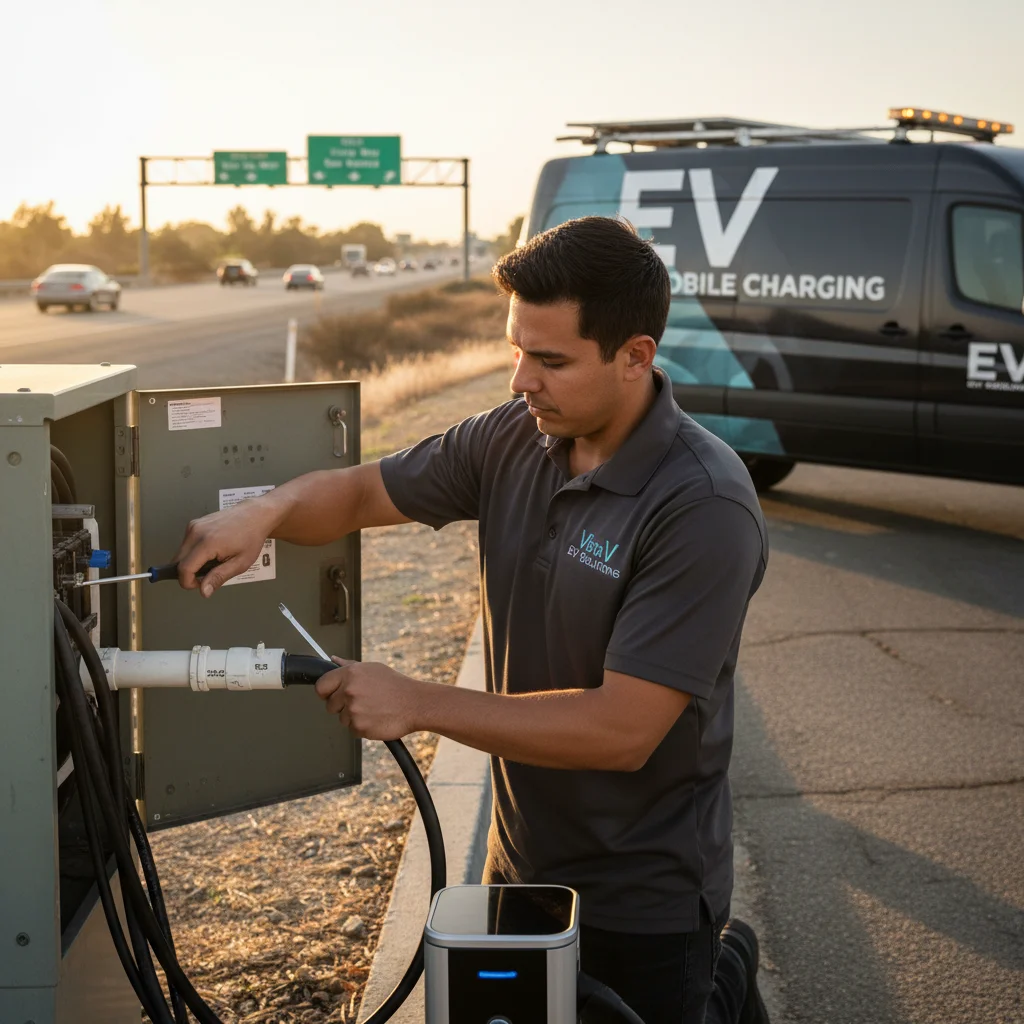
What the operator brings, and what we don’t
Charge Pro LV doesn’t own a truck, a yard, or a warehouse. We don’t employ technicians. We don’t hold a trade license. The pros we connect you with bring the gear to your bumper.
They bring a 240-volt Level 2 source to the car. Tesla uses the native NACS plug. Other EVs use a CCS or J1772 adapter. Charging time typically adds 10 to 20 miles. That’s 15 to 30 minutes of charging. It isn’t a promise of when someone arrives. We don’t publish arrival times. We don’t publish business hours. The operator gives you a quote. You accept or you don’t.
If the car won’t take a charge, they should say so on site. A pack fault or a jammed charge port is a different path. Don’t pay for a charge the car refuses. Confirm that before work starts.
The freeway patrol, and the silence on EVs
NDOT’s Freeway Service Patrol works the busiest Las Vegas Valley freeways. Quality Towing operates it, and GEICO sponsors it. Coverage runs 5:00am to 8:30pm, seven days a week, free to motorists. Published help includes tire changes, jump starts, fuel, minor fire suppression, and traffic control. NDOT says the patrol clears about 55,000 incidents a year statewide. About 31,500 of those are in Las Vegas. NDOT’s published FSP materials don’t mention electric vehicles. They also don’t mention EV charging or EV-specific service. That’s an advertising silence, not a claim they can’t touch an EV. They advertise jump starts. They don’t advertise a traction-pack refill. Plan on a mobile charge for the empty-pack case.
After 8:30pm the patrol isn’t on that published clock. You’re arranging your own help then. Nevada State Police Highway Patrol, formerly Nevada Highway Patrol, dispatches rotation tows through Autura. The cell shortcode is *647. Southern Command is (702) 486-4100.
What Nevada law says while you sit
NRS 484B.440 covers a vehicle disabled so it can’t avoid stopping. That stop is exempt from the no-stopping-on-highway rule. The statute doesn’t cap how long you may remain. NRS 484B.443 lets law enforcement remove a disabled or abandoned vehicle. On freeways and primary highways, abandoned means 24 hours. Other roads use 72 hours. The owner pays for removal.
Tow operators need a Nevada Transportation Authority certificate. That’s NRS 706.4463, 706.4467, 706.4469, 706.4477, and 706.4479. A still-hooked vehicle must be released at the original location. That release uses the operator’s own fee. We don’t publish that fee. Private-property tows need posted signs and a 48-hour warning sticker. Owners must get certified-mail notice within 15 days. Crash-related tows use 21 days. Non-consent tow rates are operator-filed tariffs under NAC 706.408. There’s no single statewide maximum on this site. Confirm that tariff with the tower before they lift the car.
Get fully out of the travel lane if the car can still creep. Put the hazards on and stay with the car if it’s safe.
Charge at the car, or take a tow
Mobile charging keeps the car where it stalled. You add range and drive your own plan. That plan might be home in 89123 or 89183. It might be a stop you already had on the southbound map. This page won’t guess the distance to a public plug. Station inventories weren’t verifiable when this was reported. Use your own charging app, then decide.
A tow is the better call when the car won’t accept power. It’s also the call after a collision. It’s the call when a pack fault is on the dash. Don’t treat a tow as the default for a low state of charge. The operator at the bumper can tell you if charge is even possible.
How to get an operator on this corridor
Charge Pro LV serves Silverado Ranch and the rest of the Las Vegas Valley. We match you with a local independent operator. They quote before they start. They bill you directly. Call (702) 935-4699 when the pack is empty on this launch. Use the same number if the car won’t wake.