The pack just hit empty on I-15 near Silverado Ranch. Get fully onto the right shoulder and switch on the hazards. Stay behind the car, not between it and the lane. Report the stop, then call for a mobile charge at the vehicle. Heat and weekday HOV toward the Spaghetti Bowl can spend a thin buffer. I-15 here stays free. There’s no toll lane to buy your way around traffic.
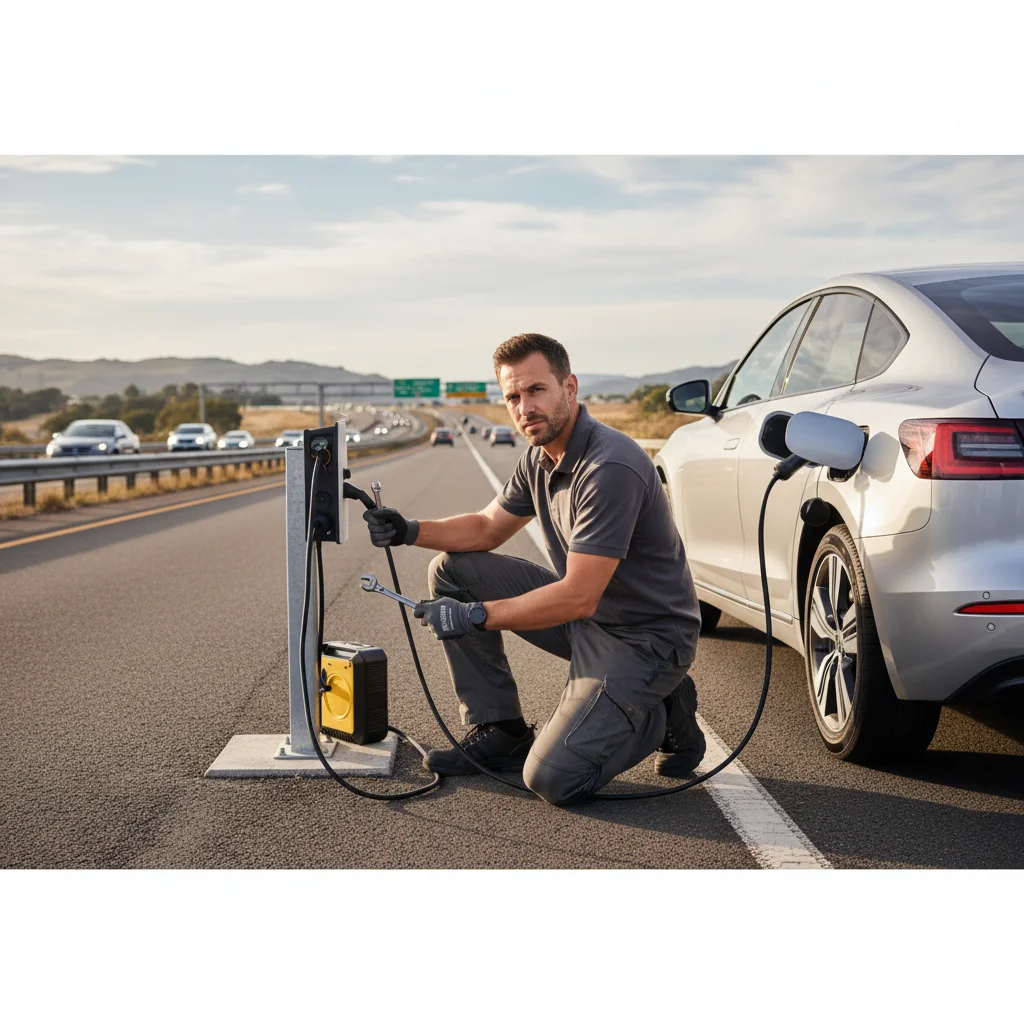
Why this south-valley merge spends a thin pack
Silverado Ranch sits in the south Las Vegas Valley at the I-15 and 215 junction. It’s not its own Census place, so this page won’t invent a population. Mail here uses ZIP codes 89123 and 89183. Commuters merge onto I-15 at this hub. Travelers also pass through while staging for the later run toward Primm.
The HOV network on I-15 begins here. Those lanes run from Silverado Ranch to the Spaghetti Bowl. Weekday hours are 6:00am to 8:00am and 4:00pm to 6:00pm. You need two or more occupants in those windows. A solo EV doesn’t get a pass. The federal single-occupant EV HOV exemption expired on September 30, 2025.
Nevada has no toll roads, express lanes, or transponder systems. I-15 and I-215 stay free. If the general lanes stack during a weekday peak, you sit there. The cabin still wants cold air. The pack keeps working while the car barely moves.
That’s the local trap. You left a south-valley driveway with a number that looked fine. Then HOV pushed a solo driver into thicker traffic. Summer heat added climate load on top. The estimate fell before the Bowl.
On a weekend, that HOV clock isn’t the published restriction. Heat still is. The junction still feeds I-15 south toward Enterprise and Southern Highlands. It still feeds north toward the Bowl. Slow weekend traffic can spend the last miles the same way a commute does.
If you’re solo in the restricted hours, don’t nose into HOV and hope. Nevada doesn’t give electric cars a single-occupant pass anymore. Stay legal, stay right, and plan the exit while the car still rolls.
| I-15 HOV window | Published rule |
|---|---|
| Weekdays, 6:00am to 8:00am | Two or more occupants |
| Weekdays, 4:00pm to 6:00pm | Two or more occupants |
| Solo EV in those hours | No exemption |
| Toll or pay-lane fallback | None in Nevada |
NWS Las Vegas records an average July high of 104.5F. About 78 days a year reach 100F or more. About 9.4 days a year reach 110F or more. The official all-time high is 120F on July 7, 2024. Recurrent Auto found about 5% range loss at 90F, and 17 to 18% at 100F. Cooling a hot cabin can draw 3 to 5 kW. Holding a cooler cabin is about 1 kW. AAA, in May 2026, measured 8.5% range loss at 95F. No Tesla-published range-loss figure turned up for this page. Treat the dash as a live estimate, not a lab number.
The valley floor sits about 2,000 to 2,920 feet. This stretch isn’t a mountain climb like Kyle Canyon. It’s still hot pavement, merge traffic, and a cabin under sun. Drivers leaving Silverado Ranch for a north crawl often start thinner than they thought.
July and August also bring monsoon weather. Flash flooding hits washes and underpasses. If you stall in a low spot during a storm, stay with the car. Don’t walk an underpass that’s taking water.
First moves when the car is dying
Don’t wait for a full shutdown to move right. Start drifting over as soon as the warning is real. A live I-15 lane near the 215 junction is a bad place to lose power.
Pull completely onto the right shoulder. Get as far from the travel lane as the pavement allows. If there’s a barrier, sit close to it. Don’t straddle the white line.
Turn the hazards on before you finish the stop. Other drivers need that signal while you’re still slowing.
Leave through the passenger-side door if you can. The driver door opens toward traffic. Stand behind the car, on the barrier side. Never stand between the car and the live lane.
Don’t walk the shoulder toward an exit. Stay with the vehicle. Keep your body behind the rear tire and off the fog line.
Nevada gives you a clear rule for a true disablement. NRS 484B.440 exempts a vehicle that can’t avoid stopping from the no-stopping-on-highway rule. The statute sets no time limit on that stop. That’s not a camping permit. NRS 484B.443 lets law enforcement treat a freeway vehicle as abandoned after 24 hours. They may remove it. The owner pays that removal.
If a tow is already hooked, ask about a release at the original location. Nevada Transportation Authority rules require that release. The tow company sets the fee. Ask them for the current figure before you argue on the shoulder. This site doesn’t publish tow rates. Non-consent rates are operator-filed tariffs under NAC 706.408. There’s no single statewide maximum, and no rate is posted here.
Who to call from the shoulder
Call Nevada 511 or open nvroads.com for cameras and closures. You can also reach Nevada State Police Highway Patrol at the cell shortcode *647. Southern Command is (702) 486-4100. Give your direction of travel, the last exit you passed, and a short vehicle description.
The NDOT Freeway Service Patrol covers the busiest Las Vegas Valley freeways. Quality Towing operates it. GEICO sponsors it. Hours are 5:00am to 8:30pm, seven days a week. The help is free to motorists. Published work includes tire changes, jump starts, fuel, minor fire suppression, and traffic control. NDOT says the program clears about 55,000 incidents a year statewide. About 31,500 of those are in Las Vegas.
None of NDOT’s published patrol materials mention electric vehicles or EV charging. That’s an advertising silence. It isn’t a claim the patrol can’t help an EV. A jump they list is for a 12-volt battery. It isn’t a pack charge. An empty high-voltage pack still needs range added at the car.
After 8:30pm, that published patrol window is closed. You still report the stop through 511 or *647. You still stay with the car. You still ask for a charge at the vehicle if the pack is the problem.
| What you need | Who to try first | What they publish |
|---|---|---|
| A logged stop and a welfare check | Nevada 511, *647, or (702) 486-4100 | Conditions, dispatch, and rotation tows |
| Tire, jump, fuel, or traffic control, 5:00am to 8:30pm | NDOT Freeway Service Patrol | No published EV charging |
| Range added at the car | A mobile operator quoted before work | Level 2 charge at your plug type |
Empty pack or a dead 12V
A car that won’t wake isn’t always out of charge. A failed 12V can lock the doors and kill the screens. It can also refuse a charge session even when the pack still holds energy. If the dash is dark, treat it as a 12V problem first. Do the same if the handles won’t present, or the car won’t go into park. Operators in this network can jump or replace a dead 12V on site. They handle Tesla and every major EV brand.
If the car is on and the range reads zero, that’s an empty pack. Don’t sit in Drive hoping for a hidden reserve. Get it stable on the shoulder. Then ask for out-of-charge recovery.
A Silverado Ranch roadside guide covers more of this south-valley I-15 pattern. Read it after you’re already safe.
What a mobile operator brings
Charge Pro LV is a referral line. It matches you with an independent local operator. It doesn’t own trucks. It doesn’t employ technicians. It doesn’t set a price or promise an arrival time. The operator quotes you before work starts and bills you directly. The pros we connect you with are licensed and insured.
Those operators typically bring a 240V Level 2 source to the car. Tesla owners get a native NACS plug. Other EVs use a CCS or J1772 adapter. A typical session adds 10 to 20 miles of range in 15 to 30 minutes of charging. That clock is charging time. It’s never an arrival time.
Ten to twenty miles is usually enough to leave the shoulder. You can then reach a place you choose. It isn’t a full pack. It’s a way off a live interstate.
When you call, give direction of travel, last exit, year, make, model, and color. Add the last percentage you saw, and whether the car still powers on. That lets the operator confirm the connector and quote the job.
Tow, charge, or both
A tow is sometimes the right call. A charge at the car is often the cleaner one on I-15.
Most modern EVs need a flatbed if they must move with no propulsion. Dolly tows can stress all-wheel-drive hardware and regen systems. A flatbed still leaves you with an empty car at a lot or shop. Someone still has to charge it there.
Nevada tow operators need a Nevada Transportation Authority certificate. If you didn’t want the hook, ask about the release-at-the-scene rule before the truck leaves. Confirm the release fee with that operator. Don’t guess it from a blog.
The hidden costs of towing a dead EV walk through the extra steps a tow adds. A mobile charge keeps the car yours on the same shoulder. You leave with enough range to exit.
If the car is in a travel lane, say that when you call. Say it too if the shoulder is too narrow to work safely. The operator and Highway Patrol can sort traffic control. Don’t walk into a lane to wave people around.
If you’re already low and pointed south
Drivers use this junction as a launch toward Enterprise and Southern Highlands. The same launch later reaches Jean and Primm. If you’re already low here, don’t treat that southbound stretch as a place to make it. If the car will still roll, take the first safe exit and stop in a lot. If it won’t, stay on the shoulder and charge there. A separate note covers running empty on I-15 south toward Primm. Another covers a generic valley freeway stall.
If you still have a few miles
Call before the number hits zero. A short, honest buffer is often enough for the next exit, then a lot. Meet the operator off the interstate if you can still climb the ramp. If the cabin load or a sudden drop makes that a guess, stay on the shoulder.
Don’t hunt a public stall from the shoulder on foot. Charging inventory for Clark County couldn’t be verified from the national station database when this was written. This page won’t invent a nearest plug. Your job is to stay safe and get energy to the car you’re in.
NV Energy serves Silverado Ranch and the rest of the core valley. That matters for home rates later, not for a live I-15 stop. Nevada has no state EV purchase rebate and no EV-specific registration surcharge. None of that helps you on the shoulder.
Add only what you need to leave the interstate cleanly. Then charge on your terms, at a site you can confirm in your own app. If the 12V acted up, schedule a test. Heat ages that small battery.
Frequently asked questions
What should I do first if the pack dies on I-15 near Silverado Ranch?
Get fully onto the right shoulder with the hazards on. Stay behind the car. Report the stop to 511 or *647. Then ask for a mobile charge at the vehicle. A charge on the shoulder leaves you able to exit. A tow still leaves you with an empty car at a lot.
Does the NDOT freeway patrol charge an empty EV here?
The patrol doesn’t advertise EV charging. Its published list is tires, jumps, fuel, minor fire work, and traffic control. Those hours are 5:00am to 8:30pm. A jump is a 12V service. An empty pack still needs an operator who can add range at the car. Don’t read the silence as a claim they can’t stop for an EV.
Can a non-Tesla get a charge on this I-15 shoulder?
Operators in the network bring a native NACS plug for Tesla. They carry CCS or J1772 adapters for other brands. Rivian, Ford, Hyundai, Kia, GM, and most other current EVs use one of those. The operator confirms the connector when they quote the job.
If the pack just died on I-15 near Silverado Ranch, call (702) 935-4699. We’ll connect you with a local operator who quotes the work before it starts. The operator bills you directly. You get range at the car, not a promise about when someone arrives.