You left a Spring Valley driveway with a full pack. Then Blue Diamond Road starts the climb toward Red Rock. Or you sit too long on Spring Mountain Road. That’s when EV roadside assistance in Spring Valley means a charge at the car. A home overnight on NV Energy power doesn’t cover a west-valley grade. It also doesn’t cover a long shop dwell.
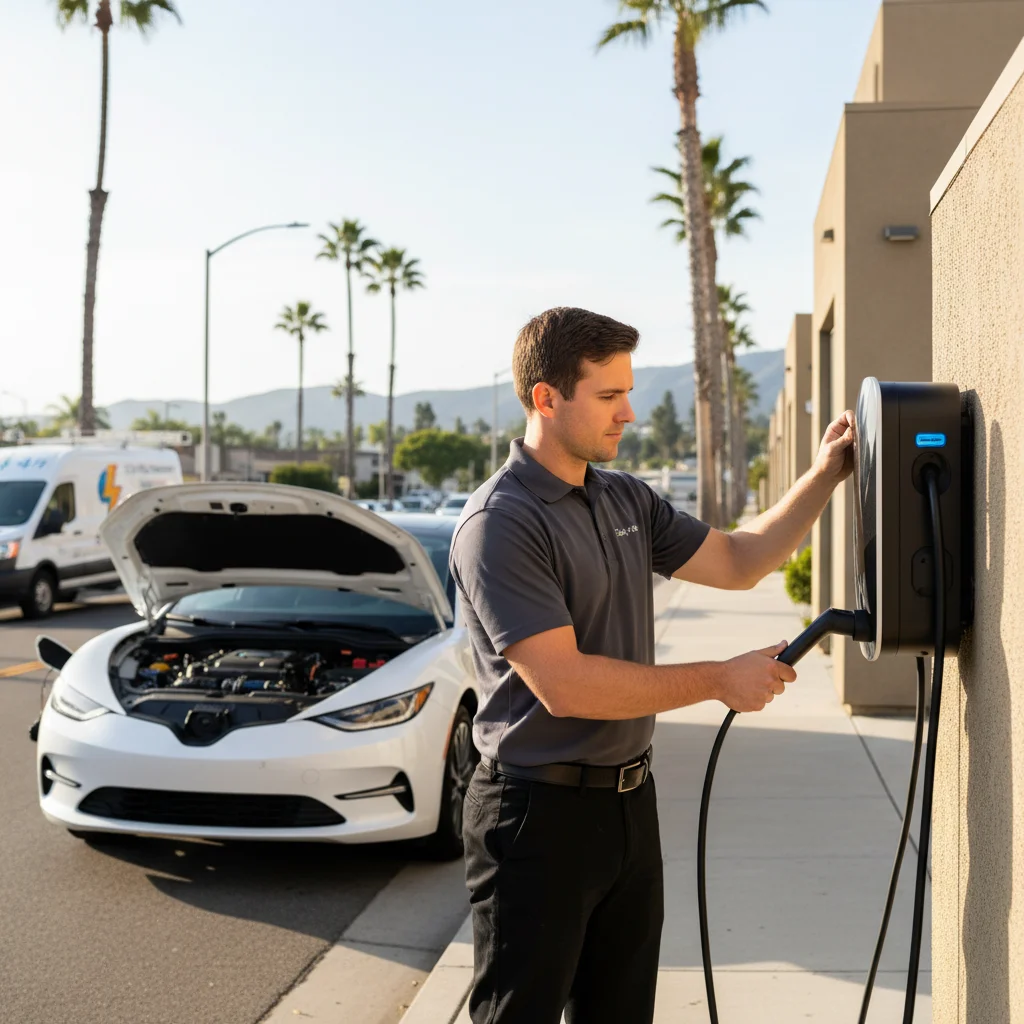
Why a home-charged pack still dies here
Spring Valley is a large west-valley community, not a small suburb. ACS 2019-2023 counts 219,913 residents. The district runs from Spring Mountain Road’s Chinatown corridor toward the 215 Beltway. That mix is the point. Dense apartments sit toward the Strip side. Many of those buildings have no home plug. Farther west, houses do plug in overnight. Both groups still call for help.
The apartment pattern is simple. The car never starts the day full. Short trips plus cabin cooling spend what’s left. Then you’re stuck in a lot. The house pattern looks safer and still fails. You charged on NV Energy’s overnight window. Then you burned the buffer on Blue Diamond. Or you burned it sitting on Spring Mountain. For the apartment side, see home backup versus a mobile charge in Spring Valley.
NV Energy, as Nevada Power, serves all of Spring Valley. Nevada doesn’t offer retail electric choice. Voters rejected that in 2018. The Residential Electric Vehicle Recharge Rider names a window from 10:01pm to 8:00am. That’s when a lot of west-valley packs fill. The rider doesn’t follow you onto Blue Diamond Road. It also doesn’t help a car that’s already empty in a shop lot.
Only 12.2% of Spring Valley housing was built before 1980. Most of the stock is newer than the east-valley cores. Newer houses can take a home charger more easily. That doesn’t erase the apartment belt.
Blue Diamond, the 215, and the Red Rock climb
Blue Diamond Road is how this side of the valley launches west. It feeds Red Rock Canyon National Conservation Area. The Bureau of Land Management runs that unit. Timed-entry reservations apply from October 1 to May 31. The scenic loop is 13 miles. You can leave Spring Valley full and still run short on that outing. Cabin cooling, the climb, and slow loop traffic all spend range.
Valley floor elevations sit about 2,000 to 2,920 feet. Summerlin sits around 3,500 feet. Ground near Red Rock rises toward 4,400 feet. Spring Valley sits on the floor side of that rise. You’re still lifting the car toward cooler rock. If heat already cut the pack, the last miles vanish on the grade.
If you die on the loop, that’s a different shoulder. Use the path for a dead EV on the Red Rock scenic loop. This page is the feeder. It’s Spring Valley streets, Beltway ramps, and the Blue Diamond start.
The 215 Beltway on this edge doesn’t charge a toll. Nevada doesn’t have toll roads, express lanes, or transponder systems. I-215 and CC-215 are free, like the rest of the state’s main highways. You won’t spend range in a pay-lane queue. You can still stall on a Beltway shoulder. NRS 484B.440 lets a disabled vehicle stop when it can’t keep moving. The statute doesn’t set a clock. NRS 484B.443 still lets law enforcement remove the car. On freeways and primary highways, it’s treated as abandoned after 24 hours. On other roads, that mark is 72 hours. The owner pays removal. Treat the shoulder as a short emergency, not a lot.
Nevada 511 and nvroads.com show closures and cameras. The Nevada State Police Highway Patrol dispatches rotation tows. The cell shortcode is *647. Don’t wait on a freeway through a full day.
Shop dwells on Spring Mountain Road
The Chinatown corridor on Spring Mountain Road is the other trap. You park for a meal, errands, or a long table. The car soaks in west-valley heat. Climate control already ran on the drive in. After a long sit, two failures show up. The 12V may not wake the car. Or the traction pack is lower than you thought. Either way, you’re in a stall with no driveway plug.
It’s a parking stall that won’t let you leave. Apartments closer to the Strip add the same sit. The car lives in a garage or a surface lot. It never sees overnight Level 2. A day of short hops plus cooling can spend the buffer. Then you need mobile EV charging at the stall.
Public charging inventory for Clark County couldn’t be confirmed in the research pull. Don’t plan the last miles around an unchecked stall in the car’s map. Drive the buffer you can see on the dash. Call before the pack hits zero on Blue Diamond.
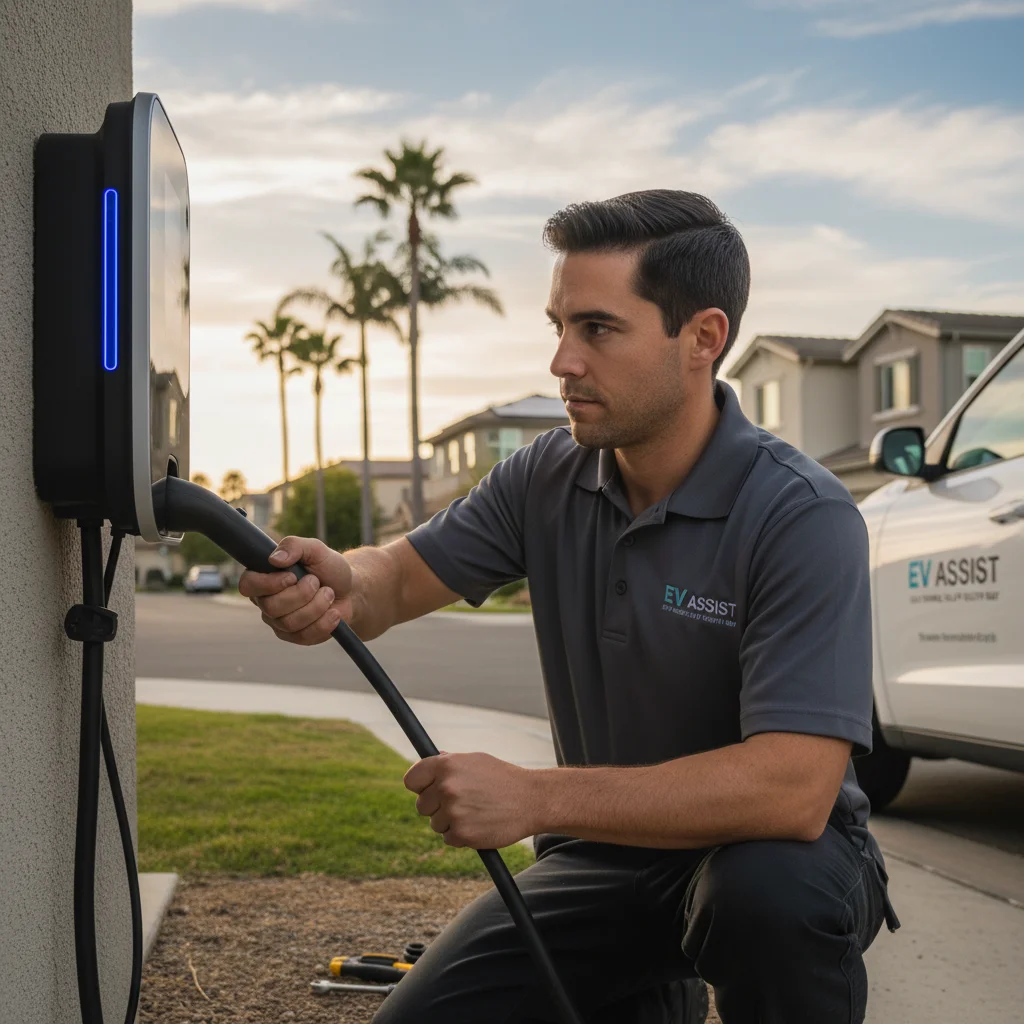
Heat on the west-valley floor
NWS Las Vegas at KLAS puts the average July high at 104.5F. About 78 days a year reach 100F or more. About 9.4 days reach 110F or more. The all-time record high is 120F on July 7, 2024. Recurrent Auto found about 5% range loss at 90F. At 100F, that study found 17 to 18% loss. Air conditioning can draw 3 to 5 kW to cool a hot cabin. AAA in May 2026 measured 8.5% range loss at 95F. Don’t treat those as Tesla numbers. No Tesla-published range-loss figure turned up.
The airport heat island runs 5 to 15F warmer than outlying areas. East valley and downtown can run up to 11F hotter than the rim. Spring Valley sits west of that core. Summer still cooks the floor. A pack that looked fine at 8:00am can look thin by midafternoon. That’s how a home-charged car dies on a local errand. Cabin cooling on Blue Diamond in July surprises people who charged at 7:00am.
Empty pack or a dead 12V
Every modern EV still carries a small 12V battery. Tesla, Ford, Rivian, Hyundai, GM, and the rest use it. It powers computers, locks, and the contactors. When that 12V dies, the car looks fully dead. The charge port may not open. The traction pack can still hold energy you can’t reach. A Tesla 12V jump on site is a different job from adding range. The pros we send can jump or replace a dead 12V at the car.
Shop dwells make the 12V more likely. Cabin electronics, hot soaks, and wake cycles wear it. The high-voltage pack is a separate question. Tell the operator what the dash showed before it went dark. If a range number was falling, you need electrons. If it was a no-start with range still showing, start with the 12V.
NDOT’s Freeway Service Patrol covers the valley’s busiest freeways. Quality Towing operates it. GEICO sponsors it. Hours are 5:00am to 8:30pm, seven days a week. It offers tire changes, jump starts, fuel, minor fire suppression, and traffic control. Statewide it clears about 55,000 incidents a year. About 31,500 of those are in Las Vegas. None of NDOT’s published FSP materials mention electric vehicles. They don’t mention EV charging or EV-specific service. The patrol doesn’t advertise EV charging. Don’t assume a freeway truck is bringing a 240-volt source.
What the operator brings to the car
Charge Pro LV is a referral line. We match you with an independent local operator. We don’t own trucks or equipment. We don’t employ technicians. We don’t hold a trade license for the work. We don’t set prices. The operator quotes you before anything starts. Then that operator bills you directly.
What those operators bring is a 240V Level 2 source. Tesla and other NACS cars get a native NACS plug. CCS and J1772 adapters cover non-Tesla EVs. Typical charging time, never travel time, adds about 10 to 20 miles. That add happens in 15 to 30 minutes of charging. That’s enough to get off Blue Diamond. It’s enough to leave a Spring Mountain lot. It isn’t a full overnight fill.
Tesla roadside is a separate channel. It isn’t the same as a local mobile charge.
Charge at the car, or take a tow
A tow still has a place. A hardware fault points to a flatbed, not a charge. A damaged port or a pack that won’t take a charge does too. Nevada tow operators need a Nevada Transportation Authority certificate. That’s under NRS 706.4463 and the related sections. Non-consent tow rates are operator-filed tariffs under NAC 706.408. There’s no single statewide maximum published here. Confirm the current rate with the company that hooks the car, before you pay.
For an empty pack or a dead 12V, charge or jump at the stall. You stay with the car. You drive it off under its own power. The charge, jump, or tow guide walks that choice. The operator on scene should say when a charge won’t take. Don’t pay for a hook if electrons will move the car.
Call for a quote, not a clock
If the car won’t move in Spring Valley, call for a mobile operator. Use (702) 935-4699. We’ll connect you with a local pro who quotes before work starts. Nobody here can promise when a truck arrives. The quote and the charging time are what you can plan around. We serve every city in the county. Spring Valley is on that map.