You left Primm with 60 percent on the R1T and a tailwind forecast. By Sandy Valley the pack is at 18 percent, the gauge is dropping faster than the miles, and there is no charger between here and the next town. Rivian roadside help is the right call. Heat plus a southwest headwind did the math.
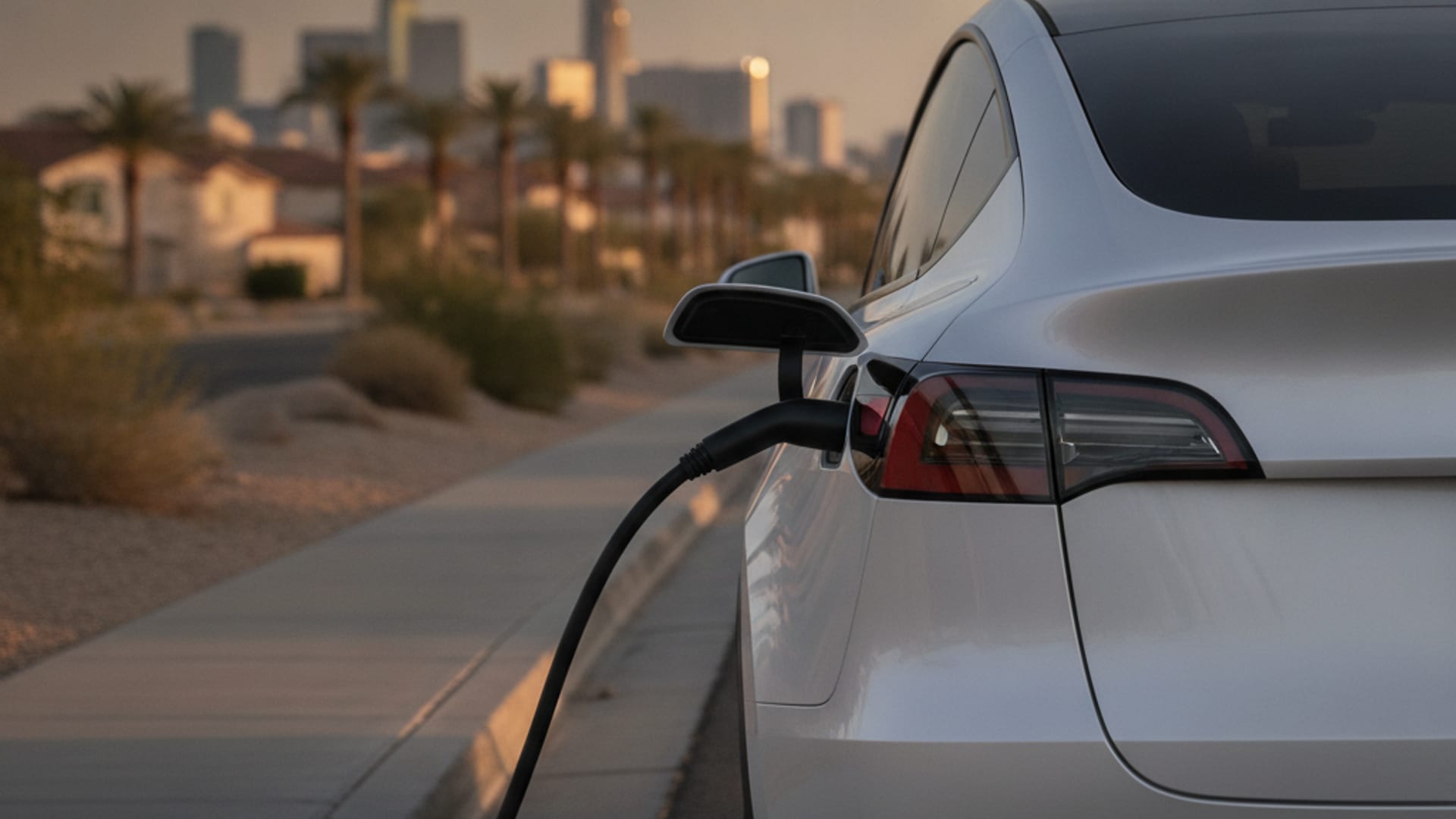
What makes Sandy Valley a different kind of stall
Sandy Valley sits about 50 miles southwest of the Strip on I-15, past Primm and Jean. It is a small community served by Valley Electric Association, a co-op, not NV Energy. There is no public DC fast charger inside Sandy Valley that we could confirm. The next dependable plug sits back toward Jean or forward toward the Pahrump side. That gap is the shape of the risk.
Recurrent Auto measured about 5 percent range loss at 90F. That rose to 17 to 18 percent at 100F. Cabin cooling drew 3 to 5 kW to cool a hot cabin. Holding a cool cabin used about 1 kW. AAA, in May 2026, measured 8.5 percent range loss at 95F. Those are independent studies. They are not Rivian numbers. Treat them as the floor of what the desert does to any EV on a southbound climb.
A southwest headwind adds drag. The R1T is a large truck with a wide frontal area. Wind on I-15 South out of Jean can run steady for an hour. A driver who planned on a 20 percent reserve at Sandy Valley can land there on 5 percent with the gauge still moving.
Why the pack number fell faster than the miles
Three things were stacked. First, the climb. The I-15 South grade rises and falls as it crosses the California border high point at Mountain Pass on the California side. On the Nevada side, Jean sits around 2,841 ft and Primm around 2,618 ft according to USGS figures. The terrain is not flat.
Second, the heat. The valley average July high is 104.5F. Sandy Valley runs hotter than the airport because it sits out in the open. The urban heat island that adds 5 to 15F at Harry Reid does not apply. The desert floor simply bakes.
Third, climate control. The truck spent pack miles cooling a cabin that came back hot from the last stop. Preconditioning on the wall plug before departure would have spent house power instead. Out on the road, that is no longer an option.
Out of charge on I-15 South to Primm covers the same corridor. The read there is that the climb from the Strip to Primm already costs more than the map suggests. Sandy Valley extends that run.
What Rivian roadside will and will not do
Rivian’s roadside line covers tow, tire, lockout, and a 12V jump. The published materials do not advertise on-site Level 2 charging. A tow to the nearest charger is one option. A tow to a service center is another. If the R1T is on a flat shoulder and the truck can be hooked, that is the Rivian path.
A flat shoulder off I-15 South is not always safe. NDOT’s Freeway Service Patrol runs from 5:00am to 8:30pm. Quality Towing operates it and GEICO sponsors it. The published patrol covers tire changes, jump starts, fuel, minor fire suppression, and traffic control. It does not advertise EV charging. That patrol covers the busiest valley freeways. I-15 South past Primm sits at the edge of its published zone. Confirm on scene.
NRS 484B.440 lets a disabled vehicle stay when it cannot avoid stopping. The statute sets no time cap. NRS 484B.443 lets law enforcement treat a vehicle as abandoned after 24 hours on freeways and primary highways. On other roads the mark is 72 hours. The owner pays removal. Do not assume a parked Rivian on the shoulder will sit untouched.
What a local mobile operator does differently
A mobile rescue operator comes to the truck. They bring a 240V Level 2 source and a CCS1 to J1772 adapter for the R1T or R1S. A typical session adds 10 to 20 miles of range in 15 to 30 minutes of charging. That is charge time at the truck, not a clock on arrival.
Charge Pro LV is a referral line. It does not own trucks or equipment. It does not hold a trade licence or set prices. The operator you reach quotes the job before starting and bills you directly. The pros in the network are licensed and insured.
Ten to twenty miles is often enough to reach Jean or Primm. From either of those, the truck can rejoin the network. The other path is a tow. Nevada Transportation Authority rules cover non-consent tows under NAC 706.408 as flat-rate operator-filed tariffs. This page does not print those numbers. Confirm with the operator on the call.
For the corridor as a whole, EV roadside assistance in Jean and EV charging in Primm cover the next two towns north. The Sandy Valley call is the rural stop between them.
How to leave the Strip without repeating this
Treat Sandy Valley as its own trip, not a stop between two larger towns. Top off at Jean or Primm before the run back out. The I-15 South climb to the California state line at Mountain Pass is real, and the headwind on the return run is often worse.
Watch the energy graph, not just the percentage. The R1T shows a consumption number in miles per kilowatt-hour. A climb into a headwind will push that number down. If it drops below what the truck shows in the morning, the return run is the risk.
Precondition the cabin while still on Level 2 in Jean or Primm. Spend grid power before you spend pack miles. Open the windows for the first mile, then close them and run the compressor. That sequence reduces the peak load on the pack.
For the broader pattern, how mobile EV charging trucks work explains the equipment an operator brings and the connector math behind it. Out of charge recovery is the service page for that work.
What to do right now if you are reading this from the shoulder
Set hazards. Move as far off the travel lane as you can. Stay with the truck if it is safe. Do not stand in the windbreak of a parked truck on a live highway. Call Rivian roadside first, and if the wait runs long, call the local line.
The local number for this corridor is (702) 935-4699. Tell the operator the truck’s port, the gauge percentage, and the closest mile marker. They will tell you what they can do and what it will cost before they start. For more on the climate behind the stall, the NWS Las Vegas climate page is the authoritative read on valley heat.
Related guides
For another angle on the same valley stall, see Jean on the I-15 climb · Out of charge on I-15 south to Primm.
Frequently asked questions
Is there a charger in Sandy Valley, Nevada?
We could not confirm a public DC fast charger inside Sandy Valley. The next dependable plugs sit toward Jean or Primm on I-15, or back toward the Strip. Confirm a live stall in your network app before you drive out.
How long can a Rivian sit on the I-15 shoulder in heat?
NRS 484B.440 lets a disabled vehicle stay when it cannot avoid stopping. The statute sets no time cap. NRS 484B.443 lets officers treat a vehicle as abandoned after 24 hours on freeways and primary highways. Plan to clear the truck or move it before the 24-hour mark.
Can a mobile operator bring Level 2 to my Rivian in Sandy Valley?
Yes. An operator with a 240V source and a CCS1 to J1772 adapter can charge the truck at the shoulder. A typical session adds 10 to 20 miles in 15 to 30 minutes of charging. That is usually enough to reach Jean or Primm.
Will Rivian tow my R1T to Las Vegas?
A Rivian partner can hook the truck and move it. Confirm the destination before the hook, and confirm whether the destination is a Rivian service center or a partner yard. NAC 706.408 governs non-consent tow rates as operator-filed tariffs. This page does not print those numbers.