Two low EVs on a Las Vegas Valley shoulder almost never share charge. One EV can charge another only with export hardware most cars lack. Valley heat makes leftover miles in both cars too precious.
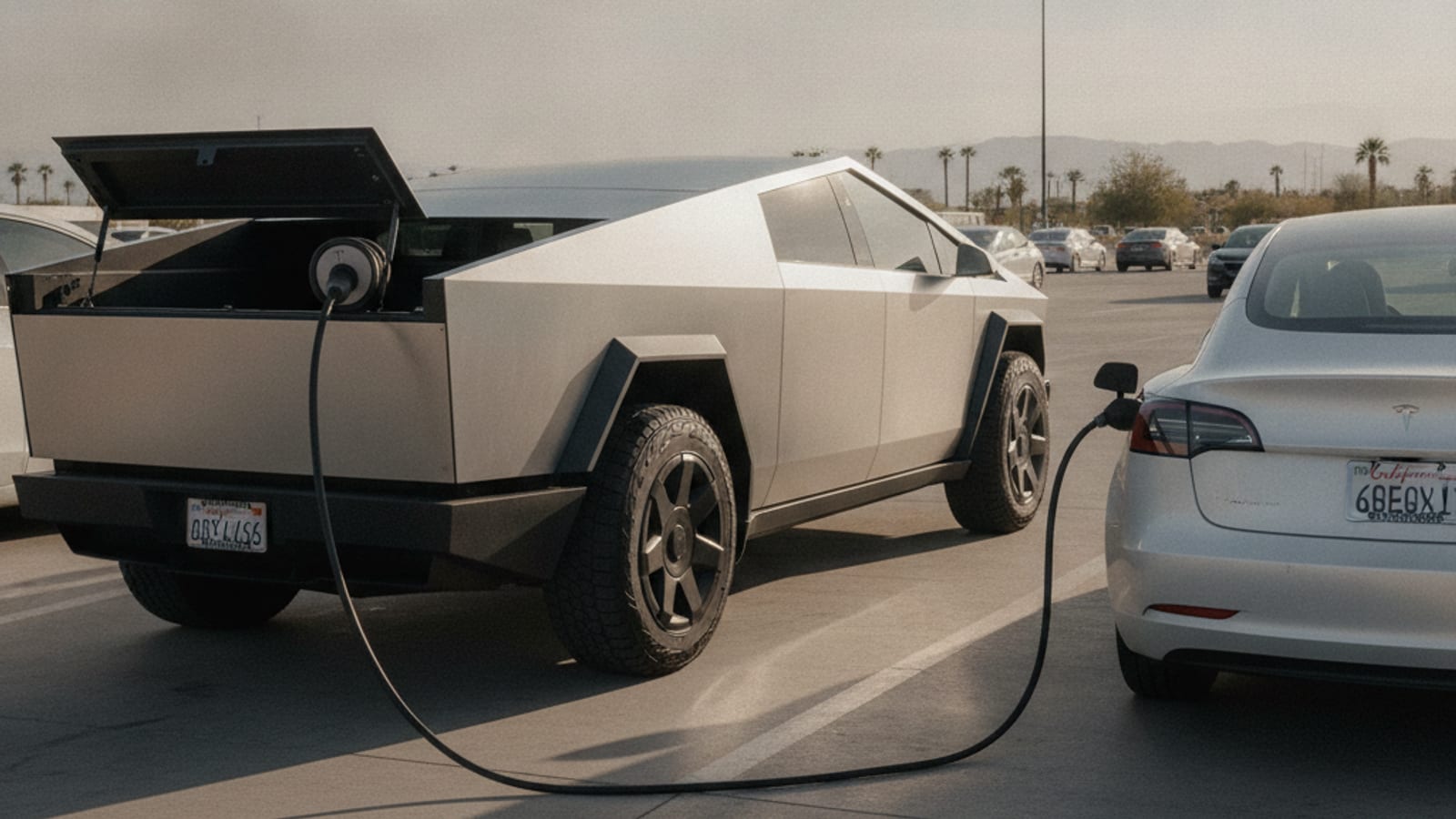
The search behind this page is simple enough. A friend rolls up in another electric car. You both ran the cabin air all afternoon. The NWS average July high here is 104.5F. About 78 days a year reach 100F, and about 9.4 hit 110F. The all-time record is 120F on 2024-07-07.
Recurrent Auto found about 5% range loss at 90F. The same work found 17 to 18% loss at 100F. Air conditioning can draw 3 to 5 kW to cool a hot cabin. Holding a cool cabin takes about 1 kW. AAA’s May 2026 test measured 8.5% range loss at 95F. That 8.5% figure isn’t a Tesla number. Tesla hasn’t published a range-loss figure we can cite.
Both of you are already burning the pack faster than a mild day. Sharing what’s left often leaves two stuck cars.
Why car-to-car charging is rare on the road
Every EV stores energy in a high-voltage pack. Moving that energy into a second car isn’t a 12V jump. The donor car needs an inverter that can send power out. It needs an outlet or adapter the other car can use. It needs a cable that matches NACS, CCS, or J1772.
Most EVs never expose that path, so the energy stays inside. Tesla Model 3, Y, S, and X don’t export traction power. Tesla has shown bidirectional charging in lab videos. It isn’t a feature on those cars today.
The 12V pigtail at a Tesla tow-eye is a different tool. It can help wake another car’s 12V. It can’t fill a dead traction pack.
Which EVs can export, and which cannot
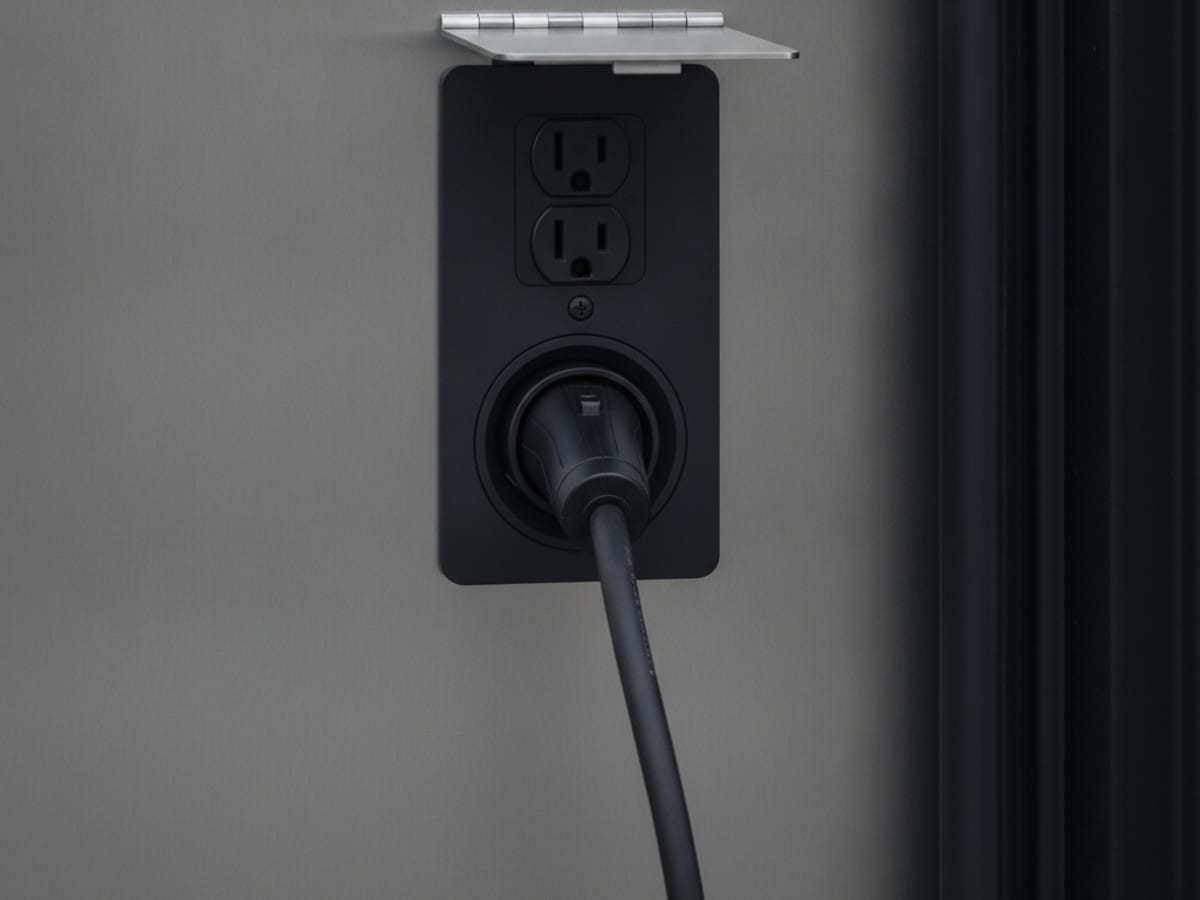
A few trucks and adventure EVs ship with real outlets. The Cybertruck has Pro Power outlets in the bed and frunk. One bed outlet is a 240V NEMA 14-50, like a dryer receptacle. Ford’s F-150 Lightning offers Pro Power Onboard for the same kind of load. Hyundai Ioniq 5 can use a V2L adapter on the charge port. Kia EV6 and EV9 use the same style of adapter. Some Rivian R1T and R1S camp packages put 120V in the bed. Chevrolet’s Silverado EV also lists power-takeoff outlets.
Those systems were built for tools, camping, and house backup. They weren’t built so two low valley cars can rescue each other.
A 240V export from a truck is still Level 2 speed. Independent operators add 10 to 20 miles at that class of power. That 15 to 30 minutes is charging time, not an arrival time. Public DC fast charging is far quicker at a stall you already planned. Car-to-car export is a trickle next to that.
Heat on this valley makes both packs precious
The valley floor sits about 2,000 to 2,920 feet. Summerlin sits near 3,500 feet and rises toward Red Rock. Henderson sits lower, around 1,867 feet on the south side. A Red Rock loop or a Kyle Canyon climb spends range on grade. Cooling the cabin spends still more of that buffer. East-valley and downtown pavement can run up to 11F hotter than the rim. The airport heat island often runs 5 to 15F warmer than outlying areas.
If a friend’s Lightning still has a deep buffer, export might move a few miles. If that friend already saw a low-battery warning after a 100F afternoon, stop. Draining them is a bad trade in this heat. You’d both sit in the same heat after that. You’d both need the next move anyway.
Geotab found hot-climate packs degrade about 0.4% per year faster. Phoenix-style desert heat was the worst case in that work. That’s a long-term wear note, not a stall diagnosis. It’s a reason not to empty a second pack. The gesture may not get either of you home.
A second EV is not the rescue truck
Charge Pro LV is a referral line, not a shop. We match stranded drivers with independent local mobile rescue operators. We don’t own trucks, and we don’t run the charge. We don’t employ the technicians who do the work. The operator quotes you before work starts and bills you directly.
The operators we connect you with bring their own 240V Level 2 source. Native NACS for Tesla, and CCS or J1772 adapters for other brands. Typical charging time adds 10 to 20 miles in 15 to 30 minutes. That gets you rolling without spending a friend’s remaining range.
If the car won’t wake, the 12V is often the first check. A dead 12V can look like an empty pack. Jumping or replacing that small battery is a different job. Filling the traction pack is the empty-range job.
For the truck-to-truck path, see Can an F-150 Lightning charge another EV on the shoulder. To stretch what you still have, read How to stretch remaining range when your EV’s running low.
When you’re already stopped on a valley road
A disabled vehicle that cannot avoid stopping is exempt from the no-stopping-on-highway rule. That exemption is NRS 484B.440, and the statute sets no time limit. Law enforcement may still remove a disabled or abandoned vehicle under NRS 484B.443. On freeways and primary highways, a vehicle is treated as abandoned after 24 hours. On other roads the window is 72 hours, and the owner pays removal.
Stay with the car if it is safe, and use hazards. Nevada 511 at nvroads.com reports closures and cameras. The NDOT Freeway Service Patrol covers the busiest valley freeways. Hours are 5:00am to 8:30pm, seven days a week. The stop is free to motorists who need it. Quality Towing operates it, and GEICO sponsors it. Published patrol materials don’t advertise EV charging or EV-specific service. Confirm on scene what they can actually do. Listed help includes tire changes, jump starts, fuel, and traffic control. They also list minor fire suppression in the same kit.
There aren’t any toll roads anywhere in Nevada. I-15, I-215, CC-215, US-93, US-95, and I-11 are free. That fact doesn’t change two low packs.
Skip the share and charge the car that died
Check whether this is a 12V problem or a truly empty pack. Dark screens and a car that won’t wake point to the 12V. If the car still drives, stay put rather than chasing a second EV. Do that when remaining miles won’t cover the next plug you already planned. Call for a mobile charge instead of waiting on another thin EV.
A mobile EV charging stop at the car keeps the friend’s remaining range intact. Out-of-charge recovery covers the empty-pack case at the same car. For what actually rolls up, see What’s an EV charging truck, and who actually owns it here.
West-rim stalls have their own heat and grade pattern. EV roadside assistance in Blue Diamond is the Red Rock approach. A dead EV on the Red Rock scenic loop is grade and heat, not a share.
If you need a local operator, call (702) 935-4699. We’ll match you with an independent pro who quotes before starting.