A Ford F-150 Lightning can charge another EV from its bed outlets. In the Las Vegas Valley that’s a slow courtesy, not the default rescue. Desert grades and July heat spend the miles you just added. Keep the truck’s own pack for the climb home.
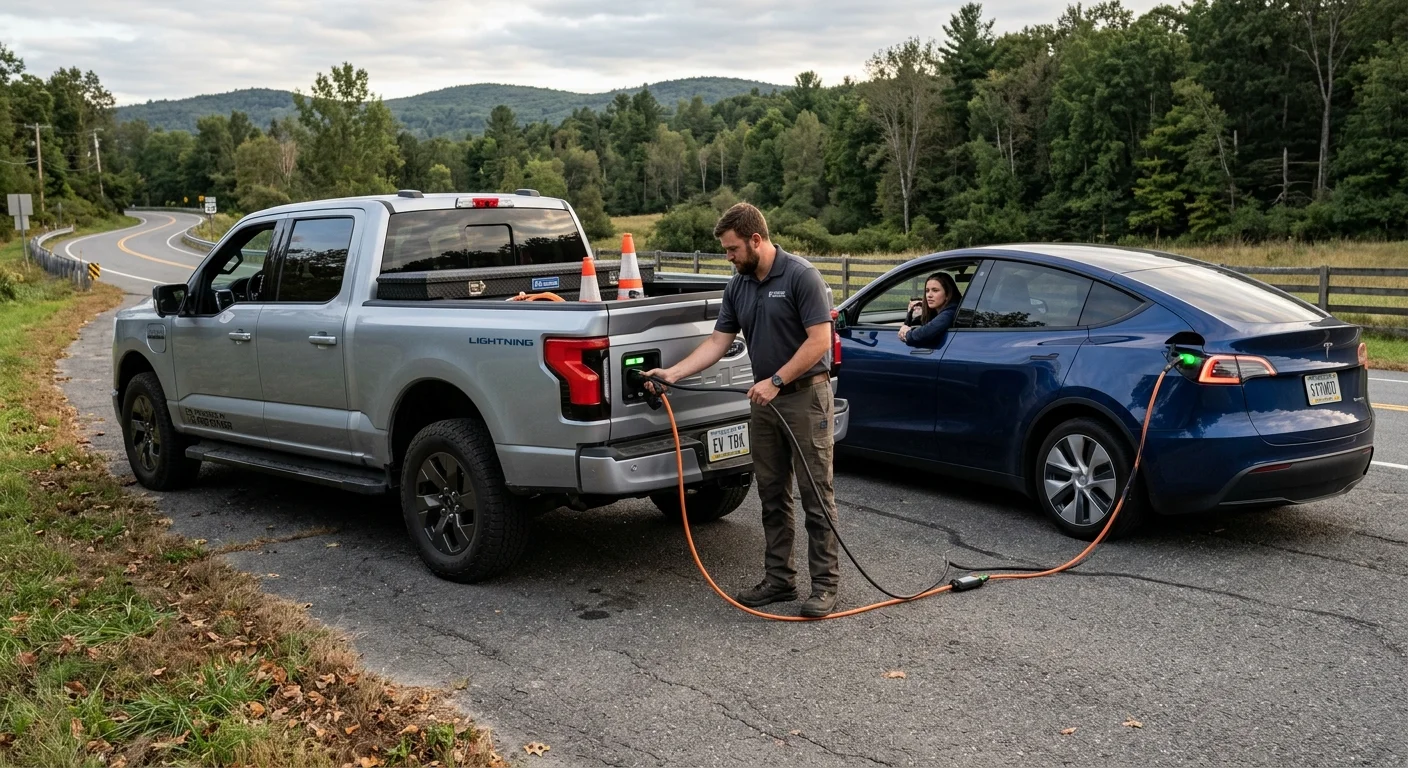
Why a desert climb changes the share
A driveway top-off and a shoulder session aren’t the same job. Summerlin sits near 3,500 feet and rises toward 4,400 feet by Red Rock Canyon. Kyle Canyon Road climbs toward Mount Charleston, where the town sits about 7,506 feet. Railroad Pass toward Boulder City is about 2,360 feet. I-15 through Jean sits near 2,841 feet on the run toward Primm.
Those grades spend range after a small add. Recurrent Auto found about 5% range loss at 90F. At 100F that work put the loss at 17 to 18%. AAA, in May 2026, measured 8.5% range loss at 95F. Cabin air conditioning can draw 3 to 5 kW to cool a hot interior. NWS Las Vegas lists an average July high of 104.5F. The valley sees about 78 days at or above 100F. An hour on the shoulder in that heat is a long sit. The car you just helped still has to climb.
Nevada had about 85,600 EVs registered in the 2025 AFDC figures. Clean Cars Nevada is already pulling more electric models into Clark County. The ZEV rules start with model year 2025. You’ll see more Lightnings and more stranded packs. That doesn’t make truck-to-car charging the plan for I-15.
What Pro Power Onboard actually is
Ford built Pro Power Onboard for tools, camp gear, and home backup. It turns the Lightning into a rolling AC source. Outlets live in the bed and the cabin, at 120 volts and 240 volts. Power doesn’t come from the truck’s DC fast-charge inlet.
Trim level sets how much power you can share. The base Pro Power setup is 2.4 kW. A lot of Lightning trims offer 7.2 kW instead. The top Pro Power option is 9.6 kW. Even that last figure is still Level 2 AC. That 9.6 kW still isn’t DC fast charging.
This setup is vehicle-to-load, often shortened to V2L. You’re running a portable charger from a household-style outlet. It’s the same family of idea as one EV charging another. The Lightning just ships with the plugs already in the bed.
If you’re asking how long the truck itself takes to fill, that’s a different clock. Sharing power out of the pack is slower. Taking power in at a DC stall is a different job.
The kit that has to be in the bed
A lamp cord from the cab won’t talk to an EV. You need a portable Level 2 EVSE with a NEMA 14-50 plug. That plug matches the 240-volt outlet in the Lightning’s bed. If that brick isn’t in the toolbox, the outlets stay workshop outlets.
Most non-Tesla cars in North America take J1772. A Chevy Bolt or a Hyundai Ioniq 5 can take that connector. A Volkswagen ID.4 uses the same J1772 inlet. A stranded Tesla still needs one extra adapter. You need a J1772-to-NACS adapter so the portable EVSE fits the Tesla port. The operators we connect you with bring a native NACS plug. They also carry CCS and J1772 adapters for other brands. A private Lightning owner has to pack that kit.
Match the ratings before you click anything together. The EVSE and adapters have to handle the outlet’s output. A light-duty cable on a 9.6 kW outlet is the wrong mix.
What an hour of sharing actually adds
Keep that add-rate honest as you plan the stop. These are typical-EV estimates, not a Ford range chart.
- 2.4 kW adds about 8 to 10 miles per hour
- 7.2 kW adds about 20 to 25 miles per hour
- 9.6 kW adds about 30 to 35 miles per hour
That’s the pace of 240-volt charging when you aren’t at home. It can roll a car off a lot. It doesn’t refill a pack for a long desert run. A Lake Mead day trip still has the climb back through Lake Mead NRA. Red Rock Canyon’s scenic loop is 13 miles. Timed entry runs from October 1 to May 31. Home-charged Summerlin EVs still get stuck on that west-rim grade.
If you need fifty miles in a hurry, you’ll sit a long time. You’ll drain the Lightning while you sit and wait. The truck still has to get itself home. It may still need Kyle Canyon or US-95 toward Indian Springs.
A valley shoulder isn’t a charging bay
You won’t find a toll road anywhere in Nevada. I-15, I-215, US-95, and I-11 stay free. That doesn’t turn the shoulder into a workshop. NRS 484B.440 lets a disabled vehicle stop when it can’t avoid it. That statute sets no time cap on the stop. NRS 484B.443 still treats a freeway stop as abandoned after 24 hours. On other roads the window is 72 hours. Law enforcement can remove it, and the owner pays.
NDOT’s Freeway Service Patrol covers the busiest valley freeways. Quality Towing runs it, and GEICO sponsors it. Hours are 5:00am to 8:30pm, seven days a week. The patrol can change a tire and jump a 12-volt. It can add fuel and handle traffic control. NDOT’s published FSP materials don’t advertise EV charging. A patrol stop isn’t the same as a pack fill.
Nevada 511 and nvroads.com show closures and cameras. That helps you judge whether the lane is a bad place to linger. Nevada 511 doesn’t charge the car for you.
I-15 HOV lanes run from Silverado Ranch to the Spaghetti Bowl. Restricted hours are 6-8am and 4-6pm weekdays, with two-plus occupants. There’s no single-occupant EV exemption in those hours. The federal HOV exemption for EVs expired on 2025-09-30. A Lightning stopped beside those lanes is still a traffic problem.
The Strip and Harry Reid International Airport sit in unincorporated Paradise. They aren’t inside the City of Las Vegas. Event lots at Allegiant Stadium and the Las Vegas Convention Center fill and sit hot. A courtesy share in that traffic still leaves both vehicles blocking a stall.
When the Lightning share still makes sense
Use it when nobody is in a live lane. Think of a neighbor in Spring Valley who woke up short. It also fits a campsite pair who packed the extra EVSE. It works on a Henderson driveway after a hot night. A few extra miles can reach a workplace plug. Clock time isn’t the issue in those spots. Both drivers can wait without blocking a lane.
Skip it as the default on I-15 toward Jean and Primm. Skip it when the next miles are Kyle Canyon. Skip it when you’d empty your own truck before the west rim. Repeated vehicle-to-vehicle sessions also wear the donor pack. The Lightning is a truck, not a public charger.
Ford owners should still know their own 12-volt. Heat here kills 12-volt batteries on every EV brand. If the Lightning itself won’t wake, Pro Power won’t help anyone. Start with the Lightning 12-volt checks when the truck is the dead one.
What a referred operator does instead
Charge Pro LV is a referral line only. We match stranded drivers with independent local mobile rescue operators. We don’t own trucks, yards, or a fleet. We don’t hire the technicians who show up. We don’t set prices for the operator visit. The operator quotes you before work starts and bills you directly.
The pros we connect you with bring a 240-volt Level 2 source. They roll that source up to the car. They use a native NACS plug, or a CCS or J1772 adapter. Typical charging time adds 10 to 20 miles of range. That window is 15 to 30 minutes on the cable. That’s charging time, and never an arrival time. You keep the Lightning’s pack for your own grade.
That path is mobile EV charging when the car is already sitting. It also fits a Tesla that only needed a 12-volt jump. Pro Power Onboard won’t fix that dead 12-volt.
If you’re the stranded driver, call (702) 935-4699. We then connect you with a local operator. That operator quotes you before any work starts.