An EV charging truck brings 240-volt Level 2 power to a stalled EV. Independent operators in the Las Vegas Valley own those trucks. Charge Pro LV doesn’t own the truck, the gear, or the crew. We match you with a local independent operator. That operator quotes before they start, then bills you directly.
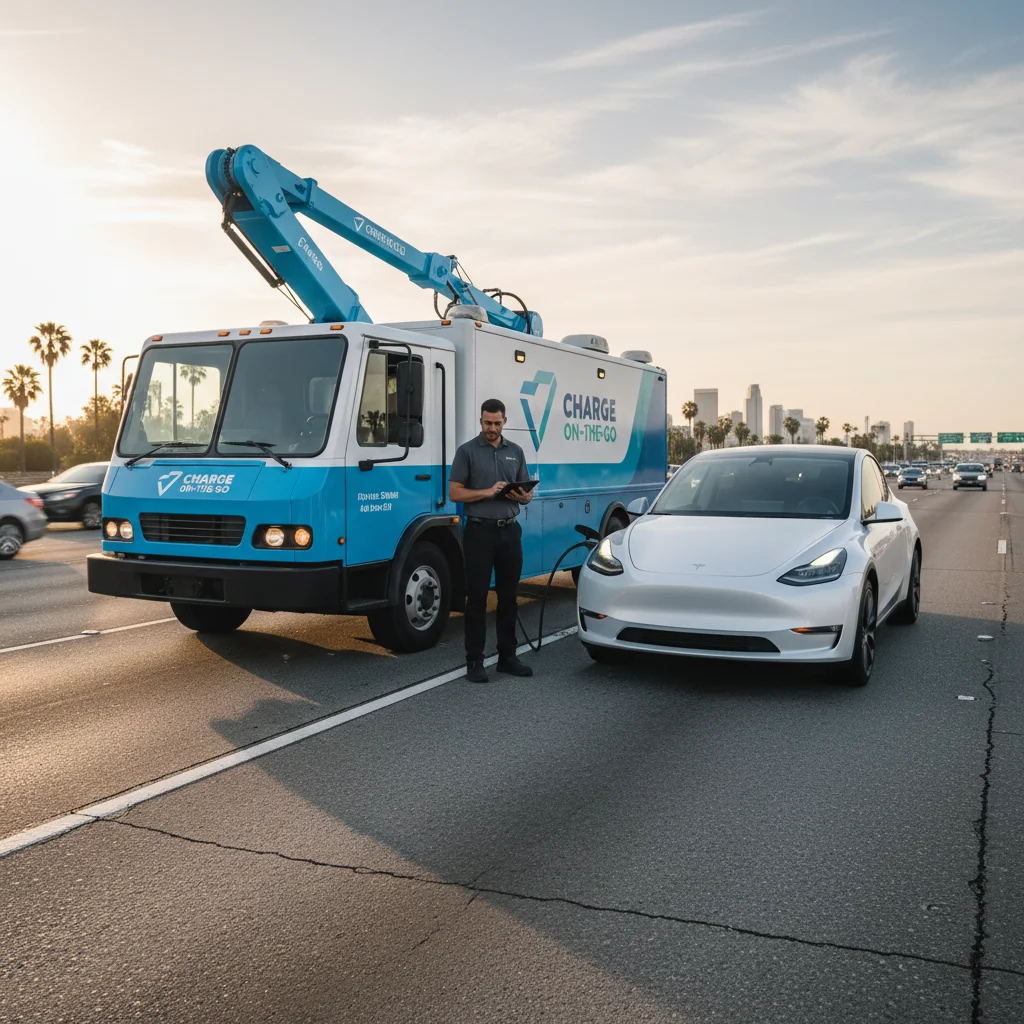
Search results treat an EV charging truck like a brand-owned fleet. Here, the truck belongs to an independent operator. That’s true if you’re in a Paradise resort lot. It’s true on a Centennial Hills driveway too.
The truck isn’t a Supercharger on wheels
A lot of explainers call these trucks mobile DC fast chargers. That isn’t what operators on this network bring. They bring a 240V Level 2 source to the car. That’s the same voltage class as a home wall unit. They use native NACS for Tesla and a CCS or J1772 adapter otherwise. The job is a short top-off at the bumper. It isn’t a public stall bolted onto a van.
A Supercharger pushes DC into the pack at high power. Level 2 feeds AC through the car’s onboard charger. That’s slower, and it’s what works when your car isn’t sitting at a plug. Harry Reid long-term parking is a common place for a car to sit dark. So is an Allegiant Stadium stall after a game. So is a pullout on the Red Rock scenic loop. The operator still brings the source with them.
Typical charging time is 15 to 30 minutes. That’s time on the cable, never an arrival time. In that window, operators typically add about 10 to 20 miles. That’s enough to leave the shoulder or finish a climb. It isn’t a full pack, and it isn’t meant to be.
Level 1, Level 2, and DC are easy to mix up. EV charging levels that actually help when you’re already stranded keeps them apart. For the equipment list, see what a mobile EV rescue truck actually brings to your car.
Who actually owns it here
Charge Pro LV is a referral line for the Las Vegas Valley. We don’t hold a trade license for this work. We don’t run a warehouse or a yard. We don’t stock parts or set a session price. We don’t publish hours, and we don’t quote an arrival time.
The independent operator owns the EV charging truck. They choose the chassis and the power source. They carry the cables and work the shoulder. They quote you first, and they bill you. If a page describes this brand as the fleet, it’s describing a different company.
We serve every city in the county. The City of Las Vegas is only one piece. North Las Vegas and Henderson are separate cities. The Strip and Harry Reid sit in Paradise and Winchester. Those are unincorporated Clark County, not the city. An operator who meets you at Sphere is still independent.
Heat and grade, not a blank map
Cars run short here because the air is hot and the roads climb. NWS Las Vegas lists an average July high of 104.5F. About 78 days a year reach 100F or more. About 9.4 days a year reach 110F or more. The official record high is 120F, set July 7, 2024. The airport often runs 5 to 15F warmer than outlying areas. East-valley and downtown pockets can run up to 11F hotter than the west rim.
Recurrent Auto measured about 5% range loss at 90F. The same work found 17 to 18% loss at 100F. Cooling a hot cabin drew 3 to 5 kW. AAA’s May 2026 test measured 8.5% range loss at 95F. Geotab found hot-climate batteries degrade about 0.4% per year faster. None of those percentages come from Tesla itself. No Tesla-published range-loss figure turned up for this page.
Heat is one load, and elevation is the other. The valley floor sits about 2,000 to 2,920 feet. Summerlin sits about 3,500 feet and rises toward 4,400 near Red Rock Canyon. Railroad Pass sits about 2,360 feet on the Boulder City run. Jean sits about 2,841 feet on I-15 south. Primm sits about 2,618 feet near the state line. Mount Charleston town sits about 7,506 feet.
A thin buffer from Downtown Summerlin can vanish on the Red Rock loop. Timed entry there runs October 1 to May 31 on the 13-mile scenic loop. A return from Lake Mead NRA can sag on the way back. Kyle Canyon Road spends range on the climb. I-15 through Enterprise and Silverado Ranch runs hot and fast. None of that needs a guess about the next public stall. It only explains why the last bar disappeared.
Home power and roadside power are different systems. NV Energy, as Nevada Power Company, serves most of the Las Vegas Valley. Boulder City runs its own municipal utility, largely on Hoover and Glen Canyon hydro. Valley Electric Association serves Blue Diamond, Indian Springs, and Sandy Valley. Overton Power District Number 5 serves Moapa Valley, Logandale, and Moapa. Call those utilities for a home rate, not for an EV charging truck.
NV Energy’s Residential Electric Vehicle Recharge Rider is a home time-of-use rate. The published EV charging window is 10:01pm to 8:00am. That rider doesn’t roll a truck to I-15.
Two ways a truck can make the power
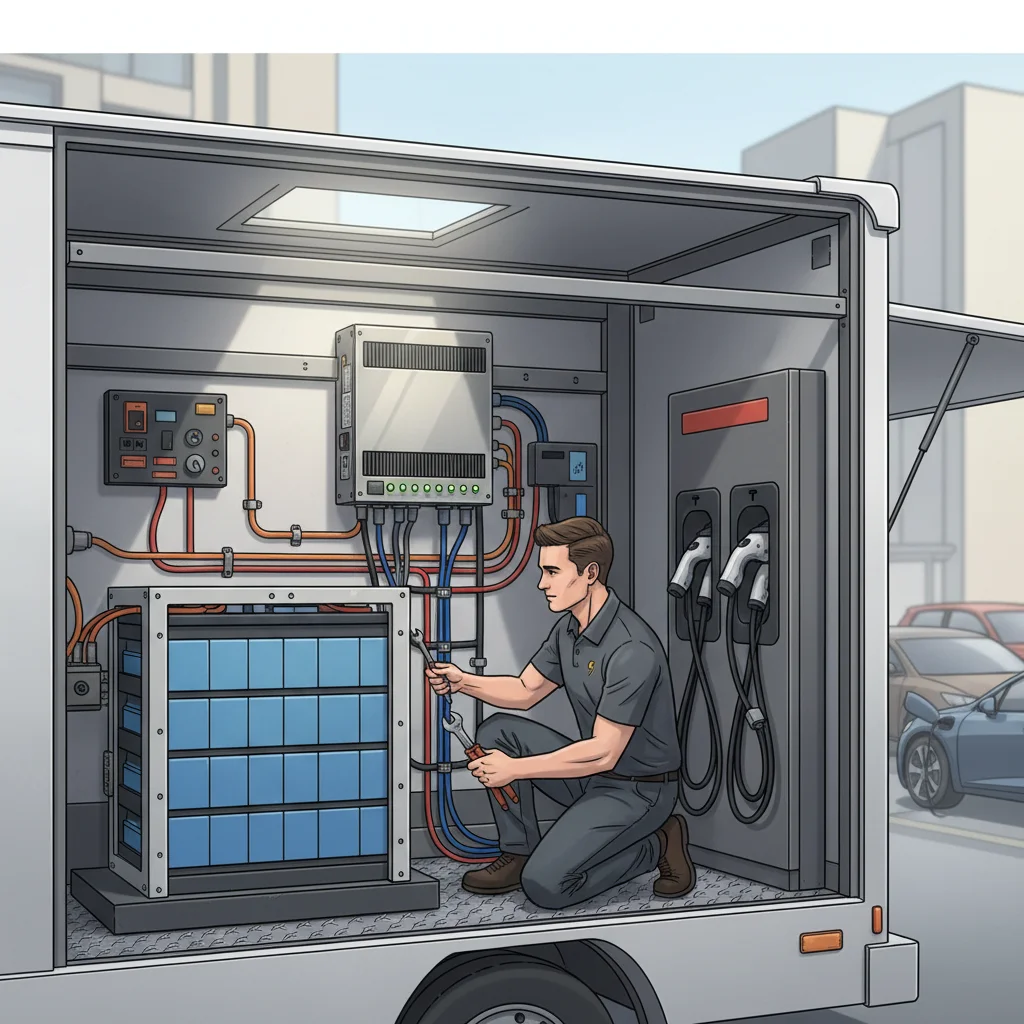
Operators don’t all store energy the same way.
Battery on the truck
Some trucks carry a lithium pack that’s separate from the drivetrain battery. Stored energy goes through an inverter before it hits your port. Then it goes out a 240-volt Level 2 cable into your car. The usual pitch is quiet output on a residential street. This page can’t tell you which local operators use that layout. We don’t keep an inventory of their trucks.
Generator on the truck
Other trucks make AC on site with gasoline, diesel, or propane. That power still needs conditioning before your car will take it. You’ll hear it, and you’ll smell exhaust. It’s still a mobile charge, not a public DC stall. It isn’t this brand’s gear, so ask which setup you’re getting when they quote.
NACS, CCS, and J1772 on the same visit
Tesla’s NACS plug is now the North American Charging Standard by name. Ford, GM, Rivian, and others put it on newer models. Operators bring a native NACS cable for those cars.
Non-Tesla EVs still show up with J1772 for AC. CCS1 appears when the car also fast-charges on DC. CCS1 is J1772 plus two large DC pins. A Level 2 rescue uses the AC path. Operators carry CCS or J1772 adapters for that inlet. A Bolt, an Ioniq, a Mach-E, an ID.4, or a Lyriq can still connect.
Tesla and every major EV brand are in scope. For the adapter path, see who helps a non-Tesla EV in the Las Vegas Valley.
Dark car, empty pack, or both
From the curb, a dead 12-volt and a pack at zero look the same. Locks may not wake, the screen may stay black, and the port may not open. Teslas and most other EVs still need the 12V to boot. Valley heat is rough on that small battery.
Operators can jump or replace a dead 12V on site. That’s a different task from a Level 2 pack feed. If the car won’t wake, start with the 12V. If the car is awake and the pack is empty, you need port power. A tow is for moving the car, not filling it.
A patrol truck isn’t an EV charging truck
NDOT’s Freeway Service Patrol covers the busiest Las Vegas valley freeways. Quality Towing operates it, and GEICO sponsors it. Hours are 5:00am to 8:30pm, seven days a week, free to motorists. Published help includes tire changes, jump starts, and fuel. It also covers minor fire suppression and traffic control. NDOT says the program clears about 55,000 incidents a year statewide. About 31,500 of those are in Las Vegas.
None of NDOT’s published patrol materials mention electric vehicles. They also don’t mention EV charging or EV-specific service. That’s an advertising silence, not a claim the patrol can’t look at an EV. A 12V jump might still be in play. A Level 2 feed into the traction pack isn’t something the patrol advertises.
Nevada State Police Highway Patrol, formerly Nevada Highway Patrol, dispatches rotation tows through Autura. The cell shortcode is *647, and Nevada 511 plus nvroads.com post road conditions. Nevada has no toll roads, express lanes, or transponder systems. I-15, I-215, CC-215, US-93, US-95, and I-11 are free. I-15 HOV lanes run from Silverado Ranch to the Spaghetti Bowl. You need two-plus occupants, 6-8am and 4-6pm weekdays. EVs don’t get a solo HOV pass anymore. The federal authorization for that exemption expired September 30, 2025.
Club roadside is a separate product, and AAA or a mobile charger when your EV is empty is that comparison. Factory Tesla roadside is another fork from this page. This page stays on the charging truck.
What Nevada law says while you sit
NRS 484B.440 covers a vehicle that’s disabled so it can’t avoid stopping. That vehicle is exempt from the no-stopping-on-highway rule. The statute sets no time limit on that stop. NRS 484B.443 lets law enforcement remove a disabled or abandoned vehicle. On freeways and primary highways, abandoned treatment starts after 24 hours. On other roads it’s 72 hours, and the owner pays removal.
Tow operators need a Nevada Transportation Authority certificate. Non-consent tow rates are operator-filed tariffs under NAC 706.408. There’s no single statewide maximum on this site. Confirm any tow price with the operator and the Authority before you pay. Stay visible, and stay out of live lanes if you can.
How the match works
Call the line with your location, your car, and a callback number. A cross-street, an I-15 exit, or a map pin is enough. We match you with an independent operator who takes that job. They quote, they bill you, and we don’t. They’ll say whether they’re feeding the pack, jumping the 12V, or replacing the 12V. How a mobile EV charging quote works when you stall is the money conversation. Mobile EV charging is the service page for the charge.
No on-site arrival window belongs on this page. Strip traffic and a Convention Center load-out change a drive. So does monsoon water in a wash or underpass. The operator on your call is the one who can speak to their day. Out of charge on I-15 south toward Primm is the corridor walkthrough. It’s the same Level 2 idea on different asphalt.
If you need the match, call (702) 935-4699. Give your location, your car, and whether the car is dark or just empty. The independent operator quotes you before they start.