A Chevy Bolt that won’t take a charge is usually protecting itself. Valley heat is the usual trigger. Check the plug, the 12-volt battery, and the pack first. If you’re already stuck, a mobile Level 2 at the car is next.
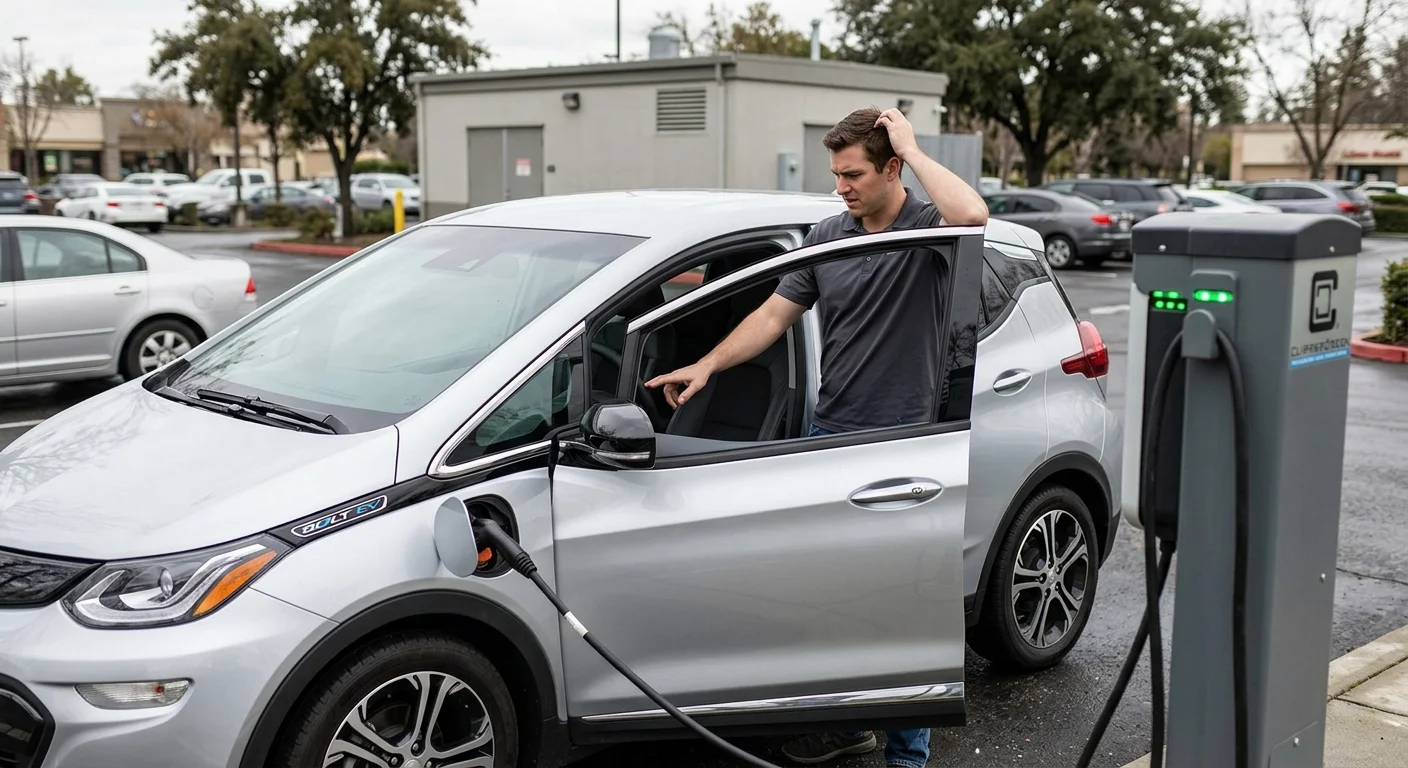
Don’t jump to a tow because the screen went dark. Don’t blame the stall until you’ve tested the car. Heat is the main stress on a Bolt’s charge handshake here. NWS Las Vegas lists an average July high of 104.5F. About 78 days a year reach 100F or more. About 9.4 days reach 110F. The record high is 120F, set on July 7, 2024. Recurrent Auto found about 5% range loss at 90F. Loss rose to 17 to 18% at 100F. AAA, in May 2026, measured 8.5% range loss at 95F. Cooling a hot cabin can draw 3 to 5 kW. A Bolt that sat in a Paradise resort lot can refuse the plug. The pack can still show miles.
The floor runs hotter than the rim
The Las Vegas Valley is not one climate. Harry Reid International Airport sits in Paradise. That’s unincorporated Clark County, not the City of Las Vegas. The airport often runs 5 to 15F warmer than outlying areas. The east valley and downtown can run up to 11F hotter than the rim. Winchester and Sunrise Manor sit on that hotter side. Summerlin sits around 3,500 feet and climbs toward Red Rock. Henderson sits near 1,867 feet. A Bolt charged overnight in Summerlin can still fail after a midday Strip sit. That’s pack heat and 12-volt sag. It’s not a random dash glitch.
NV Energy serves Las Vegas, North Las Vegas, and Henderson. It also serves Paradise, Winchester, Spring Valley, Enterprise, Sunrise Manor, Summerlin, and Whitney. Boulder City has its own municipal utility. Blue Diamond, Indian Springs, and Sandy Valley sit on Valley Electric Association. Know which utility owns your meter before you chase a home-charge fault. NV Energy’s Residential Electric Vehicle Recharge Rider uses a 10:01pm to 8:00am window. A session that dies after midnight is often a tripped breaker. It can also be a hot garage. Clark County Title 30 requires EV-ready wiring in new construction. A Level 2 home charger still needs an electrical permit. Nevada has no state EV purchase rebate. Confirm current program rules with NV Energy. Boulder City drivers should ask Boulder City Utilities instead.
Check the plug, then the 12-volt, then the pack
Treat the refusal as three separate faults. First, confirm the cable is actually live. Second, confirm the 12-volt battery is awake enough to allow charging. Third, confirm the high-voltage pack isn’t too hot to accept more power.
Start at the port. Seat the J1772 latch until it clicks. Wipe dust and monsoon grit off the pins. July and August bring flash flooding in washes and underpasses. Water in the port after a storm will stop a session. Dry the port first. Don’t force a wet connector. On a public AC stall, try the next handle on the same cabinet. If that handle also fails, keep the Bolt in play. DC fast charging uses a different handshake. A DC fail doesn’t prove the onboard charger is dead. A Level 1 fail at home doesn’t prove DC will fail. Test the level you need to move.
Then open the hood. The Bolt still needs a healthy 12-volt battery to close the charge relays. That small battery runs the computers and the locks. It also runs the modules that approve the plug. After a long sit in a hot garage, the 12-volt can sag. The drive pack can still show range. The dash may stay dark. Accessories may flicker. The port may ignore the handle. Look for corrosion on the terminals. Jumping or replacing an EV 12-volt is specialized work. Leave it to a technician who knows the car.
Last, respect the pack. The battery management system will halt charging if power is unstable. It’ll also halt charging if cells are too hot. That’s protection, not a broken Bolt. A dirty public stall can cause the same halt. So can a home circuit that shares a dryer. Check the breaker. Swap the cable if you have a spare. Then decide whether the pack needs time to cool. If you can’t wait, you need range added at the bumper.
The Chevy Equinox EV follows a similar path. If both cars share a driveway, start with the Equinox checklist. Read Chevy Equinox EV won’t charge: what to check before you call.
Unable to Charge is a blanket, not a diagnosis
Unable to Charge means the handshake failed. It doesn’t name the part. The Bolt and the charger negotiate voltage, current, and safety first. Kilowatts move only after that talk succeeds. A dead stall can break it. So can a bent pin or a software glitch. A 12-volt that never woke the charge module can break it too. A flicker on a shared circuit can trip the same message. A hot pack can refuse more heat and show the same line.
You won’t get a dealer scan from the dash. Don’t wait for one in a resort garage. Unplug the handle. Power the car down. Open and close the driver door. Wait a few minutes. Power the Bolt back up. Plug in again. That sequence clears a lot of temporary module noise. It won’t revive a failed 12-volt. It won’t cool a pack that sat in 110F sun. If the message returns right away, stop looping the reset. You’ve isolated a real fault.
Sometimes the session starts, then dies at a random percent. Heat soak is a common reason. Why EV charging stopped at a random percentage in the heat covers that stall. Public charger says connected but isn’t charging in the heat covers the stall that pretends it’s working.
The overnight session that never started
You plugged in after dinner in Spring Valley. Morning shows the same percent. That’s a charge-fault story too. The garage is a heat box after a 104F day. The 12-volt may have sagged overnight. The breaker may have tripped when the charger shared a circuit. NV Energy’s overnight window starts at 10:01pm. If you plugged in earlier on a time-of-use plan, the car may have waited. Check the charge schedule in the car before you assume a hardware fail. Then check the breaker. Then see whether Unable to Charge is sitting on the dash.
Apartment parking in Winchester and Sunrise Manor has the same overnight pattern. The car sits in a lot with no shade. The pack soaks heat until late evening. A Level 2 at the bumper in the morning is still a range tool. It’s not a repair. Geotab found hot-climate batteries degrade about 0.4% per year faster. Phoenix-style desert heat is the worst case they measured. That’s a long-term wear note. It’s not a reason to skip today’s handshake checks.
If you’re already stopped on a valley road
Put the hazards on. Stay out of travel lanes if you can. Nevada has no toll roads. I-15, I-215, US-95, and I-11 are free. I-15 HOV lanes run from Silverado Ranch to the Spaghetti Bowl. They need two-plus occupants, 6-8am and 4-6pm weekdays. A Bolt gets no solo HOV pass. The federal exemption expired on September 30, 2025. Those lanes don’t change a dead Bolt.
NRS 484B.440 lets a disabled vehicle remain when it can’t avoid stopping. The statute sets no time limit. NRS 484B.443 lets law enforcement remove a disabled or abandoned vehicle. On freeways and primary highways, abandoned means 24 hours. On other roads, it’s 72 hours. The owner pays removal. Non-consent tow rates are operator-filed tariffs under NAC 706.408. The Nevada Transportation Authority regulates those rates. There’s no single statewide maximum on this site. Confirm the filed rate before a hook goes on.
The NDOT Freeway Service Patrol covers the busiest valley freeways. Hours are 5:00am to 8:30pm, seven days a week. Quality Towing operates it. GEICO sponsors it. It’s free to motorists. Published help includes tire changes, jump starts, and fuel. It also includes minor fire suppression and traffic control. NDOT’s FSP materials don’t advertise EV charging. Ask for what they publish. Don’t assume a Level 2 truck will roll up. Nevada State Police Highway Patrol dispatches rotation tows. The cell shortcode is *647. Southern Command is (702) 486-4100. Nevada 511 and nvroads.com report closures and cameras.
Harry Reid parking is in Paradise. The airport publishes free battery jump starts and tire inflation at (702) 261-5122. That’s a 12-volt jump, not a pack charge. Whether those lots have EV charging could not be confirmed from the airport’s own pages. Don’t plan a session on an unpublished stall. Allegiant Stadium lots in Paradise fill after Raiders and UNLV games. A Bolt that sat through kickoff is a heat-soak case first. Enterprise and the I-15 south launch add headwind and grade after a hot sit. Centennial Hills is the north-valley version of the same wait.
A mobile Level 2 at the car versus a tow
A tow moves the Bolt. It doesn’t wake a 12-volt. It doesn’t add range. A hook can also trigger Nevada Transportation Authority rules if you didn’t consent. For a charge fault, on-site help usually fits better than a tow. Your electric car died: should you charge, jump, or tow lays out that choice.
Charge Pro LV is a referral line. We match stranded EV drivers with independent local mobile rescue operators. We don’t own trucks. We don’t employ technicians. We don’t set prices. We don’t promise an arrival window. The operator quotes you before starting, then bills you directly. The operators we connect you with are licensed and insured. They bring a 240-volt Level 2 source to the car. For a Bolt, that’s a J1772 handle. They typically add 10 to 20 miles of range. That takes 15 to 30 minutes of charging. That’s charging time, not a promise of when someone arrives. They can also jump or replace a dead 12-volt on site.
That’s enough to leave a Paradise garage, a Winchester street, or a Henderson lot. You can then reach a working plug on your own terms. It also helps when a home Level 2 breaker has tripped. You may need to move before an electrician can meet you. Non-Tesla EV rescue is the page for Bolt, Equinox EV, and other CCS or J1772 cars. Mobile EV charging is the page for the Level 2 source at the bumper.
Heat care still matters after you’re rolling. How to care for an EV battery through valley heat is the habit list for the next park.
When to pick up the phone
You’ve seated the plug. You’ve tried another stall. You’ve reset the car. The 12-volt still looks weak, or Unable to Charge won’t clear. You’re in a lot you can’t leave. Call. We’ll match you with a local operator who quotes before any cable goes in. The number is (702) 935-4699.