The lights went down at Allegiant Stadium, and you walked back to the lot. Your EV won’t wake. The app is silent. After a Raiders or UNLV game, the sit is the problem. Paradise heat works the car while you’re in your seat. Cabin cooling drains the small 12V battery. The traction pack can spend the miles you needed to leave. This page covers EV charging after an Allegiant Stadium event. You’ll see what failed and what to check. A mobile charge at the car is how you leave the lot.
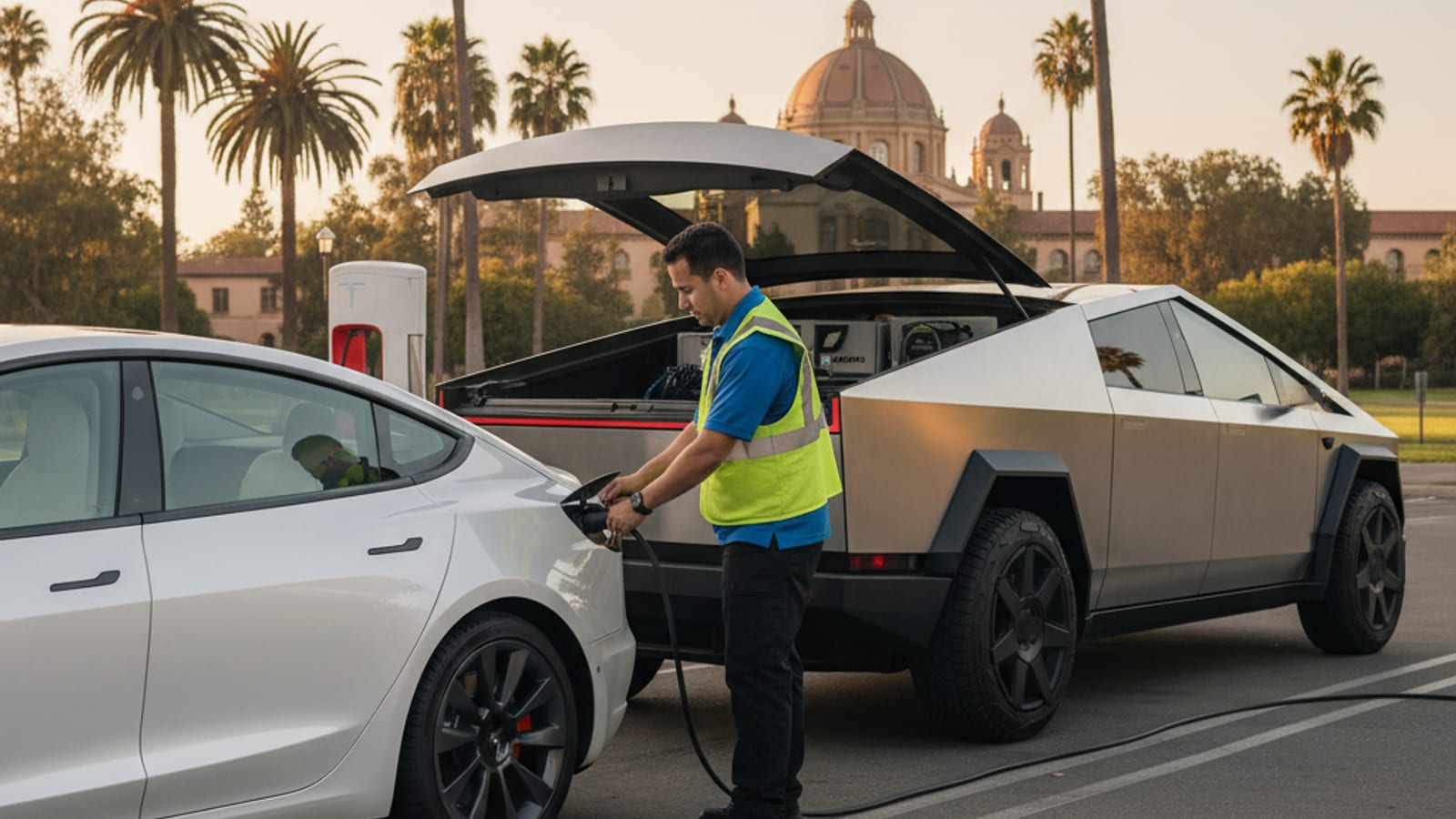
The stall you left is hotter than the drive in
Allegiant Stadium sits in Paradise, unincorporated Clark County. It isn’t in the City of Las Vegas. Harry Reid International Airport sits in the same town. NWS Las Vegas has the airport 5 to 15F warmer than outlying areas. Downtown can run up to 11F hotter than the rim. A parked EV in that pocket soaks heat for hours.
July’s average high in the valley is 104.5F. About 78 days a year hit 100F or more. About 9.4 days hit 110F or more. The all-time record is 120F on 2024-07-07. You didn’t drive those hours. You sat them in the lot.
Recurrent Auto found about 5% range loss at 90F. It found 17 to 18% range loss at 100F. AAA, in May 2026, measured 8.5% range loss at 95F. Air conditioning can draw 3 to 5 kW to cool a hot cabin. Holding a cool cabin takes about 1 kW. None of those figures come from Tesla. They’re independent tests. They still describe a Paradise afternoon in a closed lot.
Annual rainfall here is 4.18 inches. That sounds gentle. Monsoon months are July and August. Flash flooding hits washes and underpasses. Watch I-15 and I-215 underpasses on the way home. If water sits in the charge port later, stop plugging in until it’s dry.
Two failures look the same from the sidewalk
A dark Tesla, Ford, Hyundai, or Rivian looks like one problem. It’s usually one of two.
A dead 12V with miles still in the pack
The 12V runs computers, locks, and contactors. Newer Teslas use a small lithium low-voltage pack for the same job. Game-day dwell keeps those circuits awake. Sentry-style cameras draw from that battery. Cabin overheat protection draws from it too. Phone-key polling adds another trickle. In heat, the 12V sags. The high-voltage pack can still show a healthy percentage. The car just won’t close the contactors. You get a brick that still had range.
A jump at the stall can wake it. Sometimes the 12V needs a replacement, not another jump. If it dies again after a jump, treat that as a failed battery. The Tesla 12V battery jump path is for that brick. It isn’t a pack charge.
Lead-acid 12V units hate heat. Lithium 12V units fail differently, but they still fail. Either way, the dash goes dark. Don’t keep hammering the start button. Don’t borrow clamps from a gas car unless you know the EV’s jump points.
An empty traction pack after the dwell
You arrived with a thin buffer. Then the cabin sat in Paradise heat. Climate control ran. Preconditioning ran. The exit crawl on I-15 spent the rest. The 12V may be fine. The car just has nowhere to go. That’s an out-of-charge recovery job. You want 240V at the bumper. You don’t want a tow by default.
Telling them apart is simple. If screens stay dark and doors won’t unlock, start with the 12V. If the car wakes, shows a low percentage, and won’t drive, it’s the pack.
Creep in a packed lot uses energy too. The speedometer barely moves. Climate stays on. The buffer you saved for Henderson or Summerlin gets spent on ramps.
A stadium sit isn’t a grocery-store sit
Raiders and UNLV games hold you for hours. Tailgates add more time on pavement. Overtime adds more. You’re not parked for a short errand. The lot is a long, hot soak.
You’re also leaving with everyone else. I-15 beside the stadium stacks up. Sphere and Michelob ULTRA Arena at Mandalay Bay sit nearby. Town Square sits in the same south-Strip cluster. Same heat pocket. Same post-event surge. Harry Reid’s lots in Paradise see a long sit with a different crowd. A stadium night still has its own rhythm. Kickoff. A full game. Then a mass exit.
This page won’t invent a charger count for that lot. Charging inventory for Clark County could not be verified here. The NREL station API was in a DNS outage on 2026-09-18. Tesla’s site blocks automated stall counts. Electrify America publishes a statewide roll-up, not a Paradise list. So we won’t name a stall map or a distance to a plug. Open your charging app in the lot. Read what’s actually online.
If a stall is open and you can still roll, use it. If you can’t roll, charge at the parking stall. That’s the useful EV charging at Allegiant Stadium tonight.
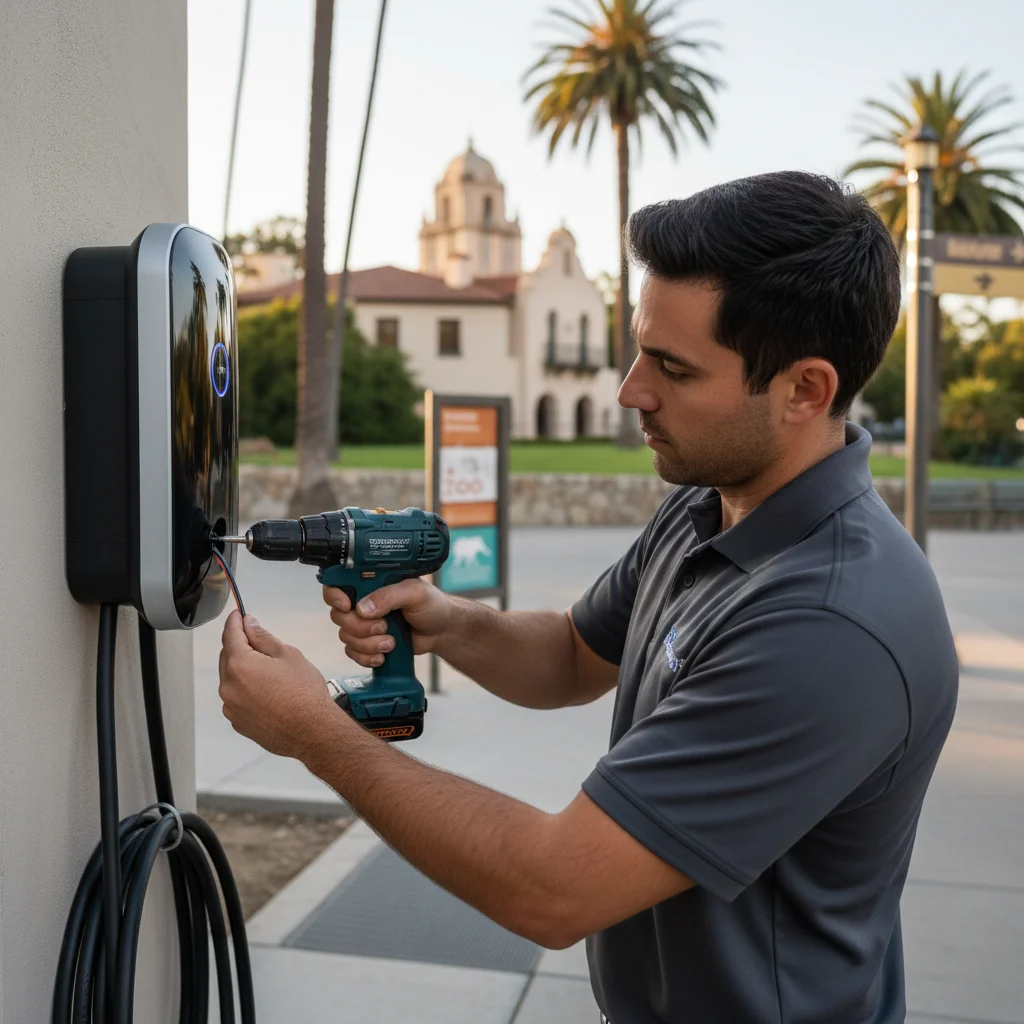
What EV charging at Allegiant Stadium can mean tonight
You want a plug by the gate. That’s fair. The verified record is narrower.
NV Energy serves Paradise, the Strip corridor, Enterprise, and the valley floor. Boulder City has its own municipal utility. Valley Electric Association covers Blue Diamond, Indian Springs, and Sandy Valley. Overton Power District No. 5 serves Moapa Valley, Overton, Logandale, and Moapa. For a stall at Allegiant Stadium, those outlying utilities don’t matter. In the lot you’re on a public network that’s actually working. Or you’re charging from a mobile 240V source at the car.
Level 2 is 240V AC. That’s the class of power mobile operators bring. They use a native NACS plug on Teslas. They carry a CCS or J1772 adapter for everyone else. Typical add is 10 to 20 miles of range. That takes 15 to 30 minutes of charging. That’s charging time. It isn’t an arrival promise.
DC fast charging pushes DC into the pack. You need to reach a working stall first. Superchargers are Tesla’s version of that. Many newer non-Tesla EVs use NACS. Others need a CCS-to-NACS adapter. Bring the adapter you already own. Don’t assume a stadium lot keeps one at a booth. That isn’t a published fact.
Charge Pro LV is a referral line. It matches you with independent local operators. It doesn’t own the truck. It doesn’t hold a trade license. It doesn’t set the price. The operator quotes you before work starts. The operator bills you directly. The pros we connect you with are licensed and insured. That’s a claim about the network.
For the mobile piece, see mobile EV charging.
Charge at home on NV Energy’s overnight window
The cleanest Allegiant Stadium plan starts the night before. NV Energy’s Residential Electric Vehicle Recharge Rider is called REVRR. It sets an EV charging window from 10:01pm to 8:00am. That’s a named program. This page doesn’t publish a rate. Confirm the current tariff with NV Energy before you lean on it.
NV Energy also names a Residential Managed Charging Program. The handbook was revised 2026-07-29. Residential EV Charging Station Incentives exist by name. So do Multifamily Charging and Public Charging programs. The Lower Income EV Rebate closed 2023-06-30. Dollar figures for any of those stay off this page.
Nevada has no retail electric choice. Question 3 failed in 2018. In Paradise you’re on NV Energy. Nevada has no state EV purchase rebate. It has no EV-specific registration surcharge. Those facts don’t help you in the lot. A full pack before you leave for the game does.
If you live in an apartment with no plug, that overnight window isn’t yours. Don’t fake a Level 2 session on a wall with no outlet. Plan the return miles as a separate problem. Paradise EV charging is the local hub for that community.
Clark County’s Title 30 code requires EV-ready wiring in new construction. A Level 2 home charger needs an electrical permit. That’s for a future install at home. It isn’t a stall in stadium parking.
Checks you can run in the seat
Stay with the car if you can do it safely. A packed post-game lot is not a place to wander. Follow lot staff if they give directions. Ask before you assume a service truck can enter. Access rules are theirs. They aren’t published in the sources used here.
Try the phone key and the physical key card or fob. If the car is a Tesla, open the app. If the app still sees it, read the 12V and pack figures. If nothing lights, treat it as a low-voltage failure first.
Don’t keep cycling drive. Don’t jump from a stranger’s bumper unless you know the clamp points. EV 12V jumps have their own posts and polarity. Wrong clamps cost you a computer.
If the car wakes and shows a low pack, stop using climate. One-pedal driving helps once you’re moving. It doesn’t help you leave a stall at zero.
If you need a human, start with EV roadside assistance in Paradise. That’s a local path, not a gas-can call.
The freeway patrol doesn’t advertise an EV charge
NDOT’s Freeway Service Patrol covers the valley’s busiest freeways. Quality Towing operates it. GEICO sponsors it. Hours are 5:00am to 8:30pm, seven days a week. It’s free to motorists for tire changes and jump starts. It also covers fuel, minor fire suppression, and traffic control. NDOT says it clears about 55,000 incidents a year statewide. About 31,500 of those are in Las Vegas.
None of NDOT’s published FSP materials mention electric vehicles, EV charging, or EV-specific service. That’s an advertised silence. It isn’t a claim the patrol can’t touch an EV. A 12V jump is still a jump. A pack fill isn’t in the brochure.
A night game can let out after 8:30pm. Then you’re outside the published FSP window. Nevada State Police Highway Patrol dispatches rotation tows through Autura. The cell shortcode is *647. Nevada 511 and nvroads.com show closures and cameras.
If you die on I-15 after you leave the lot, stay with the car. NRS 484B.440 lets a disabled vehicle remain when it can’t avoid stopping. The statute sets no time limit. NRS 484B.443 lets law enforcement remove a disabled or abandoned vehicle. On freeways and primary highways, abandoned is 24 hours. On other roads, 72 hours. The owner pays removal.
Nevada has no toll roads and no express-lane transponders. I-15, I-215, US-95, US-93, and I-11 are free. I-15 HOV runs from Silverado Ranch to the Spaghetti Bowl. It needs two-plus occupants, 6-8am and 4-6pm weekdays. The federal single-occupant EV HOV exemption expired 2025-09-30. After a Sunday game, that HOV clock usually isn’t running. After a weekday evening kickoff, it might be. Don’t solo an HOV lane during the posted window.
Jump, charge, or tow from private pavement
Allegiant Stadium parking is private property. Nevada’s private-property tow rules live in NRS 706.4463 through 706.4479. Tow operators need a Nevada Transportation Authority certificate. Posted signs are required. A 48-hour warning sticker is required before some private-property tows. Owners get certified-mail notice within 15 days. It’s 21 days if the tow is crash-related. A still-hooked vehicle must be released at the original location. The operator sets that release fee.
Non-consent tow rates are operator-filed tariffs under NAC 706.408. There’s no single statewide maximum on this site. Confirm posted lot rules on the way in. Don’t wait until the car is already dead.
A tow moves a brick. It doesn’t add miles. Flatbed is the usual EV method when a tow is the only path. If the 12V is the failure, jumping in place avoids the hook. If the pack is empty, charge, jump, or tow is the decision tree. Charge at the stall when that’s enough to roll.
A sibling walkthrough lives here: Allegiant Stadium parking and an EV that won’t leave the lot.
What shows up when you want range in the stall
Independent operators bring a 240V Level 2 source to the car. Native NACS for Teslas. CCS or J1772 adapters for other brands. They can jump or replace a dead 12V on site. They handle Tesla and every major EV brand.
They quote before they start. They bill you. Charge Pro LV doesn’t take that payment. It doesn’t promise a clock. The brand connects you. The operator does the work.
Ten to twenty miles is often enough to clear the lot and join I-15. From there you can reach a public stall. You have to see it in an app first. Or you can head home if home is close. That only works if the pack needed a sip. This page won’t guess your remaining miles. Read the dash.
Geotab found hot-climate batteries degrade about 0.4% per year faster. Phoenix-style desert heat is the worst case in that work. That’s a long-term wear note. It isn’t tonight’s stall. Tonight is heat, dwell, and a small battery or an empty pack.
Nevada had about 85,600 EVs registered in 2025. It had about 16,100 plug-in hybrids. Those figures are AFDC/NREL using Experian data. The Nevada DMV said over 80,000 EVs statewide in May 2026. That’s up nearly 420% over five years, per the Nevada Independent. Clark County’s own count is not verified. You’ll still share that lot with other EVs. That doesn’t prove an open stall when you walk out.
Once you roll: Henderson, Summerlin, or north
South on I-15 is Enterprise, Silverado Ranch, and the launch toward Jean and Primm. West is Spring Valley and the Summerlin rim. That rim sits higher and often cooler than the airport pocket. Henderson sits around 1,867 ft. The valley floor is about 2,000 to 2,920 ft. Summerlin is about 3,500 ft. It rises toward 4,400 ft near Red Rock. Those elevation gaps are real. They are not a reason to invent a charger map.
North takes you through the Strip toward Downtown Las Vegas and North Las Vegas. Keep climate modest until you’ve got a buffer. January’s average low is 37F, with about 10 freeze nights. That’s a smaller slice of the year than the 100F days. Heat is still the stadium story.
Rim towns like Summerlin and Anthem sit above Paradise. The drive down is a descent. The drive back is a climb plus heat. Leave more buffer for the return than the inbound.
Adapters and the non-Tesla cars in that lot
Teslas take NACS. Many newer non-Tesla EVs now ship with NACS too. CCS remains common. J1772 is the older AC inlet. A mobile operator brings those adapters. Your own CCS-to-NACS adapter still belongs in the frunk for public DC stalls.
Don’t mix that with a 12V jump. A NACS plug will not wake a dead low-voltage battery. Charge the pack after the car can close contactors. Sequence matters.
UNLV crowds and Raiders crowds use the same pavement. The car doesn’t care which logo is on the field. It cares how long it sat, and how hot the lot got.
A pre-game habit that isn’t a promise
Charge at home in the REVRR window when you have a plug. Set cabin preconditioning while you’re still on that home circuit. Unplug after the cabin is already cool. Pack the adapter you need. Check your charging app before you shut the door at Allegiant Stadium.
Watch 12V health in the app through summer. Valley heat is the wear. If you’ve had one surprise brick this year, treat the 12V as worn. Don’t wait for another game night to test it again.
Clean Cars Nevada is in force, with ZEV rules from model year 2025. Statewide adoption is rising. The lot will keep filling with EVs. Your personal buffer still has to come from home charging. A working public stall is the other path. So is a mobile 240V session at the bumper.
None of that replaces a plan if the car is already dark.
Frequently asked questions
What EV charging exists at Allegiant Stadium parking?
A published, verifiable stall list for Allegiant Stadium parking could not be confirmed. Agency charger databases were not available to count on 2026-09-18. Use your car’s app or a live charging map. Look for current plugs in Paradise and along the south Strip. If the EV can’t move to a stall, charge at the parking space. A mobile 240V session doesn’t depend on a public post.
Why did the car die after a Raiders or UNLV game?
Hours of heat-soaked dwell. The 12V can fail while the pack still has range. The pack can also spend itself on cabin cooling. Recurrent Auto measured about 5% range loss at 90F. It measured 17 to 18% at 100F. AAA measured 8.5% at 95F. Cooling a hot cabin can take 3 to 5 kW. Holding it takes about 1 kW. Paradise sits in the airport heat island, 5 to 15F warmer than outlying areas.
Should I tow, jump, or charge in the lot?
Start with the symptom. Dark screens and dead locks point to the 12V. A live dash with a low percentage points to the pack. A jump or 12V replacement stays in the stall. A Level 2 top-off is often enough to leave. That’s 10 to 20 miles in 15 to 30 minutes of charging. A tow is for a car that still can’t move. Confirm posted private-lot rules. Nevada tow tariffs are operator-filed with the Nevada Transportation Authority. This site doesn’t publish those numbers.
If the car is still in the lot, Charge Pro LV can connect you. Call (702) 935-4699. The operator quotes before work starts and bills you directly. That’s the path when EV charging at Allegiant Stadium has to happen at the bumper. It’s for the night you can’t reach a public post.