The stall usually shows up at the end, not on the way in. Your EV sat through a long event at Las Vegas Motor Speedway. North Las Vegas heat cooked the lot while you were inside. At exit the car won’t unlock, wake, or roll. Stay with it and sort a dead 12V from an empty pack. Then get a mobile operator to the stall. Charge Pro LV is a referral line for the Las Vegas Valley. It matches stranded drivers with independent local pros. Those operators jump a 12V or bring 240-volt charging to the car. They quote before they start and bill you directly.
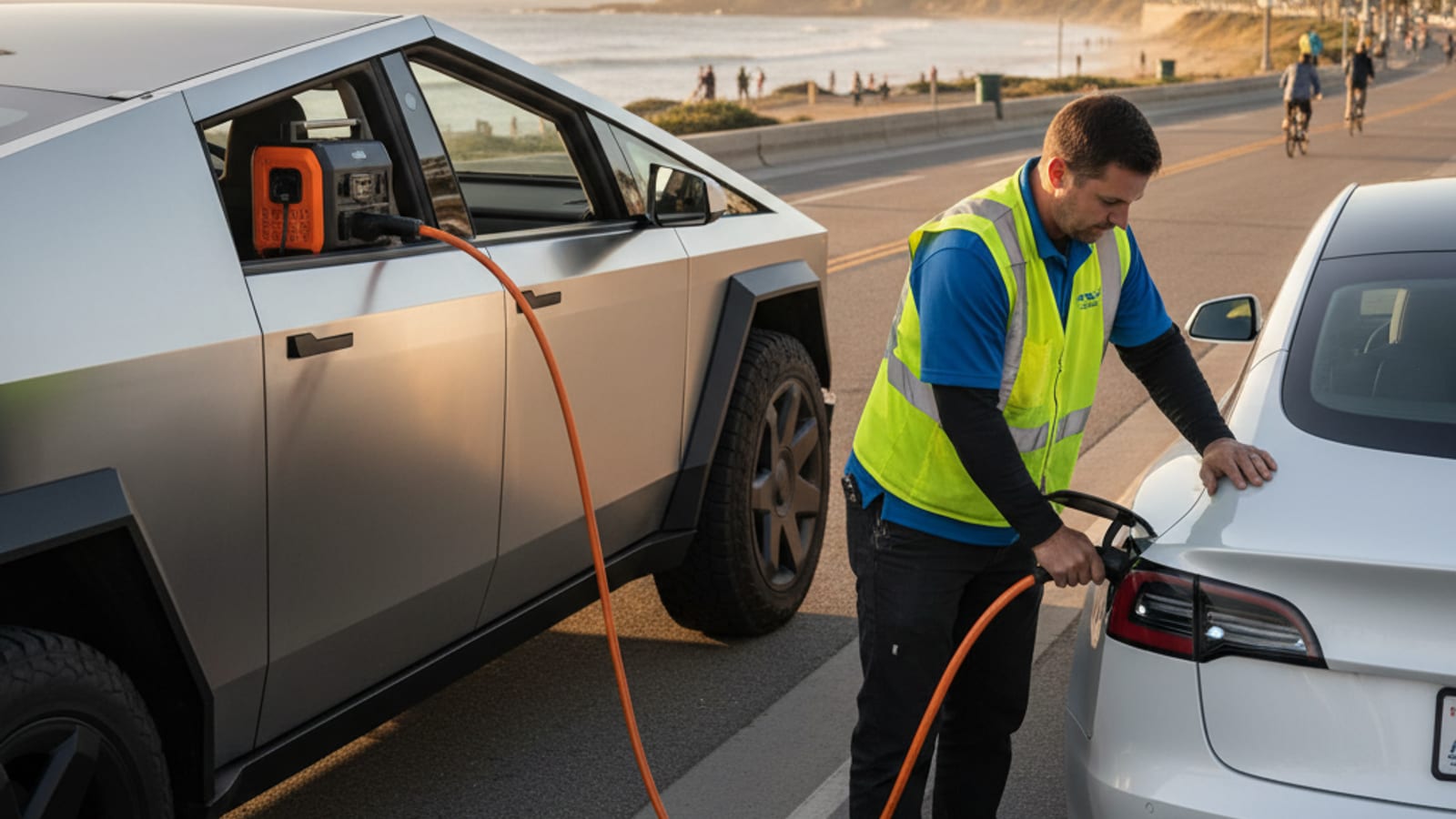
North Las Vegas heat and a long Speedway sit
Las Vegas Motor Speedway sits in North Las Vegas. It sits on the north edge of the valley floor. Event parking is open pavement with little shade. Cars rest there for hours while you’re inside. NWS Las Vegas, using the KLAS record, puts the average July high at 104.5F. About 78 days a year reach 100F or more. About 9.4 days reach 110F or more. The all-time record high is 120F, set on 2024-07-07.
That’s cabin heat and 12V heat, not a mountain grade. The small battery still has to keep modules alive. The pack still has to close contactors when you walk back. A short park in Aliante or Centennial Hills ends in minutes. A race, a show, or a long Speedway event doesn’t.
The valley floor sits about 2,000 to 2,920 feet. You don’t get Mount Charleston air in this lot. Mount Charleston town is about 7,506 feet. Speedway parking is the hot basin. Nellis Air Force Base is about 8 miles northeast. That northeast edge shares the same open sun.
Urban heat island numbers still matter on this side of town. The airport runs 5 to 15F warmer than outlying areas. East valley and downtown can run up to 11F hotter than the rim. North Las Vegas pavement is still desert, so plan for that.
Recurrent Auto found about 5% range loss at 90F. It found 17 to 18% loss at 100F. Air conditioning can draw 3 to 5 kW to cool a hot cabin. Holding that cabin takes about 1 kW. AAA, in May 2026, measured 8.5% range loss at 95F. This research didn’t find a Tesla-published range-loss figure. None of it is quoted as Tesla’s.
You may have arrived with enough miles. The sit plus a blast of AC on exit can spend more than you budgeted. Or the 12V simply won’t wake the car at all.
Tell a dead 12V from an empty pack
From the aisle, both failures look like a brick. Lights stay dark, and handles may not work. The app may not connect, and they need different help.
The 12V sat in the sun all afternoon
Every EV still has a 12-volt battery. It runs locks, screens, lights, and the computers that close the high-voltage contactors. If that battery is down, the pack can still be full. The car still won’t start. Valley heat is hard on those 12V units. Tesla drivers see this a lot, and other brands see it too.
Treat it as a 12V job when the car won’t unlock. Treat it as a 12V job when screens stay black. Treat it as a 12V job when you charged last night and still get nothing. You may hear a click, then silence.
The operators we connect you with can jump a 12V on site. They can replace one on site when a jump won’t hold. If that’s the pattern, start with a Tesla 12V battery jump. Heat is the usual wear, and Tesla 12V failure in valley heat walks through why. Don’t keep clipping a 12V that dies again in the same stall.
The pack hit zero before you could leave
Some cars roll into Speedway parking already low. Climate control, lights, and a long wait spend the rest. Some cars leave cabin protection running while you’re inside. That load comes out of the pack. At exit the displays may still wake, but the range is gone.
A 12V jump won’t add miles to a pack at zero. You need energy in the high-voltage battery. Operators in this network bring a 240V Level 2 source to the car. They use a native NACS plug. They carry a CCS or J1772 adapter for non-Tesla EVs. They handle Tesla and every major EV brand.
Charging time is typically 15 to 30 minutes. That number is charging time, never an arrival time. It usually adds about 10 to 20 miles of range. That can be enough to leave the lot. You can then continue on a plan you already had. Read mobile EV charging for what that truck actually does.
Checks you can run in the stall
Stay with the car if the lot is still moving. Turn on hazards if you’re blocking an aisle. Don’t stand in live traffic. NHTSA keeps general roadside safety guidance at https://www.nhtsa.gov/.
Run the small checks before you spend the night guessing.
- Confirm the phone key or fob is awake.
- Use the physical door release if your model has one.
- Try one start. Don’t hammer the button.
- Write down the last state of charge you remember.
- Note whether the app, lights, or locks still respond.
If the car talks to you and shows zero miles, treat it as empty. If nothing powers up, treat it as 12V until someone tests it. If the charge port is stuck, don’t yank the handle. Heat can hold a latch, so let an operator work it.
Give the operator a findable spot. Row markers, a gate, a building face, or a grandstand side all help. Las Vegas Motor Speedway is a large North Las Vegas site. Saying you’re at the Speedway isn’t a stall number. The operator needs a place to stand without boxing in the exit.
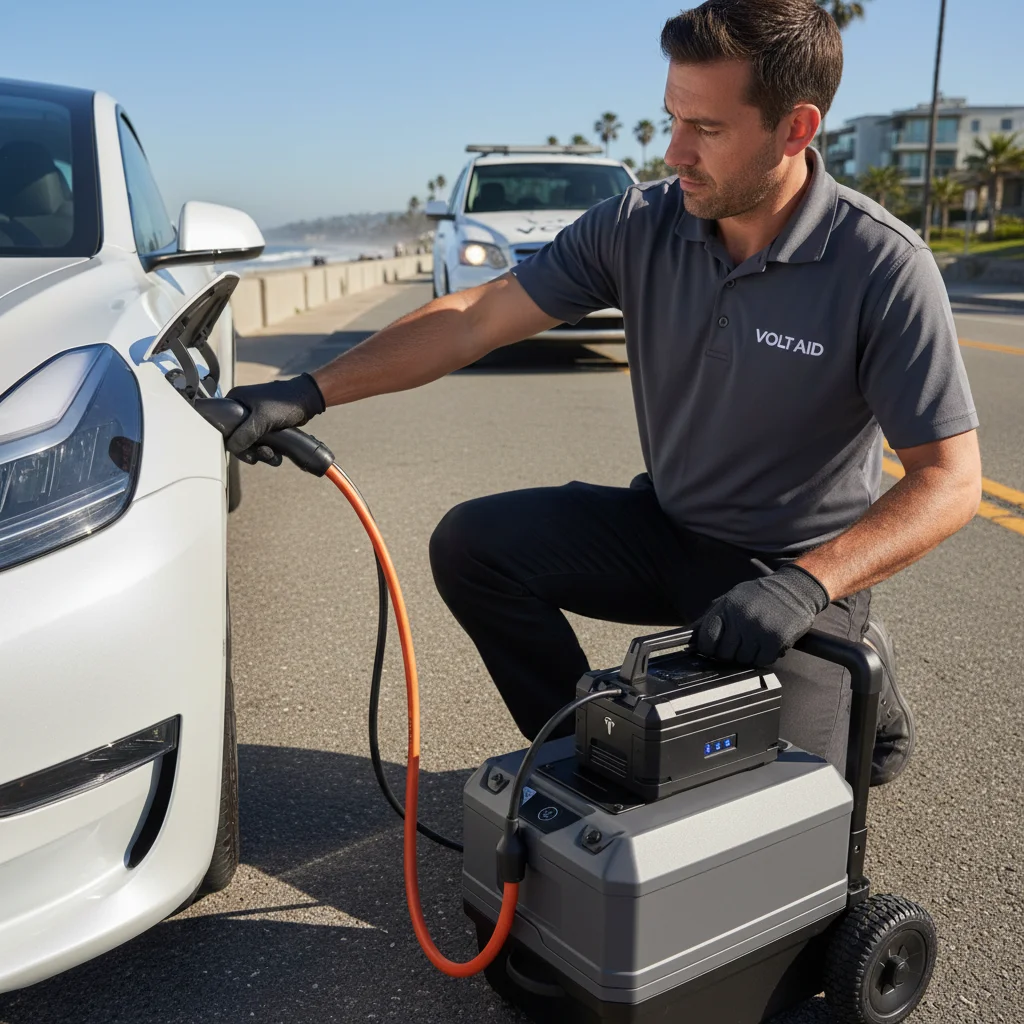
What a mobile operator brings to the car
Charge Pro LV doesn’t own trucks or a yard. It employs no technicians and doesn’t do the work. It connects you with independent local operators. The operators we connect you with are licensed and insured. They quote before they start, and you pay them directly. This brand doesn’t set their price.
At the car they test the 12V. They jump or replace it when that’s the fault. They connect Level 2 charging when the pack is empty. They don’t promise an arrival clock. Event exit traffic in North Las Vegas can slow anyone. Ask the operator for their own window when they call you back.
Event lots around the valley produce the same sit. A game-day car can fail the same way in Allegiant Stadium parking. Convention days do it in Las Vegas Convention Center lots. The Speedway version lasts longer in open sun. The north-valley heat does the rest.
Towing if the lot wants the stall cleared
Sometimes the pack won’t take a charge. Sometimes the lot wants the stall emptied. Then a tow is the path. Many EVs need a flatbed so the motors don’t drag. A wheeled pickup can damage a drive unit. Ask for a flatbed and a driver who knows EV hold points.
Tow operators in Nevada need a Nevada Transportation Authority certificate. That sits in NRS 706.4463 and related sections. Private-property tows require posted signs and a 48-hour warning sticker. That’s statute, not a Speedway policy this page can invent. Read the signs in the lot you used and follow them.
Non-consent rates are operator-filed tariffs under NAC 706.408. There’s no single statewide maximum on this site. Ask for the tariff before the hook is locked. NRS 706.4467 requires release at the original spot if the truck is still hooked. That release is for the operator’s set release fee. Confirm that fee with the tow company. It isn’t published here.
NRS 484B.440 exempts a vehicle that can’t avoid stopping from the highway no-stopping rule. That helps on a freeway shoulder. It doesn’t freeze a private lot clock. NRS 484B.443 lets law enforcement remove a disabled or abandoned vehicle. Abandoned is 24 hours on freeways and primary highways. It’s 72 hours on other roads. The owner pays removal. A Speedway stall follows posted private-property rules, not that highway timer. Don’t assume you can leave a dead EV until morning.
If you already rolled out and died on a freeway, check Nevada 511. Nevada 511 and nvroads.com report cameras and closures. Nevada State Police Highway Patrol Southern Command is (702) 486-4100. The cell shortcode is *647. Rotation tows go through Autura.
What NDOT’s freeway patrol publishes
The NDOT Freeway Service Patrol covers the most-traveled Las Vegas valley freeways. Quality Towing operates it, and GEICO sponsors it. It runs 5:00am to 8:30pm, seven days a week, free to motorists. Listed help includes tire changes, jump starts, fuel, minor fire suppression, and traffic control. NDOT reports about 55,000 incidents a year statewide. About 31,500 of them are in Las Vegas.
None of NDOT’s published FSP materials mention electric vehicles, EV charging, or EV-specific service. The patrol doesn’t advertise EV charging. That’s an observed absence in their materials. It isn’t a claim that a patrol truck can’t jump a 12V. A Level 2 charge in Speedway parking isn’t in those published duties. You’re also in a private event lot, not on a freeway they patrol.
Nevada has no toll roads, express lanes, or transponder systems. I-15, I-215, CC-215, US-93, US-95, and I-11 are free. If you leave south on I-15 in the weekday HOV window, remember occupants. HOV runs from Silverado Ranch to the Spaghetti Bowl. Hours are 6-8am and 4-6pm weekdays, with two or more occupants. The federal single-occupant EV HOV exemption expired 2025-09-30. An EV still needs two people in those lanes during restricted hours.
Range after you finally leave the property
Once the car wakes, you still have to leave North Las Vegas. Cooling a sun-soaked cabin is a real draw. Use the heat figures above when you judge remaining miles. Precondition if the car still answers you before you walk out. If it’s already a brick, you can’t. Don’t exit on a hope and a low percentage. Treat the drive home as a new trip.
North Las Vegas sits on the hot valley floor, like the Speedway itself. Aliante, Skye Canyon, Tule Springs, and Centennial Hills sit on this north side. None of that is rim country. Summerlin sits about 3,500 feet and rises toward 4,400 near Red Rock. Henderson sits about 1,867 feet. Those are different homes to return to. Climate load still follows you on a 100F night.
Tonight is usually the 12V or an empty pack. A long sit in open sun is enough to cause either one. Don’t wait to find out which it was after the lot has emptied around you.
Home charging in NV Energy territory is for the next event
A home plug won’t rescue a car that already sat through the event. It’ll help the next one. NV Energy serves North Las Vegas and most of the Las Vegas Valley. Boulder City Utilities serves Boulder City. Valley Electric Association serves Blue Diamond, Indian Springs, and Sandy Valley. Overton Power District No. 5 serves Moapa Valley. The Speedway side is NV Energy territory.
NV Energy’s Residential Electric Vehicle Recharge Rider has a set charging window. That EV window runs from 10:01pm to 8:00am. It also lists a Residential Managed Charging Program. The handbook was revised 2026-07-29. It lists residential station incentives, multifamily charging, and public charging programs. The Lower Income EV Rebate closed 2023-06-30. Dollar figures for those programs aren’t published on this site. Confirm current terms with NV Energy.
Nevada has no state EV purchase rebate or tax credit. That absence is confirmed through AFDC and the Governor’s Office of Energy. Nevada has no EV-specific registration surcharge on the DMV fee schedule. Clark County Title 30 requires EV-ready wiring in new construction. A Level 2 home charger needs an electrical permit.
Charge at home before you park for a long Speedway sit. Leave a buffer for cabin heat on the way out. That’s the prevention. Rescue is what you call when prevention missed.
Weather, season, and the extra hour you stayed
July and August are monsoon months. Annual precipitation is only 4.18 inches, but flash flooding still hits washes and underpasses. A flooded aisle is a walking hazard. Water in a charge port is a reason to stop. Don’t force a connector into a wet port.
Winter still shows up. The average January low is 37F, with about 10 freeze nights. Recurrent Auto found about 70% of maximum range retained at 20F. AAA measured 39.0% range loss at 20F. A night event in January can flatten a weak 12V. A July day can do the same. The sit is the common factor.
If you came from farther out, budget climate, not a mountain pass. This trip is valley floor. Headwind and AC matter more than Railroad Pass or Kyle Canyon. People roll in from the Strip corridor, Henderson, Summerlin, and the north-valley suburbs. Each start is a different remaining-range problem. The lot is the same: open sun, long hours, then a wake-up. If you stayed for one more hour, that hour sat on the 12V. It also sat on any climate the car kept running.
A simple order of steps
Work this order when the car won’t leave.
- Make the car visible. Stay out of aisle traffic.
- Separate 12V symptoms from an empty pack.
- Open a factory roadside ticket if you want that path. Tesla and other brands run their own programs. They may still send a contractor.
- Call for a local operator if you want independent help at the car. For north-valley context, see EV roadside assistance in North Las Vegas.
- Take the quote before any clip or plug goes on.
- If a tow is required, ask for a flatbed and the NTA tariff. Follow posted lot rules.
When the car won’t leave Las Vegas Motor Speedway parking, don’t guess. Sort 12V from pack. Get a quoted operator to the stall. Charge Pro LV connects stranded drivers with those independent pros across the Las Vegas Valley. Call (702) 935-4699 and describe your spot in the lot. The operator quotes before starting and bills you directly.
Frequently asked questions
Why did the car die after sitting through a Speedway event?
Long sun on open pavement is hard on the 12V. It’s also hard on remaining pack miles. The car may have been fine when you locked it. Hours later the small battery can’t close the contactors. Or cabin loads spent the last miles while you were inside. North Las Vegas heat makes both more likely. The fix depends on which system failed.
Can a 12V jump get me out of the Speedway lot?
It can, if the pack still has range. That’s only when the 12V was the fault. After a jump, confirm the car will complete a start and hold accessories. If the display then shows little or no range, you still need a charge. Operators we connect you with handle both jobs. A jump isn’t a tank of energy.
Does the NDOT freeway patrol charge EVs in event parking?
NDOT’s published Freeway Service Patrol materials don’t mention EV charging. The patrol covers valley freeways, not private Speedway stalls. Listed help is tire changes, jump starts, fuel, minor fire suppression, and traffic control. Hours are 5:00am to 8:30pm. A Level 2 charge at the car is a mobile operator job.