Desert heat doesn’t cancel an EV maintenance schedule by brand. Tesla, Rivian, Ford, Hyundai, and Chevy still schedule tires, 12-volt batteries, and brake fluid. The traction pack isn’t the weekly shop job. Tires, 12-volt, and brake fluid are. In the Las Vegas Valley they take heat, dust, and parked-cabin load. A mild-climate manual won’t show you that mix.
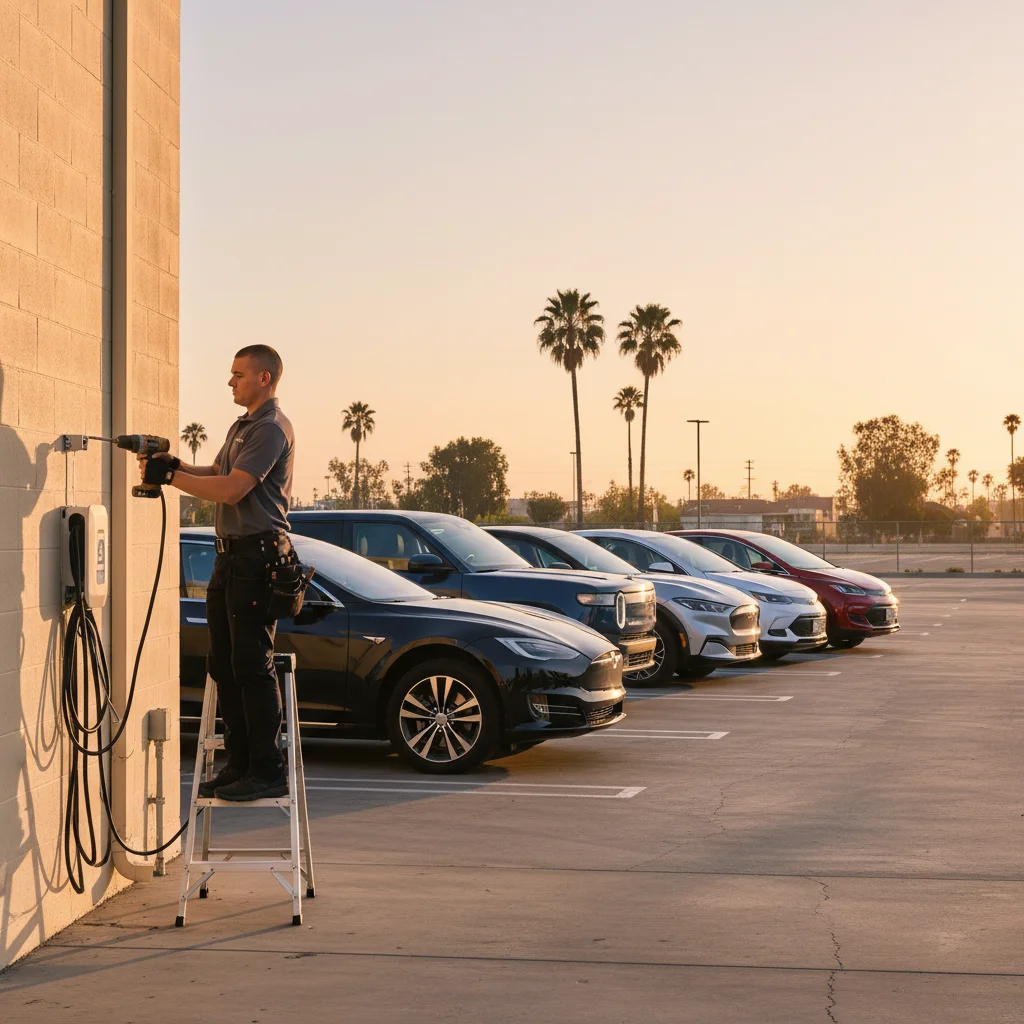
A Summerlin driveway sits near 3,500 feet, and higher toward Red Rock. Downtown and the east valley can run up to 11F hotter than the rim. The airport runs 5 to 15F warmer than outlying ground. NWS Las Vegas puts the average July high at 104.5F. About 78 days a year reach 100F or more. About 9.4 days reach 110F. The KLAS record is 120F on July 7, 2024. January still brings about 10 freeze nights. Monsoon still hits in July and August.
You still skip oil, plugs, and an exhaust. You don’t skip the intervals in the book. Brands disagree on miles and years. They agree on the same three items that leave cars dark on a shoulder.
Heat rewrites the low-maintenance pitch
People buy an EV for fewer shop visits, and that part is true. Regen also means pads often last a long time. What’s false is a car that never needs a bay. Cabin filters load with valley dust. Monsoon silt finds HVAC intakes in July and August. Tires cook on I-15 and CC-215. The 12-volt soaks in a hot bay after a Strip shift.
Range talk is about the pack, not the oil sticker. Recurrent Auto found about 5% range loss at 90F. At 100F the loss was about 17 to 18%. Cabin A/C can draw 3 to 5 kW to cool a hot interior. AAA, in May 2026, measured 8.5% range loss at 95F. Geotab found hot-climate packs degrade about 0.4% per year faster. Don’t pin those numbers on Tesla. Tesla didn’t publish a range-loss figure we could cite. Hard HVAC use is why filters and desiccant bags stay on the list.
For a valley checklist that isn’t split by badge, start with the EV maintenance schedule valley owners actually need to follow. This page splits the calendar by brand.
What every EV still needs in this climate
Treat this block as the floor. Then overlay your brand’s miles.
Tires take the first hit
EVs are heavy, and torque hits the same patch of rubber. Check pressure monthly, cold, before a Lake Mead or Red Rock day. Most brands rotate in a 6,000 to 8,000 mile band. Tesla’s interval is 6,250 miles. Rivian, Hyundai, and Chevy sit at 7,000, 8,000, and 7,500. Ford folds rotation into a 10,000-mile visit. Tesla also wants a rotation if two tires differ by 2/32 inch of tread.
Soft tires burn range in heat. That’s how a skipped gauge turns into an empty-pack stop. It isn’t a story about missing public plugs. It’s a hot tire and a long A/C pull. January freeze nights drop pressure too. Recheck after those cold mornings.
The 12-volt still wakes the car
Every EV here has a 12-volt battery, lead-acid or lithium. It runs locks, computers, and the wake sequence. The high-voltage pack can’t drive until that small battery plays along. If it dies, a full pack won’t save you. Screens stay dark, doors may not help, and the car looks bricked.
None of these brands publish a 12-volt swap the way they publish tire miles. Confirm the test interval in your owner’s manual. After a few valley summers, a shop load test is the careful move. Heat is the usual wear path. For Tesla-shaped wear, read Tesla 12V failure in valley heat. If it dies again after a jump, see signs your EV 12V needs a replacement.
Winchester’s housing is among the oldest in the valley. Cars there often sit in uncovered heat. A 12-volt doesn’t care that the pack is at 80%.
Brakes last longer. Brake fluid doesn’t.
Regen means pads and rotors often look fine for years. Brake fluid still takes on moisture. Tesla wants a health check every two years, and Rivian replaces fluid every three. The Ioniq 5 is every two years, and the Bolt waits five. Light pedal use can rust rotors. Calipers can stick after monsoon water in washes and underpasses. Inspection stays on the list even when pads have meat.
Cabin filters, wipers, and washer fluid
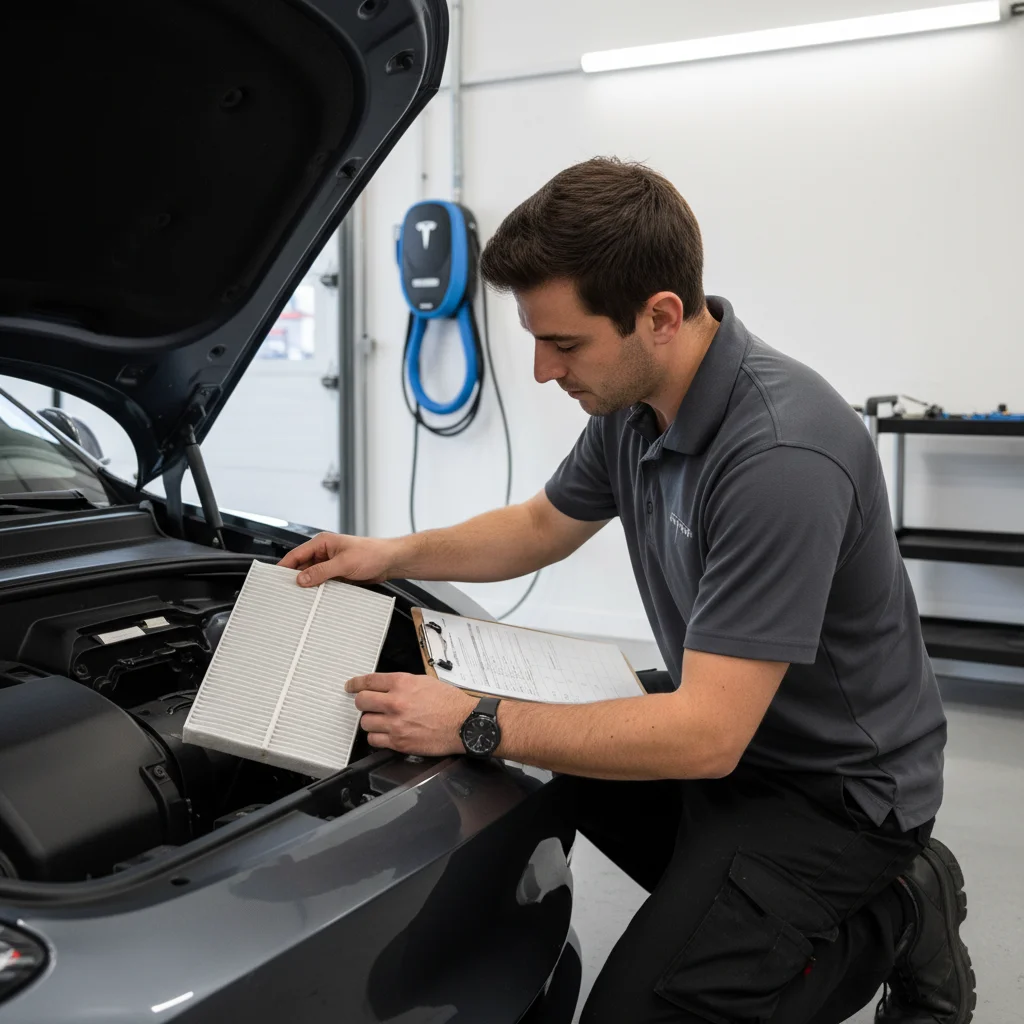
Cabin filters clean the air the HVAC pulls. Tesla is often every two years. HEPA and carbon on newer Model S and Model X run every three years. Rivian is yearly, or 14,000 miles. Ford Mach-E and Lightning sit at 20,000 miles. Ioniq 5 is 24,000 miles, and the Bolt is 22,500. Dust here is a reason to use the early side of a window. Your manual is still the authority. Don’t invent a clog percentage. Replace wipers when they streak. Keep washer fluid up through monsoon grit.
Tesla: the car tracks more than a yearly stamp
Tesla dropped the old annual service ritual. The screen and the app now flag a lot of the calendar. You still owe the car miles-based work.
Tesla intervals owners actually use
Tire rotation, balance, and alignment sit at 6,250 miles. That’s tighter than Ford’s 10,000-mile visit. Weight and torque are why.
Brake fluid gets a contamination check every two years. Replace it if the test says so.
Cabin filters are a two-year item on many Teslas. HEPA plus carbon on newer Model S and Model X is three years.
The A/C desiccant bag soaks moisture in the air-conditioning loop. Tesla’s window is three to six years, by model. Model 3 and Model Y are often four years. A 2012-2020 Model S is often three. Confirm on the service screen for your VIN. A tired bag is a long-term A/C problem. It isn’t a shoulder charge. In a climate with 78 hundred-degree days, that loop works overtime.
Tesla still runs a multi-point look when you’re already in for something else. Tires and the 12-volt are what leave people stuck in Paradise lots.
Rivian R1T and R1S: fluids and air springs
Rivian builds for weight and dirt. The R1T and R1S share tires and brakes with everyone else. They add drive-unit fluid and air suspension a Model 3 never had.
Rivian service points
Rotate tires every 7,000 miles. Check alignment every 14,000 miles. Do it sooner if inner shoulders go bald. Red Rock Canyon’s 13-mile scenic loop will show a bad alignment fast. Timed entry there runs October 1 to May 31.
Drive-unit fluid is the long item. Rivian points to 140,000 miles. It lubricates gears in the motor assemblies. Skipping it is a late-life shop risk. It isn’t a first-year roadside cause.
Inspect air suspension for leaks or damage every 28,000 miles. Replace the compressor filter at 56,000 miles. A sagging corner after a hot park is a shop job. It isn’t a mobile charge.
Cabin filter is yearly, or 14,000 miles. Brake fluid is every three years. If you air down at a Lake Mead ramp, reset pressures before the freeway.
Ford Mach-E and F-150 Lightning: a booklet you can hand a tech
Ford kept mileage checklists that feel familiar if you came from gas.
Ford EV visits
A multi-point inspection every 10,000 miles is the spine. Do it at least once a year if you drive less. That visit covers tire rotation and a brake look. Pads, rotors, hoses, and the parking brake are on it. Techs also inspect cooling hoses and half-shaft boots.
Cabin filter replacement lands at 20,000 miles. That’s longer than Rivian’s yearly swap. Valley dust is why some owners still ask for an earlier look. The manual is the authority.
Lightning owners with all-wheel drive have rear eAxle fluid at 150,000 miles. High-voltage battery coolant is the long coolant job. First replacement is 100,000 miles. Then it’s every 50,000 miles after that. Those aren’t emergency roadside items. They’re why a neglected Lightning still needs a Ford-capable shop.
Hyundai Ioniq 5 and Chevy Bolt: short cadence, light parts list
Hyundai and Chevrolet keep inspections frequent, and parts changes stay sparse.
Ioniq 5
Every 8,000 miles, rotate tires. Every 16,000 miles, inspect brakes, steering, and suspension. Every 24,000 miles, replace the cabin filter. Every 40,000 miles, inspect battery coolant. First coolant replacement is 120,000 miles. Then it’s every 40,000 miles. Flush brake fluid every two years.
Bolt EV and Bolt EUV
Every 7,500 miles, rotate tires and run a multi-point inspection. Cabin filter is 22,500 miles. Brake fluid is every five years. At five years or 150,000 miles, drain and fill the coolant circuits. Chevy splits loops for the battery, power electronics, and the cabin heater. That’s the big shop day. It isn’t a shoulder charge.
Both brands want you in a bay on a rhythm. Neither wants you guessing coolant on a Saturday.
Henderson sits lower, about 1,867 feet. Summerlin sits higher, about 3,500 feet. Mount Charleston town is about 7,506 feet. A Bolt that climbs for a cool afternoon still returns to valley-floor heat. Coolant and cabin filters don’t get a pass after a cool weekend.
How skipped items show up on valley pavement
Charge Pro LV doesn’t do this shop work. We connect stranded drivers with independent mobile operators. The operator quotes before starting, and bills you directly. Operators bring a 240-volt Level 2 source to the car. That’s a native NACS plug, plus CCS or J1772 adapters for non-Tesla EVs. Typical add is 10 to 20 miles of range. That’s 15 to 30 minutes of charging, never an arrival time. They can also jump or replace a dead 12-volt on site.
Most EV roadside assistance we match isn’t a mystery pack failure. It’s a 12-volt that wouldn’t wake the car. Or it’s range burned on A/C after ignored tire pressure. Or it’s an empty pack on a freeway shoulder. Those are different jobs.
NDOT’s Freeway Service Patrol covers the busy valley freeways. Quality Towing operates it, and GEICO sponsors it. Hours are 5:00am to 8:30pm, seven days a week, and it’s free. Published FSP materials don’t mention EV charging. A patrol jump may help a 12-volt. It doesn’t replace Tesla’s two-year brake-fluid check.
For Tesla-shaped stalls, read EV roadside assistance in Las Vegas for a dead Tesla. It walks the 12-volt versus empty-pack fork. Pack care through summer is a separate habit. How to care for an EV battery through valley heat covers that.
When the calendar failed and the car won’t move
We don’t rotate tires, flush brake fluid, or change desiccant bags. If the car won’t wake, that’s when to call. Same if the pack is empty on a shoulder. An operator handles Tesla and the other major EV brands. If the 12-volt is the fault, start with a Tesla 12-volt jump.
Call (702) 935-4699. We match you with a local operator. That operator quotes you before work starts.