Northbound I-15 through North Las Vegas spends range faster than the estimate. Drivers find the pack is short for the desert run north. You need EV roadside assistance at the car, on that shoulder.
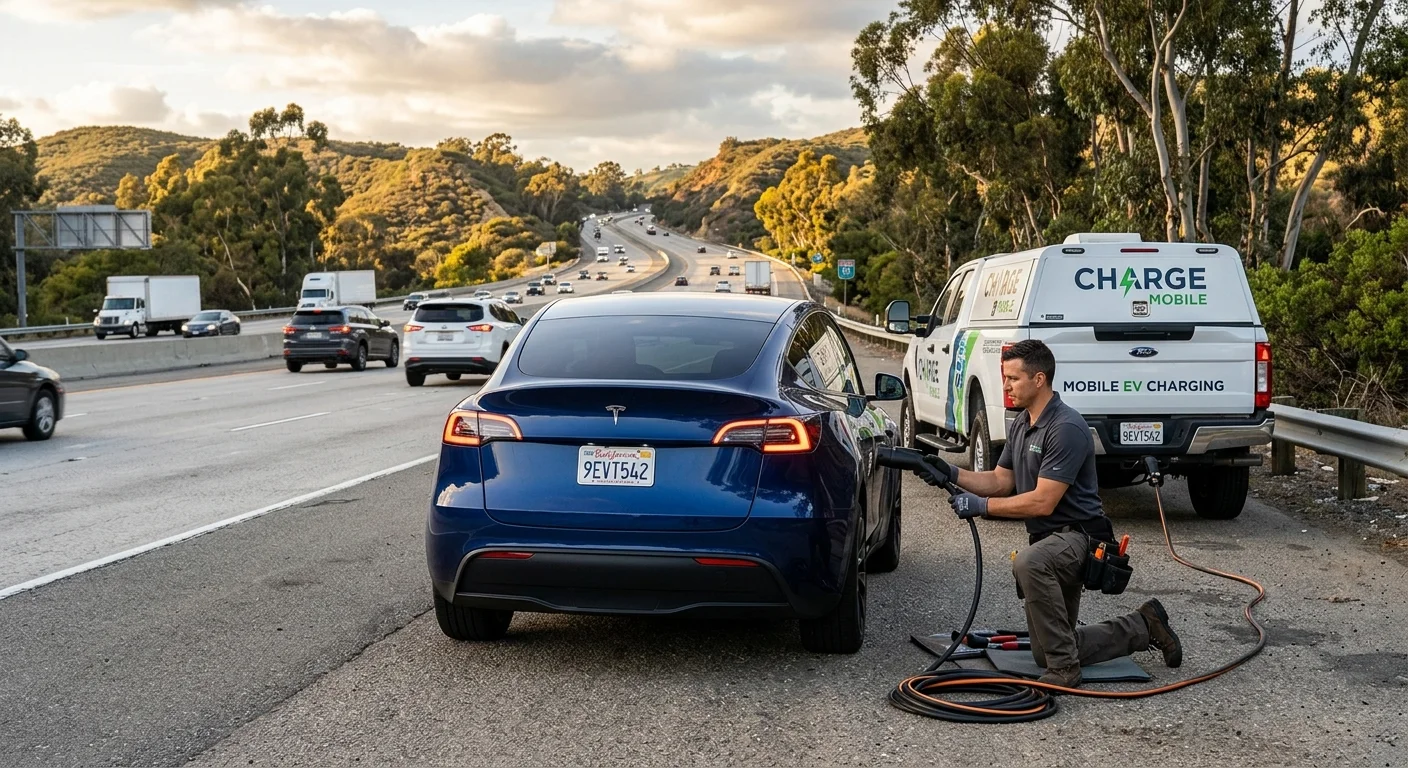
Charge Pro LV is a referral line for the Las Vegas Valley. We match stranded drivers with independent mobile rescue operators. We don’t own trucks, and we don’t send a house crew. The operator quotes you before work starts, then bills you directly.
Why the I-15 north launch eats the last miles
North Las Vegas runs from the older Craig Road core outward. Aliante, Centennial Hills, and Skye Canyon sit on that northwest edge. The 2024 Census estimate puts the city at 294,034 people. The Craig Road core is working-class and commute-heavy. The northwest edge is newer, and more homes charge overnight.
This stretch is also the I-15 north launch. It’s the start of US-95 toward Indian Springs. Northbound drivers stage here for Mesquite and Utah. They do it with less margin than that empty road demands. A full day of valley heat already cut the pack. Then the northbound freeway asks the motor for more.
July’s average high at the official NWS Las Vegas station is 104.5F. The valley sees about 78 days at or above 100F. Recurrent Auto found about 5% range loss at 90F. That rose to 17 to 18% at 100F. Cabin air conditioning can draw 3 to 5 kW to cool a hot cabin. AAA’s May 2026 test measured 8.5% range loss at 95F. None of those range figures come from Tesla itself. Tesla hasn’t published a range-loss number we could confirm.
NV Energy serves all of North Las Vegas. Its Residential Electric Vehicle Recharge Rider sets an overnight window from 10:01pm to 8:00am. Miss that window after a late commute, and you leave on a thinner pack. Clark County’s Title 30 code requires EV-ready wiring in new construction. That’s common in newer Aliante and Skye Canyon housing. It doesn’t help if you didn’t plug in. It also doesn’t help once you’re already on I-15.
Nevada had about 85,600 EVs registered in 2025. Clark County’s own EV count isn’t in a source we could verify. Heat, freeway speed, and a long northbound plan are what run them short.
Craig Road, the Speedway, and the northbound shoulder
The older Craig Road core still feeds I-15 all day. Commuters roll south into the city, then north again at night. A stop-and-go crawl on surface streets already spent energy. Then the on-ramp asks the motor for a hard pull.
Las Vegas Motor Speedway sits in North Las Vegas. Race days, concerts, and test nights dump traffic onto I-15. Event lots can sit hot for hours before they move. When the lot finally moves, the car may not have the miles you thought. There’s a separate walkthrough for an EV that died in Speedway parking.
If the car is already on the freeway, stay with it. NRS 484B.440 covers a vehicle that’s disabled and can’t avoid stopping. That car is exempt from the no-stopping-on-highway rule. The statute sets no time limit for how long it may remain. NRS 484B.443 is the one to watch next. Law enforcement may remove a disabled or abandoned vehicle. On freeways and primary highways, a vehicle is treated as abandoned after 24 hours. Under that statute, the owner pays for removal. Don’t treat that I-15 shoulder as overnight parking.
Nevada 511 and nvroads.com report closures, cameras, and road conditions. The Nevada State Police Highway Patrol takes *647 from a cell phone. They dispatch rotation tows through Autura from that call. That’s a tow path, not a charge at the car.
The NDOT Freeway Service Patrol covers the most-traveled Las Vegas Valley freeways. Quality Towing operates it, and GEICO sponsors it. Hours are 5:00am to 8:30pm, seven days a week, and it’s free to motorists. The patrol handles tire changes, jump starts, fuel, minor fire suppression, and traffic control. NDOT says it clears about 31,500 Las Vegas incidents a year. None of NDOT’s published patrol materials mention electric vehicles, EV charging, or EV-specific service. It means the patrol doesn’t advertise a pack charge.
Aliante, Centennial Hills, and the last built miles
Aliante is a master-planned community around the Aliante casino and golf. Housing is newer, and home charging is common. The pattern is a long commute south into the city, then a northbound return. People leave in the morning on a pack that looked fine. Evening heat and I-15 speeds rewrite that math.
Centennial Hills sits in the far northwest, below the 215 and US-95 junction. It’s the last built-up area before US-95 heads out toward Indian Springs. Drivers in Centennial Hills stage here for the run north. The margin is less than the empty road demands. That isn’t a map claim about public plugs. It’s about how far the next stretch of driving actually is.
Skye Canyon climbs farther toward the US-95 corridor and the Spring Mountains. It’s higher, cooler, and a longer reach from the core. Tule Springs sits at the far north around Floyd Lamb Park. The ground is open, at the edge of the built valley. A stranding there is a longer reach for any operator.
A mobile EV charging stop at the curb can add range where you sit. If the dash is dark and the doors won’t wake, start with the 12V. That’s a different failure from an empty pack.
There’s a local guide for EV roadside assistance in North Las Vegas. Use it when the stall is a driveway or a side street, not I-15.
What a mobile operator can do on I-15
The operators in this network bring a 240V Level 2 source to the car. Tesla drivers get a native NACS plug on that truck. Other EVs use a CCS or J1772 adapter. A typical session adds 10 to 20 miles of range. That takes 15 to 30 minutes of charging at the car. That’s charging time, not an arrival time, and nobody here quotes one.
They can also jump or replace a dead 12V battery on site. Valley heat is hard on that small 12V battery. A car that won’t wake on a North Las Vegas shoulder is often the 12V. Tesla, Rivian, Hyundai, Ford, and the other major EV brands are all in scope.
Stay out of the travel lanes and put the hazards on. If you can ease onto a wider shoulder, do that. I-15 through North Las Vegas is a real freeway, not a neighborhood street. There are no toll roads anywhere in Nevada, and I-15 is free.
If you need a tow instead, Nevada Transportation Authority rules apply. Tow operators on this road need an NTA certificate. Non-consent tow rates sit in operator-filed tariffs under NAC 706.408. There’s no single statewide maximum published on this site. Confirm the tow bill with that company before the hook goes on. A still-hooked vehicle can be released at the original location. That’s for the operator’s set release fee, under NRS 706.4463 and related sections.
Mobile charge or a tow from this corridor
A tow from I-15 is a real option when the car can’t take a charge. There’s a separate comparison of whether to charge, jump, or tow.
For a pack that’s simply empty, charging at the car is the smaller disruption. The operator works where you already are on I-15. You get enough range to continue the trip you already planned.
Don’t treat a patrol jump as a pack fill. A 12V jump can wake the car’s computers. It doesn’t put miles in the high-voltage battery. That’s why a Level 2 source at the bumper matters on this corridor.
If factory roadside is already on the phone, keep that ticket. Charge Pro LV doesn’t set prices for that visit. Ask what they’ll connect, and how many miles they expect to add.
When to call
Call when the car is on the I-15 shoulder and the pack has quit. Call when the 12V is dead and the car won’t wake. Call when you’re still in Aliante or Centennial Hills and the north run looks short. Call when Speedway traffic left you too low to finish the drive home.
Charge Pro LV covers the Las Vegas Valley. We serve every city in the county, including this north launch. We connect you, and we don’t perform the work. For that match on I-15 in North Las Vegas, call (702) 935-4699.